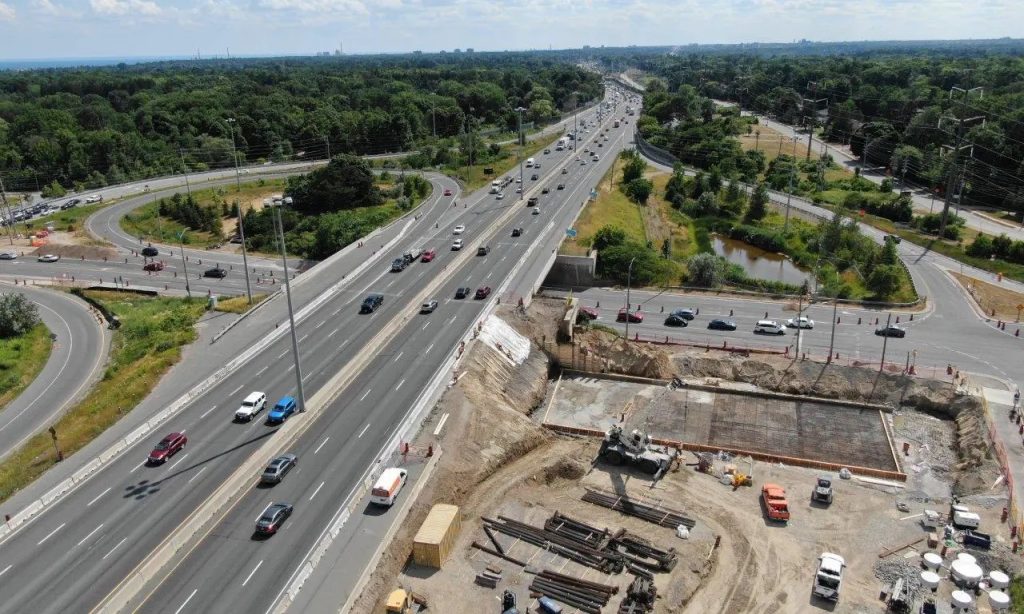
The King Road crossing under the same Lakeshore GO rail tracks in Burlington is pretty analogous; it was done in 72 hours a decade ago – here’s a 72-second time lapse video of that work:
https://www.youtube.com/watch?v=nTXNhCS4kF4
As for the rationale for the project, there are several.
1) Hurontario is Mississauga’s busiest transit (bus) line and operating an efficient and attractive service is hampered by the congestion and variation in travel times the buses experience. Creating a dedicated right-of-way for buses or LRT would solve that problem
2) The Hurontario corridor is fairly densely populated in both jobs and homes (condos); there are a lot of people who can walk to a transit stop, so that allows them to have a transit-based lifestyle and keeps cars off the road
3) The Hurontario corridor has been slated for a rapid transit line ever since Mississauga was created in 1974. I worked on plans in the 80s and 90s that led up to this project. The GO-ALRT project in 1984 planned an elevated LRT line (like the Scarborough RT) on Hurontario as part of a regional LRT network. It could be argued that rapid transit on Hurontario is about 20 years overdue
4) The line is a key part of an integrated connected rapid transit network. Mississauga and Brampton have numerous east-west major transit / transportation corridors, and Hurontario connects all of them. This allows people to connect between an east-west and north-south line to access everywhere in the area. This is like the subway network in Toronto, where you take one bus or subway line and connect to a perpendicular route to get wherever you want. In Hurontario’s case, it connects with GO Lakeshore rail line, Dundas Street (Bus Rapid Transit line under design now), Milton GO Rail line, Mississauga Transitway / Highway 403 GO bus, Highway 407 Transitway (planned), Steeles Avenue Bus Rapid Transit, and (intended) GO Rail Kitchener line in downtown Brampton. It also connects one of GO’s busiest rail stations (Port Credit) with downtown Mississauga. For example, this will be very attractive for people living in Toronto or Burlington to take the Lakeshore GO to PC then a quick transfer to the LRT and a smooth ride to the Square One area. And obviously it gives people in the Hurontario corridor great access to all the east-west rapid transit lines.
5) for all these reasons, there is a significant amount of high-density growth planned for the Hurontario and Dundas corridors, to accommodate people and jobs wanting to come to Mississauga. As part of the Greater Toronto area, Mississauga is allocated a certain amount of new population and employment, and the City has to decide how best to absorb that. Downtown Mississauga will only attract new employment opportunities if people can get there by transit, because the road system is at capacity and will not be expanded further. The use of dense corridors for travel protects the established residential neighbourhoods. This growth pattern can only be effective with high-capacity rapid transit lines such as the LRT. And transit-oriented development is typically more effective and more likely to be built around a rapid transit station rather than a surface bus route.
By the way, there is a multi-storey parking garage being built at the Port Credit GO station (separate from the LRT) to handle the continued growth in demand there. This is similar to many of the area GO stations.
And yes, it is disruptive to the community through the construction period, but decades from now people will look back and recognize how significant and impactful – and beneficial – the Hurontario LRT line has been.
Hope you get to enjoy a ride on it in a couple of years!”


 toronto.citynews.ca/wp-content/blogs.dir/sites/10/2022/10/26/QEW-closure-Metrolinx-300×180.jpg 300w,


</p>
<p> ” data-medium-file=”https://i0.wp.com/blog.metrolinx.com/wp-content/uploads/2022/02/LSW-Structure-Push-Box-2-edited.jpg?fit=300%2C169&ssl=1″ data-large-file=”https://i0.wp.com/blog.metrolinx.com/wp-content/uploads/2022/02/LSW-Structure-Push-Box-2-edited.jpg?fit=720%2C404&ssl=1″ width=”720″ height=”404″ src=”https://i0.wp.com/blog.metrolinx.com/wp-content/uploads/2022/02/LSW-Structure-Push-Box-2-edited.jpg?resize=720%2C404&ssl=1″ alt=”Image shows crews working in a concrete pit” class=”wp-image-20619 jetpack-lazy-image jetpack-lazy-image–handled” data-recalc-dims=”1″ srcset=”https://i0.wp.com/blog.metrolinx.com/wp-content/uploads/2022/02/LSW-Structure-Push-Box-2-edited.jpg?w=3927&ssl=1 3927w, <a href=) i0.wp.com/blog.metrolinx.com/wp-content/uploads/2022/02/LSW-Structure-Push-Box-2-edited.jpg?resize=300%2C169&ssl=1 300w,
i0.wp.com/blog.metrolinx.com/wp-content/uploads/2022/02/LSW-Structure-Push-Box-2-edited.jpg?resize=300%2C169&ssl=1 300w,  i0.wp.com/blog.metrolinx.com/wp-content/uploads/2022/02/LSW-Push-Box-Steps-v3-004.jpg?resize=300%2C197&ssl=1 300w,