Author: terraviva

  • EPISODE 221 YUKON DIARY 7 DUBLIN GULCH GOLD AND JACK ACHESON

    EPISODE 221    YUKON DIARY  7   DUBLIN  GULCH GOLD and JACH ACHESON

    alan skeoch
    jan. 2021

    I met Jack Acheson several  times but the most memorable was  the day he gave me
    that Mammoth tooth.   It was one of those memorable occasions that get into long
    term storage in  my brain.  A bright sunny Yukon day…blue sky.  A good to be alive day.
    Jack was  a placer gold miner at the Haggart Creek in Dublin Gulch, Yukon.


    Sorry, try to ignore my picture…look behind me…1) bull dozer tree, 2) hydraulic  hose gushing dirty water, 3) piles of overburden
    4) and on the right, perhaps, the bedrock where the gold has settled  after millions of years…just sitting there waiting for Jack Acheson


    PLACER  GOLD  AND  LODE GOLD:  WHAT IS THE DIFFERENCE?

    Gold is gold.   There is no difference in the gold.  The difference is where the
    gold  is found.  Placer gold  is  loose gold  found trapped  in bedrock ripples
    once the overburden is pushed aside and washing happens.  Placer gold was
    once Lode gold.  Gold  trapped in rock.  Lode gold  is difficult to separate from 
    rock.  Needs  heavy machinery to crush the rock.  Needs rock  drills  and  explosive
    to get chunks of rock  to the milling machines.   Dublin Gulch  as it turns out
    carried both kinds of gold.  Lots of  placer gold.  And, today, one of the largest
    Canadian  gold mines, the Eagle Mine, is  busy extracting Lode gold.

    JACK ACHESON

    Jack Acheson was the person working Dublin Gulch  in 1962.  There had been many men before him and a couple of women, who
    had found  gold  nuggets in the rubble pushed and ground  by  glaciers in the MacQuesten Valley.  Where did the gold come from?
    Dr. Aho said it percolated up from the molten magma on the crust of  which we live.


    JACK ACHESON,  SUMMER 1962, DUBLIN GULCH

    When i met Jack, he  was working a  placer gold deposit on Haggart Creek at the mouth of Dublin
    Gulch.  His system was similar to the system  we used when gold planning  earlier.
    Only  he did his search  for placer gold on a grand  scale using a bulldozer, drag line,
    huge hydraulic pump, and an  immense sluice box  with wooden riffles to catch the
    heavy gold as water sluiced over scoop shovels of gravel.


    Just to get to this stage.  I mean just to get to the gold bearing gravel, huge mounds 
    of overburden had to be cleared…trees, shrubs, boulders, earth…all had to be
    removed just to get close to bedrock  where the placer gold rested…if  it indeed
    did rest in the particular location chosen.

    Thousands of tons of rubble had  to be moved just to find  a  few ounces of  gold.
    Occasionally…rarely really…Jack did find big nuggets.   One big one he
    carried in his pocket the day I met him.  It was  oblong.  Fitted in the palm  of his
    hand.   I dimly seem to remember him saying ‘I keep it as  a knuckle duster in
    case of trouble’ but that may be a bit too imaginative.

    What I remember clearly, as confirmed by some pictures taken at the time, is the total
    devastation of the site.  Just piles and piles of sorted and unsorted gravel.  Boulders rolled aside.
    Rocks hand  picked from the sluice box.
    A drag line with a huge bucket pulling off the overburden.  A bull dozer pushing
    piles  of loose gravel into a great sluice box with a never ending stream of water
    being fed  from a flume bringing water from some place higher up.  

    And down below, close to the bedrock, Jack had an immense hydraulic hose 
    blasting dirty water at the place where he believed  he was  close to the gold
    bearing bottom.

    Dublin Gulch and Haggart Creek  were just names as far as  I was  concerned.
    Since that July day  in  1962 I have discovered that those names were and are
    just as  important as  the Klondike in the search for Yukon gold.   

    Before Jack brought in his heavy equipment the area had been worked  over
    many times  by  earlier placer miners.  A lot of  gold had  been found. But the work
    was not easy and the profits were small for the costs were high.  One earlier placer
    miner who tried to do the kind of excavation necessary wasted a lot of time
    taking little bits of gold dust to sell  at Mayo Landing just to buy diesel oil to
    run his  bull dozer.   Eventually losing everything.

    Really the stories of Dublin Gulch are stories of dreams  dashed.   A few men
    found big chunks like “Jack Acheson’s 7.5 ounce nugget” and another
    nugget weighing 8.5 ounces found by Ed Barker.  Most moving however
    was the 7 ounce nugget found by Smashnut which nicely fitted into the palm
    of his hand. “He told everyone that the depressions in the nugget were the result
    of him “clutching it so tightly when he found it”.   A few big nugget  stories were
    enough to lure placer miners.   Perhaps the saddest measure of this  trail of
    broken hearts were the derelict wagons and machines we found in places where
    there were no loner roads or even tracks.  But once, long ago, a  dreamer of
    great wealth had carved a road and lugged whatever he could to the site he
    had staked using horses and  mules.  98 horses were kept at Keno Hill by
    Wernecke for instance until they were replaced by  Holt tracked vehicles.

    Aaron Aho writes it best when he  records that these men remain
    “only a record in some obscure ledger.  John Suttles, William Portlock, Albert
    Jahnke, Fred Gill, John ‘Jack’ Maynard, Clarence Kinsey, Bobby Fisher, the
    Cantins ( Frank, Louis, Philias andJoey), Ed Barker and  others less well known
    are all gone,  yet the creek seems to whisper their names. It still rings  with the
    hopes  of those that are gone, and  hidden in its many bends are the rusted  mining
    machines, blacksmith stoves, vehicles, buggies, dog harnesses, sleighs, graders,
    tin cans, drill steels, old maps in cabins, and personal objects they left behind.” (Page 62 
    Hills  of  Silver)

    I would add Jack Acheson to the list.  Hell, why not add my own name…and Bill Scott and Bill Dunn….


    “The ruins pop up in the most unlikely places…wrecked ore wagons like this.   But there are living reminders present as well because
    some of the horses were turned  loose and thrive in small herds to this day.   The only wilde horses I saw were dating ross  the Mayo
    Landing runway but stories of them were often told.
     

    HERE is the kind of damage placer gold  mining does to the land surface.  Look at these piles of gravel.   Yes, they do
    still  contain some gold and  modern mining efforts often rework old placer gold fields and  make a profit.


    When I began  to write this Episode,  I decided  to check the internet just
    in case Jack was mentioned.   He was  not.  Then I thought to check  if
    Dr. Aho was mentioned and was startled to discover that Dr. Aaro Aho had written a book
    on mining exploration in the Yukon.  His book, Hills of Silver, The Yukon’s Mighty 
    Keno  Hill Mine,  was available on
    Amazon for $35 and with help I got a copy.  A  wonderful  book for me because
    it supports my diary but is more informed  more detailed than anything I have written.
      But reading the book and  writing an Episode per day
    is  extremely  difficult (added  to the fact that President Trump has gone 
    insane jeopardizing our world and distracting everyone from daily routines.).

    So this  Episode 221 could be much longer…should be much longer…but I
    cannot do that in a single day   Take what I have written….see the post script
    which  shows  what I intended to write.  Sorry.  Maybe more later.’

    alan skeoch
    Jan. 2021

    POST SCRIPT:  HOW I ORIGINALLY PLANNED THE STORY…UNFINISHED

    Thursday July 5, 1962

    I met Jack Acheson when I got to back to Mayo…he bought
    me a beer in the Chateau Inn.   Nice, but I did not know 
    why I deserved some kind  of  special treatment as I had
    only been in the  Yukon for little over a month.  He might need
    our help at his placer mine.  Seismic help.

    Who was Jack Acheson?

    He was a placer miner big time.   Earlier you will remember that
    we found some high grade sand and gravel in a bunch of
    rusty drums.   Following a hunch  we bought two gold pans
    …dumped in a couple handful of the barrel concentrate then
    carefully swished the pans in Haggart Creek…the lighter sand
    and  gravel swished out and the heavier gold specks remained.

    Well, Jack and his partners did the same thing only on a
    bigger scale.  They bought a bull dozer from the Outfitters 
    store in Mayo…with a downpayment and promise to
    make payments…just like buying a car.  

    Then  they used the dozer and drag line to clear the overburden.  Overburden?
    Yes, that term applies to everything above the bed rock….shrubs, soil,
    trees, gravel, boulders, mammoth teeth, mammoth tusks…everything.
    When they get close to the bedrock they get careful because there 
    may be gold sitting down at the bedrock.  Why?  Because gold is
    heavier  than the overburden.

    Let me put this in dialogue form:

    “Jack, you are making one hell of a mess with that dozer…stripping all that overburden.
    Searching for gold hardly seems worth that effort.”
    “Just the beginning. Sometimes we have to move 30 or 40 feet of overburden with 
    the dozer and hose.:’
    “Hose?”
    “Big hydraulic hose blast the loose gravel away when we get the trees and brush
    removed.  Power drive hose.. bigger than a fireman hose.   We had to build a 
    sluice to get the water from higher up in the Gulch.  Need lost of  water…tons of
    it…enough to wash away truckloads of  gravel.   Until we get down to pay dirt…
    the heavy  gravel and sand on top of the bed rock.  That’s where the gold is…
    gold dust to gold nuggets like this one.:’

    “Jack fished our a long gold  nugget from his pants pocket. Weiihs two pounds or more.”
    “why carry it in your pocket”
    “Just in case some son of a bitch  gets a notion to roll me.  One hits with this
    Knuckle duster will get that idea out of his head fast.”
    “How many nuggets…STOP, ALAN, STOP, THIS WILL TAKE TOO  LONG…SO I STOPPED

    WHY?  WHAT HAD  YOU PLANNED, ALAN.
    “I had hoped to quote RoBert Service”

    THE SHOOTING OF DAN McGREW

    A bunch of the boys were whooping it up in the Malamute saloon;
    The kid that handles the music-box was hitting a jag-time tune;
    Back of the bar, in a solo game, sat Dangerous Dan McGrew,
    And watching his luck was his light-o’-love, the lady that’s known as Lou.

    When out of the night, which was fifty below, and into the din and the glare,
    There stumbled a miner fresh from the creeks, dog-dirty, and loaded for bear.
    He looked like a man with a foot in the grave and scarcely the strength of a louse,
    Yet he tilted a poke of dust on the bar, and he called for drinks for the house.
    There was none could place the stranger’s face, though we searched ourselves for a clue;
    But we drank his health, and the last to drink was Dangerous Dan McGrew.

    There’s men that somehow just grip your eyes, and hold them hard like a spell;
    And such was he, and he looked to me like a man who had lived in hell;
    With a face most hair, and the dreary stare of a dog whose day is done,
    As he watered the green stuff in his glass, and the drops fell one by one.
    Then I got to figgering who he was, and wondering what he’d do,
    And I turned my head—and there watching him was the lady that’s known as Lou.

    His eyes went rubbering round the room, and he seemed in a kind of daze,
    Till at last that old piano fell in the way of his wandering gaze.
    The rag-time kid was having a drink; there was no one else on the stool,
    So the stranger stumbles across the room, and flops down there like a fool.
    In a buckskin shirt that was glazed with dirt he sat, and I saw him sway;
    Then he clutched the keys with his talon hands—my God! but that man could play.

    Were you ever out in the Great Alone, when the moon was awful clear,
    And the icy mountains hemmed you in with a silence you most could hear;
    With only the howl of a timber wolf, and you camped there in the cold,
    A half-dead thing in a stark, dead world, clean mad for the muck called gold;
    While high overhead, green, yellow and red, the North Lights swept in bars?—
    Then you’ve a haunch what the music meant . . . hunger and night and the stars.

    And hunger not of the belly kind, that’s banished with bacon and beans,
    But the gnawing hunger of lonely men for a home and all that it means;
    For a fireside far from the cares that are, four walls and a roof above;
    But oh! so cramful of cosy joy, and crowned with a woman’s love—
    A woman dearer than all the world, and true as Heaven is true—
    (God! how ghastly she looks through her rouge,—the lady that’s known as Lou.)

    Then on a sudden the music changed, so soft that you scarce could hear;
    But you felt that your life had been looted clean of all that it once held dear;
    That someone had stolen the woman you loved; that her love was a devil’s lie;
    That your guts were gone, and the best for you was to crawl away and die.
    ‘Twas the crowning cry of a heart’s despair, and it thrilled you through and through—
    “I guess I’ll make it a spread misere,” said Dangerous Dan McGrew.

    The music almost died away . . . then it burst like a pent-up flood;
    And it seemed to say, “Repay, repay,” and my eyes were blind with blood.
    The thought came back of an ancient wrong, and it stung like a frozen lash,
    And the lust awoke to kill, to kill . . . then the music stopped with a crash,
    And the stranger turned, and his eyes they burned in a most peculiar way;
    In a buckskin shirt that was glazed with dirt he sat, and I saw him sway;
    Then his lips went in in a kind of grin, and he spoke, and his voice was calm,
    And “Boys,” says he, “you don’t know me, and none of you care a damn;
    But I want to state, and my words are straight, and I’ll bet my poke they’re true,
    That one of you is a hound of hell . . . and that one is Dan McGrew.”

    Then I ducked my head, and the lights went out, and two guns blazed in the dark,
    And a woman screamed, and the lights went up, and two men lay stiff and stark.
    Pitched on his head, and pumped full of lead, was Dangerous Dan MGrew,
    While the man from the creeks lay clutched to the breast of the lady that’s known as Lou.

    These are the simple facts of the case, and I guess I ought to know.
    They say that the stranger was crazed with “hooch,” and I’m not denying it’s so.
    I’m not so wise as the lawyer guys, but strictly between us two—
    The woman that kissed him and—pinched his poke—was the lady that’s known as Lou.


    EARLY GOLD MINERS…PLACER GOLD  MINERS … IN DUBLIN GULCH


                                                                                                       Government of Canada – McLean, 1914 plate No. 27

    Dugald MacLachlan (left) and three other unidentified miners at the entrance of an underground mine dug at Olive in 1914. Today, Olive is encompassed by Victoria Gold’s Dublin Gulch property and is one of the sources of ore for Eagle, the largest gold mine 

    ever to operate in Canada’s Yukon Territory.


    THE EAGLE MINE IN DUBLIN GULCH TODAY

    Dublin Gulch, A History of the Eagle Gold Mine”, Michael Gates Lost Moose
  • EPISODE 220 YUKON DIARY 6 THE BIG TOOTH


    EPISODE 220    YUKON DIARY  STORY  6   THE BIG TOOTH

    alan skeoch
    Jan. 2021


    This  is  Jack Acheson.  Every summer he came to Dublin Gulch, YUKON,  and found treasures of various kinds.  He gave me one of his treasures…perhaps
    because we both wore similar work clothes.


    This is a hairy  Mammoth, related to elephants distantly.  Once upon a time 10,000 years ago they 
    wandered across  the Yukon after crossing the Bering land bridge from Asia.   Once  here some of them
    met North America’s Mastodons who look similar.   Both of these creatures were common residents
    of  North America until  killed by human predators.  They had  big teeth.  Huge tusks.  Jack finds
    them every year in Dublin Gulch, at least he did in the 1960’s.

    “How would you like this … a gift”, said Jack  Acheson as he leaned against his Cat D6 in Dublin Gulch.
    “What is it?”
    And he handed me a rock about the size of large can of fruit salad…no, bigger than that.
    “Take a guess”
    “ A big chunk  of galena…sort of shiny…raw  silver and lead…heavy.”
    “Wrong.”
    “Certainly not gold.”
    “Look at the layers…clue to what it is.”
    “Hard…looks like a stone layer cake… sidewise…many layers.”
    “Wrong again.”
    “Where  did you get it?”
    “Found it right here in Dublin Gulch…found a bunch of them
    and other weird stuff…more every year it seems.”
    “I Give up. What is it”
    “The tooth of a Hairy Mammoth…a molar tooth”
    “It is incredible…huge tooth.”


    “We find lots of Mammoth teeth…tusks,..bones…right here in Dublin Gulch.”
    “I noticed those long curved things leaning against your cabin…”
    “Those are the tusks.”
    “What do you do with them?”
    “Government people from Whitehorse come and get them.”
    “How old are they?”
    “10,000 to 12, 000 years old…ancient”
    “There were mammoths  here in the Yukon?”
    “Lots of them I think…herds…whatever term is applied to a bunch of mammoths.”
    “Complete skeletons?”
    “No…we find piles  of bones…sometimes single tusks…sometimes 
    just a tooth like this one I’m giving you.”
    “How  come the bones are all mixed up….spread around.”
    “Water … flood … there once was a big glacial river here in the McQueen Valley.”
    “Ice?”
    “Yes, glacial ice swept down this valley as well…ripped the hills apart.  You had
    lunch  up on Keno Hill I hear…you sat on the edge of  a hanging valley
    where the ice  had ripped a great slab of rock…cleaved it.”
    “Possible the carcasses of those Mammoths got ground up and the hard
    parts  like teeth and tusks were piled in the sediment.”
    “And you are giving this tooth to me?”
    “You are more interested than many.”
    “Are you sure this is a Mammoth tooth and not a  Mastodon  tooth?”
    “Absolutely.  Teeth are the easiest way to tell the difference.  This mammoth
    is  like a layer cake.   A  mastodon tooth on the other hand  looks like our
    teeth…solid with bumps for grinding.   Both kinds  of teeth were for grinding
    but mastodons ground up bigger branches while the mammoths were more
    ground feeders.  The guys from Whitehorse told me that.”


    “Thanks  Jack…wonderful thing to have….”
    “Mammoth would have to lose this  tooth somehow.  Mammoths only had two sets
    fo teeth. Once they were worn down the mammoths starved to death.”
    “Same could  happen to us if there’re no dentists around.”

    That is how I got a treasure from the Yukon.  My very own Mammoth tooth.
    Gave it a special place in my rucksack  when the Yukon job was over.  A year
    later, in the fall of 1963, I  was hired  as a history teacher at Parkdale Collegiate
    Institute, west end of Toronto.  The tooth was a great teaching tool in that
    first year of teaching.   Not long.  Sometime in the following year I went
    to get my mammoth tooth and it was gone.

    Some student stole my mammoth tooth!  Or maybe it was one of my
    fellow staff members.  Or maybe  one of the caretakers thought it
    was  garbage.   Most likely a kid.  I should have put the tooth in a
    safe place.

    Now here is a question for you to think about.  WHAT WAS JACK ACHESON
    DOING  IN  THE YUKON IN 1962?  The answer may be
    obvious for most of you.   The next Episode 221 will provide an
    interesting answer… even if you guessed correctly.


    Bill Dunn and  I did  not see any mammoths when we cooked  our lunch  beside a cliff that hung over this valley.  We did not even know
    those huge creatures once wandered around here…did not know until i met Jack Acheson.   And got my mammoth tooth.  Not sure
    who has  that tooth now.

    alan skeoch
    January 2021

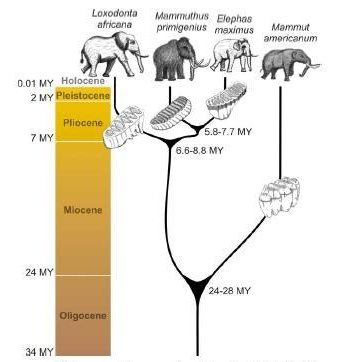
    POST SCRIPT:  MAMMOTHS AND  MASTODONS


    The analysis of a mastodon tooth explains further how climate changes in Africa provoked the divergence of humans, chimps and gorillas. Loxodonta=African elephant; Elephas=Asian elephant; Mammuthus=mammoth; Mammut=mastodon

       The analysis of a mastodon tooth explains further how climate changes in Africa provoked the divergence of humans, chimps and gorillas. Loxodonta=African elephant; Elephas=Asian elephant; Mammuthus=mammoth; Mammut=mastodon

    Humans and elephants evolved in the same African dry savanna. That’s why elephant fossils offer a clue on the type of environment in which our ancestors lived. An analysis of DNA painstakingly retrieved from an ancient mastodon tooth has further pushed back the time when mammoths split off from elephants. It appears that the mammoths and Asian elephants split about 5.8 to 7.7 million years ago when humans and apes could have shared a common ancestor.

    It appears that environmental changes at the time caused a massive period of speciation (species formation) in Africa. “Until recently, scientists believed that humans and chimps last shared a common ancestor about 5 million years ago. But fossil studies and genetic discoveries in recent years have pushed this date back by at least 1 million years.” said Paul Matheus at the University of Alaska in Fairbanks, US.

    Now, Matheus team employs a mastodon tooth recovered in Alaska to revise the evolutionary history of mammoths and elephants, previously believed to have diverged from each other about 5 million years ago. Mastodons are elephant related animals, with elephant-like build, but with straighter tusks, longer body, longer head, shorter limbs and more primitive teeth. Fossil data showed that mastodons split from elephants about 24 million to 28 million years ago.

    The Alaskan mastodon tooth was estimated to be 50,000 to 130,000 years old. The mastodon DNA was extracted from 30 grams of ground tooth. They sequenced the whole mitochondrial DNA of the mastodon, about 16,000 pairs of nucleotid pairs. They were compared with similar DNA sequences from African elephants, Asian elephants and mammoths (mammoths were just hairy species of elephants).

    As the fossils showed mastodons split off from elephants about 26 million years ago, the researchers could calculate the rhythm of mutation accumulations in time, called the evolutionary clock. 


  • EPISODE 219 WE NEED TO RELAX…HERE – YOU CAN SNUGGLE UNDER A BLANKET OF SNOW (forget about Trump for a moment)

    EPISODE 219    WE NEED  TO RELAX…HERE YOU CAN  SNUGGLE UNDER A  BLANKET OF SNOW


    alan skeoch
    jan. 7, 2021

    What  a day that was yesterday…the US Capital  stormed  and  ransacked  by a mob that had
    been  incited to violence by the President of the United States.  If this happened in a  fiction
    novel  it would  be hard to believe.  But the act was not fiction.  Trump did it.  Does he know
    what he is doing?  Has he gone mad?  Hopefully his hand will be kept away from the nuclear codes.

    We  need to relax.  So  here are the wonders of  wintertime…no purpose…no story…just
    something nice.   We need it…the therapy of snowflakes…cool, refreshing, beautiful.

    alan


  • Fwd: EPISODE 217 THE YUKON JOB PART 5 MINING TIMELINE TO HELP SORT OUT EVENTS


    Begin forwarded message:


    From: ALAN SKEOCH <alan.skeoch@rogers.com>
    Subject: EPISODE 216 THE YUKON JOB PART 5 MINING TIMELINE TO HELP SORT OUT EVENTS
    Date: January 3, 2021 at 10:40:14 AM EST
    To: Marjorie Skeoch <marjorieskeoch@gmail.com>, Alan Skeoch <alan.skeoch@rogers.com>, John Wardle <john.t.wardle@gmail.com>


    WHEN WORKING IN THE YUKON

      I NEVER KNEW HOW IMPORTANT MAYO LANDING WAS…MORE IMPORTANT THAN
    THE GOLD FIELDS OF THE KLONDIKE.  TONS AND TONS OF SILVER WERE SHIPPED OUT
    OF MAYO LANDING.  ONE OFTHE GREAT SILVER MINERAL REGIONS OF THE WORLD.   
    BUT IT IS A  CONFUSING  REGION BECAUSE THERE
    WERE SO  MANY MINES AND THE ORIGINAL  MINES HAD THEIR NAMES  CHANGED EACH
    TIME A NEW MINING COMPANY TOOK OVER.

    A FEW OF YOU WILL FIND THESE FACT INTERESTING.  MORE OF  YOU, I SUSPECT, WOULD
    RATHER I RELATE THE  STORIES OF ACHISON AND HIS SLAB OF GOLD HE CARRIED AS
    A KNUCKLE DUSTER IN CASE  SOMEONE TRIED TO ROLL HIM OR, BETTER STILL, THE STORIES
    OF  THE HOOKERS THAT TOOK OVER KENO CITY OR MAYBE YOU JUST LIKE MY DAILY DIARY.
    THERE  IS  STILL MUCH TO SAY .

    OH, BY THE WAY, REMEMBER I MENTIONED DR. AHO. THE MINING MAN WHO BOUGHT US
     ‘DOUBLE OP’S’…OVERPROOF
    RUM WITH COCA COLA?  GOT YOUNG PUNKS LIKE BILL DUNN, BILL SCOT AND ME  FALLING  
    DOWN DRUNK. YOU MAY HAVE THOUGHT HIM TO BE A JOKER.. TURNS
    OUT HE WAS BRILLIANT AND SPENT A  GOOD PART OF  HIS LIFE GATHERING YUKON STORIES
    WHILE GATHERING YUKON SILVER.  YOU WILL SEE HE IS MENTIONED BELOW AND
    WILL BE  THE SUBJECT OF A  SPECIAL STORY LATER ON.  I JUST MANAGED TO GET
    A COPY OF HIS BOOK TODAY THANKS TO AMAZON.  REALLY IMPRESSIVE. I TOTALLY
    MISJUDGED HIM.


    The silver mining town of Elsa in the boom years of the 1960,s.   When the boom collapsed these company houses were suddenly vacant and shuttered.

    Buildings that could be moved were sold.  When Elsa became  empty a caretaker was hired to maintain the protect the town.


    EPISODE 216     THE YUKON JOB PART 5   TIMELINE TO HELP  SORT OUT EVENTS

    Alan skeoch
    Jan. 2, 2021


    WHERE DID THE  SILVER ORE ORIGINATE?

    DR.AHO, WHO WE WORKED WITH IN 1962 WROTE THAT SILVER, GOLD, AND OTHER VALUABLE MINERALS CAME FROM

    THE  MOLTEN MAGMA UPON  WHICH THE EARTH’S TECTONIC  PLATES FLOAT.  CRACKS IN THE  TECTONIC PLATES
    GAVE THE MOLTEN SILVER ORE  OF KENO HILL A CHANCE TO MOVE UPWARDS THEN  COOL TO FORM
    VEINS OF SILVER AND OTHER PRECIOUS METALS.

    “tens of millions of years ago, these rocks were arched up causing fissures which penetrated tens of miles deep, tapping a hot subcrustal crucible from which sulphur, lead, zinc, silver, gold and other elements spread upward. In the softer rocks, the fissures remained tight and discontinuous, but in the harder rocks (quartzites and greenstones), they ground against other cross fractures and branched like forked lightning. As the rocks were strained again and again, these fissures dilated repeatedly while fabulous riches continued to pour into the openings and solidify as veins containing exotic silver minerals.” 


        Dr. Aaro Ano

    page5image121272033608809670014946668485612.jpg

    KENO HILL SILVER DISTRICT

    “The legendary Keno Hill Camp in the Yukon Territory was host to Canada’s second largest primary silver producer and one of the richest Ag-Pb-Zn vein deposits ever mined in the world. Following a small amount of hand mining between 1913 and 1917, larger scale production was almost continuous from 1919 to 1989 with over 200 million ounces of silver was produced at an average grade of 1373 grams per tonne

    Keno Hill produced more wealth than the Klondike, one of the richest placer gold districts in the world, and became one of the mainstays of the Yukon economy from the 1920s to 1960s, following the end of the gold rush. Larger scale and mechanized production was virtually continuous from 1919 to 1989, with Treadwell Yukon Corp. Ltd. and United Keno Hill Mines Ltd. (UKHM) producing the majority of ore. Both companies went bankrupt due to a period of sustained low silver prices.”

    Report dated March 26, 2017, by Alexco

    Below  is a timeline that explains what has happened on Keno Hill and
    related  mines.   We were there
    in 1962, the boom years of the 1960’s’ when mining companies hoped to find new silver veins
    using geophysical technology. (in our case the Turam system developed in Sweden.)
    We were  ‘field men’ and were never told if we were a success or a failure.  Results
    of our surveys were  secret usually.  Simplly put… I was just a’field man’ gathering geophysical

    data for professionals at Huntec in Toronto to interpret.  


    Alan Skeoch, January 2, 2021


    page6image1212967040


    HISTORY OF THE KENO HILL SILVER DISTRICT

    • 1898 Placer gold discovery in Duncan Creek brought prospectors from the Klondike goldfields.
    • 1902 Mayo township established.
    • 1903 Argentiferous galena discovered at Silver King and mined 1913‐1917.
    • 1918 Argentiferous galena discovered on Keno Hill.
    • 1919 Keno Hill Ltd staked claims on Keno Hill.
    • 1920 Keno City established.
    • Grades had to be more than 125 oz/t to be economic, cost of horse transport to Mayo the same as to smelters in US.
    • 1921 Treadwell Yukon Company acquired claims at Sadie Ladue on Keno Hill.
    • 1925 Treadwell established mill at Sadie Ladue. Bulldozers significantly reduced the cost of ore haulage.
    • 1927 Treadwell acquired Lucky Queen high grade mine.
    • All operations suspended in 1932 during Depression.
    • 1934 Treadwell Yukon acquired all the Keno Hill Ltd properties.
    • 1924 Elsa vein discovered on Galena Hill, re‐opening of Silver King and discovery of Hector–Calumet, and optioned by Treadwell Yukon.
    • 1935 Mill moved to Elsa and mining continued until 1941 when all work ceased and equipment was sold to US Army for construction of Alaska Highway during World War II.
    • Livingstone Wernecke had led Yukon Treadwell and produced 44 Moz silver with 80% milled at 60 oz/t and 20% hand-sorted at 340 oz/t. 60% of production came from Keno Hill.
    • 1946 Treadwell Yukon assets purchased by Keno Hill Mining Company, later named United Keno Hill Mines (UKHM), and mill began re‐operating. Power was generated from coal mine purchased in Carmacks, and transport was improved by the government building the Whitehorse – Mayo road.
    • 1951 New discoveries at Hector‐Calumet led to construction of a town and a new mill built at Elsa, with power supplied from a new hydro plant in Mayo.
    • UKHM’s success bought new companies to the district and another mill was built at Mackeno near Christal Lake.
    • 1950 Zinc recovery became economic.
    • New exploration from 1963 led to the discovery of the Husky deposit in 1970 just as the Hector‐Calumet was closing.

    • At peak in 1960’s UKHM (United Keno Hill Mines) had 600 employees, and with families, supported about 20% of the Yukon population. The operation also kept the White Pass Railway going and was responsible for the development of the Mayo airport.

    • 1972 Husky Mine commenced production.
    • 1977 Economics became uncertain due to fluctuations in silver price, open pit mining commenced unsuccessfully.
    • 1982 ‐ 1989 Small scale tribute mining continued until UKHM closed.
    • 1990 ‐ 1998 Dominion Mineral Resources and Sterling Frontier Properties acquired 32% of UKHM, conducted exploration but were unsuccessful in reopening mines; rights reverted to UKHM but environmental liabilities and site maintenance drove UKHM bankrupt. Federal government inherited assets.
    • 2006 Alexco Resource Corp purchased the UKHM property.
    • 2010 Metallic Minerals predecessor acquired Keno Hill claims.
    • 2017 Metallic Minerals added to its land position, nearly tripling its total Keno Hill Silver District holdings to 166 square kilometres.
    Report March 28,2017 by Alexco


    ELSA, KENO,AND CALUMET

    BY  LES MCLAUGHLIN


    Elsa, Keno, and Calumet are sometimes the forgotten communities in the grand scheme of Yukon history. They are, however, no less important to the history of the land. They are – or were – communities along the so-called Silver Trail.
    Miners had prospected the area between Mayo and Keno City since the 1880s. Elsa was established in 1914. In 1918, large deposits of silver were discovered and large-scale mining began. In 1920, Keno Hill Limited, a subsidiary of the Yukon Gold Company of Dawson, staked six hundred silver claims on Keno Hill alone. A few years later, discoveries were made on nearby Galena Hill. At one time Keno City had five hotels. In the 1920s, the area’s silver mines were famous around the world.
    By 1932, deposits on Keno Hill were thought to be depleted. However, prospects on Galena Hill looked good so the company moved the mill from Keno to Elsa during the winter of 1932-33. Elsa gained importance in 1935 when the Treadwell Yukon Company moved its mill from Wernecke to Elsa because of the discovery of the Calumet mineral deposits.
    By 1938, Elsa had a school, a hockey rink, stores, churches and a community hall. The mine employed almost two hundred workers on a year-round basis. Then, with the outbreak of World War II, the U.S. Government decided it would no longer buy foreign silver. Treadwell Mines closed their Mayo District operation.
    In November 1945, the Keno Hill Mining Company was formed around the old Treadwell properties, financed by the Frobisher Exploration company and Conwest Exploration Ltd.
    In 1947, the Treadwell Yukon Company reorganized under the name United Keno Hill Mines Limited, and revived the mines and town of Elsa. A tram line delivered ore from Calumet to the mill in Elsa whose population grew rapidly between 1950 and the mid-’60s, in part because the Calumet workers moved to Elsa so that services could be consolidated. By 1953, United Keno Hill had become Canada’s second largest silver operation, and perhaps the fourth largest in the world.
    Whitehorse was a busy place partly because of the endless truck loads of ore from the Keno Hill region to the waiting White Pass trains. However, in 1989, after years of losses and low silver prices, United Keno Hill Mines closed down its operations.
    The residents of Elsa moved away and most of the houses and buildings have been dismantled. No one remains except for caretakers. But Keno City, population 20, still thrives, nestled in the mountains at the end of the Silver Trail.


    A CKRW Yukon Nugget by Les McLaughlin.

    Les McLaughlin

    LES MCLAUGHLIN

    As storyteller, radio man, and music producer, Les proved a passionate preserver of Yukon heritage throughout his life — nowhere more evident than as the author and voice of CKRW’s “Yukon Nuggets,” from its inception until his passing in 2011.


  • EPISODE 217 YUKON DIARY 6 JULY 3, 1962 TO DAWSON CITY (ON THE LEDGE)

    EPISODE 217    YUKON DIARY  6   JULY 3 1962   DAWSON CITY


    alan skeoch
    Jan. 3, 2021


    OVERVIEW

    …DAWSON CITY.. Who pays the bill?
    …SLEEP ON  A LEDGE…IN  POURING RAIN
    …FLOOR SHOW…really on the floor
    …FOXY…a lot of money had been spent by the Canadian government
    …HARDWARE  STORE…with no hardware
    …MYSTERY MAN ACHINSON
    …ROBERT SERVICE…Mc’Cluskey’s Nell


    JULY 3, 1962

    NOTE:  How often has someone said to you, “Take a 3 day holiday
    in Dawson City.  You guys are working too hard?.” Bet, not many.
    We forgot to respond
    correctly by asking “All expenses paid?”  We were rather stupid.  This was
    a three day holiday at our expense.  Both of us did not have much spare
    cash.  “These 3 days could cost us $100″…nearly 1/3 of my monthly income.
    So we did  the trip as cheaply as we could nervously expecting Dr. Paterson
    (in Toronto) to cover the $18 bus fare.  He might take the costs our of our salaries.
    To be frank WE  SHOULD NOT HAVE  GONE TO DAWSON CITY.
    But that is an afterthought made today Jan. 3,2021.

    DAWSON CITY HERE WE COME

    “What a  day this has  been…what a rare mood I’m in….”  
    “You guys should take a 3 day holiday in Dawson.”
    So  Bill Scott and  I drove from Peso to Mayo Landing where my U. of T. results
    had arrived.    Four firsts, two seconds.  Whoopee!  Not sure I deserved that.
     Then Bill and I had  two beers
    before beginning the trip to Dawson City.  The bus had only  two other passengers
    from Whitehorse.  We saw two  moose on the way to Dawson City.


    Dawson City is a ramshackle place with many old frame buildings slowly sinking into
    the permafrost… people with
    nothing much to do…slipping into slobbering oblivion with  too much alcohol in 
    their bloodstream.  Just a fast opinion…could not be  true.
     

    BOMBAY  PEGGY’S HOUSE OF ILL REPUTE…

    Fair ladies of my lusty youth,  I fear that you are dead and gone:  Where's Gertie of the Diamond Tooth,  And where the Mare of Oregon?  What's come of Violet de Vere,  Claw-fingered Kate and Gumboot Sue?  They've crossed the Great Divide, I fear;  Remembered now by just a few.  
                                                                                                                                                    ROBERT SERVICE


     Bill and I wandered all over town …I got some good pictures.  Rather than eat
    our pork and beans we decided to go all out andhad a buffalo meat supper. 


    Then We climbed the hill behind the town, carrying  our sleeping bags.   prepared our camp on a 
    narrow ledge 
    where once long ago some other fellows had pitched a tent.   Then we got a warm fire
    going for it was drizzling and very cold.  We will try to sleep on some spruce
    boughs…but sleep seems  doubtful .  We walked back to the main street of
    Dawson and had  two beers in a salloon…really dingy place.  Many First Nations
    people.  We needed the beer to make us  less uneasy  about the night on the ledge.

    In the bar Two older people…male and female…were making love on the
    floor…no one remarked or seemed surprised… no one took much notice. Bill and I
    tried to be nonchalant but gave each other a raised eyebrow message..  

    (NOTE: I Seem to remember The barman rolled and tried to roll them
    out the door.  That could not have been true.  I was reticent to mention
    this  performance which was both comic  and tragic…but it happened)

    We walked back to our sleeping bags … crawled  in …and rain came
    down heavy.   Sleep?  Not a wink. .
    Dawson City was losing any charm it once had  in my mind.

    Expenses (chargeable?)
    insect repellent   $3.19
    hunting knife        4.50
    Bus fare            12.00
    Food (3 days)   18.00
    Total         $27.69
    DARE WE SUBMIT THIS?

    Personal expenses
    Necklace for Marjorie  $7.50
    Foxy                             6.00
    Rum                             9.00
    Food (3 day)               3.00
    Beer                           3.00
    Cards                        2.00
    Total                $30.50

    July 6,1962

    “What’s that?” “Something crackling!”  I was suddenly awakened at 6 a.m. to discover
    two Big dogs…right in camp with us.  Silent.  Staring.  Were they hungry?   My sleeping bag  was soaking wet
    from the rain.   Cold pork and beans and a box of  cookies sitting
    in our rain soaked sleeping bags with a  Labrador Retriever on one side and what looked
    like a wolf on the other  side  while gazing down at Dawson City far below.    The 
    dogs wandered away.

     We had a full day in Dawson City.  More time than we needed.   On the main street we stopped at a tent
    with sign ‘Bank of B.N.A.’ where  a hostess was pleasant. “You really must see Foxy…at the theatre”

    We needed a place to dump our soaked sleeping bags…not a play at the fancy theatre.

    OCCIDENTAL  HOTEL…EARLY PICTURE…NOT SO  ROUGH WHEN WE STAYED THERE


    OCCIDENTAL HOTEL IN 1977…NOT DOING SO WELL…


    BANK  OF COMMERCE WHERE ROBERT SERVICE WORKED


     “Let’s register in the Occidental
    Hotel for tonight…dump our bags..”  Got a  nice old fashioned room with two beds for $9.  Wandered around
    noting some of the Dawson old timers who would just have been born back in the 1890’s
    gold rush days.  Then back to the Occidental for a nap as we sure did not get much sleep
    last night.   

    I bought Marjorie a necklace for $7.50.   Then we had a  big supper in the Occidental
    dining room.     The actor Bert Lahr sat at the next table.  The star of the special
    play Foxy for whom the brand new theatre had  been built.  Dawson City was  
    expecting a big tourist boom this  summer.  Lots of federal money had been spent…most
    of it constructing the theatre and more to import the professional cast of actors
    and  dancers.   I remembered  flying north with some of the chorus girls who
    were very excited.  I wondered what they thought now…a month later. 


    The Balance Grand theatre.


    The girls of Dawson in the Gold Rush Days…maybe.


    I DID not see any of the chorus girls who were on my flight to Vancouver a month ago.  They were so excited to be part of the musical Foxy
    …excited to be living in Dawson City for the summer.  No sign of them here below.


    We bought tickets at the Palace Grand for tonight’s performance of Foxy
    which turned out to be a good show. It tried to capture the essence
    of Dawson City and did so.

    The plot:  Three old prospectors hobbled through a milling crowd…spectres from
    the past that no-one cared about  …gold rush days remembered. We enjoyed
    the play.  Not too many other tourists  in town.  

    Then we went down to the Bonanza  bar and drank in some of the atmosphere
    of Dawson.   Felt pleasantly good.  The barmaid was a  very pretty First Natons
    girl.   Went back to the Occidental where Bill went to bed and I wrote Marjorie
    a letter from the vintage hotel foyer.

    We were not having a  great time really.  Might have been better to save 
    our money and stay back in camp.

    Thursday July 5m  1962

    Up at 6 a.m. and out in the sunshine thankfully.   With my camera..trying
    to capture the gold rush flavour of Old Dawson City which is easy to do.
    …the old  hotels, the restored stern wheeler S.S.Keno hauled up on
    the Yukon River shore, the slanted ruins of the hardware store, the
    Presbyterian Church where the basement has  been returned  to the
    permafrost (chairs and tables and hymn books covered nice), etc.

    Then I went back to wake Bill up at our Occidental room where we
    had breakfast with a drunk and a welfare case from Mayo Landing
    (native lady with 6 kids)….All of us boarded the bus for the  return
    trip to Mayo.  


    WAITING FOR THE BUS ….GOING HOME TO MAYO LANDING


    Nice drive down the Alaska highway to Stewart 
    crossing where Mr. Hutton met us and we  hooked left to Mayo in
    his truck.   Nice to be heading home.

    At Mayo we got into a conversation with Jack Atchinson, a placer miner…on
    Haggert Creek.  Pleasant fellow.  He bought me  a beer and I pulled up  a
    chair at a liege table where he was
    entertaining two  women from Elsa…an Australian girl  married to a
    man from United Keno and her friend.  quite  normal people…families
    from Elsa where the population was 600 in 1962 .  Boom times. Lots
    of silver ore.  Sober people. Families with kids.

    (NOTE:  This  meeting with Jack Atshinson turned out not
    to be accidental.  I would meet him later.  He was a big time
    placer miner who was interested in us…wanted to hire to help him.)

    Then we  had to face the terrible walk back to our camp at Peso Silver from Haggart
    Creek.  We had no way to tell the camp we were coming back so
    we had to walk .. to climb really …for five mlles from the bottom
    of the Great Valley to the Peso Camp.  We  were welcomed
    when we got back.   Everyone was surprised..    Dirk drove down
    and got our wet sleeping  bags.

    Glad to be back home.

    Was the three day holiday worth it?   Not  really…it it was
    somewhat interesting…got some good  pictures.  The best
    thing about the Dawson Episode was that it gave me
    a great idea as to how I would  leave the 
    Yukon when the job was  over.

    How would I leave the Yukon ?
    …cold  cans of  port and  beans….White Pass bus to Whitehorse
     …White Pass Railway to Skagway
     …Ferry boat to Juneau  Alaska
     …”Big 707 set to go” flight to Seattle
    …Then flight home to Toronto
    …all  I Would  need was a spoon and a can opener.

    alan skeoch
    Jan. 3  2021

    HERE’S A ROBERT SERVICE POEM THAT YOU MIGHT LIKE

    MC’CLUSKEY’S NELL

    BY ROBERT SERVICE


    In Mike Maloney’s Nugget bar the hooch was flowin’ free, An’ One-eyed Mike was shakin’ dice wi’ Montreal Maree, An roarin’ rageful warning when the boys got overwild, When peekin’ through the double door he spied a tiny child. Then Mike Maloney muttered: “Hell! Now ain’t that jest too bad; It’s Dud McClusky’s orphen Nell a-lookin’ for her dad. An’ him in back, a-lushin’ wine wi’ Violet de Vere- Three times I’ve told the lousy swine to keep away from here.” “Pore leetle sing! He leaves her lone, so he go on ze spree: I feex her yet, zat Violet,” said Montreal Maree. Now I’m accommodatin’ when it comes to scented sin But when I saw that innocent step in our drunken din, I felt that I would like to crawl an’ hide my head in shame. An’ judgin’ by their features all them sourdoughs felt the same. For there they stood like chunks o’ wood, forgettin’ how to swear, An’ every glass o’ likker was suspended in the air. For with her hair of sunny silk, and big, blue pansy eyes She looked jest like an angel child stepped outa paradise. So then Big Mike, paternal like, took her upon his knee. “Ze pauv’ petite! She ees so sweet,” said Montreal Maree. The kid was mighty scared, we saw, an’ peaked an’ pale an’ sad; She nestled up to One-eyed Mike jest like he was her dad. Then he got strokin’ of her hair an’ she began to sob, An’ there was anger in the air of all that plastered mob, When in a hush so stark an’ strained it seemed to stab the ear, We heard the lush, plunk-parlour laugh o’ Violet de Vere. Then Montreal Maree arose an’ vanished from our sight, An’ soon we heard the sound o’ blows suggestin’ female fight. An’ when she joined the gang again dishevelly was she: “Jeezecrize! I fix zat Violet,” said Montreal Maree. Then Barman Bill cam forward with what seemed a glass o’ milk: “It’s jest an egg-nog Missy, but it’s slick an’ smooth as silk.” An’ as the kiddy slowly sipped wi’ gaze o’ glad surprise, Them fifty sozzled sourdoughs uttered fifty happy sighs. Then Ragtime Joe swung on his stool an’ soft began to play A liltin’ tune that made ye think o’ daffydills in May; An’ Gumboot Jones in solemn tones said: “You should hear her sing; They’ve got the cabin next to mine, an like a bird in Spring, She fills that tumble-down old shack wi’ simple melodee.” “Maybe she sing a song for us,” said Montreal Maree. Now I don’t hold wi’ mushy stuff, tear-jerkin’ ain’t my line, Yet somehow that kid’s singin’ sent the shivers down my spine; An’ all them salted sourdoughs sighed, an’ every eye was dim For what she sang upon the bar was just a simple hymn; Somethin’ about “Abide with me, fast falls the eventide,” My Mother used to sing it – say, I listened bleary-eyed. That childish treble was so sweet, so clear, so tender true, It seemed to grip you by the heart an’ did queer things to you. It made me think o’ childhood days from sin an’ sorrow free: “Zat child, she make me want to cry,” said Montreal Maree. Then up spoke One-eyed Mike: “What can’t with us let her abide; For her dear Mother’s sake we gotta send that kid outside. Ye know this camp’s a den o’ sin, ye know that Dud’s no dice – Let’s stake her to a convent school, an’ have her brought up nice.” An’ so them bearded sourdoughs crowded round an’ on an’ all, Dug down an’ flung upon the bar their nuggets great and small. “I guess we got a thousand bucks,” exulted One-eyed Mike; “You bastards are a credit to the camp of Lucky Strike.” “You see zis leetle silver cross my mozzaire give to me – Look, boys, I hang it on zee gosse,” said Montreal Maree. Time marches on; that little Nell is now a famous star, An’ yet she got her singin’ start on Mike Maloney’s bar. Aye it was back in ninety-eight she made her first dayboo, An’ of that audience to-day are left but only two. For all them bibulous sourdoughs have bravely passed away. An’ Lucky Strike is jest another ghost town to-day. But Nell now sings in opera, we saw her in Boheem; ‘Twas at a high-toned matinay, an’ say! she was a dream. So also thought the white-haired dame a-sittin’ down by me – My lovin’ spouse that once was known as Montreal Maree.