EPISODE 323 SAD LIFE AND DEATH OF LIVERPOOL ANDY (At The Jarvis Street slip where Stonehookers sold their stone)
alan skeoch
april 2021

chuckmantorontonostalgia.files.wordpress.com/2015/08/postcard-toronto-unknown-location-called-beach-at-point-women-in-surf-notes-waves-drawn-n-c1910.jpg?w=150&h=97 150w,
chuckmantorontonostalgia.files.wordpress.com/2015/08/postcard-toronto-unknown-location-called-beach-at-point-women-in-surf-notes-waves-drawn-n-c1910.jpg?w=300&h=193 300w,
chuckmantorontonostalgia.files.wordpress.com/2015/08/postcard-toronto-unknown-location-called-beach-at-point-women-in-surf-notes-waves-drawn-n-c1910.jpg?w=768&h=495 768w” sizes=”(max-width: 966px) 100vw, 966px” style=”caret-color: rgb(17, 17, 17); color: rgb(17, 17, 17); font-family: Georgia, “Times New Roman”, Times, serif; font-size: 1.6em; font-weight: bold; text-align: center;”>
TORONTO HARBOUR IN 1900 WAS REALLY AN OPEN SEWER … THE WATER WAS YELLOW BROWN…NOT
LIKE THIS PHOGRAPH.
Jarvis Street, Toronto, 1890’s. LOTS OF ANIMALS…IMMENSE MANURE PROBLEM
Nobody knows the trouble I’ve seen
Nobody knows but Jesus

PICTURE: Taddle Creek…an open sewer. The Jarvis Street sewer outlet was far worse…circa 1900
“TRUE”…ONE LITTLE WORD TRIGGERED THIS EPISODE…THE WORD ‘TRUE’
One little word. “True” Just that word standing alone at the end of Snider’s #47 Schooner Days series. “True” given special status. Why did Snider feel
he had to reinforce his story #47 with the word “true” . Almost seemed as if story 47 was true then all the others might be ‘untrue”. Not so. The reason
he gave the word “true” special status was because the story of Liverpool Andy is so hard to believe….and so tragic.
A question in my mind led me to Liverpool Andy. I wondered what it was like to try to sell a ’toise” of rock in Toronto harbour in 1900.
Were stonehookers g iven first class landing rights…like loads of strawberries
or peaches? Or were the stonehookers treated miserably? Then I remembered the return loads of horse manure. The return cargoes of horse manure were unlikely to be piled with the strawberries
at the fancy market. St. Lawrence Market was no place for stonehookers.
The stonehookers were assigned the Jarvis Street slip which sat overtop the Jarvis street sewer outlet known better as the “West Market street dump”
Little wonder that stonehookers did not sing the praises of Toronto the Good. The Jarvis Street slip was a vile smelling place to unload
stone. If possible a stonehooker would head home as fast as possible. In all the literature about stonehooking I have never seen one
word praising the Jarvis street slip. The water was a yellowish brown just like the excrement that oozed out of
the sewer pipe beneath the stonehooker hull. Even worse was the fact that Stonehookers whose bottom boards needed sealing because the oakum
had loosened were prone to fill the hold with the greasy shitty waste sewerage as a makeshift sealant. The fact that stonehookers used this
says much about a stonehokers place in Canadian society If the return load was to be horse manure then using such a
slurry would not be noticed. Except by the human nose.
WO WAS LIVERPOOL ANDY?
THIS IS NOT LIVERPOOL ANDY. THIS IS GEOREGE EVERETT GREEN, A BARNARDO BOY. THEIR LIFE EXPERIENCES WERE SIMILAR. TERRIBLE.
Canadian society was composed of various classes of people. One class looked down on the class below it and looked up with envy or
anger at the class above it. Stonehookers were looked down upon by the commercial fishermen in Port Credit. Local farmers considered
stonehookers thieves even when some of the hookers of stone paid farmers for their stone piles from their fields or the slabs of blue shale
from their beaches. Who could be lower than a stonehooker?
The roustabouts that hung around the Jarvis Street slip were damn close to the bottom of the Toronto class pyramid. And among them
were the “Pummies” who were even lower. Liverpool Andy was a “Pummy”. He was English. In the years before and after 1900 there
were hundreds…perhaps thousands of children gathered from the street of English industrial cities by rescuers such as Dr. Barnardo.
The boys Dr. Barnardo sent to Canada were treated well by the Barnardo missionaries. Homes were found for them on farms
across Canada, in particular across Ontario. These Home Children were looked down upon by many Canadians and some were
treated dreadfully.
A couple of decades ago I researched and wrote a manuscript about the horrific treatment of one Barnardo boy
who was used as slave labour on a desperate farm north of Owen Sound. Near the Lake of Despond which says
it all. I flew to Liverpool to look at the Barnardo records The boy died of abuse but his case was never given much weight because a whispering campaign said
“he was syphilitic” The story of George Green would have made very depressing reading. I gave up on he
project after doing a couple of CBC radio stories. .
Liverpool Andy was not a Barnardo boy. He was lower than a Barnardo boy…he was a “Pummy”, a child with no fixed
address…a street person whose street ended at the Jarvist Street slip where in 1900 the sewage sludge from the better people
of Toronto poured or oozed into the harbour.
The boy was called a Pummy because he was British but had no money…no means of support. An immigrant who was
a drain on regular employed society. Terms of derision applied to people like Liverpool Andy … words like Lemonhead
and Limey….and many others. Prejudices prevailed. The use of pommy or pummy was rather odd because he word was short
for pomegranate. Makes no sense. Rather odd
Liverpool Andy “might have been any age from 8 to 80 from the look of his face….it was seamed with sores that were always healing but never healed.
His uncombed hair was scanty and colourless. His eyes were a faded blue. His hands were gnarled like an old man’s and his mouth was
slack as a child’s.” (Snider, Schooner Days) The description of Andy in Schooner Days (#47) paints the picture of a boy who is barely surviving in a society where
there was no safety net. People like Andy either starved to death or found some way to stay alive. “The dockside loafers called him a Barnardo boy.
That was only because he was English and an orphan….He was a foundling who escaped from some parish paria-pen when he was eleven….stowed
away in a fruit ship bound for New York.”
This was a terror trip because Liverpool Andy lived “in the dark hold with no water…he lived on green bananas for ten days, according to his story, and
broke out in sores which scarred his face forever afterwards. He reached Toronto by the blind baggage route (hidden on train). He stopped off at the old West Market
street slip (foot of Jarvis Street) because the train crew discovered him” and dumped him off the train there after a close call with death under a shunting
engine.”
Andy adjusted to the smelly West Market street dump” and even found a disgusting way to earn a bare living at the Jarvis Street sewer mouth. Occasionally he
was hired to help unload stonehooking schooners. Otherwise he was engaged in “dock walloping and blind-stabbing”
Whoa down! Dock walloping?…blind-stabbing! Never heard of those words!
“Dock-walloping was an open shop form of stevedoring … remunerated at the rate of 15 cents an hour or so much a toise —according to the state of the
market, the stonehooker skipper’s temper, and the state of sobriety of the labourer.” In other words a Dock Walloper was paid a pittance to unload the rocks
and stone slabs. There was no union rate…there were no union members on the Jarvis Street slip when a stonehooker with patched
sails docked. But there were dock wallopers like Liverpool Andy who no one cared about or would ever care about.
Blind-stabbing was even worse. A blind-stabber had to borrow a skiff, a rake or scoop, some tobacco and a match. Then, using the rake, feel around the wharf in
hopes of finding a hard head (granite boulder) or flat piece of blue shale that had slipped from someone’s hands and fallen into the water while unloading..
Why tobacco and a match? This was the Jarvis Street sewer outlet. The smell was worse than a latrine full of diarrhea. Being a blind stabber
could pay well…perhaps $2 a day if lucky. Getting the stone from the muck below was no easy task. The water was so foul that
the only way to find a rock was by probing for a solid lump in the ooze. Then manhandling it to the skiff and then the dock. This was life in the 1890’s
when everyone was poor.
Both of these jobs were only good in the months when ships could reach the stinking Jarvis Street pier. Winter was quite another matter. Remember there was
no safety net…no free medical attention….no minimum wage. No unemployment insurance. No relief from starvation except the odd free breakfast once a week
at a mission whose ability to help was stretched beyond real help. People did starve on the Jarvis Street slip in winter time. Liverpool Andy might earn 10 cents
shovelling snow or holding a horse while its owner quaffed a beer uptown. But most of his short life Liverpool Andy lived on the Jarvis Street wharf.
WHAT WAS TORONTO HARBOUR LIKE IN 1900?
Let me quote Snider. If I use my own words you might think I have exaggerated. “Toronto Bay at this time was a cesspool. A dozen sewers spewed their undigested
contents into it raw. The one at Jarvis Street was the ripest, rankest, foulest of them all. When oakum, tar and tin patches all failed, the sickest stonehookers used to be
hauled into the Jarvis Street slip to let the sewer coat their gaping seams with scum that would keep the rest of Lake Ontario out. For this reason the slip was nick-named by the
hooker men ‘The Hospital’.
Bubbling up with the watery excrement were the occasional blobs of grease. Another income earner for Liverpool Andy. He gathered the blobs of grease
and sold them to candle makers and soap makers. Where did this grease come from? Even today in 2021 thoughtless people dump excess grease from cooking
down their sinks. This grease…tons of it…fouls sewers. Causes sewer back ups in even the best of houses. And when this happens the smell can be unbearable.
In the 1890’s and early 1900’s the greasy chemical waste from homes and businesses all tumbled into Toronto Harbour. Open sewer outlets were common along
the Harbour front. Easily located by the smell and the appearance. And The Don River was really one giant sewer.
False was the belief that tons of human excrement and grease and chemical waste would be broken up an dispersed in the open waters of Lake Ontario. The foul
stuff never got that far. When the Don River was re-chanelled into the Keating Channel the situation got even worse. The Keating Channel forces the Don River
to make a hard right turn to reach Toronto Harbour. That slows the River and allows the river to dump the load of crap it might be carrying. The mouth of the
Don River clogs with waste of all kinds. Even human bodies are found where the River makes that hard right turn. Seems insane.
Over time Toronto Harbour became clogged with sewer refuse and a dredge had to be used to clear the muck which was several feet thick. This was not a
nice place in 1900. It is better today but certainly not perfect. Take a look at the place where the DonRiver meets the Keating Channel and you will get what
I mean.
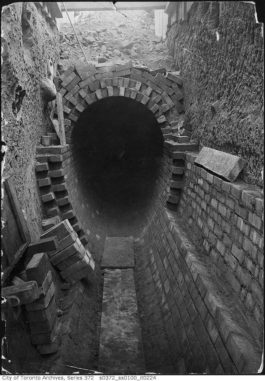
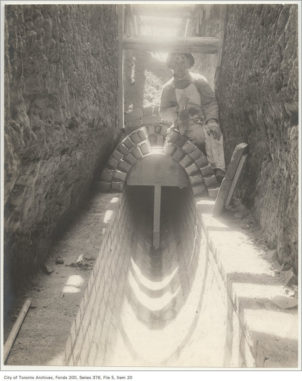
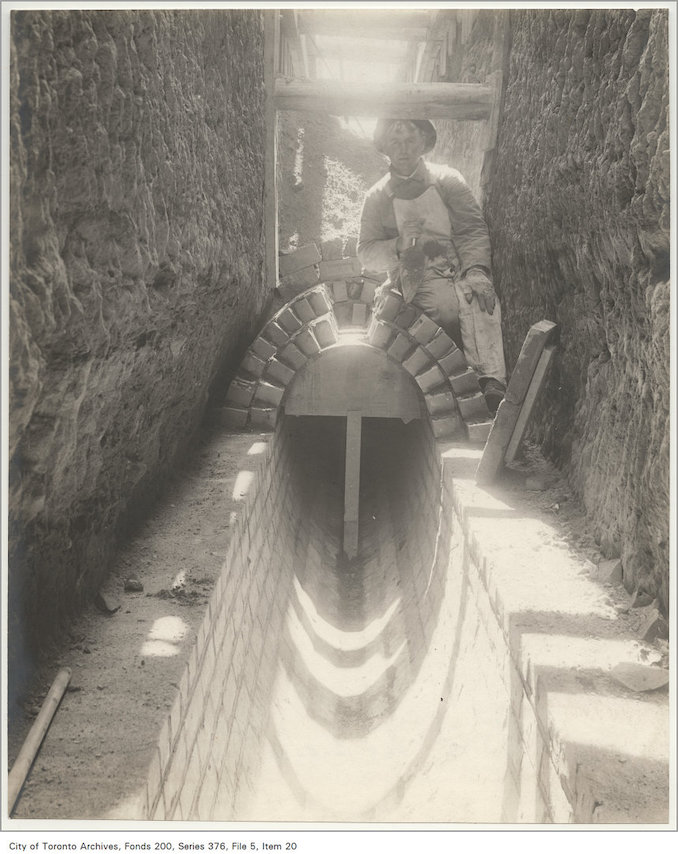
AVENUE ROAD SEWER 1890
MARITIME HISTORY OF THE GREAT LAKES
(TORONTO TLEGRAM, 1932, Schooner Days story 48, By Snider)
“SPRING was ever the season for rejoicing in Liverpool Andy’s breast. Grease collection fell off with the warming of the Bay water, but it was replaced as a means of livelihood by the occasional voyage as pummy in the newly outfitted hookers.
Up or down the lake shore, in the primeval fastnesses of Petticoat Creek, Goose Point, or the Rouge Mouth, he might be able to pot enough game for his favorite feed, blackbird pie; or corn beef and cabbage, his second choice, would put flesh on his winter starved ribs.
Or if he chose not to tempt the unsalted deep but stuck to the sunny side of the waterfront, there was the happy-go-lucky chance of a meal and money for “throwing them out” when the stone-hookers arrived, swimming scupper-deep with square edged blue-grey builders, or granite hardheads with the bottom-grass still dripping from them like drowned women’s hair.
One May like this, Liverpool went up the lake as pummy in the old Hyanwyde, which few lakesmen will remember. The grub was not bad and the raking was good, and Liverpool Andy’s only regret was that he had left behind his boon companion, Billy the Carpenter.
Guillaume Le Charpentier was this worthy’s real name, as recorded in Quebec, where he was born, but, like Liverpool, he had gone waterfront early in his career, and forgotten more than his Norman accent. He was no hand with tools, but all along the front he was called The Carpenter, even by those who did not know his first name was Billy.
The Carpenter missed Andy, too. They had shivered winter nights through together in slab cars and hay wagons, and had shared the proceeds of sewer grease and blind-stabbing. But when Billy had discovered a single “site” in the Hyanwyde, he had remembered that Andy had not had a square meal since the fall before, and declared loudly he was through with making fortunes for other people and would never lift a set-pole or hardhead-rake again.
DEATH OF BILLY THE CARPENTER
Billy the Carpenter tacked down Jarvis street in the general direction of the Defiance by the light of the May moon. The hooker nuzzled the splayed piling which raggedly outlined the slip below the gurgling sewer mouth. The Carpenter reached for her rigging to swing himself, aboard. The rigging was not where he thought it was. He fell. His head struck something. The slip water closed over him. He did not come up. He made hardly more splash than the hideous gas-bubbles which belched up as the circles of filthy water widened in the moonlight.
LIVERPOOL ANDY: A FIVE CENT GERANIUM TOMBSTONE FOR BILLY THE CARPENTER
Liverpool shambled up dusty West Market street. The swing doors of the City Arms wafted an enticing aroma of beer and tobacco, but Liverpool, with his slack mouth watering, passed it by. He quaffed without enthusiasm at Morrison’s Bar, by which name Blake Mathews immortalized the market drinking fountain presented to the citizens of Toronto by Angus Morrison, Esq., M. P., in 1877, on the Queen’s Birthday, celebrating the second of his three terms as Mayor of Toronto. It stood on Front street then, near the public weigh scales; since moved a mile away, to the ferry wharves. Then he passed on to the flower stalls in St. Lawrence Market, which lay between the two streets. He emerged on Jarvis with a tiny terra-cotta pot in his gnarled young hands; in the pot, a geranium, flaming like a crimson torch amid its stout green brown-circled leaves.
He bore his prize back to the slip. One spile or mooring post, more upright than the rest, marked the vicinity of The Carpenter’s moon-lit disappearance. Like everything else around The Hospital, it was soft with reek and rot. There was a cavity in the top of it. Here Liverpool Andy planted his geranium pot; and on the spile he chalked:
SACERD TO
MEMRY OF
BILle thE
CARpnTR
He sailed back up the shore again next day in the Hyanwdye. To make two trips in succession in one hooker was a rare exhibition of industry on his part. With the skipper’s muzzle-loading shotgun he made great havoc among the blackbirds at the creek mouth, and much feasting on blackbird pie resulted.
It was night when they got back a week later, and again it was moonlight. Liverpool made some excuse about walking up the dock before turning in. He promised to be “right back.” But he did not turn in. Neither, did he turn up.
The Hyanwyde skipper waited for his pummy, but not long. He went to bed grumbling about young night hawks. Next morning he found Liverpool Andy’s body floating in the slip; below a rotting spile, from whose top a gay geranium greeted
the rising sun.
True”
The story of Liverpool Andy was so sad and disgusting as to be unbelievable to Snider. So he added that one little word…”true”
alan skeoch
april 2021
END EPISODE 323
LATER I will write an episode that will show that the Toronto Harbour was disgusting in 1900 just as described here.


 heritagemississauga.com/wp-content/uploads/2018/07/Port-Credit-Brickyard-1908-570×424.jpg 570w,


 torontoguardian.com/wp-content/uploads/2018/12/1910-Davenport-Road-sewer-brick-work-209×300.jpg 209w,


 torontoguardian.com/wp-content/uploads/2018/12/1890-Avenue-Road-sewer-copy-238×300.jpg 238w,