Month: June 2021

  • EPISODE 374 GYPSY MOTH CATERPILLARS…THOUSANDS OF THEM JUNE 2021


    EPISODE 374      GYPSY MOTH CATERPILLARS…THOUSANDS OF THEM   JUNE 2021

    alan skeoch
    June 2021


    MARJORIE SKEOCH GOES TO WAR

    “ALAN,  we are under attack…can’t you do something.”
    “Attack?”
    “Thousands…tens of thousands of them…moving down the street…denuding the neighbourhood.”
    “What can I do?”
    “At the very least you can join me in stamping on them…I have killed hundreds…my shoes are slippery
    with their crushed flesh.”
    “Good for you, meeting them head on as they come down the street.”
    “I think they have killed Hubert Lack’s great oaks…and the oaks next to 
    him have been stripped bare.”:
    “Ancient trees…100, perhaps 200 years old…stripped…get out here and help.”
    “We have the only oak that has survived.”
    “They will get it too…unless you start stamping  on them”
    “You are fighting a losing war, Marjorie.”
    “I am not.”
    “They have outflanked you…invading through the grass…hard to spot.”
    “Our tree…save our tree…stop your damn talking.””
    “Need helicopter spraying…not done this year.”
    “Get the wrap around burlap with glue impregnated insulation…seems to stop them a bit.”
    “Thousands got over the glue…put defence up too late.””
    “What do you want me to do, Marjorie?”
    “Go get my other shoes…get my rubber boots…help stamping on them.”

    “Did you know they are dangerous to humans?”
    “No.”
    “Yes, if you get those little feathery stickles in your arm a rash will happen.”
    “Danger to kids?.”
    “You bet…especially if a child eats one. Serious”
    “Damn…there is one coming up my pant leg.”

    “Shake the shrubs…they drop down on filament parachutes.”

    “Alan, get my flanks…I am dealing with the main onslaught…you get
    the sneaky little devils in the grass.”
    “Too many, Marjorie.””
    “Coward!”
    “I read somewhere that the oak trees are strong enough to survive…to set out
    new leaves when the Gypsy Moths leave the caterpillar stage.”
    “Now isn’t that just like you…to read a book while we are under attack.
    You do not deserve to have our magnificent oak.”
    “The neighbours are up in arms…calling Stephen Dasko, our councillor.”
    “What is he going to do?”
    “Next year there will be helicopter spraying.”
    “Will there be any trees to spray?
    “I think the oaks will recover.”
    “Time will tell.  Meanwhile go get my rubber boots…stamping time now.”

    NOTE: Helicopter spraying of insecticide does some good but not much.
    If insecticide is too strong it will kill too many good bugs…and birds.
    The Gypsy moth has been winning the war with property owners
    since the Moth first got loose in the 1880’s in Massachusetts.  Some
    Gypsy moths, from Europe, escaped from an American laboratory.   Sounds
    chillingly familiar to the Covid 19 virus, dos it not?


    There have been many reports of children getting rashes from Gypsy moth caterpillars in the recent weeks. Is it dangerous? What are the symptoms and what should you do if you think your child has contracted it? We break down the fast facts to these questions and more below.
    • This rash is typically contracted through direct contact with the gypsy caterpillar or moth (pictured below). If they are found in high numbers, however, their setae (tiny hairs) can travel through the wind or fabric (such as towels, clothing, etc.) causing the same reaction. Additionally, their setae can be found in soil, tree bark, and silk cocoons causing reactions months after.
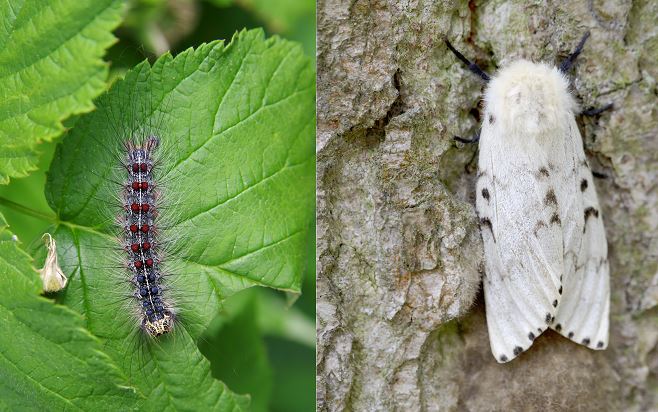
    • Symptoms include mild to moderate stinging or pain accompanied by welts, vesicles (small, fluid-filled sacs), raised red bumps, and patches of red, scaly skin.
    • These symptoms appear within minutes or hours after contact and last anywhere from one to several days.
    • Contact with mucous membranes (for example, a child putting a caterpillar in their mouth) can cause more serious reactions such as shortness of breath, conjunctivitis, difficulty swallowing, and hay fever.
    • Treatment typically only requires the removal of visible embedded setae. Any that can’t be removed loosen themselves over the next several days.
    • Pain from skin reactions usually subsides within a few hours but can also be medicated with over the counter pain relievers such as ibuprofen or acetaminophen.
    If you think your child has come into contact with Gypsy Moth setae, pediatrician Stacey Maslow advises: “Try to remove the hairs as best you can and treat with pain relievers as needed. If any of the more serious side effects start to occur, like shortness of breath, contact your doctor.”

    Campbellford & District Horticultural Society

    “The crazed panic over LLD (Gypsy) Moth continues!! It is too late to spray, despite many companies still offering this service or selling the spray. 

    Not every caterpillar, moth and butterfly is an LLD moth (see below for some native lookalikes). 

    Its gross, but temporary. Leaves will grow back. Focus on keeping your trees healthy with a good soaking of water if there isn’t a good rain, and feed the soil in the dripline of the tree(s)with a thin layer of good compost or other natural fertilizer (not chemical fertilizer, they can screw up the good soil microbes). 

    When you see the fuzzy, cream-coloured eggs masses on bark in a few weeks from now, scrape off as many as you can into soapy water to reduce next year’s crop. They are cyclic in population and will peak then crash within the next couple of years.”


    Government Spraying of Insecticide


    Yes, the Government might spray for Gypsy Moths, and they may even do your property. However, they may not spray enough or use an insecticide that is very effective. This may may not be all bad. If they sprayed something more potent they might kill all the desirable preditor insects such as ladybugs, praying mantis and lacewings, as-well-as other beneficial insects such as bees and butterflies, and even birds and toads. 

    Besides, the Government has been spraying Gypsy Moths for over a hundred years, and the moths are still with us and spreading. See our “Fighting The Gypsy Moths” section.

    If you want to your property to be protected you might have to join the fight. 

    Things That Individual Property Owners Can do Themselves


    1. Duct tape and tanglefoot
    2. Burlap folded strips
    3. Burlap strips sprayed with insecticide
    4. Gypsy moth traps
    5. Search for and destroy egg masses 
    6. Aid the spread of virus fatal to gypsy moths
    7. Encourage birds to visit your property
    8. Hire a professional exterminator to spray from the ground


    Origin of Gypsy Moths in the United States


    This section provides information about how gypsy moths came to the United States.


    E. Leopold Trouvelot

    E. Leopold Trouvelot


    Gypsy Moth History


    The gypsy moth was brought to North America from France by Mr. E. Leopold Trouvelot. His purpose was to breed hybrid silkworms that would be hardier than the Chinese species and that could be used to establish a silk industry in the United States. By 1865 he had a million caterpillars feeding under protective netting at his home in Medford Massachussets. In 1869 some of them escaped and were apparently scattered by a windstorm. 

    By 1881 the gypsy moth caterpillars had become so common in the neighborhood of Trouvelot’s old home, that the villagers in Medford considered them a local nuisance.

    The population of gypsy moth caterpillar exploded during the spring of 1889. The year before had been a good one for insects, and gypsy moths had flourished and laid record numbers of eggs. Hatching in April and May of 1889, millions of gypsy moth caterpillars stripped leaves from trees yard after yard and street after street in Medford. Caterpillars covered tree trunks, fences, and sides of houses.

    Gypsy moth spread map

    Gypsy moth spread map
    University of Wisconsin


    From this unfortunate start in Medford Massachussets, gypsy moths have now spread to many other portions of the United States 

    From 1892 to 1900 gypsy moths were confined to the extreme eastern portion of the State of Massachusetts.

    By 1914 they had spread to New Hampshire, Maine, Rhode Island, and Connecticut.

    By 1941 they were in Northeastern Pennsylvania and in extreme eastern New York State.

    By 1981 they were all over Pennsylvania and New Jersey.

    They have now spread to many other states, including Michigan and Wisconsin, as shown on the map on the right.

    Gypsy Moths are now also in Virginia, West Virginia and Oregon. How did they get to Oregon? It is believed that they hitchhiked on a car or truck.

    They continue to spread. 

    Follow this link to see efforts over the years to rid the country of Gypsy Moths: Gypsy Moth Wars

  • EPISODE 373 THE DEATH OF POISONOUS PARSNIP PLANT JUNE 2021

    EPISODE 373     THE DEATH OF POISONOUS PARSNIP PLANT    JUNE 2021


    alan skeoch
    June 2021


    Were we overcautious?  That thought occurred to me as I waited for Andrew to arrive
    with his jump suit and rubber gloves…and a lethal knife to cut the  throat of
    the poison parsnip which had overtaken the perennial garden.  Seemed to
    me that the plant had been growing elsewhere with minimal attention.

    Then I took another look at the injuries the wild parsnip did to exposed flesh.
    Huge gross fluid filled blisters.   The chemical that oozed from the wild parsnip 
    is the same or very similar to the chemical oozes from giant hogweed. Capable
    of causing blindness and even death.

    Andrew arrived.  Dressed in coveralls… no exposed flesh;  Like a skilled  butcher
    he slit the throat of the parsnip and carefully stuffed all of the plant into a large
    plastic bag.   “we could just leave here and lt the sun look it but better for uou
    to put it in the garbage.”  Then he was gone.   I could have done that myself.

    The root was large…a parsnip.  Apparently  the root is edible.   Should I open
    the bag and get the root.  Boil the parsnip up into some kind of parsnip soup?
    Then serve it to friends?     

    Hold on!   I will throw the plastic bag on Brad Schneller’s lawn!   He likes parsnips.


  • EPISODE 373 POISONOUS PARSNIP … DO NOT TOUCH …extreme danger

    EPISODE 373     POISONOUS PARSNIP  – EXPLOSIVE GROWTH…DEADLY PLANT…LOOKS LIKE QUEEN ANNE’S LACE


    Alan skeoch
    June 19, 2021


    “Alan, look what grew in the perennial garden.  Is it a flower or a weed?”
    “Not sure…looks sort of like Queen Anne’s Lace but twice the size.”
    “Should we pull i out or let it flower?”
    Quite stunning to look at.”
    “Are you sure it is not Hogweed…the killer of the fence row.”
    “Don’t touch it just in case.   Hogweed sap can make a person blind…even kill.”
    “Too small for Hogweed.”
    “Give Andrew a call.”

    “Tempted to pull it out…to cut it at the base.”
    “Do not do a bloody thing.”
    “The plant grew fast…seems it was so small and now it is 3 feet high and getting higher.”
    “Scares me.”
    “Give Andrew a call now.”
    “I will need pictures…”
    “Pictures?   PICTURES!!!”
    “Give Andrew a call now.”


    “ANDREW,  There is a STRANGE plant growing in centre of the garden…looks
    like Queen Anne’s lace but bigger and greener.”
    “Do not touch it Dad…get away.”
    “Why?”
    “”Wild Parsnip..for sure…sap will burn your skin…REALLY BAD…GET AWAY FROM IT.”
    “But the plant is in the centre of the perennial garden.”
    “I will get it tomorrow…need to be careful…gloves, mask, long pants…need to
    dig up the wild parsnip roots as we’ll.”
    “Marjorie is worried about her perennials.”
    “Danger, dad…real danger…the sap can torture…”

    How did it get here?    Wild parsnip loves disturbed ground.  Gardens..road shoulders…hiking trails.


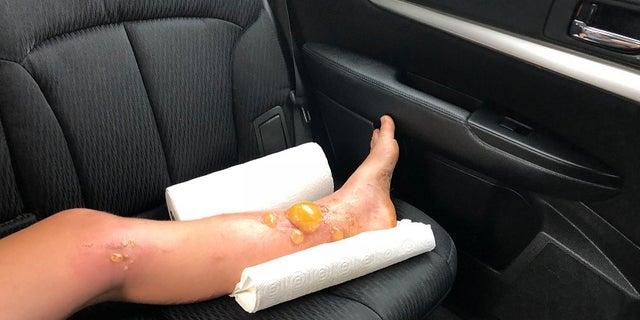
    EVIDENCE…NO JOKING MATTER…LOOK AT THE BLISTER WHEN THIS LADY
    ACCIDENTALLY FELL INTO SOME POISONOUS PARSNIP.  DO NOT TOUCH THE PLANT
    WITH BARE SKIN…TAKE PRECAUTIONS .

    alan skeoch


    WARNING: ARTICLE CONTAINS GRAPHIC IMAGES

    A Vermont woman who received the equivalent of second-degree chemical burns to her legs after falling into a wild parsnip plant is warning others about the dangers of the seemingly harmless herbage.

    Around the first of July, Charlotte Murphy, of Essex, Vermont, was traveling to the southern part of the state for her internship with a local artist. When she stopped on the side of the road, she lost her footing and fell into the plant, breaking it, causing the sap from the wild parsnip plant to come in contact with her bare legs.


  • EPISODE 372 meeting of the castlefield institute June 17, 2021 (John Ricker presiding)

    EPISODE 372    MEETING OF THE CASTLEFIELD INSTITUTE  JUNE 17, 2021  JOHN RICKER PRESIDING


    alan skeoch
    june 17, 2021


    This is John Wardle…creator and manager of the relatively unknown Castlefield Institute, an organization
    that discusses and makes suggestions concerning world events some of which threaten our very existence.

    Most of the time, however, we just enjoy each others company   We laugh a lot which is a good sign.
    And every one seems to have an opinion some of which are astounding…i.e. brilliant.  Many are just
    plain silly.   Silly and delightful.  We have a good time.

    alan


    And this is John Ricker in whose honour the Castlefield Institute was created.  John Ricker has suggested to John Wardle a disparate assembly of 
    people to join him in monthly discussions.


    “Mmmmmmmmmmmm!”   (read below to understand the Mmmmmmmmmm!)


  • EPISODE 372 THIS EUCLID DUMP TRUCK MAKES OUR VAN LOOK LIKE A DINKY TOY…COAL MINING CONTROVERSY 1990’S OHIO


    EPISODE 371   STRIP MINING IN OHIO


    alan skeoch
    June 2021

    See if you can find Andrew in this picture.   Behind the Euclid are heaps of rubble that was once a dense and beautiful
    Caledonian forest.   Why destroy the forests of Central Ohio?  Imagine the scale of destruction this Euclid could wreak.
    A few loads like this and our farm in Southern Ontario would cease to exist.   Can you guess the economic justification
    of using these Euclids?   What is being sought under the Osage Orange groves?  Under the Shagbark Hickory trees?
    Under the top soil?  Under the subsoil?


    Mining is not pretty.  Strip mining is especialy ugly….extremely so.

    We had good friends in central Ohio back in the 1990’s and spent several 

     week-ends driving down to their farm outside Zanesville.   To us it was
    a new world in many ways…sometimes a startling new world.

    For instance Osage Orange trees thrived and in the fall dropped bushels
    of aromatic smelling warted fruit the size of baseballs.  The Osage Orange
    trees, however, were not so pleasant as they were covered in spikes the size
    of hypodermic needles.

    Perhaps the most startling thing  however was not the work of nature.
    It was the opposite.  Beneath the lovely forested hills of southern Ohio
    are seams of coal. Layered parallel to the ground.  These seams vary from
    60 to 120 feet below the ground…technically called overburden.

    To get access to these seams of coal it is easier to strip the hills of
    their trees, shrubs, plant life with bulldozers.    Then use gigantic
    scoop shovels that, in the 1990’s, were bigger than some apartment
    buildings.

    The  damage done to the hills and valleys of southern Ohio
    by these strip coal mining operations is hard to describe.  Best
    seen visually in the picture of one Euclid dump truck that is so
    large that it makes our truck look like a Dinky Toy.

    After strip mining is complete the coal companies are obligated
    to put top soil back but the end result robs central Ohio of
    its former beauty.

    alan skeoch
    June 2021

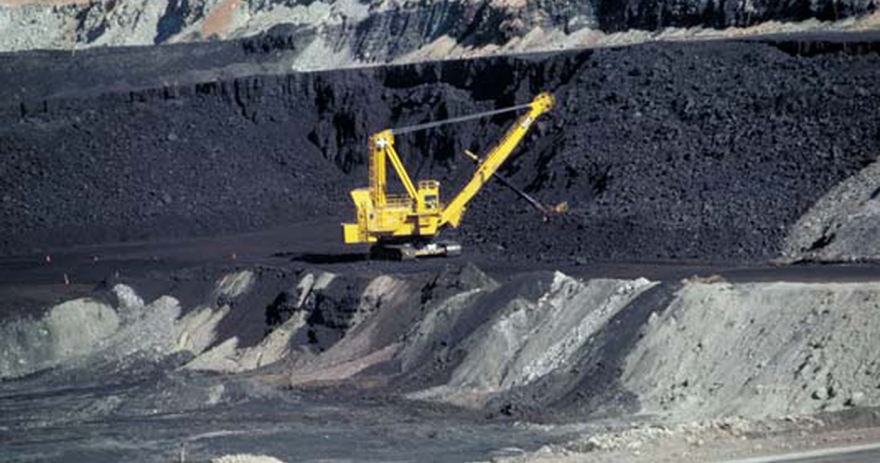
    When is it economic to strip mine in Ohio?
    • Generally it is economic to strip mine when there is a 20:1 ratio of overburden-to-coal seam, meaning, for example that a three-foot coal seam can be surface mined economically when the overburden is up to 60 feet. However, at some surface mines in Ohio, highwalls of up to 200 feet high remain where five-foot-coal seams have been extracted.


    Just a few pictures below.


    In the 1990s, a new form of surface mining,mountaintop removal, became more common. This more invasive method provides access to coal that would’ve been left behind by traditional strip mining. In recent years, tensions over mountaintop removal have risen between those wanting to boost the state’s diminishing coal industry and activists wanting to protect the environment.


    wiki-wyoming-coal-mine.png


    One final thought:  WHAT HAPPENS TO OUR CIVILIZATION WHEN WE HAVE CONSUMED ALL THE COAL AND
    OIL DEPOSITS?