EYWOOD COUNTRY ESTATE, titley. herefordshire, england
Text written by, and copyright of, Nicholas Kingsley – many thanks
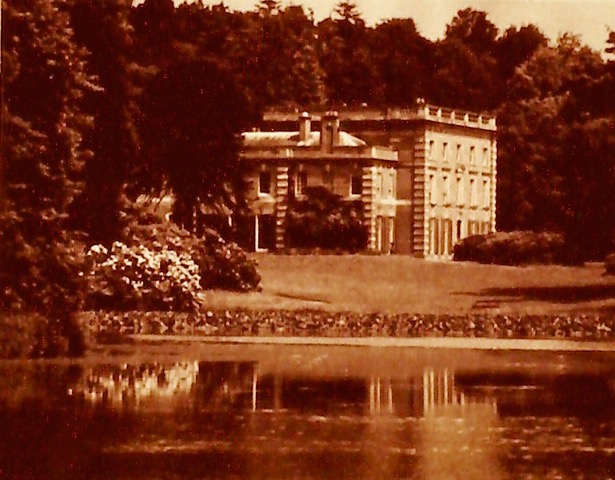
The Eywood estate at Titley was acquired at the beginning of the 18th century by Edward Harley (1664-1735), the younger brother of Robert Harley, 1st Earl of Oxford, who was Speaker of the House of Commons and later Chancellor of the Exchequer under Queen Anne. Edward was appointed by his brother to the lucrative office of Auditor of the Imprest, and the proceeds of this appointment are said to have funded the building of a new house at Eywood in about 1705. I have not found an 18th century view of the house, although it seems likely that one exists, but it seems probable that the house of this time was a plain five by five bay block of three storeys. The rusticated basement and giant Ionic columns, which decorated the front may also have been original features, or they may have been added later in the 18th century (the house is said to have been ‘much altered’). Inside, there was a fine staircase, with three turned and fluted balusters per step, which survived later alterations to the building. Another fine room was the fully-panelled Oak Room, used latterly as a billiard room, and the house also retained some other plain but handsome fireplaces which were obviously of the 1705 period. 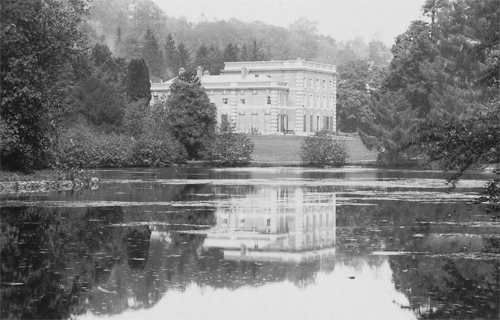 In 1735 Edward Harley was succeeded by his son, Edward Harley (1699-1755), who succeeded his cousin as 3rd Earl of Oxford in 1741. With the earldom came the Brampton Bryan estate in Herefordshire, the ancient seat of the Harleys, and Eywood seems thereafter to have became a secondary estate of the earls. This did not, however, mean that Eywood was neglected. Either Edward Harley or the 3rd Earl established a landscaped setting for the house, for Bishop Pococke noted on his travels in September 1756 that ‘Lord Oxford has a large house and a fine lawn, with a beautiful piece of water and great woods on the hill over it’, which remained a fair description of the house in later years. Edward Harley (1726-90), 4th Earl of Oxford, brought Capability Brown to Eywood in 1775, but it is far from clear that he made any proposals for the estate, let alone that these were executed. Nonetheless, by 1795 there were three pools at Eywood (two remain) and there are still great stands of woodland in the parkland setting of the house.
Edward Harley (1773-1848), 5th Earl of Oxford, came of age in 1794, and in that year married Jane Scott, a Hampshire clergyman’s daughter. She was to be the Countess of Oxford with whom Lord Byron had an affair in 1812 (when she was forty and he was 24 and on the rebound from Lady Caroline Lamb). By the time Byron stayed at Eywood in 1812, however, the house had been greatly altered, for Lord Oxford employed Robert Smirke in 1805-07 to enlarge and modernise it. Smirke seems to have turned the early 18th century square block into a courtyard house by adding much longer, three-storey wings to either side of the original house, and a connecting wing joining the ends of the two wings to the north-west. On the main south front, the new wings were stepped back a little from the original block, which with its tall parapet and giant order continued to dominate the appearance of the house. A new entrance was made into the north-east wing, and the ground floor of the main block and this wing were rusticated. Inside, Smirke created new interiors, including a grand new dining room with a screen of columns across one end, a new drawing room, and several other rooms with fine chimneypieces and simple plasterwork, A new pleasure ground was laid out around the house.
In 1848, Eywood and Brampton Bryan passed to Alfred Harley (1809-53), 6th and last Earl of Oxford. When he died, Brampton Bryan passed to his widow (d. 1877) while Eywood passed to his elder daughter, Lady Langdale. She died in 1872 and after some legal wrangling, Eywood passed to her sister, Lady Charlotte Bacon, the widow of Gen. Anthony Bacon, whose career had encompassed being ‘the finest cavalry officer in the army’, two years imprisonment for debt, an abortive attempt to found a colony in south Australia, and military service under Don Pedro, King of Portugal and Emperor of Brazil. At the time of her inheritance, Lady Charlotte was living in Australia with her children, but she came home and died at Eywood in 1880. Her son, Edward Bacon (b. 1842) sold Eywood to Arthur Walsh (1827-1920), 2nd Baron Ormathwaite, who in turn sold it in 1892 to Charles James Paul Gwyer (1854-1940) and his wife Mary (1862-1950).
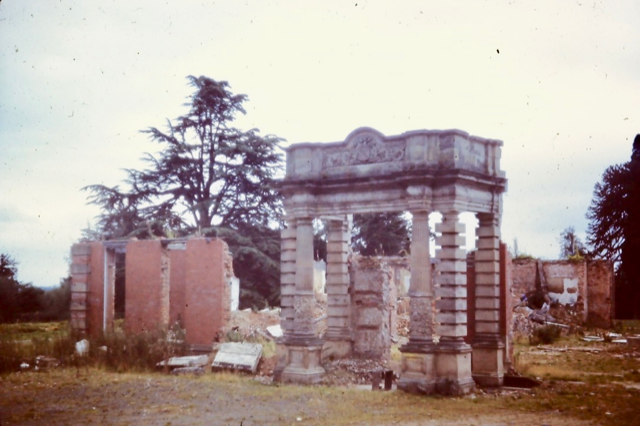
The Gwyers brought in W.O. Milne to remodel the house, which was looking decidedly run-down after half a century of only intermittent occupation. The wings of of the house were reduced from three storeys to two, and the central block was remodelled, removing the giant order and replacing it with bold rustication at the angles of the building and rather chunky window surrounds. The house that resulted was more unified in appearance than before. A large new porch with eclectic detailing was built on the east side, and this is ironically almost the only part of the building to survive today. For after the death of Mrs Gwyer in 1950, the estate was sold to a Mr Vowells, who sold off the farms and demolished the house almost entirely. The house went, it would seem, because it was so large and the owner had no use for it: it appears not to have been in poor condition. The landscaping and the stable block survive, but the porch and some odd stumps of walling are all that remain of the house today. At least one of the chimneypieces from the house was acquired by the Harleys and taken to Brampton Bryan
Leave a Reply