Year: 2021

  • EPISODE 376 STRAWBERRIES (and whipped cream…yum yum)


    Begin forwarded message:


    From: ALAN SKEOCH <alan.skeoch@rogers.com>
    Subject: Strawberries
    Date: June 28, 2021 at 8:37:52 AM EDT
    To: Alan Skeoch <alan.skeoch@rogers.com>


    EPISODE 376      STRAWBERRIES

    alan skeoch
    June 2021

    Yesterday I sent an episode implying that the future of  farming is rather bleak for
    small time operators.  Today I would like to correct that.  Why?  Because today
    we dropped into a tiny farm…perhaps an acre of productive land.  The parking lot
    is bigger than the field.   Yet the production is fantastic.  And the price matches
    the production.  These berries come from the cooler of a strawberry farm
    just a mile or so west of Georgetown…follow he signs on the Fifth Line. NO time
    for us to hand pick,  The field had about 20 pickers already.

    Bring money.   Marjorie bought this flat of fresh berries for $42.  Expensive!
    Yes.  Cheaper if you pick your own and get them weighed.   But these
    berries are the best…big and sweet and ready for big dollops of whipped cream.

    There is a crowd picking these berries at this very moment.  I an hesitant
    telling you where it is located.   But I will.  Turn on to the Fifth line north
    of highway 401 or drive north on Trafalgar Road…look for a hand lettered
    strawberry sign…make a left turn a mile or so north on Trafalgar.  Look for the signs.

    First picture is all green.  Second picture adds lots of red.


    Sent from my iPhone


  • Fwd: EPISODE 376 THE FACE OF MODERN AGRICULTURE….2021


    Begin forwarded message:


    From: ALAN SKEOCH <alan.skeoch@rogers.com>
    Subject: EPISODE 376 THE FACE OF MODERN AGRICULTURE – ANTHONY ACRES….2021
    Date: June 26, 2021 at 3:08:23 PM EDT


    EPISODE 376    THE FACE OF MODERN AGRICULTURE – ANTHONY ACRES – 2021


    alan skeoch
    June 2021


    CORPORATE FARMING:  STRIKING A DEAL WITH ANTHONY ACRES


    There are still 100 acre farms here and there in Southern Ontario. Winaries for instance.  They must be economically worthwhile.  But the face
    of modern agriculture is increasingly changing in scale.  That is not really news.   Just a drive in the countryside presents lots
    of evidence.  Empty old bank barns and oversized tractors. We meet the new machines of agriculture every time we drive to the farm.  Imagine the investment necessary for
    corporate farming like Anthony Acres.   How could they  make a profit.  Thousands of acres are necessary.   Anthony Acres rents thousands
    of acres.  Most of their Land is rented not owned.   

    Our two sons and partner Nick own a farm with about 60 to 70 acres of cropland.  They are not farmers.   Andrew dropped in to
    the home farm of Anthony Acres which is just a short distance from their farm.  fifth line, Limehouse, Ontario.  The meeting was a good one.   Perhaps I can
    put the conversation in dialogue form.  (My words)

    “Hi, we own the old McLean – Saunders – McLeod farm up the road and wonder
    whether you are interested in leasing the cropland before the weeds take over.”
    “Might be interested but I’ll have to take a look first.”
    “Now?”
    “Yes…good a time as any…if land is good we can get a cover crop in fast.”

    (Visit to farm)


    “Let’s strike a deal…we need a three year lease at least…and will pay $90 an acre yearly…about 60 acres.”
    “That will help pay the property taxes…for sure.”
    “Should cover about 75% of the cost.”
    “We  want to keep one field and the barnyard.”
    “Fine.”
    “I overheard a conversation once that claimed rented land was just being mined…corn, year after year,
    until the land was exhausted.  Hate to think of that.”
    “That’s pure hearsay…not true.  We care for the land.  No till agriculture…always keep the top soil covered
    …cover crops like clover…nitrogen fixing.  We improve the soil.  Crop rotation…corn, soybeans, wnter wheat…
    top soil never gets exposed to wind.”
    “Did you notice the stones?”
    “I did.”
    “Won’t they be a problem?”
    “Lots of the land around here is stony…ancient ice sheets 10,000 year ago pushed and ground stones as the ice
    age advanced.  Then, when the ice retreated, the land was strewn with rocks.”
    “One of my dad’s uncles ruined his Massey Ferguson combine when one rock got into the cylinder…bent it all to hell.”
    “We are super careful.   I will send in a rock picker to go over all your fields before planting time.”
    “Rock picker?”
    “Tractor with steel forks…gets all the big rocks.  Where do you want them dumped…we’ll send one of the boys
    up here next week.   Fields will be safe for combines after that.””
    “But the  rocks get pushed up every year by the frost.”
    “Then we’ll do another picking.  Part of the business.”

    “Did you noice the old stone silo>?”
    “Sure did.  Not many of those around.  Made out of the stones gathered by the Mclean family in the 1870’s.  Never saw
    one before.”
    “Used for Sileage, I think…Chopped up corn….stalks and all…fine dining for cattle n winter.””
    “Yes. Some people think our silos are used that way.  Not true…our steel silos are filled with shelled corn….moved around with elevators to 
    get the kernels dry.   Eliminate any chance of mould.    No relation to your fieldstone silo.  Better get a roof on it if you can.”

    “All those machines must set you back a fortune…all John Deere except for the tractor trailers …”
    “That’s why we need a lot of land…thousands of acres.”

    (Unspoken thought:  “One of those tractors with attachments would cost a small fortune.
    If Anthony Acres tried to buy all the land they needed the business would not be viable.  Renting, however, made good sense.)


    NOTE:   BELOW IS A SHORT EXCERPT FROM ANTHONY ACRES WEB PAGE


    Where and how we operate

    Anthony Acres Ltd is a Canadian company operating in Southern Ontario within a large region from the Greater Toronto Area in the south, to the Dundalk Highlands in the north, from Guelph in the west to Caledon in the east. This area, inclusive of the Regions and Counties of Halton, Peel, Wellington and Dufferin, represents some of the best farmland in all of Canada.
    By means of Best Management Practices and Precision Agriculture, Anthony Acres Ltd is dedicated to conserving, preserving, protecting and improving the farmland and the environment in which we work.
    We are vertically integrated, with all facets of the business being done in-house.
    This includes:
    • crop marketing and sales
    • agronomy
    • seed cleaning and treating
    • field cropping and crop protection product application
    • equipment maintenance
    • trucking
    • cropland improvement and protection.
    We have 2 elevating, drying and storage facilities, one in the Greater Toronto Area and on the border of Wellington County and Dufferin County.


  • EPISODE 375 1957 THUNDERBIRD ON HOIST…PINK1

    EPISODE 375    1957 THUNDERBIRD ON HOIST…PINK


    alan skeoch
    June 2021


    I am not much of a car enthusiast but this car got my attention.
    All I could see from the passenger seat where we got gas at $1.32.9 cents
    a litre was the back tail light.  Unusual. Jutted out and had a fin.

    “Marjorie look at that car up on the house.  Odd!”
    “It’s a 1957 model.”
    “”How would you know that?””
    “Says so on the licence.”
    “Oh!”
    “What is it?”
    “Man pumping gas says its a 1957 Thunderbird.”
    “Pink”
    “Those were the years…the 1950’s…when cars were not bland…turquoise and white…or pink like this.”
    “Our old 53 Meteor was Double Brown…others were bright red and white.”
    “Same colours as popsicles.”

    “Ask if I can go into the workshop.”
    “He says you can.”

    NOTE   A lot more could be said about 1957.  I think my Uncle Frank Freeman still had
    a team of horses for instance.

    “Wasn’t there a cosmetic company that gave away pink cars to its best salespeople.?  Mary Kay, I believe.”

    alan skeoch

  • EPISODE 374 GYPSY MOTH CATERPILLARS…THOUSANDS OF THEM JUNE 2021


    EPISODE 374      GYPSY MOTH CATERPILLARS…THOUSANDS OF THEM   JUNE 2021

    alan skeoch
    June 2021


    MARJORIE SKEOCH GOES TO WAR

    “ALAN,  we are under attack…can’t you do something.”
    “Attack?”
    “Thousands…tens of thousands of them…moving down the street…denuding the neighbourhood.”
    “What can I do?”
    “At the very least you can join me in stamping on them…I have killed hundreds…my shoes are slippery
    with their crushed flesh.”
    “Good for you, meeting them head on as they come down the street.”
    “I think they have killed Hubert Lack’s great oaks…and the oaks next to 
    him have been stripped bare.”:
    “Ancient trees…100, perhaps 200 years old…stripped…get out here and help.”
    “We have the only oak that has survived.”
    “They will get it too…unless you start stamping  on them”
    “You are fighting a losing war, Marjorie.”
    “I am not.”
    “They have outflanked you…invading through the grass…hard to spot.”
    “Our tree…save our tree…stop your damn talking.””
    “Need helicopter spraying…not done this year.”
    “Get the wrap around burlap with glue impregnated insulation…seems to stop them a bit.”
    “Thousands got over the glue…put defence up too late.””
    “What do you want me to do, Marjorie?”
    “Go get my other shoes…get my rubber boots…help stamping on them.”

    “Did you know they are dangerous to humans?”
    “No.”
    “Yes, if you get those little feathery stickles in your arm a rash will happen.”
    “Danger to kids?.”
    “You bet…especially if a child eats one. Serious”
    “Damn…there is one coming up my pant leg.”

    “Shake the shrubs…they drop down on filament parachutes.”

    “Alan, get my flanks…I am dealing with the main onslaught…you get
    the sneaky little devils in the grass.”
    “Too many, Marjorie.””
    “Coward!”
    “I read somewhere that the oak trees are strong enough to survive…to set out
    new leaves when the Gypsy Moths leave the caterpillar stage.”
    “Now isn’t that just like you…to read a book while we are under attack.
    You do not deserve to have our magnificent oak.”
    “The neighbours are up in arms…calling Stephen Dasko, our councillor.”
    “What is he going to do?”
    “Next year there will be helicopter spraying.”
    “Will there be any trees to spray?
    “I think the oaks will recover.”
    “Time will tell.  Meanwhile go get my rubber boots…stamping time now.”

    NOTE: Helicopter spraying of insecticide does some good but not much.
    If insecticide is too strong it will kill too many good bugs…and birds.
    The Gypsy moth has been winning the war with property owners
    since the Moth first got loose in the 1880’s in Massachusetts.  Some
    Gypsy moths, from Europe, escaped from an American laboratory.   Sounds
    chillingly familiar to the Covid 19 virus, dos it not?


    There have been many reports of children getting rashes from Gypsy moth caterpillars in the recent weeks. Is it dangerous? What are the symptoms and what should you do if you think your child has contracted it? We break down the fast facts to these questions and more below.
    • This rash is typically contracted through direct contact with the gypsy caterpillar or moth (pictured below). If they are found in high numbers, however, their setae (tiny hairs) can travel through the wind or fabric (such as towels, clothing, etc.) causing the same reaction. Additionally, their setae can be found in soil, tree bark, and silk cocoons causing reactions months after.
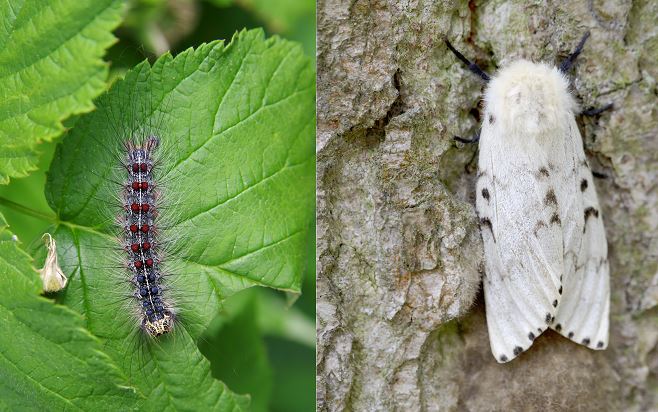
    • Symptoms include mild to moderate stinging or pain accompanied by welts, vesicles (small, fluid-filled sacs), raised red bumps, and patches of red, scaly skin.
    • These symptoms appear within minutes or hours after contact and last anywhere from one to several days.
    • Contact with mucous membranes (for example, a child putting a caterpillar in their mouth) can cause more serious reactions such as shortness of breath, conjunctivitis, difficulty swallowing, and hay fever.
    • Treatment typically only requires the removal of visible embedded setae. Any that can’t be removed loosen themselves over the next several days.
    • Pain from skin reactions usually subsides within a few hours but can also be medicated with over the counter pain relievers such as ibuprofen or acetaminophen.
    If you think your child has come into contact with Gypsy Moth setae, pediatrician Stacey Maslow advises: “Try to remove the hairs as best you can and treat with pain relievers as needed. If any of the more serious side effects start to occur, like shortness of breath, contact your doctor.”

    Campbellford & District Horticultural Society

    “The crazed panic over LLD (Gypsy) Moth continues!! It is too late to spray, despite many companies still offering this service or selling the spray. 

    Not every caterpillar, moth and butterfly is an LLD moth (see below for some native lookalikes). 

    Its gross, but temporary. Leaves will grow back. Focus on keeping your trees healthy with a good soaking of water if there isn’t a good rain, and feed the soil in the dripline of the tree(s)with a thin layer of good compost or other natural fertilizer (not chemical fertilizer, they can screw up the good soil microbes). 

    When you see the fuzzy, cream-coloured eggs masses on bark in a few weeks from now, scrape off as many as you can into soapy water to reduce next year’s crop. They are cyclic in population and will peak then crash within the next couple of years.”


    Government Spraying of Insecticide


    Yes, the Government might spray for Gypsy Moths, and they may even do your property. However, they may not spray enough or use an insecticide that is very effective. This may may not be all bad. If they sprayed something more potent they might kill all the desirable preditor insects such as ladybugs, praying mantis and lacewings, as-well-as other beneficial insects such as bees and butterflies, and even birds and toads. 

    Besides, the Government has been spraying Gypsy Moths for over a hundred years, and the moths are still with us and spreading. See our “Fighting The Gypsy Moths” section.

    If you want to your property to be protected you might have to join the fight. 

    Things That Individual Property Owners Can do Themselves


    1. Duct tape and tanglefoot
    2. Burlap folded strips
    3. Burlap strips sprayed with insecticide
    4. Gypsy moth traps
    5. Search for and destroy egg masses 
    6. Aid the spread of virus fatal to gypsy moths
    7. Encourage birds to visit your property
    8. Hire a professional exterminator to spray from the ground


    Origin of Gypsy Moths in the United States


    This section provides information about how gypsy moths came to the United States.


    E. Leopold Trouvelot

    E. Leopold Trouvelot


    Gypsy Moth History


    The gypsy moth was brought to North America from France by Mr. E. Leopold Trouvelot. His purpose was to breed hybrid silkworms that would be hardier than the Chinese species and that could be used to establish a silk industry in the United States. By 1865 he had a million caterpillars feeding under protective netting at his home in Medford Massachussets. In 1869 some of them escaped and were apparently scattered by a windstorm. 

    By 1881 the gypsy moth caterpillars had become so common in the neighborhood of Trouvelot’s old home, that the villagers in Medford considered them a local nuisance.

    The population of gypsy moth caterpillar exploded during the spring of 1889. The year before had been a good one for insects, and gypsy moths had flourished and laid record numbers of eggs. Hatching in April and May of 1889, millions of gypsy moth caterpillars stripped leaves from trees yard after yard and street after street in Medford. Caterpillars covered tree trunks, fences, and sides of houses.

    Gypsy moth spread map

    Gypsy moth spread map
    University of Wisconsin


    From this unfortunate start in Medford Massachussets, gypsy moths have now spread to many other portions of the United States 

    From 1892 to 1900 gypsy moths were confined to the extreme eastern portion of the State of Massachusetts.

    By 1914 they had spread to New Hampshire, Maine, Rhode Island, and Connecticut.

    By 1941 they were in Northeastern Pennsylvania and in extreme eastern New York State.

    By 1981 they were all over Pennsylvania and New Jersey.

    They have now spread to many other states, including Michigan and Wisconsin, as shown on the map on the right.

    Gypsy Moths are now also in Virginia, West Virginia and Oregon. How did they get to Oregon? It is believed that they hitchhiked on a car or truck.

    They continue to spread. 

    Follow this link to see efforts over the years to rid the country of Gypsy Moths: Gypsy Moth Wars

  • EPISODE 373 THE DEATH OF POISONOUS PARSNIP PLANT JUNE 2021

    EPISODE 373     THE DEATH OF POISONOUS PARSNIP PLANT    JUNE 2021


    alan skeoch
    June 2021


    Were we overcautious?  That thought occurred to me as I waited for Andrew to arrive
    with his jump suit and rubber gloves…and a lethal knife to cut the  throat of
    the poison parsnip which had overtaken the perennial garden.  Seemed to
    me that the plant had been growing elsewhere with minimal attention.

    Then I took another look at the injuries the wild parsnip did to exposed flesh.
    Huge gross fluid filled blisters.   The chemical that oozed from the wild parsnip 
    is the same or very similar to the chemical oozes from giant hogweed. Capable
    of causing blindness and even death.

    Andrew arrived.  Dressed in coveralls… no exposed flesh;  Like a skilled  butcher
    he slit the throat of the parsnip and carefully stuffed all of the plant into a large
    plastic bag.   “we could just leave here and lt the sun look it but better for uou
    to put it in the garbage.”  Then he was gone.   I could have done that myself.

    The root was large…a parsnip.  Apparently  the root is edible.   Should I open
    the bag and get the root.  Boil the parsnip up into some kind of parsnip soup?
    Then serve it to friends?     

    Hold on!   I will throw the plastic bag on Brad Schneller’s lawn!   He likes parsnips.