EPISODE 134: ONCE UPON A TIME THERE WAS A MOTOR CAR CALLED THE LITTLE SKEOCH
(also called The Skeoch Motorcycle Car)
alan skeoch
Nov. 27. 2018
REVISED OCT. 2020 (slightly)
It has now been two years since I touched base with the men rebuilding The Litle Skeoch Motor Car
in Scotland. It is a daunting task. We had planned on a visit to their workshop but sad events
got in the way…and Covid 19 makes such visits difficult today. How the world has changed.
Maybe I can get a progress report from Scotland. Meanwhile I feel this story should be part
of the Episodes (#134) just in case it gets lost.
alan
Maybe we should bring back the LITTLE SKEOCH MOTOR CAR. It was small,, cheap and simple…sort of a 4 wheel bicycle seating two people with a chain drive and small
motorcycle engine. So small that only two very slim people could ride in it since the
car was only 31 inches wide and a little over 8 feet long.
Some of you may think this is some kind of joke. Wrong. In 1920, James Skeoch built his first Little Skeoch, then entered it in a Scottish auto show and sold it
in ten minutes. All told less than a dozen Little Skeoch’s were built in his small factory. Ten were quickly purchased at that auto show. Price? 180 pounds…which was the cheapest car in the show. None have survived. Sadly in 1921 a fire consumed his little factory and as a result the Burnside Motor Company in Dalbeattie, Scotland, ceased to exist.
Pictures of the Skeoch production line were retrieved from Skeoch family albums. Not exactly an automated factory.
But the LITTLE SKEOCHS were real mini cars and seemed about to make a big splash in the booming car market of the 1920’s
until fire ended the enterprise. Everything became a blackened pile of scrap iron.
James Skeoch moved on. His skills were valued. He had a long successful career and died in 1954.
Not many people, by 1954, were even aware that there was such a car as the SKEOCH. Memories are short especially since
none of the Little Skeochs survived. Gone Gone Gone.
Well, not quite.
POSSIBLE REBIRTH OF THE LITTLE SKEOCH
The Skeoch is about to be reborn. All was not lost. By good fortune the motor and gearbox of one of the Little Skeoch’s
has been found. A group of men, largely retired mechanics and carpenters, have decided to rebuild the car and to do so
in the same Scottish town where the originals were built. Dalbeattie.
This is Fiona Sinclair, granddaughter of James Skeoch. Her family records and artifacts gave a big boost the idea of
rebuilding the car. When Ron Skeoch, James Skeoch’s son died, treasures were found in his home… The plans, radiator and other
parts of the Little Skeoch
And this is Geoff Allison of Dalbeattie, Scotland, who is one of the prime movers of the restoration project.. He has founded
the Dalbeattie Men’s Shed which is hardly a glorious name for the little factory where All the bits and pieces
of the Little Skeoch have been assembled along with quite a gathering of men…engineers, mechanics, widowers,…some
men who are just lonely and want something to do in their retired years that seems meaningful.
The brainchild behind the project is Martin Shelley, a car enthusiast, who suggested that the Dalbeattie Men’s Shed might
consider doing something remarkable and then dropped the bits and pieces on to their work benches.
Their job makes me think of
the Nursery Rhyme about Humpty Dumpty. Only this time Humpty Dumpty, i.e. The Little Skeoch, could be put back together again,
HUMPTY DUMPTY SAT ON THE WALL
HUMPTY DUMPTY HAD A GREAT FALL
ALL THE KING’S HORSES
AND ALL THE KING’S MEN
COULDN’T PUT HUMPTY TOGETHER AGAIN.
…Then along came GEORGE ALLISON and his men from Dalbeattie, Scotland…who
plan to put Humpty togehter again.
.
i2-prod.dailyrecord.co.uk/incoming/article12137301.ece/ALTERNATES/s810/Mens-Shed-Dalbeattie.jpg 810w” src=”https://i2-prod.dailyrecord.co.uk/incoming/article12137301.ece/ALTERNATES/s615/Mens-Shed-Dalbeattie.jpg” alt=”Dalbeattie Men’s Shed members Geoff Thomas, John Forrest, Robin Gilchrist and Geoff Allison with part of the original engine and plans for the Skeoch car.” content=”https://i2-prod.dailyrecord.co.uk/incoming/article12137301.ece/ALTERNATES/s615/Mens-Shed-Dalbeattie.jpg” class=””>
Dalbeattie Men’s Shed members Geoff Thomas, John Forrest, Robin Gilchrist and Geoff Allison with part of the original engine and plans for the Skeoch car. (Image: Jim McEwan)
Will the Little Skeoch ever see the light of day again nearly a century later? That remains to be seen. The job is demanding and the cost of the right parts is high but
the men are optimistic. And Fiona Sinclair hopes a reborn Little Skeoch will be on the road so her mother, the daughter of James Skeoch will be able to take the first ride.
These four men are only part of the gathering of men devoted to the project…about three dozen strong. Men who wanted something to do and both Shelley and Allison found that
something.
“This is a truly local car, it was the only cycle car ever made in Scotland and it was manufactured right here in Dalbeattie.
“This was a Dalbeattie man building a car the likes of which has never been built since.
“We have already had a lot of interest from visitors staying here.
“It’s already attracting a lot of attention and when it is finally road-worthy will really put Dalbeattie on the map.”
Project manager, Men’s Shed member Robin Gilchrist, 73, reckons sufficient local skills exist to do the job “in-house”.
He said: “We will draw in a lot of expertise because some of the work is quite technical in nature.
“There’s enough specialists in Dalbeattie who can help us do the precision engineering work.”
Quotes from an interview with journalist Stephen Norris (Scottish Daily Record, March 6, 2018)
alan skeoch
Nov. 27, 2018
P.S. BELOW IS AN ARICLE ON THE SKEOCH MOTOR CAR WRITTEN
FOR BBC SCOTLAND NEWS , Feb. 27, 2018
Drive to rebuild ‘forgotten’ early car
By Nichola Rutherford BBC Scotland News
Published
27 February 2018
IMAGE COPYRIGHTDALBEATTIE MUSEUM
image captionThe Skeoch Utility Car was built using parts normally used to manufacture motorcycles
When James Skeoch designed and built one of Scotland’s firstaffordable cars, he must have dreamed of huge success.
With a price-tag of just £180, the first Skeoch Utility Car was the cheapest on display at the Scottish Motor Show in 1921.
It sold within 10 minutes and a further nine were quickly snapped up by customers keen to join the automobile revolution.
But within months Skeoch’s business was in ruins. His uninsured workshop in Dalbeattie, Dumfries and Galloway, burned to the ground.
Since then the Skeoch Utility Car has been largely forgotten by all but keen historians of Scotland’s motor industry.
Now, almost 100 years later, plans are are being drawn up to recreate the so-called “cycle car” in the town where it was manufactured.
IMAGE COPYRIGHTDALBEATTIE MUSEUM
image captionThe Skeoch car was the cheapest on show at the Scottish Motor Show in 1921 and apparently sold within 10 minutes
The ambitious project has been taken on by a group of mainly retired local men, known as Dalbeattie Men’s Shed.
Using some of the original parts and working from the original drawings, they hope to build a working Skeoch car in time to mark its centenary.
Motoring enthusiast Martin Shelley approached the Men’s Shed with the idea for the project after reading about the group on the BBC Scotland website last year.
IMAGE COPYRIGHTDALBEATTIE MUSEUM
image captionBurnside Motor Works in Dalbeattie, where the Skeoch was manufactured, was devastated by fire in December 1921
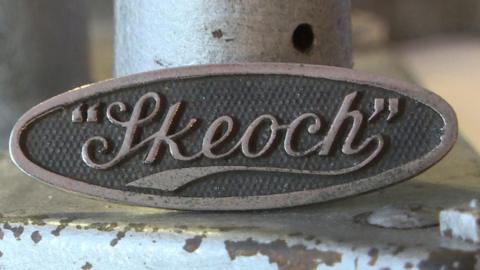
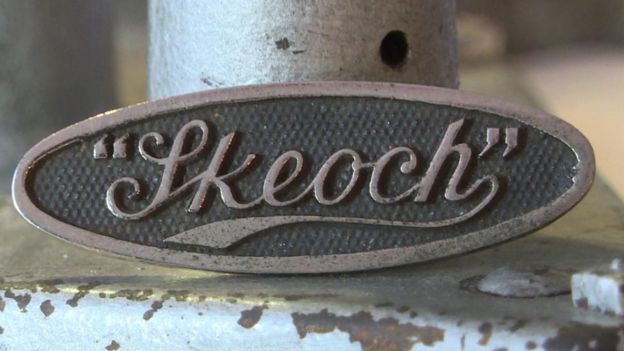
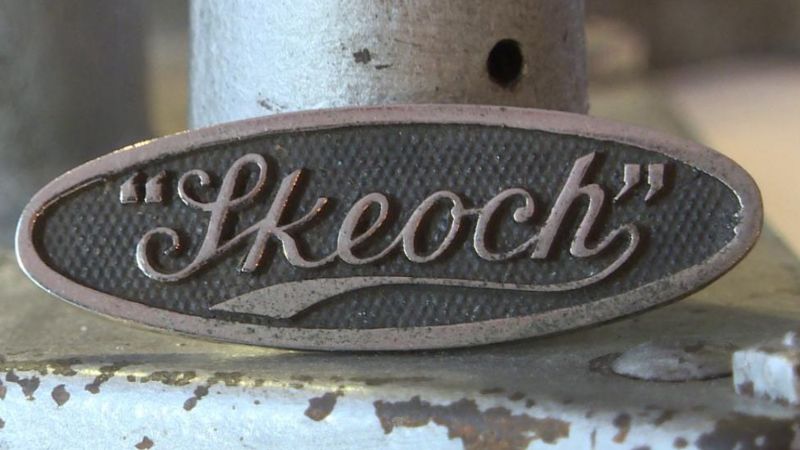
image captionThe Skeoch radiator badge was among the original parts found in the home of Mr Skeoch’s son following his death last year
image captionDalbeattie Men’s Shed have also been given an original engine and gearbox with which to build a Skeoch car
Mr Shelley said: “After World War One, the ordinary working man was much more used to the idea of riding a motorcycle or driving a car so they knew about the technology and now they wanted to try and build their own cars.
“In the early 20s, there was a huge flowering of people making these cars. As it turned out, Skeoch in Dalbeattie were the only people in Scotland to ever attempt to make these things commercially.”
The original drawings and parts – including the radiator badge – were found in the Wishaw home of Ron Skeoch, James Skeoch’s son, after he died last year.
Mr Shelley said he hoped they could be used to capture the “spirit” of the 1920s vehicle.
“You could make a replica of the car which would pass muster, using a modern engine and a modern gear box and using modern parts. But the spirit of the car is very much based on the parts that were available in 1920,” he said.
“This project will be very like the original car and that to me is what the joy of the whole thing is.”
image captionFiona Sinclair hopes to be able to sit in one of her grandfather’s cars
image caption“It’s going to be something for posterity,” said Geoff Allison of Dalbeattie Men’s Shed
The granddaughter of James Skeoch, Fiona Sinclair, is also involved in the project.
She never knew her grandfather – he died in 1954 – but she hopes that her mother – Skeoch’s daughter – will get the chance to ride in one his cars.
“I think it’s going to mean a lot to my family,” she said. “It’s tragic that the fire put an end to his ambition.
“I’m actually rather hoping I can physically get to sit in the car, I’m not quite sure I could be trusted with driving it.
“It’s only got two gears apparently but I think it would be rather wonderful. What I really hope is that my mother gets the opportunity to actually sit in the car as well.”
The project is “immensely exciting”, said Geoff Allison, the secretary of the Dalbeattie Men’s Shed, which has members with engineering and mechanical skills.
“It’s engineering-rich, it’s Dalbeattie-rich, it’s community-rich, it fills so many of our requirements,” he added.
“It’s big, it’s going to be eye-catching, it’s going to be something for posterity. It’s got a lot to recommend it.”
EPISODE 623 “WHY ONTARIO BARNS HAD WHEELS?” ROBERT ROOT ANSWERS
alan skeoch
july 2022
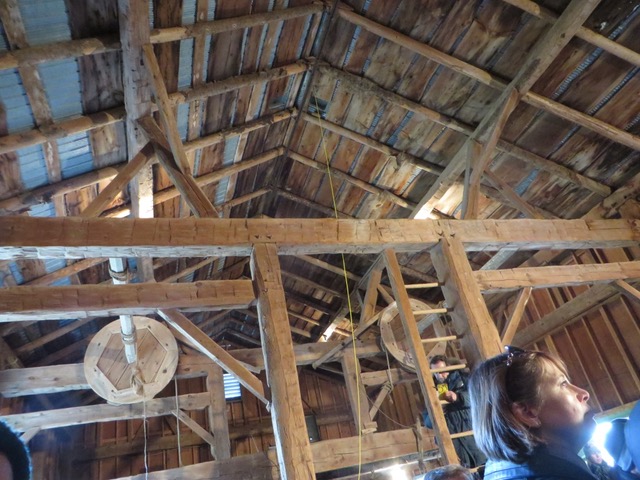
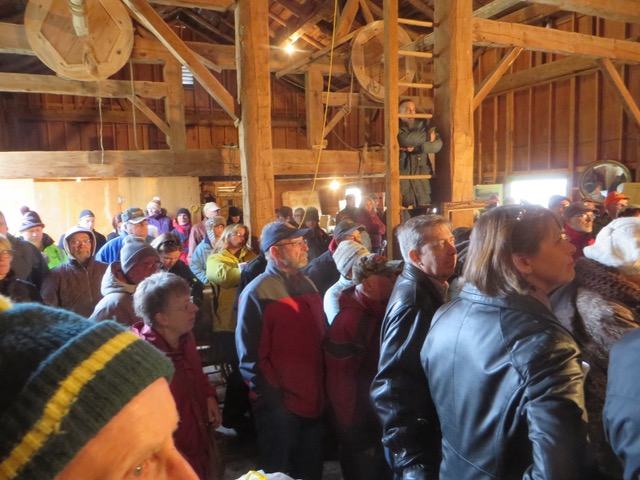
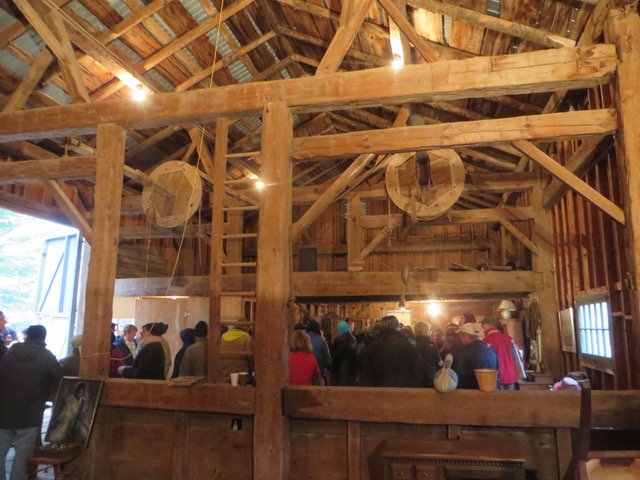
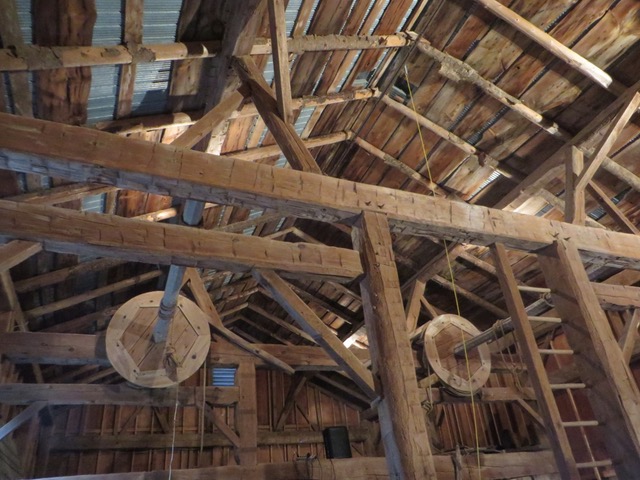
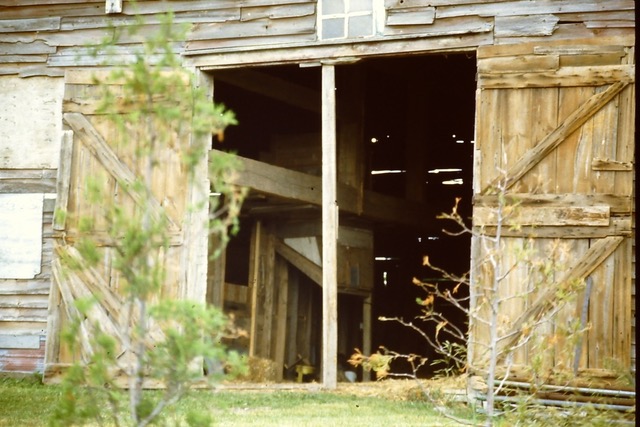
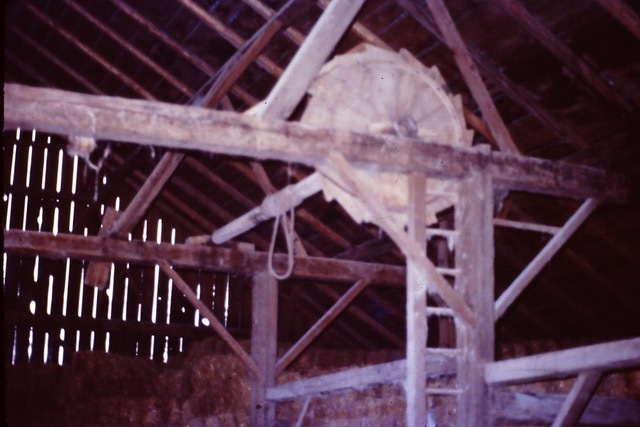
Most Ontario barns also had wheels high up on the high beams. Why ?
This was time when barns also used teams of horses , lots of long ropes, pulleys attached
to the floor and lots of two and three pronged forks. About now, end of July, those wheels were moving
as were the horses, ropes and pulleys….and the pitch forks.. Why?
This is BoB Root, who I call “Rooter” for no particular reason other than friendship. Our life paths
have crossed many times. He has answered my questions about the rack lifters in detail.
And even sent a note about another method of getting loose cut hay into hay mows on
either side of the threshing floor of Ontario barns. Both methods were a lot of work. But
hay had to be stored as winter feed.
MY MEMORY IS FAULTY. I THINK UNCLE FRANK USED THE HAY CAR METHOD
DESCRIBED BY BOB ROOT RATHER THAN THE HAY RACK METHOD. I HOPE TED
FREEMAN WILL CORECT ME. S BOTH METODS ARE DESCRIBED BY BOB.
Hi Alan,
Those wheels were used as rack lifters. The wagon load of loose hay or straw would be pulled up by the team of horses
so that the load would be positioned under the wheel assemblies.
Ropes would be attached to the wagon rack and the axles of the wheel assembly.
Horses would then pull on the ropes around the wheels and the wagon rack would be lifted off the wagon frame and
raised to the level of the haymow where the farmer could fork the load off of the wagon rack and into the haymow.
The unloaded rack would then be lowered back onto the wagon frame where it could return to the field for another load.
This was all a lot of work in the days before hay balers and elevators were invented.
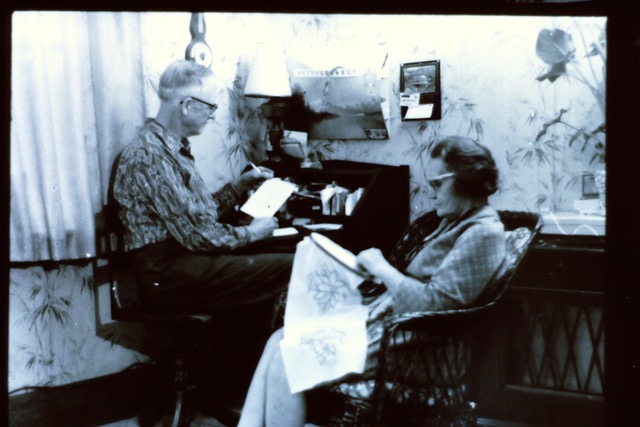
MY UNCLE FRANK FREEMAN AND HIS WIFE LUCINDA
(Cousin Ted Freeman had grown up when this picture was taken)
Of all my farm relatives, Uncle Frank and Aunt Lucinda Freeman worked the hardest and got the least
reward for their labour That is my opinion. They would never say this. I am not sure if cousin
Ted would agree. Their farm was in a nest of hills that drained into a large pond that was dead
centre. Tough land. Lots of stones and lots of danger. I spent a lot of time with them, more
than with any of our legions of Skeoch farms around Fergus. I never appreciated how hard they
had to work to make a living until they were gone.
This picture of them at rest is inappropriate because they never had
much time for rest since they had to squease an income from the piles
of glacial till left for them 10,000 years ago when the Laurentian ice sheet
melted.
Bob Root has explained the rack lifting system.
Hi Alan,
Those wheels were used as rack lifters. The wagon load of loose hay or straw would be pulled up by the team of horses
so that the load would be positioned under the wheel assemblies.
Ropes would be attached to the wagon rack and the axles of the wheel assembly.
Horses would then pull on the ropes around the wheels and the wagon rack would be lifted off the wagon frame and
raised to the level of the haymow where the farmer could fork the load off of the wagon rack and into the haymow.
The unloaded rack would then be lowered back onto the wagon frame where it could return to the field for another load.
This was all a lot of work in the days before hay balers and elevators were invented.
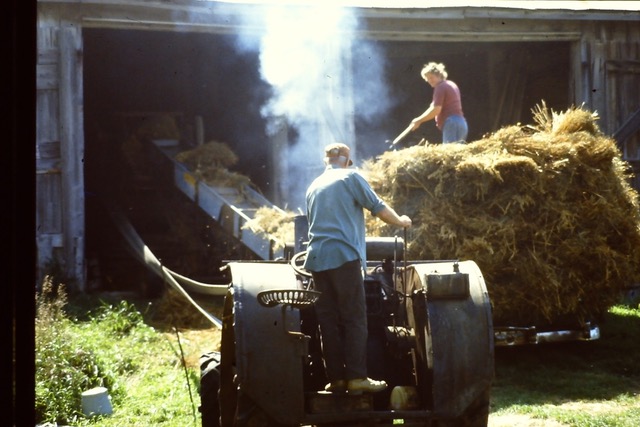
This is what a hay wagon would look like when driven into the barn…only this
is a load of sheaves of wheat being fed into a threshing machine by cousin Eleanor and her
husband James Calder other Bellwood farm.
Robert Root
“On our farm we didn’t use this method but the Awrey farm across the road from us did.”
“On our farm we used a hayfork system. The loaded wagon was pulled up onto the driving floor and the large hayfork was plunged into the load of hay. Horses with a rope attached would then walk out the gangway pulling the rope behind them and this would lift the hayfork loaded with a large bundle of hay up to the roof level where a 4 wheeled trolley ran along a track and it could carry the hayfork forward or backwards and also sideways into various mows. At the desired location the jaws of the fork would be opened and the bundle of hay or straw would be released and fall down into the mow. By the time I was a kid the horses were replaced by a tractor which pulled the long rope up and down the gangway. I remember one day that my cousin Ken and I were sitting in the sand playing at the base of the gangway and the rear tire of the tractor ran over Ken’s outstretched legs as it pulled the rope to lift the hayfork.
This whole process was very dusty and so when balers became available we quit the hayfork business but the hayfork track always remained hanging from the inside peak of the barn roof.”
“Rooter….how much hay would 1cow need for winter…or a horse…miscalculation = starvation…I wonder how farmers made this calculation””
“Trial and error, Alan, If it looked like the farm was going to run out of hay then a couple of animals would have to be butchered.”
EPISODE 620 ‘AIN’T NO SUNSHINE NOW SHE’S GONE”…the Midnight Hour band at Benares
alan skeoch
july 30, 2022
I WAS LATE.
“ALAN, you missed Midnight Hour and three other great R and B songs.”
“Had to get camera battery damnit.
“the guys are great. Can we dance?”
“Alone?”
“Ain’t no sunshine ….when they’re gone Alan”
“This band looks like the rebirth of the Blues Brothers.”
“Loved them.”
“Midnight Hour lyrics are very suggestive, you know.”
MIDNIGHT HOUR
I’m gonna wait ’til the midnight hour
That’s when my love come tumbling down I’m gonna wait ’til the midnight hour When there’s no one else around I’m gonna take you, girl, and hold you And do all things I told you, in the midnight hour
Another ‘midnight’ song…but not part of this evening’s selections. Could be next year.
MIDNIGHT SPECIAL
Well, you wake up in the mornin’ You hear the work bell ring And they march you to the table You see the same old thing Ain’t no food upon the table And no pork up in the pan But you better not complain, boy You get in trouble with the man
Let the Midnight Special shine a light on me Let the Midnight Special shine a light on me Let the Midnight Special shine a light on me Let the Midnight Special shine an ever-lovin’ light on me
EVERYBODY NEEDS SOMEBODY
Everybody needs somebody Everybody needs somebody to love (everybody) Someone to love (needs somebody) Sweetheart to miss (everybody) Sugar to kiss (needs somebody)
JANE JANE JANE
Woah Jane you’re playin’ a game But why I don’t see Jane you’re playin’ for fun But I play for keeps, yes I do (Jane, Jane, Jane) That’s a game on me, yeah (Jane, Jane, Jane) So plain to see (Jane, Jane, Jane) Janie, Janie, Janie, Janie, Janie (Jane, Jane, Jane) Why you foolin’ with me, me, me (Jane, Jane, Jane) (Jane, Jane, Jane) (Jane, Jane, Jane) (Jane, Jane, Jane)
MIDNIGHT HOUR
I’m gonna wait ’til the midnight hour
That’s when my love come tumbling down I’m gonna wait ’til the midnight hour When there’s no one else around I’m gonna take you, girl, and hold you And do all things I told you, in the midnight hour
AIN’T NO SUNSHINE WHEN SHE’S GONE
Ain’t no sunshine when she’s gone It’s not warm when she’s away Ain’t no sunshine when she’s gone And she’s always gone too long Anytime she’s goes away
Wonder this time where she’s gone Wonder if she’s gone to stay Ain’t no sunshine when she’s gone And this house just ain’t no home Anytime she goes away
BENARES front porch makes me feel I am privileged to have a special concert just
for my friends on a summer evening. Perhaps close to one hundred people arrived
July 29, 2022 to hear the Midnight Hour rhythm and blues band bring back memories of
Ray Charles, the Blues Brothers, Wilson Picket…others. Listeners will correct me
because the band did not play Midnight Special but rather play the sexy Midnight
Hour. Nor did they play Georgia on my Mind, the Ray Charles R and B favourite.
The band only had a two hour window at Benares…wish it was more. I kept hollering
Midnight Hour! in the hope they would do an encore. I did hear the song as I hustled
across the Benares field with my camera charged and ready.
Perhaps the most powerful of their songs was a rendition of ‘Ain’t Know Sunshine when she’s Gone’…a song
that really hurts. As Dean Fulton, lead singer shows below.
WHO WAS RAY CHARLES?
Who Was Ray Charles?
Ray Charles was a legendary musician who pioneered the genre of soul music during the 1950s. Often called the “Father of Soul,” Charles combined blues, gospel and jazz to create groundbreaking hits such as “Unchain My Heart,” “Hit the Road Jack” and “Georgia on My Mind.” He died in 2004, leaving a lasting impression on contemporary music.
Early Life
Ray Charles Robinson was born on September 23, 1930, in Albany, Georgia. His father, a mechanic, and his mother, a sharecropper, moved the family to Greenville, Florida when he was an infant. One of the most traumatic events of his childhood was witnessing the drowning death of his younger brother.
Soon after his brother’s death, Charles gradually began to lose his sight. He was blind by the age of 7, and his mother sent him to a state-sponsored school, the Florida School for the Deaf and the Blind in St. Augustine, Florida — where he learned to read, write and arrange music in Braille. He also learned to play piano, organ, sax, clarinet and trumpet. The breadth of his musical interests ranged widely, from gospel to country, to blues.
GEORGIA ON MY MIND
Georgia, Georgia The whole day through (the whole day through) Just an old sweet song Keeps Georgia on my mind (Georgia on my mind)
I said Georgia Georgia A song of you (a song of you) Comes as sweet and clear As moonlight through the pines
Other arms reach out to me Other eyes smile tenderly Still in peaceful dreams I see The road leads back to you
I said Georgia Oh Georgia, no peace I find (no peace I find) Just an old sweet song Keeps Georgia on my mind (Georgia on my mind)


 i2-prod.dailyrecord.co.uk/incoming/article12137301.ece/ALTERNATES/s810/Mens-Shed-Dalbeattie.jpg 810w” src=”https://i2-prod.dailyrecord.co.uk/incoming/article12137301.ece/ALTERNATES/s615/Mens-Shed-Dalbeattie.jpg” alt=”Dalbeattie Men’s Shed members Geoff Thomas, John Forrest, Robin Gilchrist and Geoff Allison with part of the original engine and plans for the Skeoch car.” content=”https://i2-prod.dailyrecord.co.uk/incoming/article12137301.ece/ALTERNATES/s615/Mens-Shed-Dalbeattie.jpg” class=””>
 ichef.bbci.co.uk/news/320/cpsprodpb/4D35/production/_100156791_skeochbadge.jpg 320w, ichef.bbci.co.uk/news/480/cpsprodpb/4D35/production/_100156791_skeochbadge.jpg 480w, ichef.bbci.co.uk/news/624/cpsprodpb/4D35/production/_100156791_skeochbadge.jpg 624w, ichef.bbci.co.uk/news/800/cpsprodpb/4D35/production/_100156791_skeochbadge.jpg 800w” src=”https://c.files.bbci.co.uk/4D35/production/_100156791_skeochbadge.jpg” width=”976″ height=”549″ loading=”lazy” class=”css-evoj7m-Image ee0ct7c0″ style=”margin: 0px; padding: 0px; border: 0px; font-family: inherit; font-size: inherit; font-style: inherit; font-variant-caps: inherit; font-stretch: inherit; line-height: inherit; vertical-align: baseline; display: flex; width: 800px; height: 450px; overflow: hidden; position: absolute; inset: 0px; -webkit-box-pack: center; justify-content: center; -webkit-box-align: center; align-items: center; object-fit: cover;”>