EPISODE 134: ONCE UPON A TIME THERE WAS A MOTOR CAR CALLED THE LITTLE SKEOCH
(also called The Skeoch Motorcycle Car)
alan skeoch
Nov. 27. 2018
REVISED OCT. 2020 (slightly)
It has now been two years since I touched base with the men rebuilding The Litle Skeoch Motor Car
in Scotland. It is a daunting task. We had planned on a visit to their workshop but sad events
got in the way…and Covid 19 makes such visits difficult today. How the world has changed.
Maybe I can get a progress report from Scotland. Meanwhile I feel this story should be part
of the Episodes (#134) just in case it gets lost.
alan
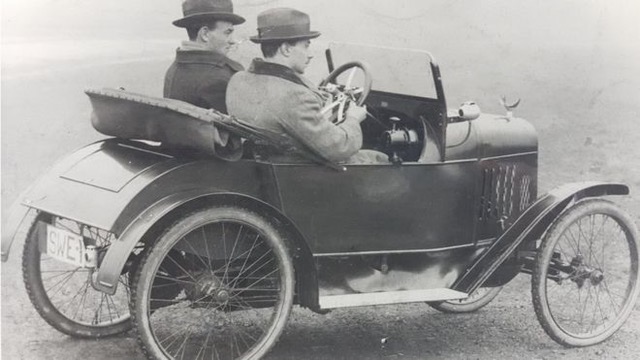
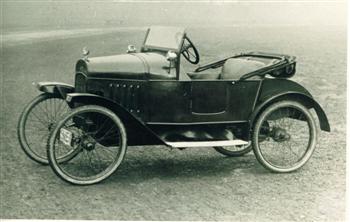
Maybe we should bring back the LITTLE SKEOCH MOTOR CAR. It was small,, cheap and simple…sort of a 4 wheel bicycle seating two people with a chain drive and small
motorcycle engine. So small that only two very slim people could ride in it since the
car was only 31 inches wide and a little over 8 feet long.
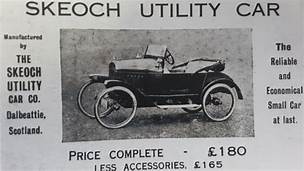
Some of you may think this is some kind of joke. Wrong. In 1920, James Skeoch built his first Little Skeoch, then entered it in a Scottish auto show and sold it
in ten minutes. All told less than a dozen Little Skeoch’s were built in his small factory. Ten were quickly purchased at that auto show. Price? 180 pounds…which was the cheapest car in the show. None have survived. Sadly in 1921 a fire consumed his little factory and as a result the Burnside Motor Company in Dalbeattie, Scotland, ceased to exist.
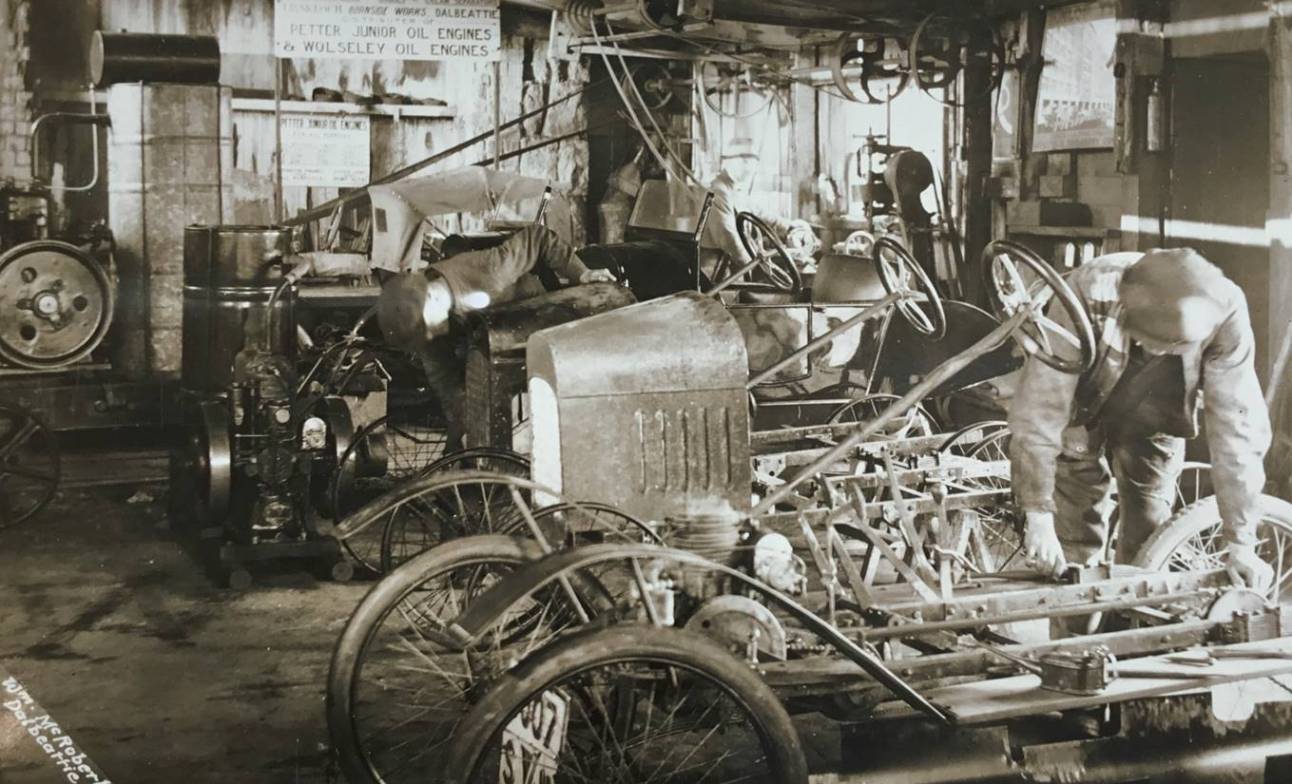
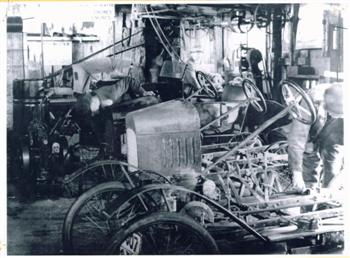
Pictures of the Skeoch production line were retrieved from Skeoch family albums. Not exactly an automated factory.
But the LITTLE SKEOCHS were real mini cars and seemed about to make a big splash in the booming car market of the 1920’s
until fire ended the enterprise. Everything became a blackened pile of scrap iron.
James Skeoch moved on. His skills were valued. He had a long successful career and died in 1954.
Not many people, by 1954, were even aware that there was such a car as the SKEOCH. Memories are short especially since
none of the Little Skeochs survived. Gone Gone Gone.
Well, not quite.
POSSIBLE REBIRTH OF THE LITTLE SKEOCH
The Skeoch is about to be reborn. All was not lost. By good fortune the motor and gearbox of one of the Little Skeoch’s
has been found. A group of men, largely retired mechanics and carpenters, have decided to rebuild the car and to do so
in the same Scottish town where the originals were built. Dalbeattie.
This is Fiona Sinclair, granddaughter of James Skeoch. Her family records and artifacts gave a big boost the idea of
rebuilding the car. When Ron Skeoch, James Skeoch’s son died, treasures were found in his home… The plans, radiator and other
parts of the Little Skeoch
And this is Geoff Allison of Dalbeattie, Scotland, who is one of the prime movers of the restoration project.. He has founded
the Dalbeattie Men’s Shed which is hardly a glorious name for the little factory where All the bits and pieces
of the Little Skeoch have been assembled along with quite a gathering of men…engineers, mechanics, widowers,…some
men who are just lonely and want something to do in their retired years that seems meaningful.
The brainchild behind the project is Martin Shelley, a car enthusiast, who suggested that the Dalbeattie Men’s Shed might
consider doing something remarkable and then dropped the bits and pieces on to their work benches.
Their job makes me think of
the Nursery Rhyme about Humpty Dumpty. Only this time Humpty Dumpty, i.e. The Little Skeoch, could be put back together again,
HUMPTY DUMPTY SAT ON THE WALL
HUMPTY DUMPTY HAD A GREAT FALL
ALL THE KING’S HORSES
AND ALL THE KING’S MEN
COULDN’T PUT HUMPTY TOGETHER AGAIN.
…Then along came GEORGE ALLISON and his men from Dalbeattie, Scotland…who
plan to put Humpty togehter again.
.
i2-prod.dailyrecord.co.uk/incoming/article12137301.ece/ALTERNATES/s810/Mens-Shed-Dalbeattie.jpg 810w” src=”https://i2-prod.dailyrecord.co.uk/incoming/article12137301.ece/ALTERNATES/s615/Mens-Shed-Dalbeattie.jpg” alt=”Dalbeattie Men’s Shed members Geoff Thomas, John Forrest, Robin Gilchrist and Geoff Allison with part of the original engine and plans for the Skeoch car.” content=”https://i2-prod.dailyrecord.co.uk/incoming/article12137301.ece/ALTERNATES/s615/Mens-Shed-Dalbeattie.jpg” class=””>
Dalbeattie Men’s Shed members Geoff Thomas, John Forrest, Robin Gilchrist and Geoff Allison with part of the original engine and plans for the Skeoch car. (Image: Jim McEwan)
Will the Little Skeoch ever see the light of day again nearly a century later? That remains to be seen. The job is demanding and the cost of the right parts is high but
the men are optimistic. And Fiona Sinclair hopes a reborn Little Skeoch will be on the road so her mother, the daughter of James Skeoch will be able to take the first ride.
These four men are only part of the gathering of men devoted to the project…about three dozen strong. Men who wanted something to do and both Shelley and Allison found that
something.
“This is a truly local car, it was the only cycle car ever made in Scotland and it was manufactured right here in Dalbeattie.
“This was a Dalbeattie man building a car the likes of which has never been built since.
“We have already had a lot of interest from visitors staying here.
“It’s already attracting a lot of attention and when it is finally road-worthy will really put Dalbeattie on the map.”
Project manager, Men’s Shed member Robin Gilchrist, 73, reckons sufficient local skills exist to do the job “in-house”.
He said: “We will draw in a lot of expertise because some of the work is quite technical in nature.
“There’s enough specialists in Dalbeattie who can help us do the precision engineering work.”
Quotes from an interview with journalist Stephen Norris (Scottish Daily Record, March 6, 2018)
alan skeoch
Nov. 27, 2018
P.S. BELOW IS AN ARICLE ON THE SKEOCH MOTOR CAR WRITTEN
FOR BBC SCOTLAND NEWS , Feb. 27, 2018
Drive to rebuild ‘forgotten’ early car
By Nichola Rutherford BBC Scotland News
Published
27 February 2018
IMAGE COPYRIGHTDALBEATTIE MUSEUM
image captionThe Skeoch Utility Car was built using parts normally used to manufacture motorcycles
When James Skeoch designed and built one of Scotland’s firstaffordable cars, he must have dreamed of huge success.
With a price-tag of just £180, the first Skeoch Utility Car was the cheapest on display at the Scottish Motor Show in 1921.
It sold within 10 minutes and a further nine were quickly snapped up by customers keen to join the automobile revolution.
But within months Skeoch’s business was in ruins. His uninsured workshop in Dalbeattie, Dumfries and Galloway, burned to the ground.
Since then the Skeoch Utility Car has been largely forgotten by all but keen historians of Scotland’s motor industry.
Now, almost 100 years later, plans are are being drawn up to recreate the so-called “cycle car” in the town where it was manufactured.
IMAGE COPYRIGHTDALBEATTIE MUSEUM
image captionThe Skeoch car was the cheapest on show at the Scottish Motor Show in 1921 and apparently sold within 10 minutes
The ambitious project has been taken on by a group of mainly retired local men, known as Dalbeattie Men’s Shed.
Using some of the original parts and working from the original drawings, they hope to build a working Skeoch car in time to mark its centenary.
Motoring enthusiast Martin Shelley approached the Men’s Shed with the idea for the project after reading about the group on the BBC Scotland website last year.
IMAGE COPYRIGHTDALBEATTIE MUSEUM
image captionBurnside Motor Works in Dalbeattie, where the Skeoch was manufactured, was devastated by fire in December 1921
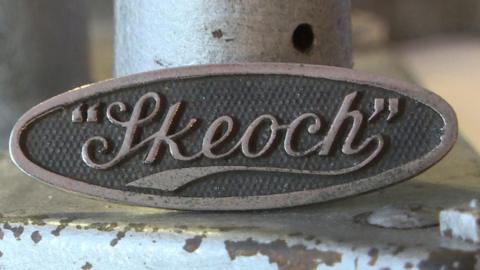
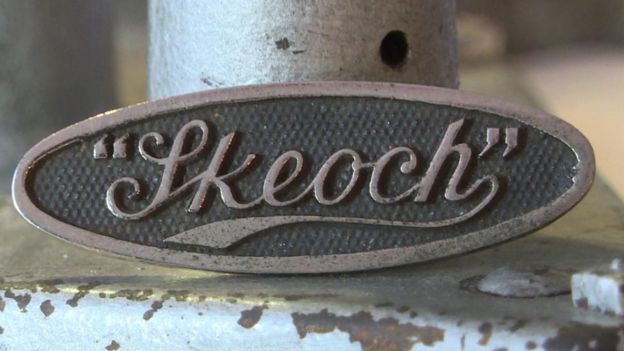
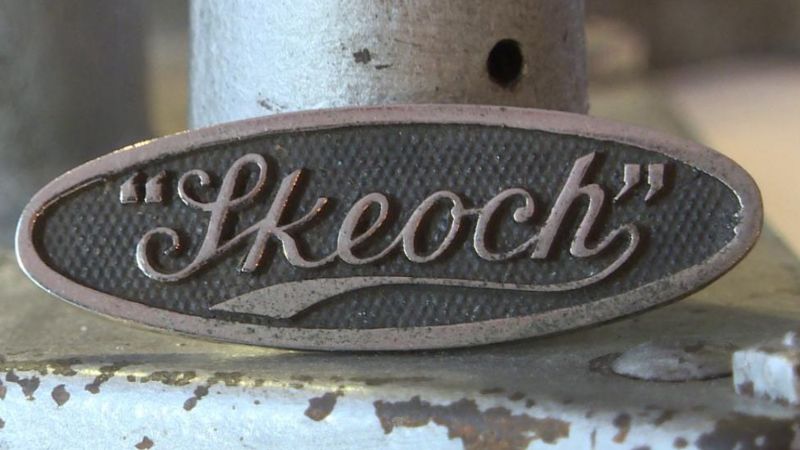
image captionThe Skeoch radiator badge was among the original parts found in the home of Mr Skeoch’s son following his death last year
image captionDalbeattie Men’s Shed have also been given an original engine and gearbox with which to build a Skeoch car
Mr Shelley said: “After World War One, the ordinary working man was much more used to the idea of riding a motorcycle or driving a car so they knew about the technology and now they wanted to try and build their own cars.
“In the early 20s, there was a huge flowering of people making these cars. As it turned out, Skeoch in Dalbeattie were the only people in Scotland to ever attempt to make these things commercially.”
The original drawings and parts – including the radiator badge – were found in the Wishaw home of Ron Skeoch, James Skeoch’s son, after he died last year.
Mr Shelley said he hoped they could be used to capture the “spirit” of the 1920s vehicle.
“You could make a replica of the car which would pass muster, using a modern engine and a modern gear box and using modern parts. But the spirit of the car is very much based on the parts that were available in 1920,” he said.
“This project will be very like the original car and that to me is what the joy of the whole thing is.”
image captionFiona Sinclair hopes to be able to sit in one of her grandfather’s cars
image caption“It’s going to be something for posterity,” said Geoff Allison of Dalbeattie Men’s Shed
The granddaughter of James Skeoch, Fiona Sinclair, is also involved in the project.
She never knew her grandfather – he died in 1954 – but she hopes that her mother – Skeoch’s daughter – will get the chance to ride in one his cars.
“I think it’s going to mean a lot to my family,” she said. “It’s tragic that the fire put an end to his ambition.
“I’m actually rather hoping I can physically get to sit in the car, I’m not quite sure I could be trusted with driving it.
“It’s only got two gears apparently but I think it would be rather wonderful. What I really hope is that my mother gets the opportunity to actually sit in the car as well.”
The project is “immensely exciting”, said Geoff Allison, the secretary of the Dalbeattie Men’s Shed, which has members with engineering and mechanical skills.
“It’s engineering-rich, it’s Dalbeattie-rich, it’s community-rich, it fills so many of our requirements,” he added.
“It’s big, it’s going to be eye-catching, it’s going to be something for posterity. It’s got a lot to recommend it.”
EPISODE 128 PORT HOPE … 77 MM GERMAN FIELD ARTLLERY PIECE CAPTURED IN WW I
alan skeoch
Sept 2020
Trophies across Canada
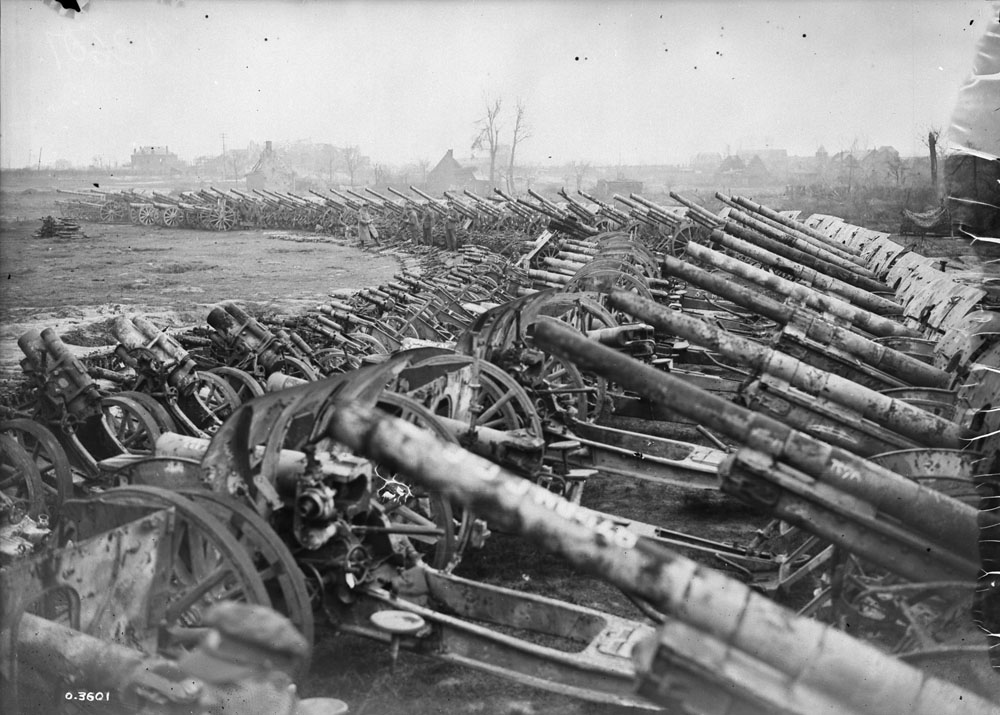
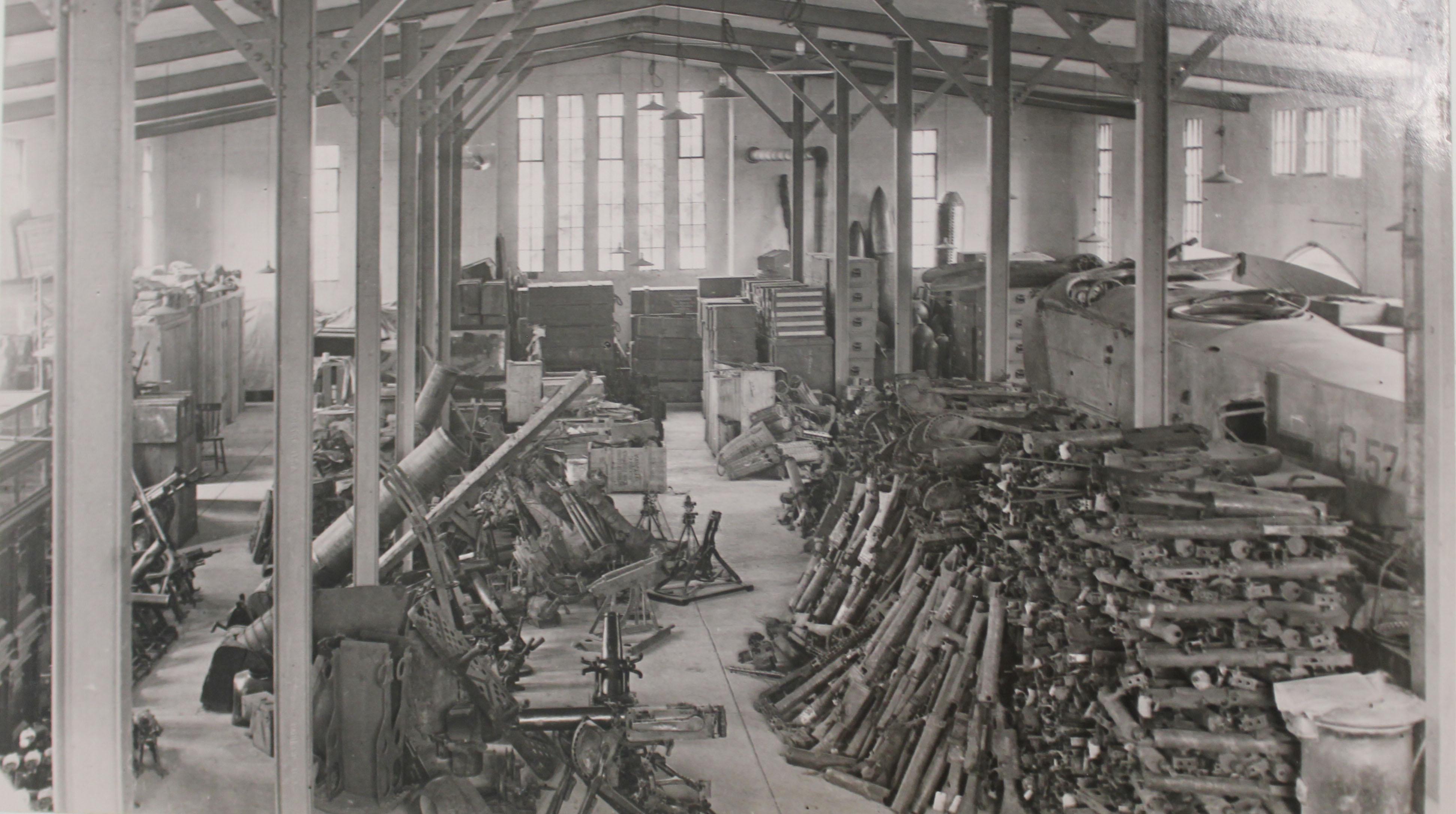
At war’s end, Sir Arthur Doughty, the Dominion Archivist, was named Controller of War Trophies and charged with gathering trophies and bringing them back to Canada. While many Canadian trophies were sent to the Imperial War Museum, thousands returned to Ottawa. In early 1920, the government’s official collection consisted of 516 guns, 304 trench mortars, 3,500 light and heavy machine-guns, and 44 aircraft.
Initial plans for a national war museum to house this collection, the official war art, and other artifacts were delayed or ignored by successive governments. The collection remained with the Dominion Archives which was soon sending pieces of it across Canada in response to requests from communities, veterans groups, schools, and military units. Cities or military bases often displayed large war trophies in central parks or in or near prominent buildings, and sometimes included them with local memorials. Acquired in the burst of patriotic enthusiasm that marked the immediate post-war period, many gradually fell into disrepair. During the Second World War, hundreds were donated to scrap metal drives, incorporating former German weapons against the new Nazi enemy.
EPISODE 131 TROPHY OF WORLD WAR ONE…PORT HOPE
alan skeoch
Oct. 2020
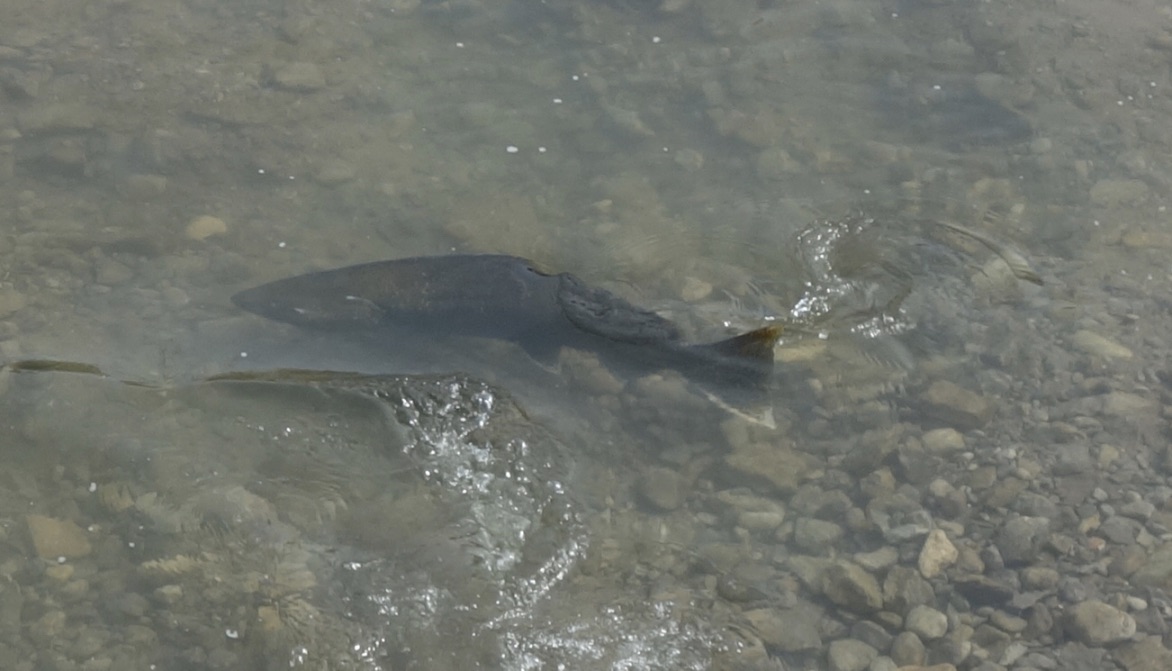
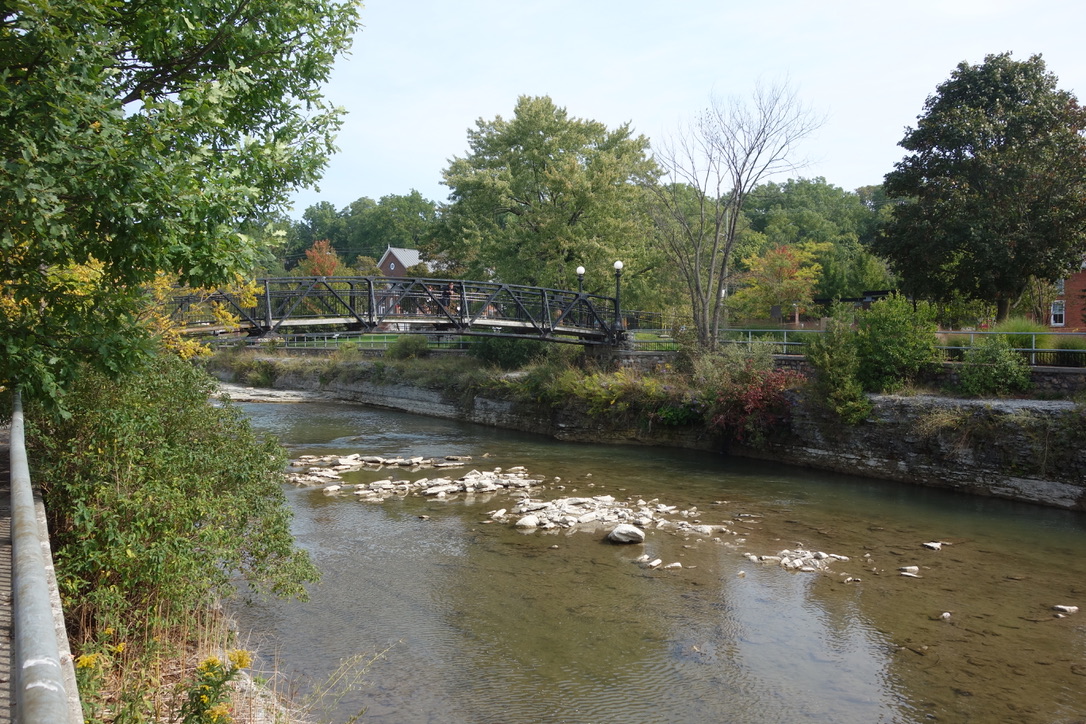
We made a fast stop to look at the salmon running (lumbering is a better word) their way
up the Ganaraska River which runs through the centre of Port Hope. With Covid 19 lurking
who knows where, we were careful and maybe unwelcome visitors. So we found an empty
parking lot and rushed to get a look at this poor salmon.
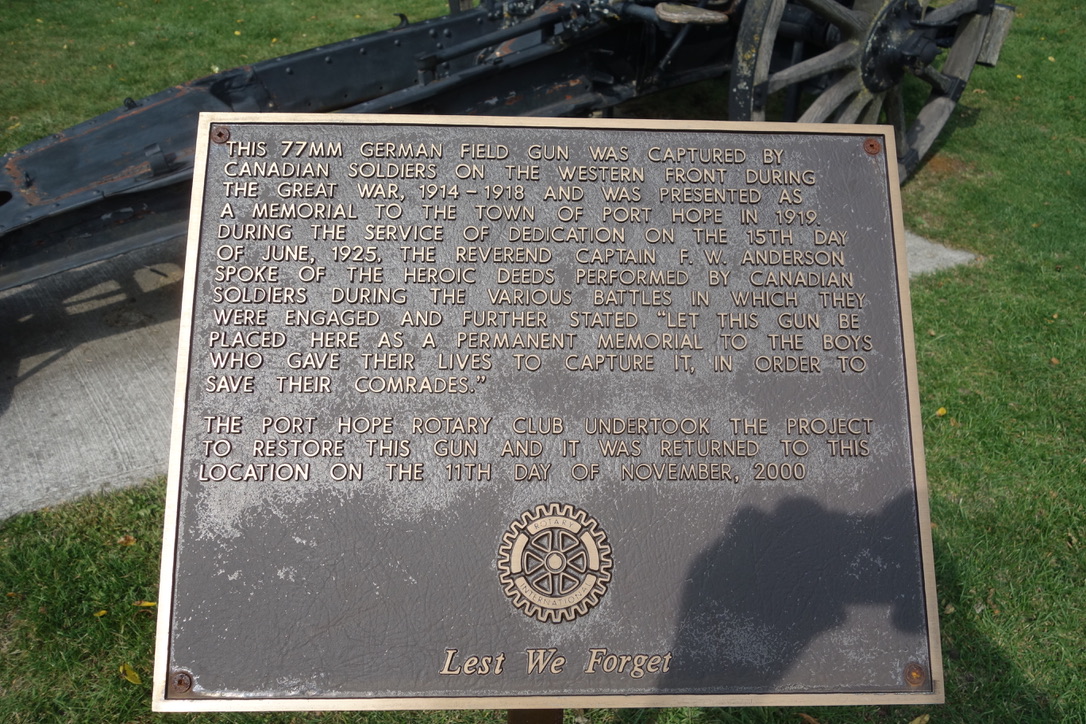
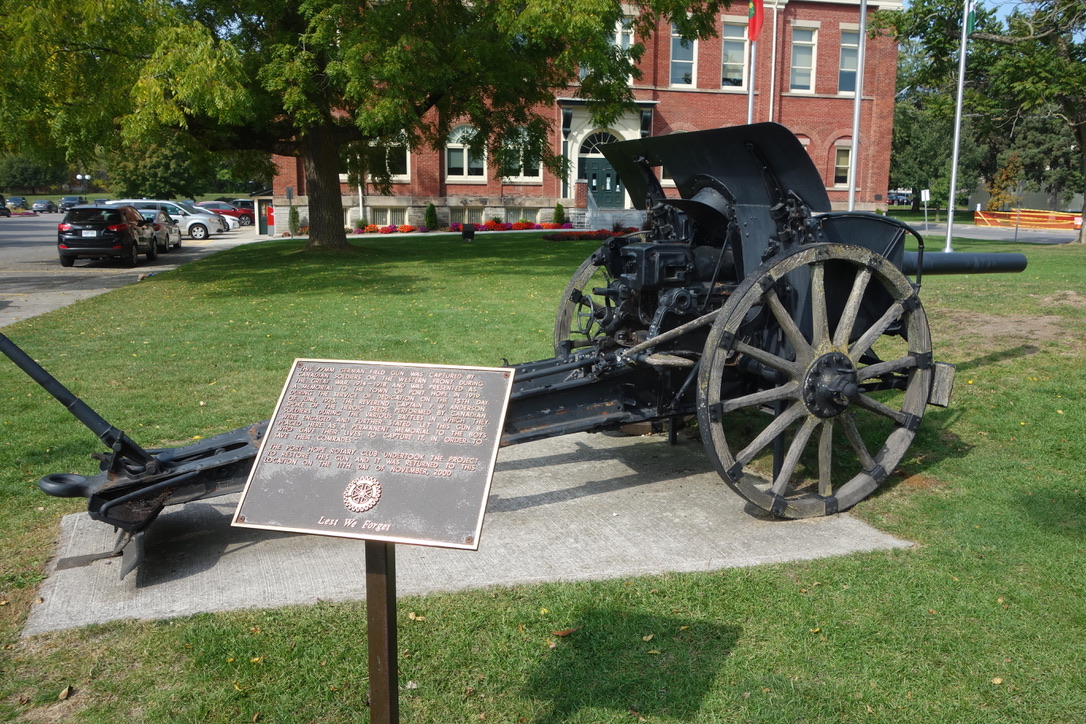
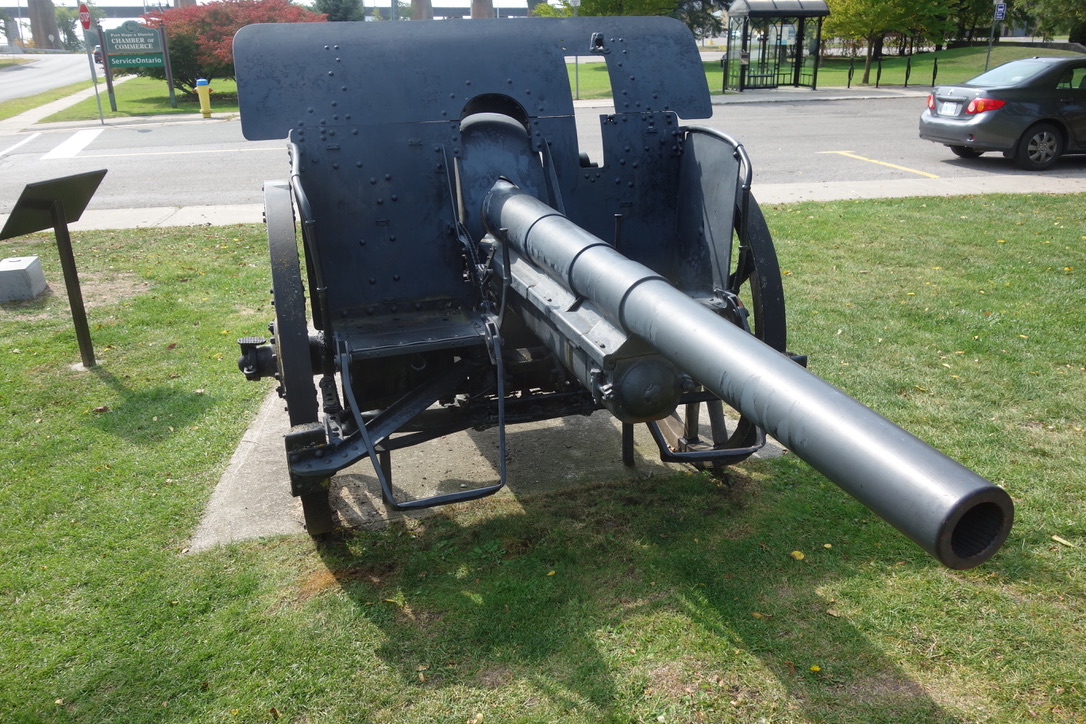
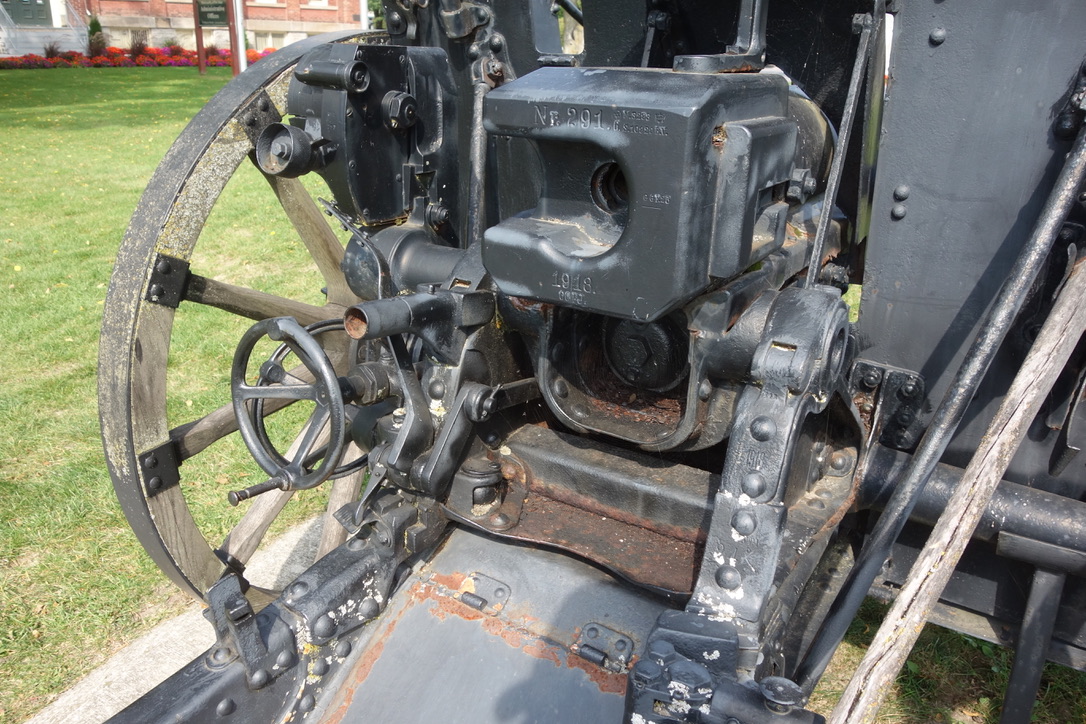
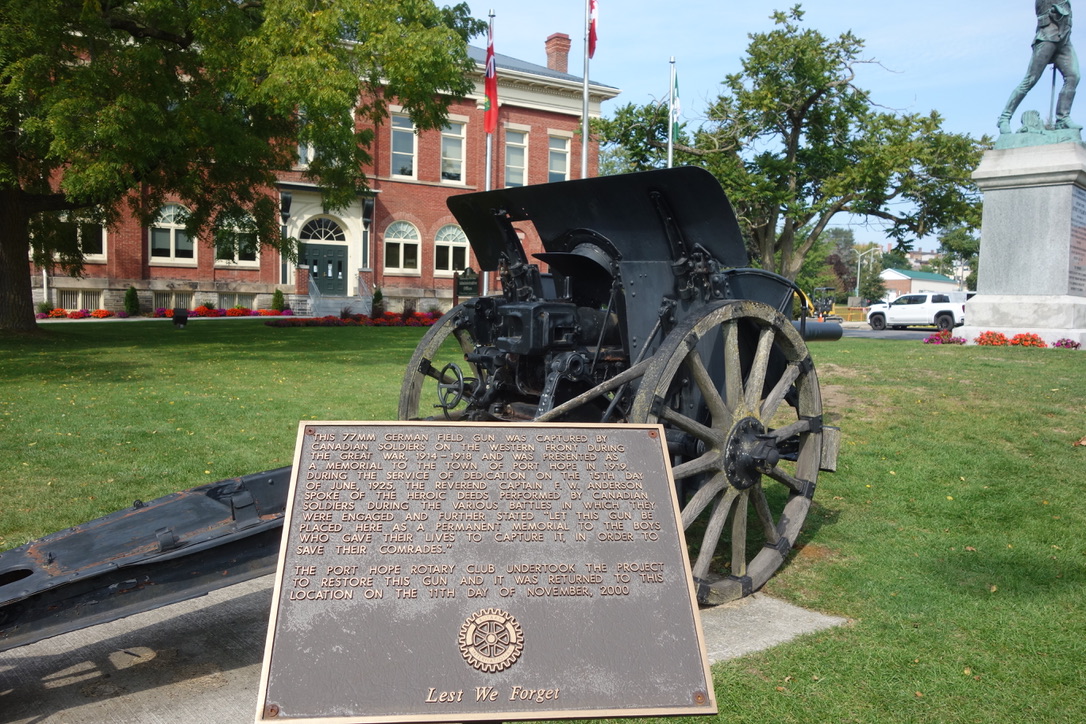
We never made it. We got distracted by a large 77 mm field gun. “Must be a Canadian gun,”
I thought until i read the bronze plaque description. The gun is … or was … German. Heavy
wooden wheels in excellent shape because of a Rotary Club restoration done back in 1000.
This gun was presented to the Town of Port Hope in 1919 as a ‘trophy of war’ that it might serve
as a memorial to the boys from Port Hope killed in its capture.
The expression “trophy of war” made me think “I wonder how many similar trophies of war were
shipped to Canada back in 1919?”
There were lots of them. Hundreds..thousands. One man, Sir Arthur Doughty, was named Controller of War Trophies when
the First World War ended. in 1920 Caada received 516 guns (like the Port Hope 77 mm field gun), 304 Trench Mortars, 3,500 light and heavy machine-guns
and 44 aircraft.
What happened to them? Initially they were stored in Ottawa but not for long. Towns and cities across Canada sent requests for war trophies…as did veterans group, schools and military units.
Many got featured space in parks or near prominent buildings as in Port Hope. If there were so many then why did the Port Hope gun surprise me?
A great many of the trophies of war were aging…wood wheels rot fast. And scrap metals were needed for a new World War in 1939. They were melted down and reformed
into more modern artillery in the war against Nazi Germany. They went home as it were.
The fate of the larger trophies of war…the aircraft..is only partially known. there were 792 Fokker fighting aircraft surrendered to Britain in 1919. Forty four of them
came to Canada. have any survived?
A seat of honour for a German artillery man…rough honour.
The fate of the larger trophies of war…the airplanes is only partially known. Believe it or not Germany surrendered 792 Fokker Aircraf
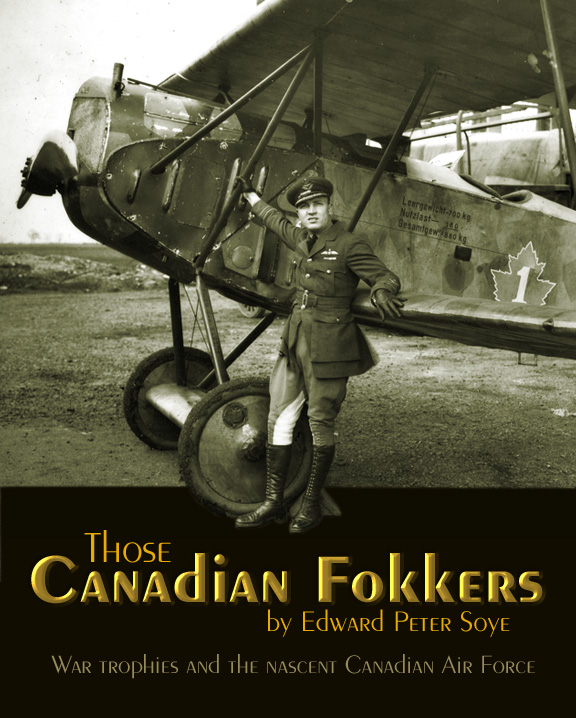
QUOTE FROM :THE CANADIAN FOKKERS
By the end of the Great War, military aviation had come of age and was recognized as a vital part of modern warfare. The Armistice of November 11th 1918 required the German Army to surrender its most potent weapons of war, so as to discourage the high command from resuming hostilities. This agreement demanded the German army turn over 5,000 artillery pieces, 25,000 machine guns, 3,000 trench mortars, as well as “1,700 pursuit and bombardment airplanes, preference being given to all of the D-7s [sic] and all of the night bombardment machines”. As a result, by the opening months of 1919, 792 Fokker D.VIIs had been surrendered to the British, French, Belgian and American armies. Several dozen of these machines ultimately found their way to Canada, and yet the details of exactly how that happened have been all but forgotten.
From a Canadian perspective, the First World War was a pivotal moment in terms of establishing a sense of nationhood. Thousands of Canadians fought with distinction in the British flying services during the war. On the ground, the Dominion of Canada fielded its first Army-sized formation – the four, over-gunned divisions of the Canadian Corps. To publicize this significant contribution to the allied war effort, Lord Beaverbrook created a public relations machine called the Canadian War Records Office (CWRO). Working with him to construct and preserve a national memory of the war years was Arthur Doughty, Dominion Archivist and Director of War Trophies. Drawing largely on spoils of war surrendered after the Armistice, Doughty amassed an artefact collection including nearly fifty aircraft. Along with the rest of the trophy collection, these state of the art aeroplanes were intended to form the nucleus of a national war museum in Ottawa to commemorate Canada’s wartime sacrifices.
During the opening months of 1919, Doughty and a young Canadian staff officer by the name of Captain R.E. Lloyd Lott persuaded the RAF and the American Expeditionary Force (AEF) to share a portion of their aeronautical booty with Canada. In February and March of 1919, the recently formed Canadian Air Force (CAF) took possession of twenty Fokker D.VIIs from the RAF. The original intent was for the CAF to pack the aircraft for shipment to Canada, but No. 1 Fighter Squadron also flew them extensively alongside their standard British service machines. In part, this was because the experienced Canadian airmen felt that the D.VII was superior to their issued Sopwith Dolphins.
Today, assessing the degree to which the CAF utilized German aircraft is based on a number of primary sources. Among the most useful documentary evidence is a handful of surviving pilot logbooks. In addition to these, a number of official Canadian photographs – one of the many products of Beaverbrook’s CWRO – captured Fokker D.VIIs in CAF custody. In the spring of 1919, CWRO cameramen visited the CAF at Hounslow Airfield (southwest of London, between the modern Heathrow Airport and Kew Gardens) where they photographed Fokkers D.VIIs being used by Canadian airmen. A number of these photographs have since been published fairly widely, yet their Canadian connection is most often entirely overlooked.
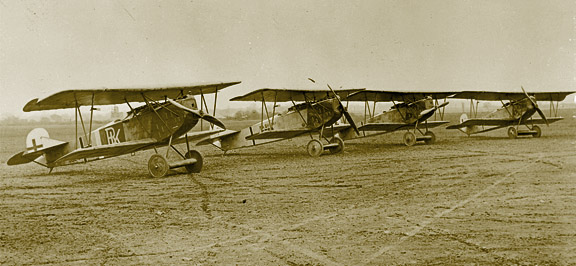
The photograph showing a line-up of four Fokker D.VIIs (the nearest bearing the ‘RK’ insignia of Richard Kraut from Jasta 63) has appeared in a number of publications. Some rightly identify the location as Hounslow, but never has a caption indentified the serials of all four aircraft in the photograph, nor has anyone noted that they were being utilized by the CAF. Through an examination of original CWRO albums held at the Canadian War Museum (CWM), and an appreciation of context in which the photos were taken this author has deduced much information about the images in this series. Two other photographs of this same foursome, taken from different angles and showing a handful of CAF members, allow the four aircraft to be identified as Albatros-built D.VIIs bearing the serials 5924/18 [often misidentified as 5324], 6769/18, 6810/18 [the so-called ‘Knowlton Fokker’ that survives in Canada to this day at the Brome County Historical Society] and 6822/18. In order to extract this information, one requires access to all three photographs, an appreciation of their relationship to one another, and good quality scans or prints from the original glass plate negatives.


 i2-prod.dailyrecord.co.uk/incoming/article12137301.ece/ALTERNATES/s810/Mens-Shed-Dalbeattie.jpg 810w” src=”https://i2-prod.dailyrecord.co.uk/incoming/article12137301.ece/ALTERNATES/s615/Mens-Shed-Dalbeattie.jpg” alt=”Dalbeattie Men’s Shed members Geoff Thomas, John Forrest, Robin Gilchrist and Geoff Allison with part of the original engine and plans for the Skeoch car.” content=”https://i2-prod.dailyrecord.co.uk/incoming/article12137301.ece/ALTERNATES/s615/Mens-Shed-Dalbeattie.jpg” class=””>
 ichef.bbci.co.uk/news/320/cpsprodpb/4D35/production/_100156791_skeochbadge.jpg 320w, ichef.bbci.co.uk/news/480/cpsprodpb/4D35/production/_100156791_skeochbadge.jpg 480w, ichef.bbci.co.uk/news/624/cpsprodpb/4D35/production/_100156791_skeochbadge.jpg 624w, ichef.bbci.co.uk/news/800/cpsprodpb/4D35/production/_100156791_skeochbadge.jpg 800w” src=”https://c.files.bbci.co.uk/4D35/production/_100156791_skeochbadge.jpg” width=”976″ height=”549″ loading=”lazy” class=”css-evoj7m-Image ee0ct7c0″ style=”margin: 0px; padding: 0px; border: 0px; font-family: inherit; font-size: inherit; font-style: inherit; font-variant-caps: inherit; font-stretch: inherit; line-height: inherit; vertical-align: baseline; display: flex; width: 800px; height: 450px; overflow: hidden; position: absolute; top: 0px; right: 0px; bottom: 0px; left: 0px; -webkit-box-pack: center; justify-content: center; -webkit-box-align: center; align-items: center; object-fit: cover;”>