Begin forwarded message:
From: SKEOCH <alan.skeoch@rogers.com>Subject: Fwd: THE LAST FLIGHT OF HX313 by ALAN SKEOCH Page 2Date: October 4, 2019 at 12:26:49 PM EDTTo: Alan Skeoch <alan.skeoch@rogers.com>, Marjorie Skeoch <marjorieskeoch@gmail.com>
Pages 1, 2, and 3
NOTE: I have begun to transcribe this story which was originally
written in an attempt to discover how RCAF sergeant George Freeman
died on May 27,1944…as time permits I will transcribe the story…and look for the pictures.
There will be typos.
THE LAST FLIGHT OF HX 313
(Original written in 1984, Current rewrite Oct. 2019)
alan skeoch
Death doesn’t impact on a six year old as much as it does on an adult. When George Freeman was declared missing on May 28, 1944, I barely noticed.
My parents were a little different that day I imagine. Quieter. Distracted. My brother Eric and I may have slipped out to Dufferin Park as usual. We didn’t
really know there was a war being fought in Western Europe, the Middle East, Burma, China and islands chains of the Pacific Ocean. Not real to us at all
To us the world war was fantasy as we spent a lot of time playing ‘guns’ with wooden weapons made from cast offs from the local piano factory. We spent
more time playing cowboys and indians than replicating the confusing combatants of World War II.
The only real war we knew about were the gang wars between the Beanery and Junction gangs which seemed to rage regularly when waves teen age hoodlums
attacked each other with lead pipes and baseball bats or fists and hand held broken beer bottles. Time has magnified these fights in my memory. There are
only a few news clippings that even mention these battles. Eric and I did see some battles that’s for sure. As to how often I cannot be sure. But they did
happen. I know this because we watched them from the safety of our rented flat at 18 Sylvan Avenue, a large Victorian house right inside Dufferin Park.
We saw the police arrive in force to break up the combat and when the field was clear we tried to pick up what was left behind by the gangs. This included
what mother called “dirty things” left earlier under the forsythia bushes which bisected the park in those days. “Good balloons, Mum.”
So the disappearance of George Freeman passed unnoticed. I never met him even though he was a cousin. I do remember, however, Mom taking us by
street car to the Hunt Club Golf Course just before Christmas in 1944. Uncle Chris Freeman was the head greenskeeper and as such lived in a nice
little house in the centre of the place. I remember aunt Kitty crying cause someone had died. Uncle Chris who had a crooked eye was stoic but
serious. Normally he liked to tease us. Good humoured kind of man. But not that year. Mom explained that their son, George, has been declared
missing in acton. He was likely dead they knew but they clung to the hope he would turn up in a German POW camp when the war ended.
His bags were sent home from his 427 squadron headquarters at Skipton on Swale in Yorkshire. Seems I remember mom saying that aunt Kitty took
the suitcase up to George’s room and left it there. Unopened. She clung to the hope he would be found and return to them at war’s end. That hope
was held through 1945 and even into 1946 because newspaper reports of long lost soldiers and airmen continued to crop up. That room was waiting.
George Freeman became a kind of ghostly mystery figure to us. His room…his bag…were a kind of mysterious presence that entered the long term
storage of my brain. Even now, over 70 years later, I can visualize that greenskeepers house with aunt Kitty misty eyed and uncle Chris stoic.
A strange thing happened to me forty years after George Freeman died in that Halifax Bomber labelled HX 313. Something made me want to try and
find out what happened to George Freeman. I began to try to put the fragments of his life together in 1984. What really happened in the skies over
Belgium on May 27, 1944? As a history teacher at Parkdale Collegiate Institute I wanted my students to understand what it was like to be young, patriotic
and idealistic in the1940’s. Wanted the students of 1984 to see themselves wearing George’s fleece lined RCAF boots rather than just reading aging
historical facts. I had no idea just how startling the story would become.
Where to begin? Records existed, I knew that but I wanted to put flesh and blood on those records. So asked George’s sister Lillian, we called her Mickey
for some reason, if she had any letters sent by George from Yorkshire. She had a few letters and small pictures but she had no idea what happened
on that last day when HX 323 fell flaming from the skies over Bourg Leopold. Most moving was a picture of George in this RCAF uniform. He looked
so much like our own sons. Young. But also serious and perhaps idealistic.
INSERT PHOTO
to be continued
…the story is longer than I ever expected
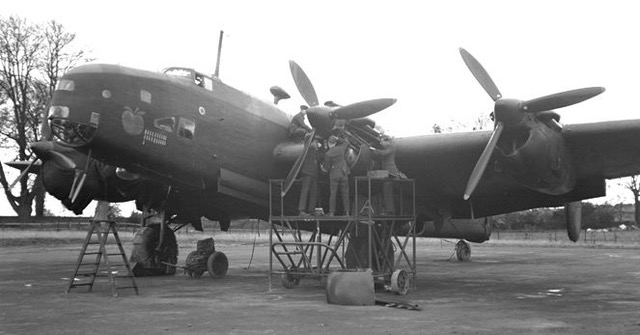
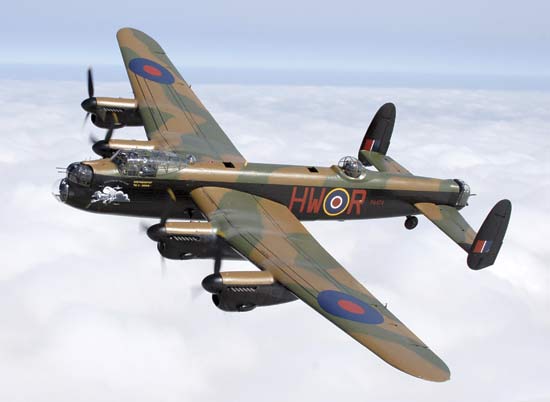
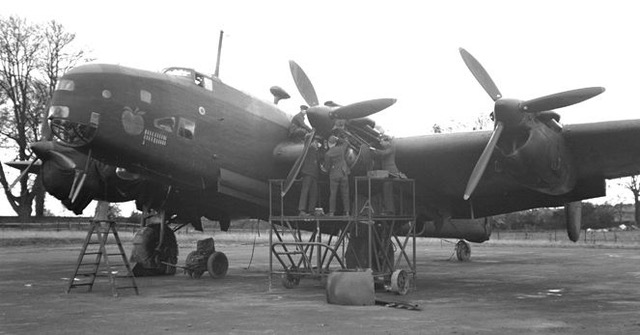
These first few fragments became parts of what became a giant jig saw puzzle with many pieces missing and others in a jumble for me to sort. One piece dated January 4, 1944was a starting point.“Please accept my sincere sympathies in this period of great anxiety. I trust that favourable word will be forthcoming of your son. The enclosed letter (and snapshots)addressed to you was found amongst your son’s personal effects. We regret the necessity of having to censor the letter for security reasons, and to ascertain if it containedanything of a testamentary nature.” signed by Squadron leader Pennington of #6 Bomber GroupThe snapshots turned out to be wonderful clues. The letter, George’s last letter, revealed that he knew his chances of survival were slim. He was taking extra flights to try and gethis 20 flights over with. Air crews who survived 20 bomber raids were relieved of future raids unless they volunteered to continue these risky flights which many did even withthe horrific death rates. George was planning to stop it seemed although that was not certain. He was committed to the war effort. But would he continue with HX 313?Maybe not for he had fallen in love with an English girl ands preparing to surprise aunt Kitty with an engagement announcement. “The girl works in our mess and is a good girl.In fact, mom, she is a Cockney, so you have an idea from that what she is like. Her parents made me very welcome and I had two eggs there.” Included with the letter was asnapshot of George and his girlfriend in each others arms. Smiling. We would never know her name. Tragic romances were all too common among members of #6 Bomber Group.INSERT PHOTOGeorge also told his mom that he had bought her a Victory Bond. But he said nothing about the war or HX 313. One tiny photograph wa dated February 10, 1944, taken in frontof a flimsy looking barrack on which was printed “Moe, Pop, Bob, Wilf, Eric, Casey and Me”. No last names but enough hints to lead me deeper. As things turned out “Pop” becamethe linchpin I needed to get all the pieces in place. Sorry for the mixed metaphor.INSERT PHOTOINSERT PHOTOThe final snapshot, taken after the war, showed wooden cross labelled ‘P.O. Freeman, G.F., RCAF, KS 28,5, 44, #J 88397”. George would not be returning To aunt Kitty and Uncle Chris.INSERT PHOTOThen I found a crumpled news clipping with the title “Nazi rockets Failed to stop Canadians” referring to George Freeman’s first flight in HX 313. A strong hint that the skies overGermany were filled with rockets and flak and night fighters…and terror.But I still knew nothing about the last flight of HX 313. George was the mid upper gunner in that lumbering Halifax bomber belonging to Tiger Squadron, RCAF. Efforts to get information from ottersfailed because the Privacy Act forbade the release of crew members that survived the war. Strange. Must be some reason for this but I failed to know what reason. LillianPeers, George Freeman’s sister, told me that the pilot of HX 33 visited their golf club home after the war. “His name was Mallet and the meeting was very emotional for all of them.”The story could have ended there were it not for the offer of a CBC Classified appeal. “At the sound of the beep, give your message…be sharp and specific”“Eric Mallet, are you listening? You were the pilot of a Halifax bomber that was shot down over Belgium on the night of May 27, 1944. Your upper middle gunner was George Freeman,my cousin, who was killed. I am trying to put together the details of his death.” Then I innocently mentioned the little snapshot of the pet Scotch Terrier sitting in George’s Air Force hat.“I have a few fragments that belonged to George. One is an RCAF hat sitting upside down with a little black dog below which is written “Nooky, Squadron Leader”, perhaps that cluemight help.” Does the word have any meaning?”Well the word certainly had meaning. Many listeners responded to let me know that Nooky referred to sexual activity of a casual nature. Mention of Skipton on Swale and #6 BomberGroup and HX 313 along with Nooky resulted in a shower of puzzle pieces. Many clarified he meaning of Nooky. “Refers to sexual activity, Alan.” I should have known that andhad I known I would never have included it in a CBC radio broadcast that went clear across Canada from seas to sea to sea.Several phone calls came immediately. Most were irrelevant. Veteran airmen just making contact…wanting to help. Mothers who had lost sons. Sisters who had lost brothers. Oneman living in a dirt encrusted room on Toronto’s River Street was insistent I visit him. Doing so I realized he had lost the battle with alcohol long ago. He had been a gunner with#6 Bomer Group but had never met George Freeman. He just wanted someone to talk to.There was no call or letter from any of the four surviving crew members of HX313. But there was one unusual call. “Alan, my name is Joyce Inkster, a listener told me to call you andoffer my help. For the past few years my husband and I have been tracing and reassembling RCAF flight crews. Perhaps we can help you.”The Inkster were part of the Allied Air Forces Reunion. Joyce Inkster was a female version of Sherlock Hollmes. Within a day she had found the casualty report for the nightof May 27/28, 1944. It listed when names of the crew and 1944 addresses. Pilot Eric Mallet was from Vancouver. Mrs. Inkster consulted her collection of telephone books fromaround the world, No Mallet listed in Vancouver. “Let’s try Victoria” There was an E. Mallett. Was it worth a call…budget over run possible was in my mind. I could not afford tocall every Mallett in Canada. “Don’t worry, I have a system. I make the call when rates are low, say the message fast…of wrong person end the call in less than a minute. But firstI need a clue that will guarantee I’ve reached the right person.”The Scotch Terrier picture…Nooky….almost barked at us.“Are you Eric Mallett the pilot of HX 313 in 1944?”“Yes,” My heart skipped a beat.“Did you have a mascot?”“Yes, we had a scotch terrier.”The pilot of HX 313 had been found and the story began to unfold. I was asked to return the CBC Joe Cote show snd tell the audience the story as it stood.We found the pilot of HX323 living in Victoria, British Columbia, talked with him…he confirmed that they had a mascot… Scotch Terrier Nooky.“We had a seven man crew normally but on our last doomed flight we had an eight member. New pilots joining the squadron were assigned to a veteran pilot forone live operations flight so we had co-pilot W.F. Elliott aboard. Of our eight man crew, 3 were killed but 5 managed to bail out.”THE LAST FLIGHT OF HX 313 – LETTER FROM PILOT OFFICER ERIC MALLETT, 1984Many Bombers featured ‘Blonde Bomber’ nose art. This photo of a Handly Page Halifax bomberis likely not HX 313.Picture of personal standing on wings of a Halifax Bomber at Skipton on SwaleYorkshire, where George Freeman was stationed as a mid upper gunner onHX 313, Number 427 Tiger Squadron, Number Six Bomber Group, RCAF.“Dear Alan:In the first place I must you that George Freeman was never known to us as George, he was Hank. Hank carried out his duties as Mid Upper Gunnerwith great courage and at no time was overcome by fear. I am enclosing the only picture of our aircraft that I have with a member of the ground crewsitting in my seat. The ‘Blonde Bomber’ was one of the finest aircraft that I have ever flown (note: Eric was an experienced pilot) At that time the Halifaxwas the fastest heavy bomber in the world. We carried 42 tons of bombs and 21,000 gallons of100 octane gasoline, total all up weight was 85,000 poundsHank’sturret had four Browning machine guns capable of firing 1,250 rounds per minute.”
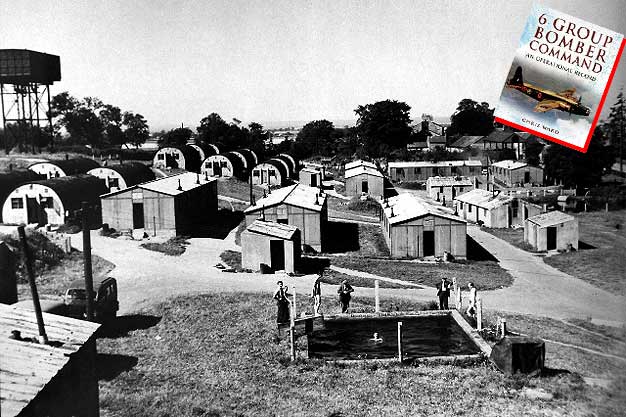
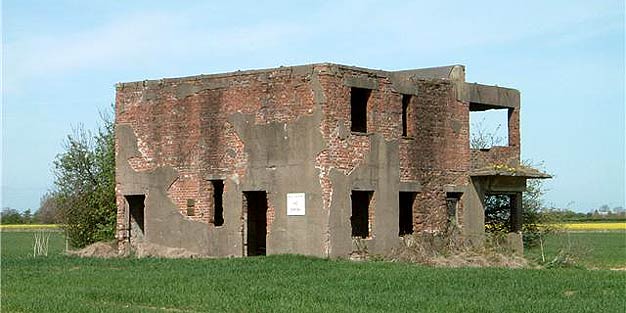
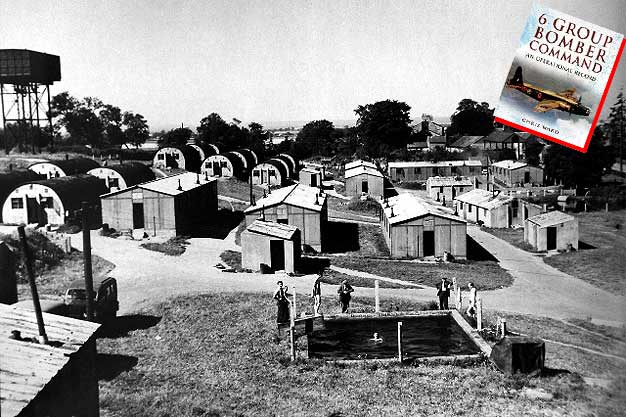
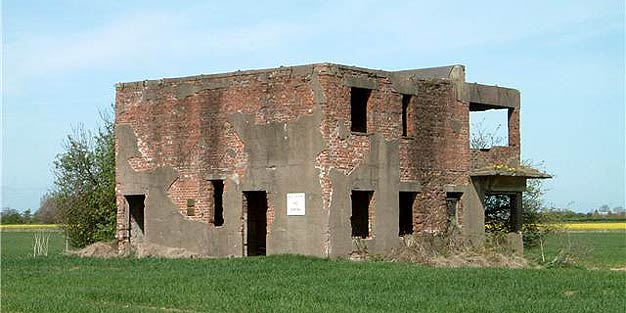
Note from 1984: Eric Mallett’s enthusiasm for the Halifax contrasted with the opinions of military historians who regarded the Halifax heavy bomber inferior to the Lancaster.Some historians even went so far as to note that the conversion of bomber squadrons to Lancasters was done in a discriminatory manner which favouredRAF bomber squadrons. Canadian Number Six Bomber Group continued to fly Halifax bombers to the end of the war.“The member of my crew were Flight Lieutenant Bob Irwin (deceased); Wireless Operator Wilf Wakely (deceased); Vic Poppa, tail gunner; Ken Sweatman, bomb aimer;Engineer Morris Muir (English); Mid-UpperGunner George Freeman (deceased); and flying officer Elliot who was coming along on his first trip…The target was BorgLeopold in Belgium a base which the Germans were using as a rest camp for their troops from the Russian front. After leaving the briefing I mentioned to thecrew that we were being sent on a mission for the sole purpose of killing people. We carried 14,000 lbs. of anti-personnel bombs and the aiming point was tobe the officers quarters. This mission did not sit well with the crew. We had already been through some tough missions against industrial targets butthis mission made us feel uneasy.”“Strangely enough we were not able to drop our load. We were right on our bomb run when we got hit. Just a few seconds prior to being hit I had anurge to take evasive action but I did not because we had our bomb doors open and had started our run. I didn’t want to spoil the bomb aimers sightingas there was no indication of an attack other than my hunch. Suddenly there was a tremendous burst of flame and I gave the order to ‘abandon aircraft ‘immediately. Knew from past experience that we only had seconds to do so because 100 octane gasoline would blow up once the flames reached thetanks. The Navigators position was right on top of the forward escape hatch. The whole crew was supposed to go out this exit so I would know when allwere out. They did not, however, because Bob Irwin couldn’t get the hatch open. The second pilot (Elliott) and engineer (Muir) took off the rear seat andwent out of the entrance hatch. I went forward to see how Bob was doing and by good fortune he was beginning to have some luck so I went back andstraightened out the aircraft. In what seemed like an eternity I returned to the hatch in time to see someone leaving. I then, did not hesitate to follow.Upon hitting the air my flying boots left me and I then tried to find the rip chord on my parachute. I couldn’t find the ring for what seemed like anothereternity. Eventually I hooked the ring, otherwise I would not be here.”Note: Even today, Oct. 2, 2019, I can remember reading Eric Mallett’s letter. Rivetting. I could hardly believe I had set an event like this inmotion back 1984. I had an idea that this was the end of the story so I read slowly and re-read even slower. But the story of the Last Flightof HX 313 was really just beginning. Read on!“Drifting down through the nigh sky, I could see the target with the bombs landing, exploding and setting fire to the buildings. I thought for a moment or twothat I was going to land right on it. The next thing I recall was seeing the ground come up to me and then ‘Boom!’…everything was silent. When I cameto, I found myself right beside a barbed wire fence. Remembered my previous training and buried my parachute. It required much effort.“It is almost impossible to describe the feeling that overcame me. Since that day nothing has ever scored me as all I have do is recall in mymind this dreadful night and the terrible feeling that I had.”“I spent the rest of the night sitting in a cornfield taking off my rings and rank markings as well as looking at my purse and pandora. The escape kitcontained Horlicks tablets, benzedrine, German, Belgian And French currency. When daylight came I discovered that I was close to a small village.I knew that i must get some help as I had a badly cut finger and no footwear. I waited and waited to see what sort of traffic was entering or leaving the village.There seemed to be none other than that of someone tying up a goat close to where I was hiding, for quite long time I wondered what the tinkling ofthe goat’s bell was.”“Alan, I am going to sign off for now for this is only the beginning of a long, long story. Enclosed you will find your map with the location of the attack. Alsoyou will find pictures of my crew, and one of the Blonde Bomber. We were not allowed to take any pictures of our aircraft for security reasons, as you canwell understand. Also included is a picture of Hank and Vic Poppa engaged in a little horseplay outside of our flight room. Vic Poppa and Ken Sweatmanwould be very pleased to hear from you if would care to write them.”Kikndest RegardsEric L. MallettNote from 2019: Wow! What a letter. More to come. Eric Mallett included the addresses of two other survivors. The story was growing and growing. It could so easily have beenlost. What followed was almost a year of contacts back and forth and even a visit with Victor Poppa in Cslifornia topped off by him travelling to Toronto in a ramshackle truckand trailer filled with spare used tires. Victor’s story eventually took over. Hank’s best friend. Could I put their life experiences back together? Pictures are a bit ofa problem for me in 2019. They are here among my books and records but it will take time to find them. My priority is to get the written account transcribed to digital.Note from 2019: This is the living quarters at airbase Skipton on Swale in 1944, a series of Quonset buildings with rounded roofs. The ruined brick buildingwas the operations centre, picture taken about 1984 when the airbase had been converted to a chicken farm after the tarmac landing strip had beenripped up.TO BE CONTINUED … TRANSCRIBING MY 1984 STORY NOW IN 2019…HOPE YOU ENJOY IT

Page 3
And so the story continues. The excitement that coursed through my body as I read Eric Mallett’s letter is hard to describe. Something akin to Eric’s feelings when he hit solid ground
in Belgium. No, that is an overstatement. Not only had i received his letter but also had two other survivors actresses … Ken Sweatman and Victor Poppa. Both of whom were ready
to talk about their experiences. Talking about the war was not easy for many. Some air force survivors just would not talk about it. One good friend, who was also a tail gunner like Victor
Poppa just did not want to talk. Why? “Because I survived and so many of my friends died.” Talking hurt in her words.
In a subsequent letter, Eric Mallett explained he had joined the British Commonwealth Air Training Plan and subsequently received his wings in 1941 at Dauphin, Manitoba, “The BCTAP
was one of Canada’s great contributions to the war effort.” For nearly two years Eric was a fight instructor and had 1300 hours of flying time before he was sent overseas as a Flight
Commander. Like so many young Canadians he was attracted to the airforce by a desire to fly. Many young men, 18 year olds just out of high school found the idea of flight the most
attractive military arm. Did they know the death rate? I am not sure of that.
Eric Mallett was older…age 24. He was married and his wife was shocked. “My wife’s reaction was one of disbelief,” wrote Eric.
By interviewing the survivors was it possible to find our what happened to George Freeman in those last few chaotic moments before HX 313 hit the ground followed by a totally disintegrating explosion?
As a mid-upper turret gunner George may have been the prime target for a diving German night fighter like the JU 88. He may have been killed in the first burst of gunfire. Gunners, like Victor Poppa
and George Freeman were used more as spotters than as gunners. The best defence against German night fighters was evasive action. Remember Eric Mallett’s hunch? Unlike the American bomber
groups who flew in high formations in broad daylight, the Canadian and British bomber groups flew at night and were on their own from the moment they left the coast of England. They flew in a stream
kind of formation most of the time. Evasive action was easier since there was no tight formation to worry about. American bombers that took evasive action were as likely to collide with other bombers.
Information overload worried me. So much that I did not know about Bomber Command in World War II. So much to learn. So much to miss. Would it be possible to get more information from the
rest of the crew? First person accounts. Like how was a bomber crew put together. I think the crew members were deliberately unknown to each other at the beginning. Never brother and brother.
Or even friend and friend. Keep emotional attachments to a minimum. But I was not sure. One thing seemed certain. Once a crew was formed they bonded tight. Now the close bonds may not have
been true for all air crews in World War II, but it was certainly true for the ill fated crew of HX313. The crew was headless when Eric Mallett arrived at Skipton on Swale. “I chose my crew from a
conversion unit. They were called a headless crew as their skipper had been shot down on his first flight with another crew.” Eric Mallett did not know that on May27,1944, Flying Officer Elliott would
suffer the same fate leaving another headless crew. Why risk sending new pilots on dangerous bombing runs The answer is simple. The the experience a new pilot got as a co pilot reduced his chances
of interception by German night fighters. But not by much. New flight crews had a higher risk of being shot down by veteran crews. And every crew had to make 20 runs over Germany. Statistically
few survived. Thousands of bombers were lost. The story of HX 313 was not unusual. It went down during its eight raid as I remember.
THE LAST FLIGHT OF HX 313: LETTER FROM KEN SWEATMAN (BOMB AIMER) 1984
“Dear Mr. Skeoch,
“Hank” and “Pop” were an inseparable pair. They did everything together…their gun inspection and harmonizing (test firing)… their courting when on leave. The stories they told of their escapades on
leave were really something else. Hank saw the fun in every situation. He was a good looking boy with his deep blue eyes and brown hair and always prided himself on looking sharp. I remember
asking as he came into barracks after a night out:
“How was she, Hank?”
“Both of her teeth were nice.”
Wilf Wakely was a slightly built but very agile chap. He often sang in a delightful Irish tenor voice, songs like “Martins and the Coys”, “Queeney” and “Lillie Marlene”. On our way from our billets o the mess Wilf
would do a few cartwheels along with forward and backward somersaults. It was Wilf who got us all whistling ‘Pedro and the Fisher Boy” wherever we went as a crew. Bob Irwin and I worked side by side
in the nose of the aircraft. I operated the H2S passing on pinpoints as they came up on the screen. We were always reassured when the flak and searchlight positions were where they should be and then we
knew we were on track. I began passing on this over the intercom but on bad nights with fighters I used chits and left the intercom to Pop and Hank.
Bob was a more serious type of person, very sure of himself. Having been in the cavalry in peacetime he had a very military bearing and manner. He had his hands and feet frost bitten on a mountain climbing
episode so he and I used to trade gloves quite often on ‘ops’ (operation flights) where the temperature could drop to minus 72 degrees centigrade. In Canada, he had won a gold watch for navigation so we
were sure of his ability. A lot of noise would bother him and he often called ‘less chattering’. He married a nurse, Kay, while on ‘ops’ which added a heavy load of worry.
Morris Muir of Nottingham, a very British Englishman, was our flight engineer who came to us from South Africa. Being on a lower R.A.F. pay scale and receiving no overseas parcels made it hard for him
to be one of us. He tried hard to fit in but he had a habit of bragging. When this happened in our crew we formed a join hands right around the culprit and sang ‘bull shit, bull shit, bull shit, it all sounds
like bull shit to me’, to the tune of ‘My Bonnie Lives over the Ocean’ It happened to us all, not just poor Morris.
Eric Mallett (our fourth pilot) came to us as a Flight Lieutenant with a British accent as he was English born. He had a log showing 10,000 hours as a flying instructor. In an easy sort of way he
became one of us. One of the first things did was make an unintentional belly landing and he became ‘Wheels up Mallett’ for a while. I remember on our ops he would call the two gunners to see
if they were OK and awake. It was hell trying to stay awake with the drone of the aircraft and constantly staring off into space.
We thought the raid on Bourg Leopold would be a piece of cake. It’s located in the NE corner of Belgium little more than a two hour flight from Skipton on Swale in Yorkshire. Also Bourg Leopold was
a POW camp, our men in other words. I remember the Wing Commanders caution, “the target it a rectangle…imagine a line dividing it diagonally. Our prisoners are on the close side and to your left.
Don’t undershoot the target.!”
The flight to Bourg Leopold was quite uneventful as the Blonde Bomber wove its way around flak stations and avoided getting coned by searchlights. A lone Mosquito bomber had already dropped
a yellow flare on the target and was backed up by a Pathfinder force dropping green and red flares. The target began to look like a bulls eye by the time the first wave of bombers were beginning
their bomb run. I think it was the poor Sterlings (*rather obsolete English Bomber aircraft) flying at 8 to 10 thousand feet that had the first run. How the Pathfinders kept from colliding amazed the crew
of HX 323 but the trick was for each wave of bombers to attack from different heights. Pathfinder crews were the best that could be found. Not only were the bombers given height instructions but
they also had precise time periods over the target. After the bomb run, the planes headed for home as fast as they could. HX 313 was part of 424 squadron and was part of the third wave coming
in at 23,000 feet…we dropped down for the bombing. At the moment the bombs were released a photograph was automatically taken. “
Note from 2019: Ken Sweatman noted that the low flying Sterlings were in one of the pictures taken. Bombs did occasionally
hit friendly aircraft flying at lower altitudes. The infantry term is ‘hit by friendly fire’
“I was about to put the fusing switches down when I reported an enemy aircraft passing below us from port ahead. Pop saw him pass on through on a straight course. Eric reported port inner engine
on fire. Nest I heard a sound like stones hitting metal and Wilf yelled ‘ouch!’. Next came Eric’s voice, very faint, “abandon aircraft…Jump! Jump!” Bob was struggling to open the the nose escape
hatch which had melted where an incendiary bullet had passed through the door jam. Between us we managed to get it open. Wilf went first, Bob next, then Eric. I recall yanking the intercom wire
from my helmet and in my panic I twisted off my oxygen tube. Snapping on my parachute, I remember thinking how I hated to leave as the wind from the holes in the nose kept the fire back. The cockpit
and backwash an inferno by now. The last thing I remember was hooking my thumb through the rip chord ring while the wind was tugging at my feet. From this instant on, all was black.
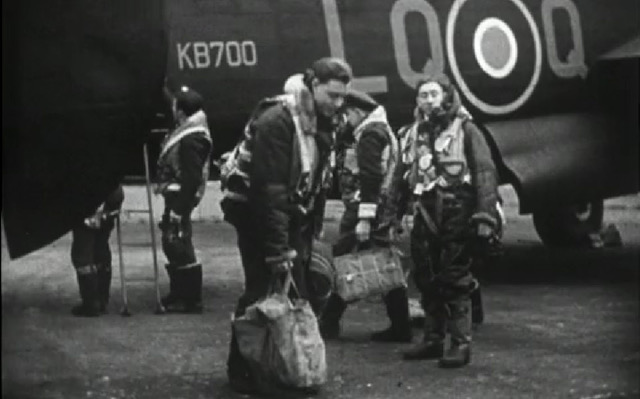
Parachutes were very awkward it seems and both Sweatman and Poppa were
not wearing their chutes when the cry came to abandon … Jump…Jump. the
picture above shows how encumbered they all were.
“I assume that I had gone out feet first facing forward. When the chute cracked open the chute casing hit me under the jaw. I landed
unconscious and took quite a beating. The next recollections are fleeting glimpses. I remember my ankle hurting as someone was ripping the leggings off my escape boots. I recall I was in a
very dark place like a dirt cellar. Next I remember Eric and someone with him saying, “Oh good,it’s Ken.” I didn’t have any idea who Ken was…and what’s more I didn’t give a damn.”
Note: The Belgian underground found Eric Mallett and Ken Sweatman and hid them in the Ardenne forest for 10 days. After this began a series adventures that eventually lento them being
liberated by American troops not long after D Day (June 6, 1944)
COMMENT BY ERIC MALLETT
“When we were struck there were white hot incendiary bullets that hit us through the crew compartment. They were hopping about somewhat like water droplets in a hot frying pan. With each hop
theist anew fire. I handed Morris the fire extinguisher. The paper from the maps were all on fire anti soon becomes infernally hot that I barely had time to trim the aircraft and head it out to sea. As I went
out I noticed Ken Sweatman sort of dazed and I motioned him to come as I jumped.”
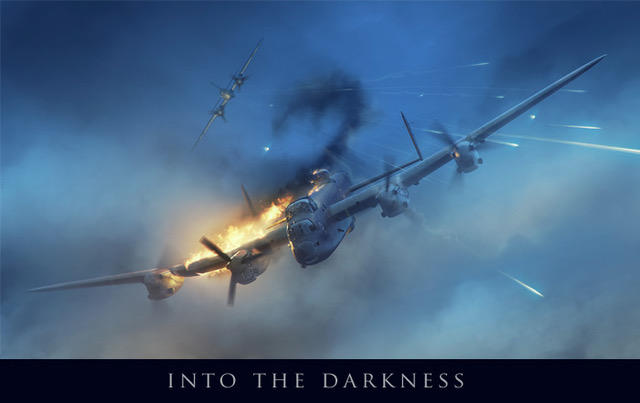
This is an artist’s take on what it must have been like in HX 33 when the German incendiary shells set the plane on fire
which soon engulfed everything. The surviving crew had seconds to jump.
TO BE CONTINUED