Category: Uncategorized

  • EPISODE 639 BARNEY DWAN 6 GOING UNDERGROUND IN AN ABANDONED IRISH MINE ON COPPER COAST

    EPISODE 639   BARNEY DWAN 6: GOING UNDERGROUND IN IRELAND


    alan skeoch
    sept. 8, 2022


    After disovering the ‘Dead Cow Legend’ was true I began to pay closer attention to
    the stories Barney Dwan told.   This episode 639 led to a major
    adventure.  
    we were laying down a baseline across tiny fields close to the sea shore when Barney said

    “Alan, how would you like together into the old mine?”
    “Can that be done?”
    “From the coast there are holes we can crawl through….I’ve done that many times.
    “Dangerous?”
    “I’ve got in and out and am still living.”
    “Let’s do it?”
    “When?”
    “Tonight after work.”


    Look closely … See Barney Dwan ewatinf jut below the old adit.


    And so began my biggest  Irish adventure.  There was a hole halfway up the cliff face
    not far from the knockmahon ruins.   To get to the hole we could scale down from
    the top of the cliff or scale up from the sea.  The hole ws barely visible.  A trickle of water
    flowed out onto a grassy shelf.  Hard to believe the hole was made by human beings.

    An adit , designed to drain part of the mine or to get air into the mine.  Perhaps both.

    The hole was about three feet high.  Occasionally higher.  Most of our walk,  however, we 
    were bent over.   And we were careful.  We had flashlights , candles and marches.  Why candles?
    To check the air quality.  If the candle would light and stay lit, then there was no danger of
    asphysiciation.  If the candle would not light or suddenly went out then we should get
    the hell out fast.  No oxygen.

    The walls of he passages were beautiful. Startling blue in place where the ore had not
    been removed.  Occasionally there were patches of pink

    At one point the passage was blpcked by a roof collapse.  Whoever dug this adit did not
    use roof bolts or even timbers to hold up the roof.  The blockage was a jumble of loose
    rock and soft muddy detritus where water had percolated its way down and loosened
    the ceiling enough for the roof to collapse.   

     FortunatelyThere was a gap. Just enough crawl space for Barney and I to pull ourselves through using our elbows .
    Barney led
    and I followed.  .  The feeling of claustrophobia was almost
    overwhelming .  What if our bodies loosened more rock.?  What if we got in and could not
    get out?   Did I tell Dr. Stam and John Hogan what we were doing?  No, I did not.  So
    we were on our own.  Now that was stupid.  My only excuse is that I was 22 years old
    an age when stupidity is commonplace.


    The hole we crawled through using our elbows.


    Once we got by the blockage  we could almost standup again.  Bent over though.
    We crabbed our way along .   I figured by then we were close to the
    old  mine ruins which were perhaps a hundred feet above us.

    This was confirmed when we found a vertical shaft.  Unsophisticated…almost natural.
    But not so.  Barney Dwan had been in here before and found a wooden ladder that
    he placed across the vertical shaft.  Easy to cross.  If he ladder was rotten we would only fall a few feet because
    the shaft was filled with water.  Crystal clear water.  Dazzling  in our flashlight beams.


    Was this one of old ladders used by 19th citify minders to reach the ore far below?

    The mine had been exploited a lot deeper than this adit.  So far down that the
    stopes were some distance under the ocean.  Flooding was one reason the mine was closed
    in 1879.  The other reasons was that the ore petered out.   There was a likelihood however
    that there were seams of copper under the ocean  that were never exploited and never would be.

    Pumps were necessary to tentatively hold back the ocean.  When the pumps were shut down 
    the ocean has perfectly preserved ever since the closure.

    The main stopes were far below us. Bunmahon  Miners reached these mineralized sections by climbing
    down long wooden ladders.   In the dark  One foot at a time on wooden ladder rungs.  In the dark.
    Between 1840 and 1879 there were no miners lanterns attached to helmets.  Indeed there were no
    helmets.  

    (I will explain more about the 19th century Knochmahon miners in a subsequent episode.   This episode is about
    the adventureS that Barney and I had which triggered my curiosity about those 19th century miners
    of Bunmahon.  Where did they come from?  Where did they go?  What was their life like when they
    lived here?  Many came from the copper mines of Cornwall.  Most of them migrated to various mines
    in North America)


    These are the ruins of the Knockmahon . Dr Stam and John Hogan are walking along
    th e coast road now known as the “Copper Trail”, an UNESCO WORLD HERITAGE SITE.
    The adit that Barney and I crawled through reached this ruin  one shaft where the 19th century
    miners had ladders to get them deep into the mine.  Today the main underground
    workings of this mine are perfectly preserved by tons and tons of sea water.


    As I said, Crawling underground with Barney was a little risky.  There was a feeling of claustrophobia
    for sure but Barney’s cheerful presence reduced my fear and trepidation.  Barney had been
    here before and alone.  He exuded confidence.
     I did not tell our boss back in Canada, Dr. Norman Paterson, as i feared he would get his
    underwear in a knot.   Much later when I Told Dr. Stam  and John Hogan about the underground
    adventure they were both interested and amused.  The oxidation on the adit walls…bright blue and pink,
    confirmed that the site was worth the cost of our survey.

    Miners drill holes for roof bolts to help prevent stopes and passageways from collapsing.
    I do not remember any roof bolts in the abandoned Kn0ckmahon mine.


    OTHER ADITS ON  THE CLIFF FACE


    I seem to remember entering the adit that is about 6 feet above the large ropeing on the ground. 
    .Thet adit led to the huge room inside with the slanted floor strewn with rocks.


    THE I.R.A. HIDING PLACE, ACCORDING TO BARNEY’
    (True or false? I would never know.)

    “Alan, there is another tunnel you might like to explore just west of Bunmahon…a special place..”
    “Why special?”
    “Story is told that IRA members hid there back in the Time of the Troubles.”
    “Time of the Troubles?”
    “Back in the 1920’s when Ireland was at war with England…civil war.”
    “Bad time?”
    “Very bad….Republicans needed a hideout and I was told this other adit was perfect.”
    “True or false?”
    “I think true. The story says this other adit became a safe place.  Not sure if it was ever discovered by
    the Black and Tans.

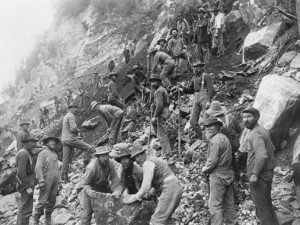
    This picture gives a glimpse at what Bunmahon miners had to do using hand tools
    and explosives.  Mostly done in the dark with flickering light of candles and oil lamps.  (The picture
    is not from Bunmahon.9

    The adit was almost too easy to fnid.  Two entrances, one straight from the beach.
    Easy to get into the front part but dangerous as we discovered when we reached a high vaulted room
    with a sharply tilted floor that angled far down to some kind of iron machine.   We never got that
    far.  The tilted floor the big room was littered with large chunks of fractured rock.  Covered in rubble
    in other words.  Directy opposite our entrance tunnel was another tunnel at the same level.  A continuation.

    We decided to traverse the rubble cluttered sharply angled floor.  To traverse we had to step on lots
    large ( baseball to pumpkin size ) rocks piled helter skelter in the room which was about 20 to 30 feet wide and 
    af hundred feet long. Memory could be wrong about size.   Maybe the room had been carved as a chute for ore to tumble down to some
    kind of mechanical crusher at the bottom.  That is just speculation.  

    Our tour ended abruptly.  We were part way across the angled floor….tordding on the rubble.  Pushing some out of the way
    to get better footing.   Then the whoile pile of loose rock began to move.   Us with it..  Not far…several feet and 
    then the rock slide stopped.

    Barney and I retreated with great care.  We did not want  to end our lives buried in a pile of rock at the mouth of
    a rock crusher if that was what the iron framed machine was at the bottom of the angled room.

    Maybe that pile of loose rock was a good way to discourage visitors.  maybe there was an easy way around the 
    jumble.  We did not the time to find out.  Too dangerous. I may have taken pictures but cannot  find them. 

    PERHAPS YOU WANT TO GO UNDERGROUND AT BUNMAHON….THERE IS A WAY TO DO THAT.

     
    IF you want to go underground you can do so..virtually.   Just punch up the  “Copper Coast Unesco Geopark (Ireland)”
    A film has been made of the underground workings at Tankardstown which is the 19th century mine east of Bunmahon
    and Knockmahon.


    Copper mining reached its peak around in the area around Bunmahon in the mid 19th century when two major mines were worked by the Mining Company of Ireland.
    The first, at Knockmahon reached peak production in 1840 when it was described as ‘the most important mining district in the empire’. It was soon unprofitable however, as the more easily reached copper was exhausted and reaching more would require digging more than an quarter of a mile deep and under the sea.
    Knockmahon was abandoned and activity moved to nearby Tankardstown in the 1850s. Here mining thrived for a time but fluctuating and eventually just declining copper prices made it nonviable and the mine closed in 1879.
    While conditions for workers in 19th century mining were harsh and the work dangerous, the period when the mines had highest employment – more than 2000 men – coincided with the years of the famine. So it’s easy to see how such a job would be greatly prized. When it all ended the Copper Coast miners mostly took their expertise and their families abroad, many to Copper Mountain in Butte, Montana and to mining areas in Wyoming.
    The picture at the top is of a group of men on a cage during an abortive effort to revive the mine in 1906. Below that is pretty much all that remains today of the mine at Tankardstown.
    Nowadays you can walk along a guided and signposted trail through the remains of the old mines. It’s a beautiful walk along a lovely stretch of coast even if you are not interested in the mines.


    COPPER COAST UNESCO GLOBAL GEOPARK (Ireland)

    “The Copper Coast tells the amazing story of the formation of Ireland”


    Celebrating Earth Heritage

    The Copper Coast UNESCO Global Geopark is located on the south east coast of Ireland, between Tramore and Dungarvan in County Waterford. To the north lie the Comeragh Mountains which reach a height of 750 m. The area is a relatively flat lying glacial outwash plain, much covered by glacial till and bog, with occasional spectacular erratics. Three roughly N-S rivers dissect the UNESCO Global Geopark and display excellent examples of glacial erosion and deposition (an excellent walk follows the Ann river starting at Annestown). The coast is spectacular with numerous sandy and rocky coves displaying sea stacks, arches and blow holes. It comprises some 25 kilometres of spectacular coastline consisting of scalloped beaches and coves buttressed and enclosed by rocky headlands.

    The Copper Coast is an outdoor geology museum with a geological heritage that reflects the variety of environments under which the area has evolved over the last 460 million years. Sedimentary and volcanic rocks define a cross-section through the core of an Ordovician age island arc volcanic system (ca. 460-455 Ma) which extended along the south-eastern flank of the Iapetus Ocean. A fossil rich siltstone/limestone (c. 462-457Ma) marks a hiatus above which the sequence is dominated by felsic volcanic rocks, with intrusive equivalents interspersed with shales, some graptolitic. Spectacular columnar jointed rhyolite is well exposed at one locality. Semi-arid fluviatile sediments (ca. 370-360 Ma), now reddish brown coloured conglomerates, sandstones, siltstones and shales, rest with marked unconformity on the Ordovician. An enormous gap in geological time separates these sequences from those next exposed, unconsolidated tills, boulder clays and outwash sands and gravels of the Quaternary period (Pleistocene epoch) all deposited with very profound unconformity on the Ordovician and Devonian sequences.

    Cross-sections of these rocks are exposed along the spectacular cliffs and are interpreted for the public at various points. For a brief introduction to these rocks, a stroll around the Geological Garden in Bunmahon will prove instructive. Copper was mined extensively in the area during the 19th century. The Geopark’s name is derived from this activity, and the Copper Coast icon is derived from the conserved remains of a mine complex on a high point of the cliffs. Panels there explain how the mine worked.


  • EPISODE 638 BARNEY DWAN 4 LEGEND OF THE LOST IRISH COW — REDISCOVERED

    EPISODE 538  BARNEY DWAN 4   LEGEND OF THE LOST IRISH COW — REDISCOVERED


    alan skeoch
    Sept. 7, 2022

    “Alan, there is a legend about a Dead Cow and a Mine Adit ….”
    (Sort of casual comments that Barney often made…fascinating comments.)


    One night John Hogan and I debated the ‘Dead Cow Legend’ while consuming a pint of Guinness
    in Kirwin’s rustic pub in Bunmahon.  Should we excavate or ignore the legend.?  Dr. John Stam
    voted yes.  And Barney Dwan led us to the site.


    We  discovered a large anomaly A short distance up the Mahon River
    in a dry valley, I think called a ‘boreen’.   
    Barney told me in his casual offhand way as we slogged from station to station.

    “Alan, there is an old story about a cow that was lost in this place.  Seems there once was
    a mine entrance on the slope and a cow wandered in the opening, got stuck and died
    there.”
    “Do you know the exact spot.”
    “I do”
    “Where?”
    “See the patch of Gorse on the east side of the valley.  That’s where the farmer sealed up
    the adit so no other cow would die.”
    “How can you be sure?”
    “The story of the lost cow has been told snd retold many times….long before I was born 
    it seems to have happened….around 1900.”

    Picture was taken NE of Bunmahon, not too far from the Dead Cow Legend’s location
    as I remember.

    Now this venture was a bit of a stretch.   Reaching into legends that may or may not be true was hardly
    an activity for our very modern search for mineral laden anomalies.  That night Dr. Stam
    John Hogan and I decided to see if the legend told by Barney Dwan was true or not.  If 
    true then we would have uncovered an adit that would give access to the old workings the
    walls of which would be meaningful.  If our actions were foolish then it was best to keep
    quiet about the plan for a ‘dig”.

    We hired one man who with pick, shovel, axe and wheelbarrow was told to clear the gorse
    and see if there was any sign of a mine opening underneath.   I am not sure if we told
    Dr. Paterson back in Toronto.  Think not at the beginning.

    Well, the rest was surprising.  The biggest surprise happened to the lone digger whose name
    I have forgotten.  He spent several days excavating.  There was a lot of earth to be
    moved once the gorse was gone.

    None of us expected an explosion.  Explosion!   Yes.  The ancient workings had filled with water
    over the decades  (160 years…1900 to 1960.   The adit was a giant reservoir and when the
    digger punctured the underground pool, tons of water whooshed out and he fled.  He Did not
    come for his money immediately.

    We waited a couple of days for the mine to drain and then all four of us entered with flashlights.’Four of us!
    Dr. Stam, JOhn Hogan, Alan Skeoch led by Barney Dwan as you can see in the picture below.


    That’s Barney Dwan heading into the Dead Cow Adit.  Seems he led the way..


    Some other creature died here.

    I am not sure about this picture.   I think it was the dead cow adit in Ireland but
    it could also be a mine adit in theYukon where the stillness of a century allowed perfect
    crystals to form.   Very delicate.  Same colours as the Dead Cow Adit.  So could be.

    This is certainly the Dead Cow Adit.   The walls were covered
    in slime and odd colours.  The adit was big enough for us to walk upright.
    At some distance we should have found water filled shaft but our exploration ended
    when we found the dead cow.  Yes, there was a dead cow…hips must
    have got wedged so she could not back out.  And there she died.  Or 
    maybe the legend was exaggerated and the old adit was used as a 
    grave for the cow who died of other problems.  The kernel of the
    legend turned out to be true which pleased all of our Irish employees
    even the digger who showed ump for his money eventually.


    The Dead Cow.  Evidence that legends can be true.


    John Hogan and Barney Dwan in the Dead Cow Adit.


    alan skeoch
    Sept. 7, 2022


  • EPISODE 637 BARNEY DWAN 3: MYSTERIOUS BALLS OF COPPER WIRE DOTTED IRISH PASTURE FIELDS

    EPISODE 637   BARNEY DWAN 3:  MYSTERIOUS  BALLS OF COPPER WIRE DOTTED IRISH PASTURE FIELDS


    alan skeoch
    sept. 3,,2022


    THIS  is our 6,000 foot base line about to be put on Barney Dwan’s back by Willy.
    Our story is centred on the surprising disappearance of sections of this base line
    which was a mystery until cattle spit out round baseball like balls of our base line.

    TROUBLE  — BASE LINE 

    Our base line was over one mile long, often longer.   This base line consisted of a single strange of yellow sheathed coper wire.  In the Canadian or 
    Alaskan wilderness there were occasional breaks in the base line caused by wile animals most often….deer, moose, raccoons.  When the base line was
    broken no signal was sent so the break had to be mended immediately which meant the base line had to be patrolled and spliced.  Time wasted as a
    result.  But the breaks were few in number normally

    Except in zieland the base line breaks were often and a lo of time was wasted.  Why so often?  Most breaks were caused by cows actually eating our 
    base line….eating dozens of metres of base line.   The first bite gave the cow an electric jolt.   Some farmers said their cows were knocked out cold
    by the electricity.  I never saw a cos flattened by our base line although it may have happened.  What happened regularly owner was cattle actually\
    eating the base line.  Gest long lengths of copper wire.  Initially we wondered why so much wire disappeared.  The reason was soon evident when 
    the cows began regurgitating baseball sized balls of our copper wire.  Cows have four stomachs needed to digest course food.  Each day they take
    a break from eating to chew their cud  Foreign material is rgujrguatated.  Everywhere we crossed a pasture field we would begin to find these balls
    of chewed copper wire.  Somewhere I have pictures of these balls of copper but they have not been found yet.    Most complaints by farmers
    wee received by Barney Dwan.  I only receive a few directly.


    Once we realized the cattle problem we kept a close eye on the herds but there were
    lots of cattle and it was difficult to stop them from munching our base line.
    That’s Barney Dwan on the right as our survey crew had to stop work to find
    where the wire was severed.  We found the guilty parties….cattle (above)

    The cattle, sheep and swine along with the people of Bunmahon were often watching us.


    COMPLAINTS

    We did get complaints from farmers, usually filtered by Barney Dwan.  In the course of the job
    I may have faced two or three irate farmers.  If Iwas a farmer and
    someone was doing a Turam survey in my pasture fields I would have been irate.  Why?
    Copper balls regurgitated as cows chewed and spewed their cud. Copper can be poisonous.


    Seemed there were more animals than people on the roads and in the fields.


    We hired this young lad to protect our grounding rods from
    cattle.   He loved the job and made out sites into personal 
    camp grounds.  He had been hurt as a child and was handicapped.
    Barney recommended him.  He took the job very seriously .


    Sometimes most of our working day was spent repairing the baseline.  Initially
    these repairs were made by Barney and I.   

    “We need to hire a man just to patrol the base line.”
    ’Another new employee that the executives back in Canada might questions but never did
    although they might have raised their eyebrows a bit.  How could a cow be worse than a moose?”

    Barney was fastest at repairing our cable and I also think he helped deflect the complaints
     about coper poisoning of cattle.   Someone may have paid damages but I never
    heard about it.  Farmers had legitimate complaints.  Perhaps the prospect of reopening
    the ancient Knockmahon copper mind trumped complaints about copper wire in the guts of cattle.

    I believe the whole community of Bunmahon hoped and prayed that our survey
    would revitalize the community.  Jobs, in other words.   That may have been the
    reason there were so few complaints from farmers.  Everyone wanted us to succeed.  Unfortunately
    success was not to be.   Dr. John Stam was a professional geophysicist.  He interpreted the raw data
    and determined, I think, that any mineralization was too badly faulted to be economically viable.
    This is speculation on my part.  All I did was get the raw data,..to find anomalies, not to interpret 
    the results.  Dr. Stam did authorize us to excavate trenches where he thought our dots indicated
    a promising site.  

     
    The trenches were deep with no support framing and as a result were dangerous.
    I think that is Barney Dwan deep down.  Perhaps not though as our trenching
    crew was separate from our survey crew.


    I wish we had been successful.

    alan skeoch

    sept. 2022 
    reflecting on the 1960 survey


    Post script:

    Outbreak of copper poisoning in cattle fed poultry litter

    In a feedlot of about 1,000 head of cattle, 146 animals died within a period of a few months affected by a disease characterized by anorexia, icterus, hemoglobinuria, constipation, or diarrhea. The clinical course of the disease lasted a few days. Postmortem findings were generalized icterus and a yellow discolored liver. The kidneys were dark brown, and the urinary bladder was filled with urine of the same dark-brown color. The main histopathological findings were centrolobular coagulative necrosis, apoptosis, bilestasis, and proliferation of bile ducts in the portal space. Changes in the kidneys included nephrosis and the presence of bile and precipitates, and cylinders of albumin and of hemoglobin in the uriniferous tubules. Liver samples, collected from 3 animals on which postmortem examinations were performed, had 2,008, 2,783 and 4,906 ppm copper in their dry matter. Two samples of poultry litter fed to the cattle contained 362 and 323 ppm copper. The green forage that formed the rest of their feed only had 4.7 ppm copper. Copper poisoning was diagnosed, most probably caused by feeding litter from poultry that had been fed a ration treated with copper sulfate to avoid aspergillosis.

    HAIRBALLS COMMONLY REGURGITATED BY CATTLE


    “Most people are familiar with the horrifying and soggy hairballs left behind by their cats, but cows can also suffer from furry masses stuck in their stomachs. While a cat can painstakingly hurl up their own matted hair, however, cows don’t have the ability to vomit up these hairballs. This means their bovine fur is stuck in one of their four stomachs for good.

    Cows have what are called ruminant digestive systems. Unlike humans, who have one stomach for digestion, cows have four, allowing them to eat tough, fibrous grass until they are full. Since this grass is high in fiber and hard to digest, sometimes the regurgitate small bits of it to re-chew. Because their stomachs are separated, foreign bits can become easily stuck in their bodies.”  (quote from source)

    IN our case the balls were made of copper wire.


    www.ripleys.com/wp-content/uploads/2019/09/078HairBalls.00_00_03_04.Still003-300×225.jpg 300w, www.ripleys.com/wp-content/uploads/2019/09/078HairBalls.00_00_03_04.Still003-768×576.jpg 768w, www.ripleys.com/wp-content/uploads/2019/09/078HairBalls.00_00_03_04.Still003-1024×768.jpg 1024w, www.ripleys.com/wp-content/uploads/2019/09/078HairBalls.00_00_03_04.Still003-360×270.jpg 360w, www.ripleys.com/wp-content/uploads/2019/09/078HairBalls.00_00_03_04.Still003-750×563.jpg 750w” sizes=”(max-width: 1920px) 100vw, 1920px” apple-inline=”yes” id=”6CFE5ABE-4B4B-49E7-A66D-8C05089A23B6″ style=”box-sizing: border-box; border: 0px; vertical-align: middle; max-width: 100%; display: block; margin: 30px auto;” data=”https://alanskeoch.ca/wp-content/uploads/2022/09/078HairBalls.00_00_03_04.Still003-1.jpeg” type=”application/x-apple-msg-attachment” height=”480″ width=”640″ apple-width=”yes” apple-height=”yes”>

    Some of the foreign items commonly found inside cows are hairballs. These masses eventually clump together, forming smooth spheres. Unfortunately, the spheres can prove deadly. As they grow larger, they make the stomach non-functional, blocking food from traveling or digesting properly. By the time a hairball reaches four inches in diameter, a cow will become emaciated and seek to drink massive amounts of water.

    Cow hairballs are often only discovered after the animal has died. Goats, sheep, llamas, and deer can all develop these hairballs. For a long time, these clumps were considered to have curative properties. Known as a”bezoar,” it was believed the hairballs absorbed poison and were an ultimate form of antidote.

  • EPISODE 637 BARNEY DWAN 3: MYSTERIOUS BALLS OF COPPER WIRE DOTTED IRISH PASTURE FIELDS

    EPISODE 637   BARNEY DWAN 3:  MYSTERIOUS  BALLS OF COPPER WIRE DOTTED IRISH PASTURE FIELDS


    alan skeoch
    sept. 3,,2022


    THIS  is our 6,000 foot base line about to be put on Barney Dwan’s back by Willy.
    Our story is centred on the surprising disappearance of sections of this base line
    which was a mystery until cattle spit out round baseball like balls of our base line.

    TROUBLE  — BASE LINE 

    Our base line was over one mile long, often longer.   This base line consisted of a single strange of yellow sheathed coper wire.  In the Canadian or 
    Alaskan wilderness there were occasional breaks in the base line caused by wile animals most often….deer, moose, raccoons.  When the base line was
    broken no signal was sent so the break had to be mended immediately which meant the base line had to be patrolled and spliced.  Time wasted as a
    result.  But the breaks were few in number normally

    Except in zieland the base line breaks were often and a lo of time was wasted.  Why so often?  Most breaks were caused by cows actually eating our 
    base line….eating dozens of metres of base line.   The first bite gave the cow an electric jolt.   Some farmers said their cows were knocked out cold
    by the electricity.  I never saw a cos flattened by our base line although it may have happened.  What happened regularly owner was cattle actually\
    eating the base line.  Gest long lengths of copper wire.  Initially we wondered why so much wire disappeared.  The reason was soon evident when 
    the cows began regurgitating baseball sized balls of our copper wire.  Cows have four stomachs needed to digest course food.  Each day they take
    a break from eating to chew their cud  Foreign material is rgujrguatated.  Everywhere we crossed a pasture field we would begin to find these balls
    of chewed copper wire.  Somewhere I have pictures of these balls of copper but they have not been found yet.    Most complaints by farmers
    wee received by Barney Dwan.  I only receive a few directly.


    Once we realized the cattle problem we kept a close eye on the herds but there were
    lots of cattle and it was difficult to stop them from munching our base line.
    That’s Barney Dwan on the right as our survey crew had to stop work to find
    where the wire was severed.  We found the guilty parties….cattle (above)

    The cattle, sheep and swine along with the people of Bunmahon were often watching us.


    COMPLAINTS

    We did get complaints from farmers, usually filtered by Barney Dwan.  In the course of the job
    I may have faced two or three irate farmers.  If Iwas a farmer and
    someone was doing a Turam survey in my pasture fields I would have been irate.  Why?
    Copper balls regurgitated as cows chewed and spewed their cud. Copper can be poisonous.


    Seemed there were more animals than people on the roads and in the fields.


    We hired this young lad to protect our grounding rods from
    cattle.   He loved the job and made out sites into personal 
    camp grounds.  He had been hurt as a child and was handicapped.
    Barney recommended him.  He took the job very seriously .


    Sometimes most of our working day was spent repairing the baseline.  Initially
    these repairs were made by Barney and I.   

    “We need to hire a man just to patrol the base line.”
    ’Another new employee that the executives back in Canada might questions but never did
    although they might have raised their eyebrows a bit.  How could a cow be worse than a moose?”

    Barney was fastest at repairing our cable and I also think he helped deflect the complaints
     about coper poisoning of cattle.   Someone may have paid damages but I never
    heard about it.  Farmers had legitimate complaints.  Perhaps the prospect of reopening
    the ancient Knockmahon copper mind trumped complaints about copper wire in the guts of cattle.

    I believe the whole community of Bunmahon hoped and prayed that our survey
    would revitalize the community.  Jobs, in other words.   That may have been the
    reason there were so few complaints from farmers.  Everyone wanted us to succeed.  Unfortunately
    success was not to be.   Dr. John Stam was a professional geophysicist.  He interpreted the raw data
    and determined, I think, that any mineralization was too badly faulted to be economically viable.
    This is speculation on my part.  All I did was get the raw data,..to find anomalies, not to interpret 
    the results.  Dr. Stam did authorize us to excavate trenches where he thought our dots indicated
    a promising site.  

     
    The trenches were deep with no support framing and as a result were dangerous.
    I think that is Barney Dwan deep down.  Perhaps not though as our trenching
    crew was separate from our survey crew.


    I wish we had been successful.

    alan skeoch

    sept. 2022 
    reflecting on the 1960 survey


    Post script:

    Outbreak of copper poisoning in cattle fed poultry litter

    In a feedlot of about 1,000 head of cattle, 146 animals died within a period of a few months affected by a disease characterized by anorexia, icterus, hemoglobinuria, constipation, or diarrhea. The clinical course of the disease lasted a few days. Postmortem findings were generalized icterus and a yellow discolored liver. The kidneys were dark brown, and the urinary bladder was filled with urine of the same dark-brown color. The main histopathological findings were centrolobular coagulative necrosis, apoptosis, bilestasis, and proliferation of bile ducts in the portal space. Changes in the kidneys included nephrosis and the presence of bile and precipitates, and cylinders of albumin and of hemoglobin in the uriniferous tubules. Liver samples, collected from 3 animals on which postmortem examinations were performed, had 2,008, 2,783 and 4,906 ppm copper in their dry matter. Two samples of poultry litter fed to the cattle contained 362 and 323 ppm copper. The green forage that formed the rest of their feed only had 4.7 ppm copper. Copper poisoning was diagnosed, most probably caused by feeding litter from poultry that had been fed a ration treated with copper sulfate to avoid aspergillosis.

    HAIRBALLS COMMONLY REGURGITATED BY CATTLE


    “Most people are familiar with the horrifying and soggy hairballs left behind by their cats, but cows can also suffer from furry masses stuck in their stomachs. While a cat can painstakingly hurl up their own matted hair, however, cows don’t have the ability to vomit up these hairballs. This means their bovine fur is stuck in one of their four stomachs for good.

    Cows have what are called ruminant digestive systems. Unlike humans, who have one stomach for digestion, cows have four, allowing them to eat tough, fibrous grass until they are full. Since this grass is high in fiber and hard to digest, sometimes the regurgitate small bits of it to re-chew. Because their stomachs are separated, foreign bits can become easily stuck in their bodies.”  (quote from source)

    IN our case the balls were made of copper wire.


    www.ripleys.com/wp-content/uploads/2019/09/078HairBalls.00_00_03_04.Still003-300×225.jpg 300w, www.ripleys.com/wp-content/uploads/2019/09/078HairBalls.00_00_03_04.Still003-768×576.jpg 768w, www.ripleys.com/wp-content/uploads/2019/09/078HairBalls.00_00_03_04.Still003-1024×768.jpg 1024w, www.ripleys.com/wp-content/uploads/2019/09/078HairBalls.00_00_03_04.Still003-360×270.jpg 360w, www.ripleys.com/wp-content/uploads/2019/09/078HairBalls.00_00_03_04.Still003-750×563.jpg 750w” sizes=”(max-width: 1920px) 100vw, 1920px” style=”box-sizing: border-box; border: 0px; vertical-align: middle; max-width: 100%; display: block; margin: 30px auto;” apple-inline=”yes” id=”6CFE5ABE-4B4B-49E7-A66D-8C05089A23B6″ data=”https://alanskeoch.ca/wp-content/uploads/2022/09/078HairBalls.00_00_03_04.Still003.jpeg” type=”application/x-apple-msg-attachment” height=”480″ width=”640″ apple-width=”yes” apple-height=”yes”>

    Some of the foreign items commonly found inside cows are hairballs. These masses eventually clump together, forming smooth spheres. Unfortunately, the spheres can prove deadly. As they grow larger, they make the stomach non-functional, blocking food from traveling or digesting properly. By the time a hairball reaches four inches in diameter, a cow will become emaciated and seek to drink massive amounts of water.

    Cow hairballs are often only discovered after the animal has died. Goats, sheep, llamas, and deer can all develop these hairballs. For a long time, these clumps were considered to have curative properties. Known as a”bezoar,” it was believed the hairballs absorbed poison and were an ultimate form of antidote.


  • EPISODE 637 KHALID AND WOODY….SERVICE THAT IS HARD TO BELIEVE

    Note:  I found this story while doing some searching on my computer .  It happened in 2018.
    It will warm your heart and renew your faith in human beings.


    EPISODE 637   KHALID AND WOODY…SERVICE THAT IS HARD TO BELIEVE


    (COMFORT INN…KANATA,   AUGUST 3, 2018)


    alan  skeoch
    sept. 5, 2022


    Friday  August 3,  2018 was arguable the  busiest day  of the year for Khalid Mohiuddin, the General  Manager
    of the  Kanada Comfort Inn.  He had a vIsiting baseball team, a  collection wolfies (weird bunch who  wore wolf  heads and  had fluffy tails), 
    a  tour  bus from the
    United States and  dozens  of  tourists.  

    Marjorie,  Woody  and  I were  just  part of  the throng.  But we became a problem .  Dogs  can  be  a big problem for hotels.  And  I mean big.


    This is  Khalid, busy trying  to find places for  everyone in his Ottawa, Ontario Comfort Inn.
              The motel was super busy when we arrived.  And we became a problem immediately
              because of Woody, our Labrador dog who had a mind of his own


    “My dog Woody will  not go upstairs fo our  second  floor room.”,said Marjorie to Khalid
    “I beg your pardon?”
    “Woody will not climb those stairs.”
    “Other dogs have done  it … regularly … surely Woody will do do if  he  sees others?”
    “Woody has his own mind…his own terrors.”
    “Terrors?”
    “Yes, Khalid, our dog sees the stairs differently.”
    “How?”
    “Here, get down  on your hands and  knees…what do  you see?”
    “Ahah!  I see through the stairs…I see the wall and  a  pit below.  Woody is not a stupid dog.   he knows
    danger.”
    “He won’t budge.  Locked his paw  over  the leash…FULL STOP!”


    “ONLY  ONE THING  TO DO  ABOUT THAT, MADAM!
    “What?”
    “I  will carry him up and  down the stairs like this.”

    And  Khalid  Mohiuddin picked Woody  up in his arms  and  carried  him 
    upstairs and  downstairs for the two nights of  our  visit.