EPISODE 577 THE SKEOCH CAR
alan skeoch May 2022
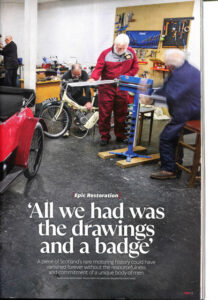
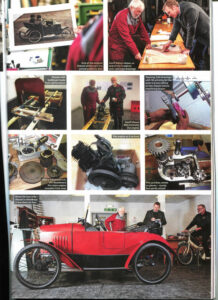
Well this note from Geoff Allison was a big surprise that may interest readers. The ‘Little Skeoch’ had a short life when created in 1921 when fire destroyed the factory and 6 of the 10 models ever made went up in smoke. Fragments of the car remained … especially the paper plans. Thanks to Geoff and his gifted friends a model of the little car has been made as you may remember as I did a story on the car some time ago.
Well today a thorough story has been printed in the june 2022 edition of Classic Car. And I mean through. With a pile of detail pictures. The full article is included.
What is our family connection to this car.? I really do not know for sure. Nice to imagine the connection may exist though.
alan
> > Dear Transatlantic Skeochs, > > I am sending you a copy of an article published in the June 2022 edition of Classic Cars which refers to the re-creation of a 1921 Skeoch Cycle Car as an epic restoration – for your interest. > > Kind regards, > > Geoff

Author: Alan Skeoch
-
EPISODE 577: Skeoch CAR re-creation hailed as ‘Epic Restoration’ in national magazine
-
EPISODE 576 : SOCKEYE SALMON or GOLD (a human dilemma )
EPISODE 576 : SOCKEYE SALMON or GOLD (a human dilemma )alan skeochmay 2,2022
WHY THE DELAY?Sorry about the story delay. What I wrote about the Alaskan mining camp
suddenly took a twist in my mind and I decided a bigger story wouldbe better.I worked in Alaska in the summer of 1959. It was a grandadventure that I have presented in an earlier episode but the storyhas unfolded into a bigger and more startling story since 1959.A story that has only recently been resolved in favour of sockeyesalmon instead of opening what would have been the largest openpit mine in the world. The gold and copper extraction would have lastedfor 45 years and 1,000 miners would have been hired at an average wage of$100,000 each. The downside? The last remaining wild sockeye salmonbreeding ground would have been lost forever. A vast tract of wilderness.This decision was madein 2021. The fight has been going on for more than 40 years. Long afterwe abandoned our mining campsite in 1959. I really believed thatbig money and human greed would trump sockeye salmon. Hard to believe thatEnvironmentalistsand the fishermen from 30 Alaskan aboriginal tribes won thebattle. At least for now!Caroline, our grandson Jack’s girlfriend is studying environmental scienceat Queen’s University. I am writing this story for Caroline and her professorsas well as my readers. The decision to abandon the Pebble Mine projectin Alaska needs to be told to a wider audience. I still find it hard tobelieve that 55 billion pounds of copper and 67 million ounces of goldwill remain buried in the Alaskan wilderness.So give me a little slack. I need time to put this decision in readable form.alan skeochmay 2, 2022POST SCRIPT: TAILING PONDS“Scars from large mining operations are permanently etched across the landscapes of the world. The environmental damage and human health hazards that these activities create may be both severe and irreversible.
Many mining operations store enormous quantities of waste, known as tailings, onsite. After miners excavate rock, a processing plant crushes it to recover valuable minerals such as gold or copper. The leftover pulverized rock and liquid slurry become tailings, which often are acidic and contain high concentrations of arsenic, mercury and other toxic substances.
Mining companies store tailings forever, frequently behind earth-filled embankment dams. Over the past 100 years, more than 300 mine tailing dams worldwide have failed, mainly due to foundation weakening, seepage, overtopping and earthquake damage.” (Research Scientists group studying river systems)
NEXT EPISODE— THE CAMP IN 1959

-
EPISODE 575 MINING CAMP ON THE ALASKAN BARREN LANDS..1959.
EPSODE 575 MINING CAMP ON THE BARREN LANDS OF ALASKA…1959alan skeochapril 2022I just found my picture of our mining camp in Western Alaska in the summer of 1959.
QUESTIONS THAT OCCUR TO YOU AS YOU READ THIS PHOTO….ANSWERS COMINGSUMMER 1959: Don VanEvery, Ian Rutherford, Bill Morrison, Mike Chinnery, Alan Skeoch and Dr. John StaM were flown to Dillingham, Alaska to conduct a Turamgeophysical ground survey in he summer of 1959. From Dillingham the Canadian crew were flown into the Alaskan interior by two SikorskyS 52 helicopters. A camp had been constructed overlooking an Alaska river valley where thousands of coho salmon were ricing to lay their eggs before they died.We were told the site was a secret. Whether this was true or not I have never been able to prove one way or another. What I doknow is that the site is located overtop a huge area of copper mineralization. To this day, April 2022, no mine has been constructedWhat questions occur to you as you read this photograph. Answers coming in next episodealan -
EPISODE 574 WHALE WATCHING IN STRAIT OF BELLE ISLE….FRIGHTENING
EPISODE 574 WHALE WATCHING IN STRAIT OF BELLE ISLE….FRIGHTENINGalan skeochapril 2022
The rocky eastern shore of Newfoundland was strewn with lobster traps…some bashed up but most couldbe easily repaired. Seemed a loss that we could help relieve. So began our Lobster Trap Rescue
Our fishing had not been too successful using fishing rods. Great schools of capelin rolled ontothe eastern beaches of Newfoundland not far from, St. John’s.Then we cut straight across theisland to the western beaches along the Strait of Belle Isle where a big surprise awaited us.Really big. Terrifyingly big“Would your boys like to go whale watching here?”said the first person we met on the banks of the Strait of Belle Isle.
We were on the long road to L’Anse aux Meadows. Just taking our time as the road was delightfullywild and the Strait of Belle Isle was easy to access as we coddled along. Two adults, two kids, two dogs,three bicycles, two lobster traps, one pop up camper, one well used Ford van…and all the other stuffneeded for a cross Canada summer trip living as close to the land as possible.In earlier episodes I described the capelin roll and also our rescue of some lost lobster traps that we decided toreturn to the owners…see picture above. Note Marjorie is still wearing her bikini. The year was circa 1980 (mistakein episode 573 where I said 1970)
From our campsite we could see a small Newfoundland village of less than a dozen buildings with open rowboatsbobbing in a rock enclosed harbour. An easy walk carrying a perfect hand made lobster trap.“Brought backthis trap that you must have lost.” Expected thanks but just to an indifferent shrug. “Government pays for thelosses…nn need to rescue them.”I know that sounded hostile but it was not. Just a statement of the facts by a young fishermanwho was really quite friendly.“Would your boys like to go whale watching?”“We would love to do that, dad…Can we?”“Suppose so…”
“I will get the motor gassed up…you can wade through the waterto the boat…only waste deep.”, he said while i was trying to translatethe message on his T shirt which seemed to say “Hard work can’thurt Yah BUT I’m not taking any chances.” This was a young manwith a sense of humour. Too bad I have forgotten his name…and thename of the village. Maybe I could find the place from the satellite butno time.

THEN THE REAL ADVENTURE BEGANWe were not too far offshore when the first whale appeared…maybe two whales or more.Could have been a Minki whale or perhaps a pod of dolphins.One thing for sure. As we proceeded the whales ran under our boat…just barely.“Do the whales know we are here?”“Sure…they have eyes and ears…better than ours.”Up to this point Andrew and Kevin were leaning over the rim ofthe boat. Once a whale slipped by about 10 feet from us…and parallelto us. Andrew hit the bottom of our boat . Full body slam.
Those dark blurs are part of whatever pod of whales or dolphins were playing with us.“This is their playground…not ours.”“Is there a chance they will lift our boat ?”“Not likely.”(which meant it was possible)“These creatures are longer than our boat.”“Whales. What would you expect.”
Then something really big surfaced. Too close for comfort. Looked like a Humpback whale fin splashing.Really big whatever it was. We began to see whales where no whales existed. The dark blue patchesof the Strait of Belle Isle water looked like whales.Andrew did not see them because he stayed on the boat below eye level. Unusual for him.
This whale … only got part of him …slipped by so close that it seemed touchableAll of us were worried.“What happens if a whale lifts our boat…dumps us. We have no life jackets.”“Life jackets are no use here.”“You must be kidding.”“Water is so cold we could never reach shore…Hypothermia would get us.”“Bloody dangerous.”“Not really. The whales are just curious. No evil intent. Sometimes I thinkthey even know who I am.”
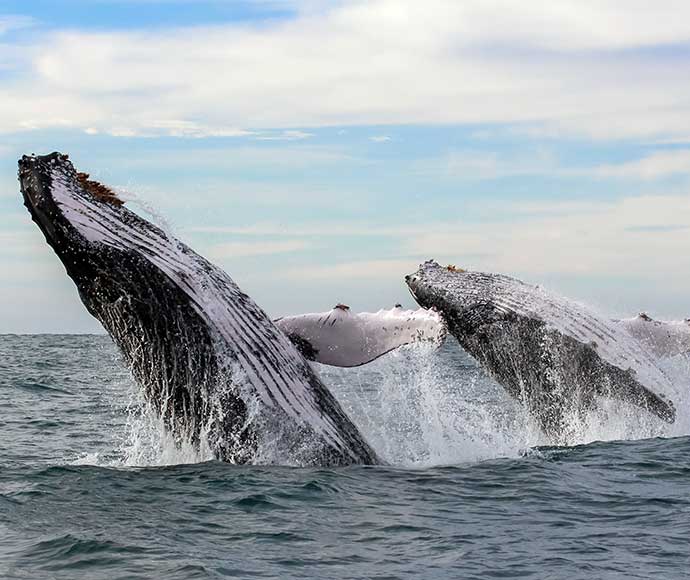
I did not take these last two whale pictures. A pair of humpback whales. Get the size of them…more than twice the size of our boat;
Just imagine if these two humpbacks decided to show off beside our boat.If they did we would all join Andrew flat out on the bottom of the boat. Or, worse,at the bottom of the Strait of Belle Isle.Why did I not take more pictures? I needed to grip the gunwales of the boat with both hands.why are the sides called gunwales anyway. I hope the whales do not hear that word.They might get angry. Why? The word ‘gun’ spliced onto the word ‘wales’sounds bloody unfriendly. I read Moby Dick long ago. Scared me back then.Close up whale watching in an overgrown rowboat is not advisable.But the young fisherman was a great example of Newfoundland friendliness.alan skeochapril 2022post script: The Strait of Belle Isle is a perfect whale watching site as it forms anatural pathway from the mouth of the St. Lawrence to the cool Arctic waters.Why would whales want to use this chute? Lots of capelin…thousands and thousands ofthose little sardine sized fishare needed to fill a whale’s tummy.
-
EPISODE 572 “HAVE YOU EVER SEEN A ‘CAPELIN ROLL?’…a fish story from Newfoundland
EPISODE 573 HAVE YOU EVER SEEN A CAPELIN ROLL? (EDIBLE APPARENTLY…NEED CLOTHESPEGS THOUGH)…a newfoundlandf ish storyalan skeochapril 2022“When can we go fishing…tired of sitting in the truck mile after mile.”“Soon.”“How about right now, Dad?”“Probably not catch much but let’s pull into this ocean cove….scenic if nothing else.”“Great…getting out the fish rods.”We were camping in Newfoundland when, by pure chance, we came upon a‘capelin roll’. These tiny sardine sized Atlantic Ocean fish play a deadly mating gameeach where thousands and thousands “roll” onto Newfoundland beaches… a smallpercentage are gathered up and hung to dry with clothespins by local people andeven some tourists like us.Humans are not the only predators feasting on capelin. “It’s the humpback whales that drive thecapelin on to our beaches. They are out there beyond the breakers feeding on thelittle fish.”
Newfoundland beach, north of St. John’s, where Andrew and Kevin Skeoch were determined to go fishing. If you lookclosely you can see the boys. Most have ben about 1970 wen we took the boys to experience life in eastern Canada.
This is Daisy with a capelin in her mouth. A little fish considered a delicacy When they rush ashore in hundreds of thousandsafter mating.


Newfoundland is a great place to go camping. Often we were find empty camping spots right on the ocean…at least that was so in 1970.Those wonderful Tourism Advertisement on television are not exaggerated. Newfoundland is unique.

People gather to watch our dogs, Daisy and Sonny, investigate a capelin roll…the shiny bits are live capelin.Once the capelin begin the trip to shore, people line the beaches to watch, catch, and scoop up these silver fish. You’ll see all manner of nets, including a cast net or dip net, as well as buckets. Many people come to simply enjoy the sight, watching kids, and adults alike shriek as they capture the wriggling creatures in their hands. The more adventurous will don their rubber boots, and wade into the shallow ocean waters to use their nets (some more successfully than others!). The more patient cast their fishing lines out to the capelin retreating from the shoreline. The festival atmosphere at these local beaches is akin to a pop-up, as family and friends gather with plenty of campfires, beach blankets, and picnic coolers. Who knows, you may even see whales lunge feeding on these delicious capelin just offshore.
And this small, slender fish is actually much healthier and tastier than you may think, although it may never become one of your favorite foods. The locals each have their own way to prepare them, from frying, to roasting over an open campfire, to pickling, along with the traditional method of salting and drying the fish. Regardless of how much you love the taste, catching them is a local food experience you’ll certainly never forget. If you ever get to see the capelin roll, it really is one of nature’s wonders.


Marjorie figured if the capelin were good enough for Daisy and Sonny to eat, then she may as well try one as well. Note Marjorie’s version of a bikini.Capelin are delicious treats for humpbacks Many people visit capelin hotspots like Middle Cove beach, just outside St. John’s, to see if the capelin roll has begun. The fact that there are 30 different coves across the province named for capelin indicates the widespread fascination with the annual tradition. To stay up to date on capelin locations, visit www.ecapelin.ca. People who spot capelin can also let others know on Twitter by using the hashtag #CapelinRoll20XX and insert the current year, which is updated annually.