Author: Alan Skeoch

  • EPISODE 686 LIVINGSTON WERNECKE’S REPORT ON THE TREADWELL MINE DISASTER, APRIL 22, 1917

    NOTE: Sitting in Mitch Lynas’s dental chair while he excavated and filled four teeth was nor he most
    pleasant experience in my life.  Thankfully I was able to escape.  Livingston Wernecke’s description 
    of that last cage being lifted out of the Treadwell Mine in 1917 is riveting.  I was with Livingston
    on that final day in my mind while Dr. Lynas did a different kind of excavating an backfilling.


    episode 685    LIVINGSTON WERNECKE’S REPORT ON THE TREADWELL MINE DISASTER, APRIL 22, 1917

    alan skeoch
    Nov 28,2022

  • EPISODE 682 ESCAPING THE YUKON, PART 6 TREADWELL MINE DISASTER , APRIL 22, 1917


    EPISODE 682    ESCAPING THE YUKON, PART 6    TREADWELL MINE DISASTER , APRIL 22, 1917


    alan skeoch
    Nov. 23, 2022

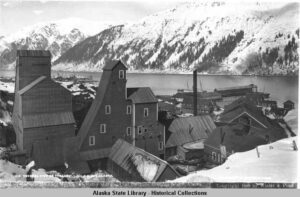
    NOTE: I COULD not SEE THIS STRANGE BUILDING FROM THE TAXI FERRY TAKING ME TO 
    JUNEAU. It is  ALL THAT REMAINS OF THE TREADWELL MINE DISASTER OF 1917.


    Take a good look at this strange building.  Notice anything?  Look again.  What is a little odd about
    the building?  


    The Treadwell Historic Preservation and Restoration Society restored the shell of the Treadwell pumphouse. Mt. Roberts serves as backdrop. (Katie Bausler)


    Hope you noticed. The stone building is built on top of a tower.  Why?   Because the structure is built 
    in the Gastineau Channel.   A fjord open to the sea.  In other words open to tidal fluctuations.  At high tide
    the building stands alone seemingly on top of the water.  The tidal change in the Channel is immense.

    And on April 22, 1917 there was a remarkably tidal flow heavier than normal.  Unusual.  So What?
    Water is heavy.  Water in a five gallon a tank is almost too heavy to lift.  Now just imagine the incredible 
    weight of the water that flows backend forth through the Channel every day.   Zillians of pounds more than a puny five gallon tank.

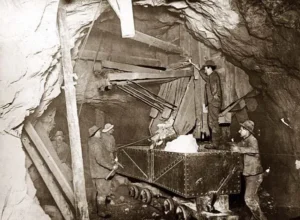
    MINING THE TREADWELL MINE


    NOTIEW THAT THE MEN ARE STANDING ON  ON RUBBLE…KNOCKED OFF CEILING, SEPARATED INTO
    ORE AND WASTE….THE ORE WAS HAULED BY HORSES THROUGH MILES OF TUNNELS TO THE 
    SHAFT THEN LIFTED TO THE TOP OF THE MINE AND DELIVERED TO THE STAMPING MACHINES.  WHICH
    BY THE WAY MADE ONE HELL OF A NOISE PULVERISINGTHE ORE INTO FINE SAND.


    FIVE HUNDRED  feet below the Channell, on April 22, 1917 there were 350 miners taking out gold bearing
    ore.  Doing so in a rather odd way to my way of thinking.   They were cutting
    chunks of ore out of the ceiling of the stopes.  Mining above their heads.  Loading the horse drawn
    mine carts with the good stuff and piling the waste rock on he mine floor.  So the stopes of the 
    Mine became high vaulted ‘cathedrals’ in which the miners worked upwards and upwards…standing with
    their tools on the increasing pile of rubble waste.  So what?   So the roof of the cathedral like stopes
    had less and less support.  

     Pillars were left to hold up the ceiling.  These pilars however were often gold bearing…therefore
    valuable as ore, so they were very thin   

    Along with the men there were 13 horses and 1 mule.  These animals had been lowered into
    the mine in slings. Getting them out would be tricky so the horses lived and worked in the  dark most of their lives.
     Most miners loved the horses and the feeling was mutual.  In the darkness
    the horses would whinny with affection as various miners stroked their necks.

    The team, men and horses were sending 5 tons of ore up the shaft
    every day.   

    WHAT IS A STAMP MILL?
    Architectural  drawing of the workings of a stamp mill.   .  Raw ore dumped  in
    stamp mill then pulverized into tiny pieces by power driven  hammer.  The noise
    from the Treadwell stamp mills was terrible.


     The stamping mills allowed mine managers to recover 50% of the gold.
    Arsenic was used to get the remaining gold.  


    The ceiling in mine got higher and higher…and weaker and weaker.


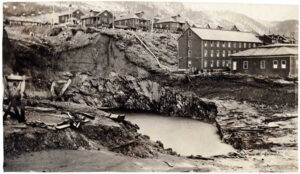
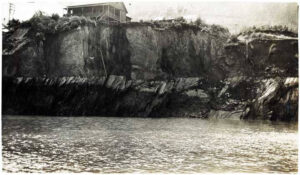
    April 22, 1917   The sudden 
    disappearance of the company swimming pool into this hole was
    the first hint that the whole mine was about to cave in.  An alarm was 
    sounded….men scrambled to get out.  Horses were left behind.


    THE TREADMILL MINE DISASTER


    1.15 A.M.  ARIL 22, 1917  

    “ground around the natatorium (workers swimming pool) and fire hall slipped sideways, then with ‘cracks, groans, and noises of shattering boards’ dropped straight down into the innards of the mine.”


    2.15 a.m.  april 22, 1917

    “another eruption at the cave-in site, a two-hundred-foot geyser of saltwater shot out of the top of the central shaft. The spouting display went on for a full five minutes before it stopped, like fireworks announcing a finale. “ *

    *Sheila Kelly, TREADWELL GOLD


    6.45 a,m.  April 22, 1917  By the time the sun lit the Treadwell Mine buildings the

    vast workings of the Mine were filled with water from the deepest spot 500 feet
    below the Channell to ground level.  Three million tons of seawater ended
    the mines life.  Ten million tons of gold bearing ore had been removed.  In doing so
    45 miles of mine shafts and drift were hollowed out.

    Seventy million dollars worth of gold was produced but it took over 8 tones
    of ore to produced 1 once of gold. (*Is this correct? Seems odd)


    WHY DID THE TREADWELL MINE IMPLODE?

    No one really knows why this happened.  There had been several ground tremors
    in the months prior to the total collapse.  strong hints that something was wrong..
    But little note was taken. 

     And when the cave in happened there were several explanations.

    1)  An extraordinary tidal surge had swept up the Gilford Channell that increased the
    weight of rock, oberburden and water on the stopes.
    2) The  managers of the mine had allowed the internal pillars to be thin and therefore
    incapable of supporting the ceiling.
    3) The mining system of working upwards created huge cathedral like stopes…open
    spaces in these stopes got larger and larger with each working day.  
    4) There was a major fault in the geology of the mine…a weakness.

    WHO WAS SAVED AND WHO WAS LOST

    Water had been pouring into the mine at an accelerating rate but the mine had so many miles of tunnels
    and stopes that there was enough time….barely…to get the miners up the shafts and out.  Luckily the
    collapse happened between shifts and there were not as many men deep down as there would
    have been normally.  350 men got out.  Only one man was not accounted for and
    his disappearance was a mystery.  Mine officials believed he had escaped and just
    took the opportunity to pretend he was lost so his wife could collect insurance
    money which she did after a court case.

    Sadly only 1 horse was brought to the surface.  The other 12 or 13 horses were about to drown
    as the miners emerged from the shaft cage.  The men were distraught as they loved the horses and some of them
    volunteered to go back down the shaft to rescue the horses.  By then, however, it was  too
    late.  They drowned.

    alan

    Post Script    Escaping the Yukon    1) Who was Livingston Wernicke?   2) Who are the Tlingits?


  • EPISODE 684 NEW DOORWAY FOR SKEOCH/FREEMAN FARMHOUSE CIRCA 1870 (AND DOORWAY 2022)


    EPISODE 684   NEW DOORWAY FOR SKEOCH/FREEMAN FARMHOUSE CIRCA 1870 (AND DOORWAY 2022)

    alan skeoch
    Nov. 24, 2022

    Mice!  Lots of them squeeze through the old frame doorway of our farm house.  This is a bad year for them.
    Marjorie has caught 28 so far.   All dead except one she caught by the tail and let it go down by the pond.
    Where  did it go?   I bet it hightailed it back to this loose brick in the old farm house.  If so, it is doomed.
    Snap traps get them. 

    But that freeway for mice may not be as bad in future years.  We ordered a new fancy doorway with sidelights and
    transom…just like the old doorway but made of metal shielded lumber  It took all summer to construct.
    Old farm houses are not constructed using  tape measures.  Ours has an inch or so difference one side to the 
    other.  Takes a skilled carpenter to overcome rule of thumb measurements.Thanks to Fossil Landscapes
    we were able to find carpenters who are artists as well as tradesmen.

    I think the cost of this doorway will be far more than the cost of a dozen mousetraps.


    On cold winter nights when icicles hung from the window frames and frost deadened all the farm house
    rooms but one.  That room was the old kitchen where a big wood stove was kept as hot as a poker
    Louisa and Ed Freeman spent the winters in that little kitchen while the rest of the 
    farm house was given over to frost and icicles.   The big front doorway was full of holes for winter wind 
    to creep through.  Nothing could be done.  The old doorway was built in the 1870-s and we thought it could
    not be replicated until now.

    Mice?  No problem.  In the past The house was so damn cold even the mice looked for better homes
    in the barn.   The mice haven was our fault when we gutted the house and modernized it.

    How smart are mice?  Will they find holes in the field stone foundation … places where ancient cement
    can be pushed side?   I think Marjorie better hold onto the traps she purchased.  If she catches a 
    mouse with a dent in its tail I will know that the mice are smarter than we are.  They can find a way!

    alan skeoch
    2022


  • EPISODE 682 ESCAPE FROM THE YUKON PART 5: THE TREADWELL MINE DISASTER — KILLS 12 HORSES, 1 MULE, MAYBE 1 MAN 1917

    EPISODE 682    ESCAPE FROM THE YUKON  PART 5:  THE TREADWELL MINE DISASTER — KILLS 12 HORSES, 1 MULE, MAYBE 1 MAN   1917


    alan skeoch
    Nov. 20, 2-22


    The Treadwell Historic Preservation and Restoration Society restored the shell of the Treadwell pumphouse. Mt. Roberts serves as backdrop. (Katie Bausler)


    My water taxi was getting ready to dock in Juneau…the land- locked capital of Alaska was a city 
    stacked like cordwood.  Ascending in tiers up a mountain on the east side of the Gatineau Channel.   
    Juneau was obvious to the naked eye. If so, then The Treadwell Mine must be equally obvious.
    I turned and looked westward across the Channel.  Douglas Island was there even though it had
    moved and reshaped itself back in 1917.  But there was no sign that this Island had once housed
    the largest gold mine in the world.  Here were the ruins of the Treadwell Mine?

    Nothing there except one measly little nondescript tiny tower poking out of raw slurry of sand and bits of rubble
    I was disappointed.  The reason for my ‘ Escaping the Yukon’ plan was to see the fabled ruins of the Treadwell Mine.
    There was….there is….nothing to see.

    Just getting here had been exciting.  Travelling down on the Yukon and White Pass Railway.  Imagining the
    3,000 bodies of inhumanely  treated horses at Dead Horse Gulch,  recreating the wild days in Skagway when
    bunco artist Soapy Smith ruled the roost, taking a tiny 10 person water taxi down the Gatineau Channel.
    All very exciting.  But the culminating event, the Treadwell Mine…was not worth the  effort.   Or so it seemed
    at first glance.
     
    “Somewhere under this channel, over 2,000 feet below us are the skeletons of 12 horses and 1 mule and maybe 1 man”
    “How do you know that?’
    “The largest gold mine in the world in 1917 was here…the Treadwell Mine”
    “Tunelled under the Gatineau Channel…5,000 tons of ore a day taken from under the  ocean?”
    “Miners excavated 65 miles of tunnels.”
    “Then it all came to a crashing end in just two hours, April, 1917….”
    “And all that remains is this peculiar building.  Looks like a tiny Greek Parthenon”
    “When Treadwell was in full flower there were buildings stretching for miles.”
    “And Douglas Island was a fulll fledged town”
    “Now there is just this one building”
    “Built on a massive pile of mine tailings that has made the Douglas Island beach where no beach was before.”

    The main event….THE TREADWELL MINE DISASTER…Is coming in the next episode.

    alan skeoch
    Nov. 21,2022

    Post script:  The Treadwell Mine was really four mines all carved out
    of a fault in the skin of our mother earth.  A crack that allowed gold
    bearing magma to ooze up.  

    Take a close look at the small cross section map of the Treadwell Mine…top right hand side, small…NOTICE ANYTHING?


    www.juneauempire.com/wp-content/uploads/2018/08/image2099306_web1_Treadwell_workers_outside_mine_building_ca_1918-300×185.jpg 300w, www.juneauempire.com/wp-content/uploads/2018/08/image2099306_web1_Treadwell_workers_outside_mine_building_ca_1918-640×396.jpg 640w” sizes=”(max-width: 1199px) 98vw, 720px” apple-inline=”yes” id=”68288B38-9943-49CE-99F7-E38E1D99DD54″ style=”box-sizing: inherit; border: 1px solid rgba(0, 0, 0, 0.15); display: inline-block; vertical-align: middle; max-width: 640px; margin: 0px 0px 0.25rem;” src=”https://alanskeoch.ca/wp-content/uploads/2022/11/image2099306_web1_Treadwell_workers_outside_mine_building_ca_1918.jpg”>

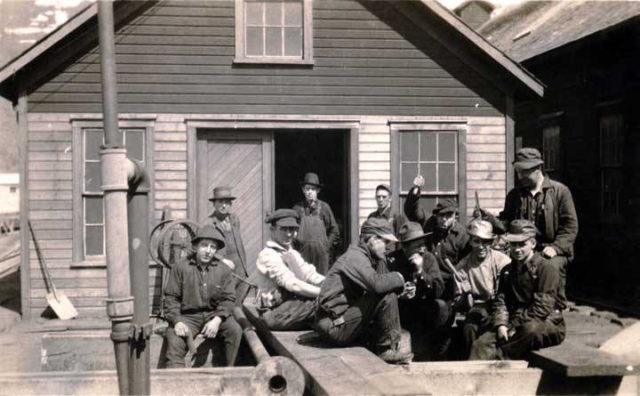
    Treadwell workers outside mine building, circa 1918. (Alaska State Library)
  • EPISODE 680 SOAPY SMITH OF SKAGWAY…CON MAN SHOT DEAD

    EPISODE 680   SOAPY SMITH OF SKAGWAY…CON MAN SHOT DEAD 


    alan skeoch
    November 18, 2022


    Soapy Smith in Skagway bari2.wp.com/www.geriwalton.com/wp-content/uploads/2022/03/Soapy_Smith_1898c-wiki.jpg?resize=208%2C300&ssl=1 208w” sizes=”(max-width: 626px) 100vw, 626px” data-recalc-dims=”1″ style=”caret-color: rgb(83, 82, 51); color: rgb(165, 163, 108); font-family: Helvetica, Verdana, Arial, sans-serif; text-align: center; box-sizing: border-box; height: auto; max-width: 100%; border: 0px none; vertical-align: middle; margin: 0px; padding: 0px; width: auto;”>
    SOAPY SMITH – BUNKO ARTIST OF SKAGWAY


    “Pay attention….you could be the lucky man.”
    “Who is that speaking.”
    “Oh, that’s Sloapy Smith…watch what happens.”
    “I am wrapping a $100 dollar bill in one of these  bars of shaving soap.
    You ould be the lucky man who gets that $100 … Now I will shuffle
    the bars of soap.  Mix Them up.  Try and keep your eyes on the
    $100 bar…it could be yours in a moment.”
    “How?”
    “For $5…just a fiver.  This is your chance right now.  Who has a five dollar bill
    and will get the hundred dollar bill?  Just five dollars.”

    “And there is a winner. Your name , sir?  Show everyone the hundred dollar bill.
    No tricks….no slieght of hand.   A winner for five dollars,

    Now here is how Soapy Smith got the nickname Soapy.  He never let on
    that the winner of the soap shuffle was a good friend of his.  The hundred
    dollar bill went back into Soapy/s pocket along with all the five dollar
    bills he fleeced from the crowd.   Soapy loved to work boom towns…mining
    towns for instance…where he was not known.  But he did not worry if he
    was known because he always had a gang of ruthless hoodlums on his side.

    He was a bunko man.  Had all sorts of ways to get money from innocent but
    greedy newcomers.

    Soapy needed towns where law and order were absent.  Mining boom towns
    always presented good pickings.  Skagway was the perfect place for a bunko
    man.  There was no law and order in the gold rush yeas.  Scams were many.
    Soapy took slamming seriously.  He gathered a gang of like minded criminals.
    Tough guys who welcomed the steamships full of gold seekers each of whom
    had a grubstake to get him to the gold fields of the Klondike,

    Soapy Smith had no intention of  climbing the Chilkoot Trail.  He had no
    intention of beating a horse to death trying to get a ton of food and tools up
    the slippery slopes of the mountains behind Skagway.  Why do that
    when the gold would eventually be brought back through Skagway where 
    he could get it with little effort.

    BUNKO SCAMS 

    Stories of Soapy Smith vary somwhat but the kernel of truth is present.  For instance
    I rely on the excellent article by Gen Walton, published February 28, 1011.

    Soapy’s most famous scam was the hidden money in the shaving soap caper.  Some sources
    say he hid a hundred dollar bill in the soap wrapper,  Gen Walton says he hid five, ten
    and fifty dollar bills.  No matter  All the bars of soap were won by his associates….
    his gang members.

    He had a whole suitcase full of scams.

    1) Sleight of hand scams were favourites because they were easy to set up and paid off immediately. i.e. the soap scam
    2) Gambling in all its forms, except no winners. None.
    3) fake stock market scams…sold stock of companies that did no exist
    4) real estates scams…gold mines with no gold
    5) fake watch and diamond auctions
    6) rigged poker games
    7) Three card monte  (Must find out how to play….see post script)

    There is a tendency to regard bunko artists and con men just as non violent thieves stealing money
    from greedy customers.  Soapy was violent.  He gathered gangs of violent men around him.  Dealing
    with Soapy was no joke.  Before he went north to Skagway he ran a gangland empire in Denver,
    Colorago.   The newspaper editor ran an article exposing Soapy’s criminal activities.  How did
    Soapy react?  With vicious violence.  For instance:

    “Smith did not want his criminal activities highlighted and he hated the News’allegations against him. He decided to get revenge on Arkins (*editor) and took a friend, “Banjo” Parker, with him. The men hid in the shadows and when Arkins emerged from the newspaper building, Smith struck him over the left temple with a loaded cane fracturing his skull and knocking him to the pavement senseless. Smith then pummeled, kicked, and beat Arkins as Parker stood guard and when Smith was finished with “his brutal work,” both men casually walked away.


    Soapy Smith History Part 3

    Soapy presided over a criminal gang empire before he ever went to Skagway but,once there, he took control of the town.  His gang members greeted newcomers prtetendimg to be journalists  or Christian ministers or
    other sal of the earth  people.   Many of the thousands of men arriving in Skagway had money.  At least enough to finance the two thousand pound survival package needed to prove to Canadian officials they could survive in the Canadian wildernes  Soapy and his men fleeced many gold seekers many of whom would never get beyond Skagway.  Violently if necessary.   What did Skagway politicians and police do to stop Soapy?
    Not much since Soapy’s men were often the various town officials expected to keep the peace.   For a while Skagway was Soapy’s town.

    i1.wp.com/www.geriwalton.com/wp-content/uploads/2022/03/Skagway-js-parlor-1898-wiki.jpg?resize=300%2C210&ssl=1 300w” sizes=”(max-width: 568px) 100vw, 568px” data-recalc-dims=”1″ style=”caret-color: rgb(83, 82, 51); color: rgb(83, 82, 51); font-family: Helvetica, Verdana, Arial, sans-serif; text-align: center; background-color: rgb(247, 247, 247); box-sizing: border-box; height: auto; max-width: 100%; border: 0px none; vertical-align: middle; margin: 0px; padding: 0px; width: auto;”>
    SOAPY SMITH’S GANG IN FRONT OF THEIR HANGOUT, SKAGWAY.


    Then one day Soapy’s criminal empire collapsed when he confronted a group of indignant citizens calling themselves
    the Committee of 101

                     “… on 7 July 1898 John Douglas Stewart, a Klondike miner, returned to Skagway carrying a sack of gold dust valued at $2,700. Three of Smith’s gang members learned of his treasure and convinced him to play three-card monte. Unfortunately, Stewart did, and he lost. When he refused to pay the three men grabbed his sack of gold dust and fled.

    Stewart reported the theft and as news broke about the robbery broke in Skagway, city-wide indignation grew. Most citizens believed it was Smith’s gang that had committed the crime. Hubbub over the robbery reached fever pitch the following day and that is when the Committee of 101 demanded that Smith return the gold. He refused and claimed that Stewart had lost fairly. The Salt Lake Herald provided a summary of what happened next:

    “Soapy got drunk and went out to fight them all. Arriving at the place where an indignation meeting was being held, Soapy found five men guarding the entrance. He rapped Frank Reid, the city engineer, over the head with a rifle. Reid snapped his pistol at Soapy and Soapy shot him in the groin. Standing on one foot Reid put three bullets into Soapy, killing him instantly.”[5]


    Funeral of Frank Ried [sic] on the street of Skagway 1898. - Alaska State  Library-Historical Collections - Alaska's Digital Archives
    ABOVE  The funeral for Frank Reid , the man who shot Soapy Smith who was, in turn killed
    by Soapy Smith before he died.


    HOW I  REMEMBER SKAGWAY IN 1961


    Skagway, Alaska - Wikipedia

    Skagway Attractions, Shops, & Local Businesses

    DATELIE SEPT 15, 1961  When I got off the largely empty train in Skagway …coming from the north…a large cruise ship 
    was docking at the south end of town and a great number tourists flooded Skagway.    I had never paid much attention to
    the criminal career of Soapy Smith but noticed Skagway’s main street seemed to feature his exploits.   Sort of like Chicago’s 
    misplaced glorification of Al Capne.   The drunkenness, and gang centred lawlessness.  All really imaginary 1961…tourist lore.Skagway was
    a living movie set for the tourists to enjoy.   Without the toursits the town was quiet…almost empty.  I was lucky.  Skagway had
    come alive..   Seemed there were a lot of girls dressed in flouncy 
    dresses reminiscent of the dance hall girls of the 1890’s.  There might even have been summer students imitating Soapy Smith
    …the bunko side of him.  Nice to be a part of the crowd.  Met quite a few people who thought I was a local resident..   Must have been my
    full beard


    Red Onion Saloon


    “Do you live here in Skagway?”
    “Nope, just arrived like you..came down through White Pass on the  train.”
    “Where are you heading?”
    “To Juneau…..have flight booked to Seattle.”
    “How will you get to Juneau?”
    “Bus, I guess.”
    “No roads out of Skagway except ferry and road north to Anchorage.”
    “You must be kidding.”
    “Why don’t we smuggle you aboard the cruise ship…good food
    and nice cruise.   We could do it….or try.”
    “Sorry….got to get to Juneau.  There must be a way.”
    “Only the water taxi.”
    “Water taxi?”
    “Small passenger boat….holds about 10  people tops. Need to reserve.”


    Alaska Water Taxis | Quick Access to the Wilderness | ALASKA.ORG

    Lucky.  Got a seat on the water taxi.  Quite a thrilling ride south past places where a large glacier was calving 
    huge chunks of ancient ice into the channel.   The water taxi got a lot closer to the
    glacier than the cruise ship.  Every one on board seemed to take the
    trip for granted.  Except for me. So excited but tried to hide it.


    Margaret glacier - Picture of Juneau, Alaska - Tripadvisor

    I’ve often thought would my life be different if I got smuggled aboard that tourist ship.
    If I had done that I would miss all the connections….would arrive in Toronto who
    knows when.    I am not sure if I even spent the night in Skagway.  I do remember a feeling
    of relief when I paid for the water taxi.  I had to leave Skagway as fast as possible.

    alanskeoch


    THREE CARD MONTE   

    Three-card Monte – also known as Find the Lady and Three-card Trick – is a confidence game in which the victims, or “marks”, are tricked into betting a sum of money, on the assumption that they can find the “money card” among three face-down playing cards.


    Definition:  BUNCO ARTIST   What does bunco mean in police terms?
    “); display: inline-block; height: 24px; width: 24px; margin-top: -1px; transform: rotateZ(-180deg);”>
    The word bunco comes from the Spanish word “banco,” which means bank, and the term is used by law enforcement to describe several criminal swindles. According to the National Association of Bunco Investigators (NABI), these schemes are also called confidence, or con, games.