Year: 2022

  • EPISODE 690 SENIORS OVER 80 DRIVING TEST — EVERYONE SCARED


    EPISODE 600      SENIORS OVER 80 DRIVING TEST — EVERYONE SCARED

    alan skeoch  
    dec. 3, 2022


    I was scared.  Everyone seemed scared.   With good reason .  The “Over 80’s’ compulsory Drivers test
    had grave implications.  To fail meant loss of drivers licence.  loss of mobility, loss of freedom, loss of confidence.
    Recognition of age and all that burden implied.  Alzeimers, dimentia, failing eyesight, Parkinson’s, Arthritis…the
    whole ball of wax.  I am 84 and in good health.  Just a bad knee from football days 70 years ago.  No real need for
    a cane although I use one whenever with people who might want me to race them around the block.

    To fail the test meant reliance on other people…to use public transportation which is not so easy in Canada where
    we need cars just to get to public transport   The plazas all have spacious parking lots.  Corner stores are pretty well
    a thing of the past.  

    “Your test will be at the Best Western Hotel on Dixie Road….do not come early as others are being tested all day long.
    Bring your drivers licence and glasses if you need them to drive.. The test will take 90 minutes.”

    So around 20 of us gathered.  All nervous.  Even me even though I had been through the test when I turned 80
    And failed.  Yes I failed.  More about that later.  I know my failure triggered your interest.  Humans are less interested
    in perfect people that they are with those who are imperfect.  Human nature.

    The odd thing about my test last week was the presence of many men who seemed very fit.  About half the women
    were using canes  One woman needed two canes.  And their bodies seemed to shake….quiver…more than those
    of the men.     But we all shared one thing.  Nervousnes.  We all knew that failure woluld mean a dramatic change
    in lifestyle.  Would  mean dependence on others…particularly dependence on our children who may or may not
    be pleased to cart us around.

    The room was a little on the dingy side….lighting was not good or my eyes were not good.  Either or both.

    “Just take a seat anywhere.  No rush.  I’m doing an eye test with these ladies right now so grab a seat,
    your time will come.  Our mandated test for those oner 80 willl take around 90 mnutes.  Perhaps less
    because the projector failed so the film will not be shown.  I am the regional manager.  Doing tests from
    here to Niagara Falls every day.  Usually around 15 per class….a few more today.  Please feel welcome.
    My name is Natasha.”  

    Natasha was the chattiest of people.  She tried to make the Drivers’ Testing of over 80 year old as
    comfortable as possible.  

    But nobody spoke,  When Matasha stopped to take a breath the silence was absolute.

    “Some of you, those over 80 will remember the written test .  Rules of the Road.  Well that test is
    gone now.  We have one test of your cognition.  I will hand out a paper face down.  When I say
    turn it over you will draw a  face of  a clock with the numbers of the hours..  And finally you will use the hands of the clock
     to indicate ten minutes after eleven.  You will have five minutes;  No cheating..keep your eyes on your own paper.”

    That’s all?  I had studied the MTO Handbook for two days.  No test.

    “To finish the test each one of you must do a vision test.  Same kind as used optomotrists.  Just to make sure
    you can see where you are going and to check your peripheral vision.?”

    Natasha did all this with a big smile as she moved among the chairs and tables.  She was not
    overtly threatening  in any way.

    But we all remained nervous.  For good reason. If we were unfit to drive then our lives would change abruptly.

    No laughing matter.  The two men on either side of me were very serous  Both wives required 
    constant care.  So bad that both women were in places where constant care was possible. The men needed to
    drive to visit their wives.  And they  now had to run their homes….washing machine, stove, bills, food, etc etc.  Most of which
    required driving.  No matter how Natasha tried to make light of her role everyone knew she had the power to
    turn their lives topsy turvy..

    HOW YOU CAN FAIL

    My previous test taught me a big lesson.  I failed.  Not the written test.  That I got perfect.  When the
    meeting was over the tester…a serious man who was not chatty…dismissed everyone “Except for you
    Mr. Skeoch.”

    “Why?”

    “I see here you got a ticket two years ago. Do you remember why?”

    “No, I only dimly remember getting s ticket…. a long time ago.:”

    “well, you did and sorry to say you will have to do a full Drivers test.  And make sure
    you bring someone with you as a driver.  If you fail the test, then you will not be able
    to drive until you pass the test. “

    There was a 30% failure rate where I was tested.  I passed.  Test only took 15 minutes.  My examiner beside me with a 
    notebook.  Checking my left turns, three point turns, parking, attention to stop and go lights, safe lane changes,
    yield signs, idling positions, …all the things we do  drivers and take for granted.

    Did you ever wonder why people over 80 are so cautious as drivers.  Why they drive the speed limit rather than
    10 M above the listed limit.  Why they do not rush orange lights.  Why they twist their heads when changing lanes?

    ANSWER:   THEY FEAR THE DRIVERS TEST…THEY FEAR FAILURE…THEY FEAR THAT THEIR
    LIFE’S PATTERNS COULD BE SUDDENLY CHANGED.  THEY NO LONGER TAKE DRIVING FOR GRANTED.
    IT WILL HAPPEN TO YOU.

    alan skeoch
    Dec. 3, 2022

                                                               
    I passed the test…now I can drive for another two years.


  • EPISODE 688 ESCAPE FROM THE YUKON PART 8 WHERE DID THE TLINGIT PEOPLE COME FROM 11,000 YEARS AGO?


    EPISODE  688   ESCAPE FROM THE YUKON  PART 8   WHERE DID THE TLINGIT PEOPLE COME FROM 11,000 YEARS AGO?

    alan skeoch
    dec. 1, 2022


    Tlingit girls, circa 1900


    Photo of two large canoes with many rowersTaku.jpgupload.wikimedia.org/wikipedia/commons/a/af/Taku.jpg 2x” data-file-width=”485″ data-file-height=”599″ class=””>
    Tlingit Canoes in Alaska, 1887…Did the Tinglits paddle there way to North America?  Or walk? No one knows.

    SKAGWAY, HAINES JUNCTION, TREADWELL, JUNEAU… ‘TLINGIT’ TERRITORY

    Several of the Treadwell miners In 1917 were First Nations people…Likely Tlingits.

    Who are the Tlingit people?  No one really knows their origin.  But there are two schools of thought.
    The first is fairly well known.  Eleven thousand years ago much of the world’s water had become ice
    A huge sheet of ice covered much of North America.  But not all of North America.  Vast amounts of water
    was stored in the Arctic and Antarctic ice caps.   

    “During the last glaciation 18,000 years ago sea levels were 120 metres (394 feet) lower than today.”
       (Brian Fagan, THE COMPLETE ICE AGE, How climate Shaped the World, P.76)  Climate changes
    not new.  The difference is the speed of climate change due to human intervention.  In the last 100,00
    or so years there have been five Ice Ages and five Warm ages.  As ice melts, oceans get deeper.  As ice forms
    oceans get shallower.

    What is now the Bering Sea was a land bridge joining Asia to North America.  It is believed that
    Asiatic human beings crossed this land bridge at various times and settled in various locations.
    The First Nations.  Why?  Because animals such as Hairy Mammoths and others had already made the
    crossing and humans were hunter gatherers.  A hairy mammoth could make a fine and lasting meal.
    This theory believes humans, like the Tlingit, ‘walked’ across the Bering land bridge.  It makes sense.

    There is another theory, however, that also makes sense. Eleven thousand years ago a small group of
    people paddled their way from island to island, from headland to headland…from the South Pacific
    to North America. Polynesians. They found the food sources available in the Alaskan panhandle plentiful.  So 
    they settled themselves on the islands and the mainland from Skagway to Juneau.  

    As our climate warmed  the sheets of ice melted, the sea got deeper and what was shoreline
    in the last ice age changed.  Evidence of the movement of stone age people who came to North 
    America by sea was obliterated.  
    Tlingits are different than other native people;  Or are they?

    upload.wikimedia.org/wikipedia/commons/thumb/a/a2/Tlingit-map.png/440px-Tlingit-map.png 2x” data-file-width=”637″ data-file-height=”1057″>


    EARLY HISTORY

    The name Tlingit essentially means human beings. The word was originally used simply to distinguish a human being from an animal, since Tlingits believed that there was little difference between humans and animals. Over time the word came to be a national name. It is speculated that human occupation of southeast Alaska occurred 11,000 years ago by Tlingit people. Haida people, with whom the Tlingit have frequent interaction, have only been in the area about 200 years, and the Tsimpsian migrated only recently from the Canadian interior mainland.

    Tlingit legends speak of migrations into the area from several possible directions, either from the north as a possible result of the Bering Sea land bridge, or from the southwest, after a maritime journey from the Polynesian islands across the Pacific. Oral traditions hold that the Tlingit came from the head of the rivers. As one story goes, Nass-aa-geyeil’ (Raven from the head of the Nass River) brought light and stars and moon to the world. The Tlingit are unique and unrelated to other tribes around them. They have no linguistic relationship to any other language except for a vague similarity to the Athabaskan language. They also share some cultural similarity with the Athabaskan, with whom the Tlingit have interacted and traded for centuries. There may also be a connection between the Haida and the Tlingit, but this issue is debated. Essentially, the origin of the Tlingit is unknown.

    NOTE No one really knows where the Tlingits originated.  Was the Pacific Ocean sprinkled with more islands 11000 years ago? Was island hopping easier?

    Even with today’s DNA testing, the origin of the Tlingit people is not certain. It is generally accepted they came from the Eastern Hemisphere across the Bering Strait and down into Southeastern Alaska. Some believe the ancient imigration by-passed the glacier-choked panhandle and instead populated parts of California and the Lower 48, even as far south as South America and then returned later when the ice had receded. Others believe some of these ancient travelers remained to settle this area.
    The pre-contact native population of the Pacific Northwest Coast is also difficult to determine. Successive epidemics of measles and smallpox took their toll on native villages, sometimes leaving only one or two survivors. There is no way to determine exactly how many lives were lost due to these new diseases, but it appears that there was a great decline in population in the first half of the nineteenth century.
    The ocean provided not only food, but also a transportation corridor. Highly skilled navigators with seaworthy canoes, the Tlingit thought nothing of paddling for days in any direction. The Chilkats and Chilkoots also had overland routes to the interior. A great trade empire was established from interior Alaska/Canada south to northern California. In the Americas, this trade empire was rivaled in size only by the Incas.
    (William M. Olson, The Tlingit, An Introduction to their culture and history, 1997
    POPOLATION
    According to the 2o16 census there are 2110 Tlingit people most of them living in Haines Junction, Alaska,   First contact with
    Europeans the population was estimated.  Not large.  

    Dance Hat
    Tlingit dance hat. circa 1850
    (National Museum of Canada)
    alan skeoch
    dec. 2,2022
    NEXT: EPISODE 689   ESCAPE FROM THE YUKON 1961:  GORDON LIGHTFOOT “IN THE EARLY MORNING RAIN”
  • Fwd: EPEISODE 687 REPRINT OF EPISODE 249 YUKON DIARY LIVINGSTONE WERNICKE . ON KENO HILL 1925 TO 1935


    Begin forwarded message:


    From: ALAN SKEOCH <alan.skeoch@rogers.com>
    Subject: Fwd: EPISODE 249 YUKON DIARY LIVINGSTONE WERNICKE . ON KENO HILL 1925 TO 1935
    Date: November 30, 2022 at 2:02:07 PM EST
    To: Alan Skeoch <alan.skeoch@rogers.com>


    Begin forwarded message:


    Subject: EPISODE 687 RERINT OF  EPISODE 249 YUKON DIARY LIVINGSTONE WERNICKE . ON KENO HILL 1925 TO 1935

    Subject: EPISODE  687  REPRINT OF EPISODE 249 YUKON DIARY LIVINGSTONE WERNICKE . ON KENO HILL 1925 TO 1935
     

    NOTE: Early in June 1961 I explored a ghost town and got mine on Keno Hill called Wernecke.  The name was strange

    and had little meaning until I did research on Livinsgston Wernecke.  My Escape from the Yukon in September 1961 
    ended in Juneau, Alaska, across the Channell from the Treadwell Mine where Wernecke worked before moving to the Yukon
    as explained in an earlier episode.  He was a very interesting  man.


    EPISODE 687  REPRINT OF EPISODE 249

    EPISODE 249   YUKON DIARY  LIVINGSTON WERNECKE   ON KENO HILL 1921 TO 1935
     
    alan skeoch
    Feb. 2021
     
    WHAT WAS IT LIKE TO BE IN WERNECKE CAMP, KENO HILL  1925
     
    Mining is dangerous.  So it is not first in line up of desirable careers.  Test yourself.  
    Would you take a job cutting out slabs of rock with explosives five  to 1,000
    feet beneath the ground where the darkness is absolute and arsenic is just
    one of the nasty minerals you will be handling while the air you breathe
    is often  filled with tiny dust particles that are sharp enough to grind  your
    lungs to a cancerous  pulp.
     
    cid:A29E50C4-A6C1-420B-8FA4-0F285F6C6B03
    Arsenic and lead pouring out of mine site…not the Wernecke mine site but the problem was present in the Yukon and remains a problem
     
    Not so nice.   Probably worse than I have noted.  Many miners, even as late
    as the 1920’s could not stand erect in the stopes.   And the water they drank
    had contaminants no one had identified…arsenic for sure.
     
    Livingston Wernecke was well aware of the dangers miners faced.  He tried
    to make the conditions in Keno Hill as pleasant as possible.  His mine was
    not filled with dust.  His drills were water infused to reduce the chances of
    silicosis of the lung;  It was safer to work  in a Wernecke mine than the
    Guggenheim mine at the top of Keno Hill.  Not perfectly safe.  Mining
    can be  dangerous but Wernecke made sure his miners knew the dangers
    and took precautions.  
     
    YES, he seems to have been erasable at times.  Miners that displeased
    him were told to ‘get your time owed and get out’.  When buying claims from
    stakers he gave fair prices as high as $100,000 if the site was tops.  But
    he only made one offer.  Take it or leave it.  He did not talk much…lacked
    the social graces. 
     
     He did not like prostitution or hard liquor.  Attempts to control both of these
    vices failed it seems but were minimized.
     
     
    WHAT WAS IT LIKE TO BE A MINER ON KENO HILL BETWEEN 1925 AND 1935.
     
       Dr. Aaro Aho in his book, ‘Hills of Silver’ shows  the good  side of Livingston Wernecke.
    He referred to his miners as his ‘boys’.  Livingston may not have spent a lot of time
    sharing stories with them over a hot drink but he made the conditions of their
    lives as good as possible.  
     
    Wernecke Camp Mine was not the wreck  that we saw in 1962.   In 1927 “there were two bunkhouses, 
    a cookery, two  shafts and head  frames, a machine shop, a framing shed, mill buildings, Wernecke’s
    and Hargreaves’ (mine manager) houses, three other residences, several outlying log cabins
    and shacks, a recreation hall with a poolroom, bowling alley, library and radio, an outdoor skating
    and curling rink, a warehouse,an office, a mess hall for 200 people,  laundry, the mill,
    power house,  and assay office.” (P. 123, Hills of Silver)
     
    Because of his stomach troubles, Livingston kept a cow for fresh milk.  Often the cow
    did not give  all the milk expected because some teamsters would  milk her at night.
    She eventually died… lead contamination from eating ore sacks. 
     
    Wernicke’s  house was attractive since he expected his wife Mabel and their
    two children to live on the mine site. Livingston liked to sit on his porch and watch moose
    wading in the lakes far down in the McQuesten Valley.  Married miners with children were welcomed
    as  employees .  Mabel and Maud (Hargreaves wife) often had games of bridge with other wives.
     
    The poolroom, barbershop and  store were operated like any  such businesses in towns like
    Dawson City, Whitehorse or even Keno City.
     
    “In the recreation hall Emil Forrest showed silent movies on a small canvas screen for 75 cents  
    admission and the  show  was always crowded  to see  Rudolph Valentino in the Sheik, Douglas
    Fairbanks in The Three Musketeers, Gloria Swanson,  Tulula Bankhead, Pavlova, Tom Mix, Charlie
    Chaplin and other great entertainers of the golden flapper era.”
     
    Dances  were held with music  provided by the miners own “Jackhammer”  band  …a sax, 3 violins, a drum,
    piano, and two banjos.   One prospector and  miner even gave dancing lessons.  When a dance
    was planned Wernecke sent invitations and  provided  transportation from Keno City or even
    as far away as Mayo Landing.
     
    At Christmas time Wernecke threw  a big party for all.  
     
    Drunkenness was unacceptable to Wernecke and one  story is told that he  threatened  to fire any
    Irishman who got drunk on St. Patrick’s day.  None got drunk.  But his Swedish employees] did
    get drunk so he  fired them all.  This sounds a little far fetched but the story does underline  the
    stiff moral code by which Werncke lived.   And his determination to make sure others shared
    his principles whether they liked it or not.
     
    The brothel down in Keno City bothered Wernecke as mentioned earlier.  He visited the place
    intending to have a talk with the Madam…perhaps named Vimy Ridge.  Before  the discussion
    got underway one of his miners noted Livingston and said, “Hello, Mr. Wernecke, I see
    you use this place too.” Seems Livingston said nothing but may have stared  at the miner in disgust.
     Another tale that may or may not be true but underlines his determination
    to protect the  health of his boys.   He paid a doctor to ensure the girls were in good health and not
    likely to infect his boys.   Infections would reduce production  at the mine.
     
    A complicated man.   He looked after his boys well.  Grant that.  But he would fire them on the
    spot for minor transgressions.   He gave terse orders which were sometimes misunderstood
    which kept his miners on pins and needles.  
     
    WHAT HAPPENED TO THE HORSES?
     
    When Bill  Dunn and I visited  the ruins of the Wernecke Camp Mine we found a horse stable with
    two horse collars.  I made a big mistake when I assumed  the Mine was  shipping ore concentrates
    by horse and sleigh or wagon to Mayo Landing where sternwheelers would load the sacks  and 
    beat their way to Whitehorse.  Livingston Wernecke got rid of his horses in 1923…the same year
    that Benjamin  Holt invented  and marketed  the Holt bulldozer…then called  the ‘caterpillar’.
    At least two of these powerful machines were shipped  to Skagway and on up the White Pass
    railway to Whitehorse then driven at crawl speed  all the way to Keno Hill.   Wernecke was criticized
    for this  leap  of technology. “We do not even know how to get the machines off the boat in Skagway let
    alone onto a White Pass railway flatcar.”   But it was done.   The Holt machines hauled multiple
    sieighs of ore all hitched to the Holt caterpillars with a caboose as living space for the drivers
    when at rest. 
     
    What happened to the horses?  The good horses  were sold. “The others were shot.”  A  few were
    kept to haul ore from the mine to the  ‘Holt train’ and others  hauled waste rock to be dumped over
    the cliff into the MvQuesten Valley.
     
    Werencke always tried to make his mine as efficient as possible for Treadwell Yukon directors
    in California.


    cid:568A7B77-9D1F-4DF7-81BE-5FA67CE4920F


    cid:DA949E58-6A04-48FA-B01B-280CE8CEF2D6
    Wernecke was quick to see that these huge  Holt Caterpillars could haul many many
    sleigh loads of silver ore from Keno Hill to Mayo Landing cheaper than the teams of horses
    …and cheaper.  


    HAVE YOU EVER HEARD OF THE WERNECKE MOUNTAIN RANGE?
     
    Livingstone Wernecke was a shy man  really.  Efficient, frugal, irascible, generous, …a man who loved the wild places as  much as he loved
    developing mining ventures.   Prospectors were often provided with food, gear and even airborne transportation to the unknown
    part of the Yukon in hopes they would make discoveries. If a prospector found  and staked promising mining sites Wernecke was
    quite willing, as mentioned earlier,  to pay as high as $100,000.   He encouraged discoveries by these free ranging unprofessionals.  He admired  their
    tenacity..their risk taking…their independent spirit.
     
    One  of the rewards, after his death, was the naming of a largely unexplored Yukon mountain range after him.  The Werneke Range.
    Incredibly beautiful.
     
    cid:2CB96AE8-4CB5-4B4F-94C0-688A595C0878


    cid:3F96BE94-577E-4D74-A7C4-EC18A3DCC455
     
    So much more could be said about Livingston Wernecke.   Too little time to do it.
     
    alan skeoch
    Feb.  2021


  • EPISODE 686 LIVINGSTON WERNECKE’S REPORT ON THE TREADWELL MINE DISASTER, APRIL 22, 1917

    NOTE: Sitting in Mitch Lynas’s dental chair while he excavated and filled four teeth was nor he most
    pleasant experience in my life.  Thankfully I was able to escape.  Livingston Wernecke’s description 
    of that last cage being lifted out of the Treadwell Mine in 1917 is riveting.  I was with Livingston
    on that final day in my mind while Dr. Lynas did a different kind of excavating an backfilling.


    episode 685    LIVINGSTON WERNECKE’S REPORT ON THE TREADWELL MINE DISASTER, APRIL 22, 1917

    alan skeoch
    Nov 28,2022

  • EPISODE 682 ESCAPING THE YUKON, PART 6 TREADWELL MINE DISASTER , APRIL 22, 1917


    EPISODE 682    ESCAPING THE YUKON, PART 6    TREADWELL MINE DISASTER , APRIL 22, 1917


    alan skeoch
    Nov. 23, 2022

    NOTE: I COULD not SEE THIS STRANGE BUILDING FROM THE TAXI FERRY TAKING ME TO 
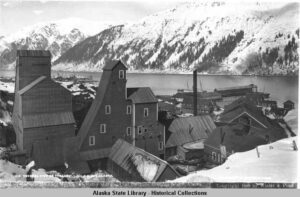
    JUNEAU. It is  ALL THAT REMAINS OF THE TREADWELL MINE DISASTER OF 1917.


    Take a good look at this strange building.  Notice anything?  Look again.  What is a little odd about
    the building?  


    The Treadwell Historic Preservation and Restoration Society restored the shell of the Treadwell pumphouse. Mt. Roberts serves as backdrop. (Katie Bausler)


    Hope you noticed. The stone building is built on top of a tower.  Why?   Because the structure is built 
    in the Gastineau Channel.   A fjord open to the sea.  In other words open to tidal fluctuations.  At high tide
    the building stands alone seemingly on top of the water.  The tidal change in the Channel is immense.

    And on April 22, 1917 there was a remarkably tidal flow heavier than normal.  Unusual.  So What?
    Water is heavy.  Water in a five gallon a tank is almost too heavy to lift.  Now just imagine the incredible 
    weight of the water that flows backend forth through the Channel every day.   Zillians of pounds more than a puny five gallon tank.

    MINING THE TREADWELL MINE


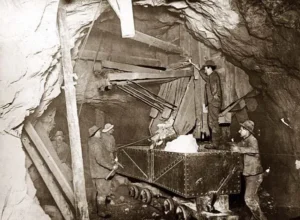
    NOTIEW THAT THE MEN ARE STANDING ON  ON RUBBLE…KNOCKED OFF CEILING, SEPARATED INTO
    ORE AND WASTE….THE ORE WAS HAULED BY HORSES THROUGH MILES OF TUNNELS TO THE 
    SHAFT THEN LIFTED TO THE TOP OF THE MINE AND DELIVERED TO THE STAMPING MACHINES.  WHICH
    BY THE WAY MADE ONE HELL OF A NOISE PULVERISINGTHE ORE INTO FINE SAND.


    FIVE HUNDRED  feet below the Channell, on April 22, 1917 there were 350 miners taking out gold bearing
    ore.  Doing so in a rather odd way to my way of thinking.   They were cutting
    chunks of ore out of the ceiling of the stopes.  Mining above their heads.  Loading the horse drawn
    mine carts with the good stuff and piling the waste rock on he mine floor.  So the stopes of the 
    Mine became high vaulted ‘cathedrals’ in which the miners worked upwards and upwards…standing with
    their tools on the increasing pile of rubble waste.  So what?   So the roof of the cathedral like stopes
    had less and less support.  

     Pillars were left to hold up the ceiling.  These pilars however were often gold bearing…therefore
    valuable as ore, so they were very thin   

    Along with the men there were 13 horses and 1 mule.  These animals had been lowered into
    the mine in slings. Getting them out would be tricky so the horses lived and worked in the  dark most of their lives.
     Most miners loved the horses and the feeling was mutual.  In the darkness
    the horses would whinny with affection as various miners stroked their necks.

    The team, men and horses were sending 5 tons of ore up the shaft
    every day.   

    WHAT IS A STAMP MILL?
    Architectural  drawing of the workings of a stamp mill.   .  Raw ore dumped  in
    stamp mill then pulverized into tiny pieces by power driven  hammer.  The noise
    from the Treadwell stamp mills was terrible.


     The stamping mills allowed mine managers to recover 50% of the gold.
    Arsenic was used to get the remaining gold.  


    The ceiling in mine got higher and higher…and weaker and weaker.


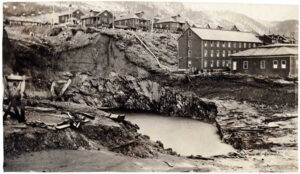
    April 22, 1917   The sudden 
    disappearance of the company swimming pool into this hole was
    the first hint that the whole mine was about to cave in.  An alarm was 
    sounded….men scrambled to get out.  Horses were left behind.


    THE TREADMILL MINE DISASTER


    1.15 A.M.  ARIL 22, 1917  

    “ground around the natatorium (workers swimming pool) and fire hall slipped sideways, then with ‘cracks, groans, and noises of shattering boards’ dropped straight down into the innards of the mine.”


    2.15 a.m.  april 22, 1917

    “another eruption at the cave-in site, a two-hundred-foot geyser of saltwater shot out of the top of the central shaft. The spouting display went on for a full five minutes before it stopped, like fireworks announcing a finale. “ *

    *Sheila Kelly, TREADWELL GOLD


    6.45 a,m.  April 22, 1917  By the time the sun lit the Treadwell Mine buildings the

    vast workings of the Mine were filled with water from the deepest spot 500 feet
    below the Channell to ground level.  Three million tons of seawater ended
    the mines life.  Ten million tons of gold bearing ore had been removed.  In doing so
    45 miles of mine shafts and drift were hollowed out.

    Seventy million dollars worth of gold was produced but it took over 8 tones
    of ore to produced 1 once of gold. (*Is this correct? Seems odd)


    WHY DID THE TREADWELL MINE IMPLODE?

    No one really knows why this happened.  There had been several ground tremors
    in the months prior to the total collapse.  strong hints that something was wrong..
    But little note was taken. 

     And when the cave in happened there were several explanations.

    1)  An extraordinary tidal surge had swept up the Gilford Channell that increased the
    weight of rock, oberburden and water on the stopes.
    2) The  managers of the mine had allowed the internal pillars to be thin and therefore
    incapable of supporting the ceiling.
    3) The mining system of working upwards created huge cathedral like stopes…open
    spaces in these stopes got larger and larger with each working day.  
    4) There was a major fault in the geology of the mine…a weakness.

    WHO WAS SAVED AND WHO WAS LOST

    Water had been pouring into the mine at an accelerating rate but the mine had so many miles of tunnels
    and stopes that there was enough time….barely…to get the miners up the shafts and out.  Luckily the
    collapse happened between shifts and there were not as many men deep down as there would
    have been normally.  350 men got out.  Only one man was not accounted for and
    his disappearance was a mystery.  Mine officials believed he had escaped and just
    took the opportunity to pretend he was lost so his wife could collect insurance
    money which she did after a court case.

    Sadly only 1 horse was brought to the surface.  The other 12 or 13 horses were about to drown
    as the miners emerged from the shaft cage.  The men were distraught as they loved the horses and some of them
    volunteered to go back down the shaft to rescue the horses.  By then, however, it was  too
    late.  They drowned.

    alan

    Post Script    Escaping the Yukon    1) Who was Livingston Wernicke?   2) Who are the Tlingits?