Year: 2022

  • EPISODE 527 THE MAIDENS BLUSH APPLE TREE


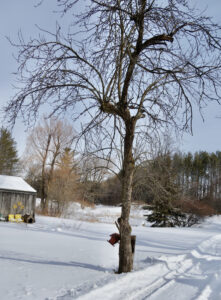
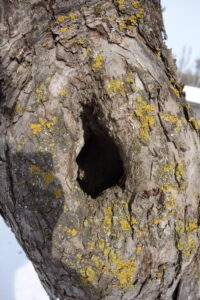
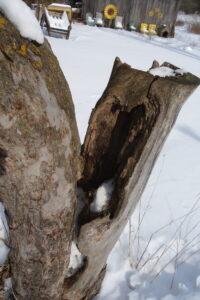
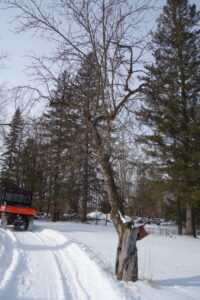
    Peek in this knot hole…Damn red squirrel has filled the apple tree knot hole with walnuts.

    Pomological Watercolor POM00000239.jpg


    EPISODE 527   THE ‘MAIDENS BLUSH’ APPLE TREE.


    alan skeoch
    Jan. 31, 2022


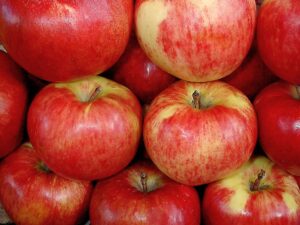
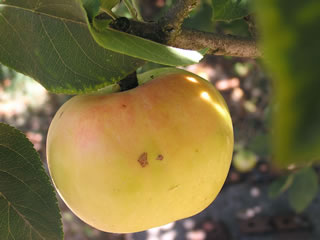
    Maiden’s Blush[59][28][266][267] Pomological Watercolor POM00000239.jpg Burlington, New Jersey, US <1817 W 86, H 69. Stalk 19 mm. A thin-skinned, flattened apple. Pale yellow-green skin has a telltale crimson blush on the side that faced the sun. Flesh white, crisp, very juicy, subacid, good. Susceptible to scab. Heavy annual bearer. Good cooker. Excellent variety for drying because the flesh remains white and bright. Use September – November. Cooking, (Eating)

    The Maiden Blush apple tree is one of the oldest American apples. Coxe wrote in 1817 that Maiden’s Blush apples were popular in the Philadelphia markets of his day. Beautiful apple of pale thin skinned, lemon-yellow color with crimson blush. Flesh is white, sprightly, crisp and tender with a sharp, acid flavor that mellows when fully ripe. Maiden Blush apple tree is an excellent grower, comes into bearing young. Dependable producer, long harvest period, and displays resistance to fireblight. 


    Maiden Blush organic heirloom apple treecdn.shopify.com/s/files/1/0250/1384/6115/products/maiden-blush-apple-tree_360x.jpg?v=1565657765 360w, cdn.shopify.com/s/files/1/0250/1384/6115/products/maiden-blush-apple-tree_540x.jpg?v=1565657765 540w, cdn.shopify.com/s/files/1/0250/1384/6115/products/maiden-blush-apple-tree_720x.jpg?v=1565657765 720w, cdn.shopify.com/s/files/1/0250/1384/6115/products/maiden-blush-apple-tree_900x.jpg?v=1565657765 900w, cdn.shopify.com/s/files/1/0250/1384/6115/products/maiden-blush-apple-tree_1080x.jpg?v=1565657765 1080w, cdn.shopify.com/s/files/1/0250/1384/6115/products/maiden-blush-apple-tree_1296x.jpg?v=1565657765 1296w, cdn.shopify.com/s/files/1/0250/1384/6115/products/maiden-blush-apple-tree_1512x.jpg?v=1565657765 1512w, cdn.shopify.com/s/files/1/0250/1384/6115/products/maiden-blush-apple-tree_1728x.jpg?v=1565657765 1728w, cdn.shopify.com/s/files/1/0250/1384/6115/products/maiden-blush-apple-tree_2048x.jpg?v=1565657765 2048w” style=”box-sizing: border-box; border: 0px; vertical-align: middle; position: relative; max-width: 320px; max-height: 100%; border-top-left-radius: 6px; border-top-right-radius: 6px; border-bottom-right-radius: 6px; border-bottom-left-radius: 6px; display: block; margin: 0px auto; filter: blur(0px); transition: filter 0.4s, filter 0.4s; min-height: 1px; width: 320px; color: rgba(0, 0, 0, 0); font-size: 0px; padding-left: 0px !important;”>


    Is it still alive?   There is (was) a lonely apple tree standing between the 
    farm house and the red barn.  I remember that farm auction as it it was yesterday
    even though it was some 40 or even 50 years ago.

    The farm is located north of Grand Valley, right at the second bridge over the Grand River…east side of 
    the road.  It was a very tidy farm on auction day.   A small farm selling mostly obsolete farm
    equipment that reflected on time when most farms in Ontario were 100 acres in size.
    Farm sales always seem to have a tragic aspect…a feeling that something will be gone and
    never seen again.

    Farm auctions now, in the second decade of the 21st century are rare. So many were put 
    up for sale between the years 1960 and 2000 that observers could not fail to notice
    a great change was happening to rural Ontario.   Surviing farms got larger and larger
    using machines that cost $200,000 upwards.   If the old barns were not pulled down then
    they slowly fell apart with their carcases dotting the landscape like a war zone. Now, in 2022
    even the carcasses are mostly gone.

    So many lost farmsteads that most are lost in the confusion of my memory cells.
    But this one remains.   Why?  Because of one lone apple tree loaded with fruit
    ripe and ready for picking.   The owner was present as were his neighbours.


    Maiden Blush organic heirloom apple treecdn.shopify.com/s/files/1/0250/1384/6115/products/maiden-blush-apple-tree_360x.jpg?v=1565657765 360w, cdn.shopify.com/s/files/1/0250/1384/6115/products/maiden-blush-apple-tree_540x.jpg?v=1565657765 540w, cdn.shopify.com/s/files/1/0250/1384/6115/products/maiden-blush-apple-tree_720x.jpg?v=1565657765 720w, cdn.shopify.com/s/files/1/0250/1384/6115/products/maiden-blush-apple-tree_900x.jpg?v=1565657765 900w, cdn.shopify.com/s/files/1/0250/1384/6115/products/maiden-blush-apple-tree_1080x.jpg?v=1565657765 1080w, cdn.shopify.com/s/files/1/0250/1384/6115/products/maiden-blush-apple-tree_1296x.jpg?v=1565657765 1296w, cdn.shopify.com/s/files/1/0250/1384/6115/products/maiden-blush-apple-tree_1512x.jpg?v=1565657765 1512w, cdn.shopify.com/s/files/1/0250/1384/6115/products/maiden-blush-apple-tree_1728x.jpg?v=1565657765 1728w, cdn.shopify.com/s/files/1/0250/1384/6115/products/maiden-blush-apple-tree_2048x.jpg?v=1565657765 2048w” style=”box-sizing: border-box; border: 0px; vertical-align: middle; position: relative; max-width: 320px; max-height: 100%; border-top-left-radius: 6px; border-top-right-radius: 6px; border-bottom-right-radius: 6px; border-bottom-left-radius: 6px; display: block; margin: 0px auto; filter: blur(0px); transition: filter 0.4s, filter 0.4s; min-height: 1px; width: 320px; color: rgba(0, 0, 0, 0); font-size: 0px; padding-left: 0px !important;”>


    Maiden Blush organic heirloom apple treecdn.shopify.com/s/files/1/0250/1384/6115/products/maiden-blush-apple-tree_360x.jpg?v=1565657765 360w, cdn.shopify.com/s/files/1/0250/1384/6115/products/maiden-blush-apple-tree_540x.jpg?v=1565657765 540w, cdn.shopify.com/s/files/1/0250/1384/6115/products/maiden-blush-apple-tree_720x.jpg?v=1565657765 720w, cdn.shopify.com/s/files/1/0250/1384/6115/products/maiden-blush-apple-tree_900x.jpg?v=1565657765 900w, cdn.shopify.com/s/files/1/0250/1384/6115/products/maiden-blush-apple-tree_1080x.jpg?v=1565657765 1080w, cdn.shopify.com/s/files/1/0250/1384/6115/products/maiden-blush-apple-tree_1296x.jpg?v=1565657765 1296w, cdn.shopify.com/s/files/1/0250/1384/6115/products/maiden-blush-apple-tree_1512x.jpg?v=1565657765 1512w, cdn.shopify.com/s/files/1/0250/1384/6115/products/maiden-blush-apple-tree_1728x.jpg?v=1565657765 1728w, cdn.shopify.com/s/files/1/0250/1384/6115/products/maiden-blush-apple-tree_2048x.jpg?v=1565657765 2048w” style=”box-sizing: border-box; border: 0px; vertical-align: middle; position: relative; max-width: 320px; max-height: 100%; border-top-left-radius: 6px; border-top-right-radius: 6px; border-bottom-right-radius: 6px; border-bottom-left-radius: 6px; display: block; margin: 0px auto; filter: blur(0px); transition: filter 0.4s, filter 0.4s; min-height: 1px; width: 320px; color: rgba(0, 0, 0, 0); font-size: 0px; padding-left: 0px !important;”>


    “Apple tree is loaded,”  I said, testing to see if he was open to conversation. Many owners
    of auction farms are not.   I can tell by the fire pits in the field where all their family documents
    have been burned wiping out memories…or trying to do so.

    “Pick what you want, just going to waste.”
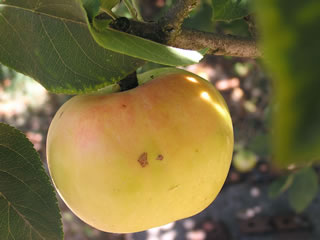
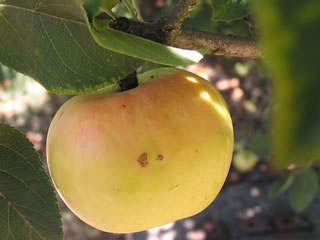
    “Taste nice…sweet .”  As I Remember the apples were green with a bit of yellow, small
    by super market standards…some, however, the size of tennis balls.  And remarkable due
    to the absence of worm holes or apple scab.  This was one nice apple tree.  All with the
    distinctive red ‘blush’…made the apple rather intimate.

    “What kind of apples?”
    “ Maidens Blush”
    “What kind?”  I asked again…not sure of his response.
    “Maidens Blush, old tree.”


    At that Grand Valle auction I bid and won a small box of copper stencils.  Never used.  Must have been a winter plan for
    an orhard that never happened.  Gardeners and farmers do that kind of dreaming in February.  I bought some copper nails 
    and mounted many of these stencils on an old baseboard as a gift for Marjorie.  Selfish kind of gift, I know that.

    Most prominent on the board is the Maidens Blush apple variety which I believed was a lost kind of apple.  Here is the
    list from the stencil board;

    Ontario
    Alexander 
    G. Russet (golden?)
    Baldwin
    Maidens Blush (*several other names, same apple)
    Snow
    Wealthy
    R. Russet (red?)
    Duchess
    Belflower
    Str. Streaks
    Ribston
    B.Orange (b?)
    Wagener
    Spitz
    Mann
    King
    N.Spy (northern)
    Can.Red (canadian?}
    Culvert
    Greenings
    Talman Sweet
    Seek

    APPLE VARIETIES BOGGLE THE MIND

    IN 1905, American pomologist W.H.Ragan published a 400 page book
    titled ’Nomenclature of the Apple’. a compendium of Known apple
    varieties between 1804 and 1904.  The list is enormous….17,000 apple
    varieties?  SEVENTEEN THOUSAND!  All with distinctive names.
    Later the list was pared down to 14,000 when the overlapping names
    were catalogued.  FOURTEEN THOUSAND !   

    The 19th century was a period of ‘unparalleled interest in apples.’
    What kind of apples?  Many were cider apples.  But lots were also
    eating apples…and cooking apples.  Cooking apples … apple pie
    apples in other words.  What variety comes to mind immediately?
    The best cooking apple stencil is on my board…NORTHERN SPY.  Discovered
    almost by accident and rejected initially because colour was not prominent.
    (see source Tom Hensley, June 2,2005)

    MAIDENS BLUSH…RECONSIDERED

    My snap judgment that I had found a lost apple variety of apple on
    that single tree north of Grand Valley was dashed when I punched the
    name into my computer.  Turns out that Maidens Blush was (and remains)
    one of the top ancient apple varieties still grown by heritage apple tree planters.

    A year or so later I found another Maiden’s Blush tree on a doomed orchard
    near Ravenna, Ontario.  Once sold all the field apple trees were uprooted…killed
    so diseases from an uncared for orchard would not contaminate other orchards.
    But the killers missed one tree that grew near the house…a Maiden’s Blush
    survivor I was told.  Truth?  I rely on the former owner for that.

    Damned if there isn’t even a winery in the Napa Valley of California that
    markets an apple wine under the name ‘Maiden’s Blush’.  See Nashoba
    Valley Winery.   49% percent Maidens Blush., 49% pears, 2% elder berries.
    Wouldn’t it be nice to buy a bottle…cost about $20 Canadian.  Doubt 
    carried in Canadian Liquor Stores.

    It is even possible to buy a Maiden’s Blush Cultivar for $44.90…were 
    they not sold out.  Sold out means apple fanciers are still planting Maiden Blush
    apple trees in 2022…in the 21st century.


    Maiden Blush Apple

    • $44.90

    The Maiden Blush apple tree is one of the oldest American apples. Coxe wrote in 1817 that Maiden’s Blush apples were popular in the Philadelphia markets of his day. Beautiful apple of pale thin skinned, lemon-yellow color with crimson blush. Flesh is white, sprightly, crisp and tender with a sharp, acid flavor that mellows when fully ripe. Maiden Blush apple tree is an excellent grower, comes into bearing young. Dependable producer, long harvest period, and displays resistance to fireblight. Please see below for further information on our organically grown Maiden Blush apple trees for sale.

    Maiden's Blush

    An award winning rose made from 49% Apples – 49% Pears – 2% Elderberries. Subtly perfumed, with an alluring flavor of apples, pears and elderberries. Similar in style to White Zinfandel. Named after the Maiden’s Blush apple, one of over 80 “antique” apple varieties grown in our orchard.


    CONCLUSION


    ART AND THE APPLE: 

    I HAVE already written 3 Episodes on apples.  Probably overkill for most readers.
    Let me leave some fine art as a conclusion.   Apple artists have left all of us a legacy
    of artistic treasures…apple varieties with romantic names.

    Pomological Watercolor POM00003442.jpg


    STURMER PIPPIN    1831 SUFFOLK, ENGLAND

    Sturmer Pippin[370][6][8][21] Pomological Watercolor POM00003442.jpg Sturmer,Haverhill, Suffolk, England <1831 A bright greenish-yellow apple with a reddish-brown blush, often on one face only. W 69, H 62. Stak 12–25 mm. Flesh white, crisp, juicy, subacid, aromatic. One of the best English keeping apples, with proper storage Sturmer Pippin lasts 4 to 5 months. Flavour is sprightly, more sharp than sweet when first picked, but improves dramatically in storage, becoming sweeter and richer, while maintaining its crisp texture. This keeping ability made it ideal for long journeys, as such, it was brought to Australia where it is still widely grown. Parent of Granny Smith. Pick mid October. Use January – April.


    Pomological Watercolor POM00004125.jpg

    WHITE PIPPIN   CANADA USA 

    White Pippin(syn. Canada Pippin)[3][392] Pomological Watercolor POM00004125.jpg US or Canada A yellow apple. W 80, H 65-70. Stalk 12-18 mm. Flesh white, crisp, juicy, subacid, very good to best. Use January – March.


    Pomological Watercolor POM00001261.jpg

    WINTER MAIDEN’S BLUSH    1850 USA


    Red astrachan.jpg

    RED ASTRACHAN    1800
    Red Astrachan[6][325][326][327] Red astrachan.jpg Russia or Sweden c. 1800 Extremely resistant to frost. H 76, W 82. Flesh white, fine, crisp, tender, juicy, subacid, aromatic, good to very good. The tree does not attain a large size. Pick and use in August. Cooking


  • Fwd: EPISODE 524 THE HEREFORDSHIRE POMONA 1885 BY EDITH BULL AND ALICE ELLIS (TWO FORGOTTEN LADIES)


    EPISODE 524   THE HEREFORDSHIRE POMONA 1885 (by Edith Bull and Alice Ellis – two forgotten ladies)


    alan skeoch
    January 30, 2022


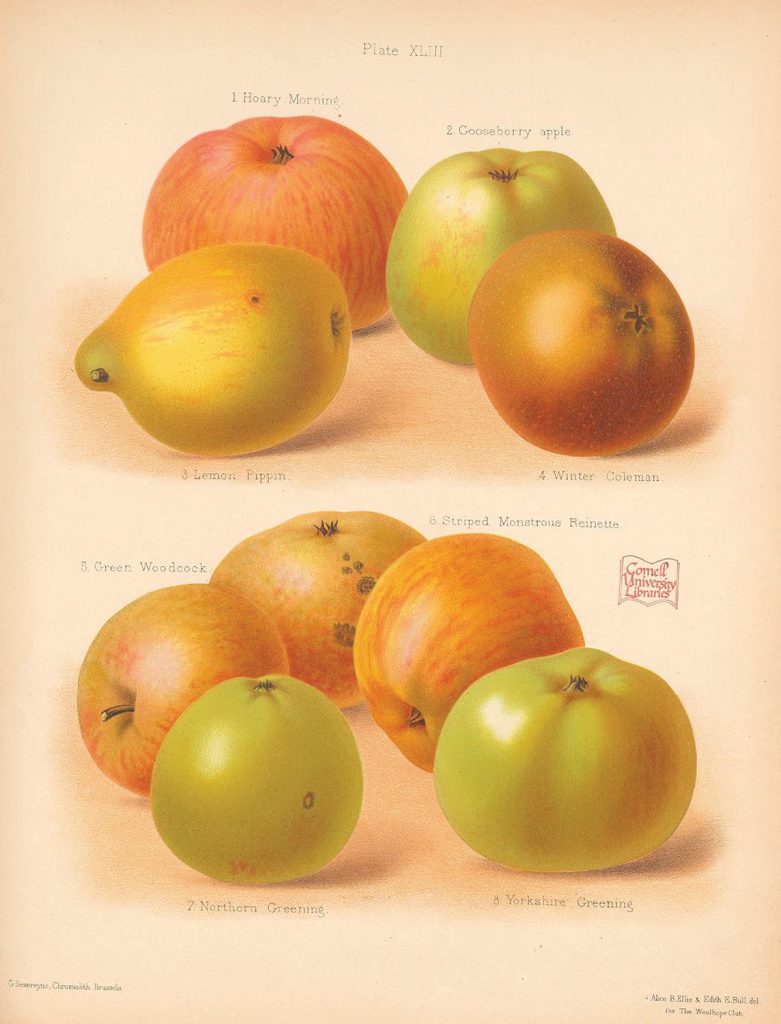
    I love the way the ladies included apple blemishes…so true to life.

    Edith Bull © Herefordshire Libraries, Herefordshire History project <a href=www.herefordshirehistory.org.uk” style=”max-height: 1021px;” apple-inline=”yes” id=”30F2CC7C-B2B5-4A14-8C31-597BDD5E6938″ src=”https://alanskeoch.ca/wp-content/uploads/2022/01/8-Edith-Bull.jpg”>
    Edith Bull at her easel….where is a picture of Alice Ellis?…these
    two ladies painted apples for several years of their lives…but
    both are forgotten. Did Edith really paint apples with that dress on?

    Illustration of a variety of apple cultivarsblog.biodiversitylibrary.org/wp-content/uploads/sites/4/2018/06/12-229×300.jpg 229w, blog.biodiversitylibrary.org/wp-content/uploads/sites/4/2018/06/12-586×768.jpg 586w, blog.biodiversitylibrary.org/wp-content/uploads/sites/4/2018/06/12-781×1024.jpg 781w” sizes=”(max-width: 450px) 100vw, 450px” apple-inline=”yes” id=”968BFFCF-C054-4FD4-92DD-9228EF2B9129″ src=”https://alanskeoch.ca/wp-content/uploads/2022/01/12.jpg”>

    Henry Bull…his daughter, Edith Bull, should be famous but
    seems to be forgotten along with Alice Ellis.

    Apple Picking, Pomona Farm - Herefordshire History

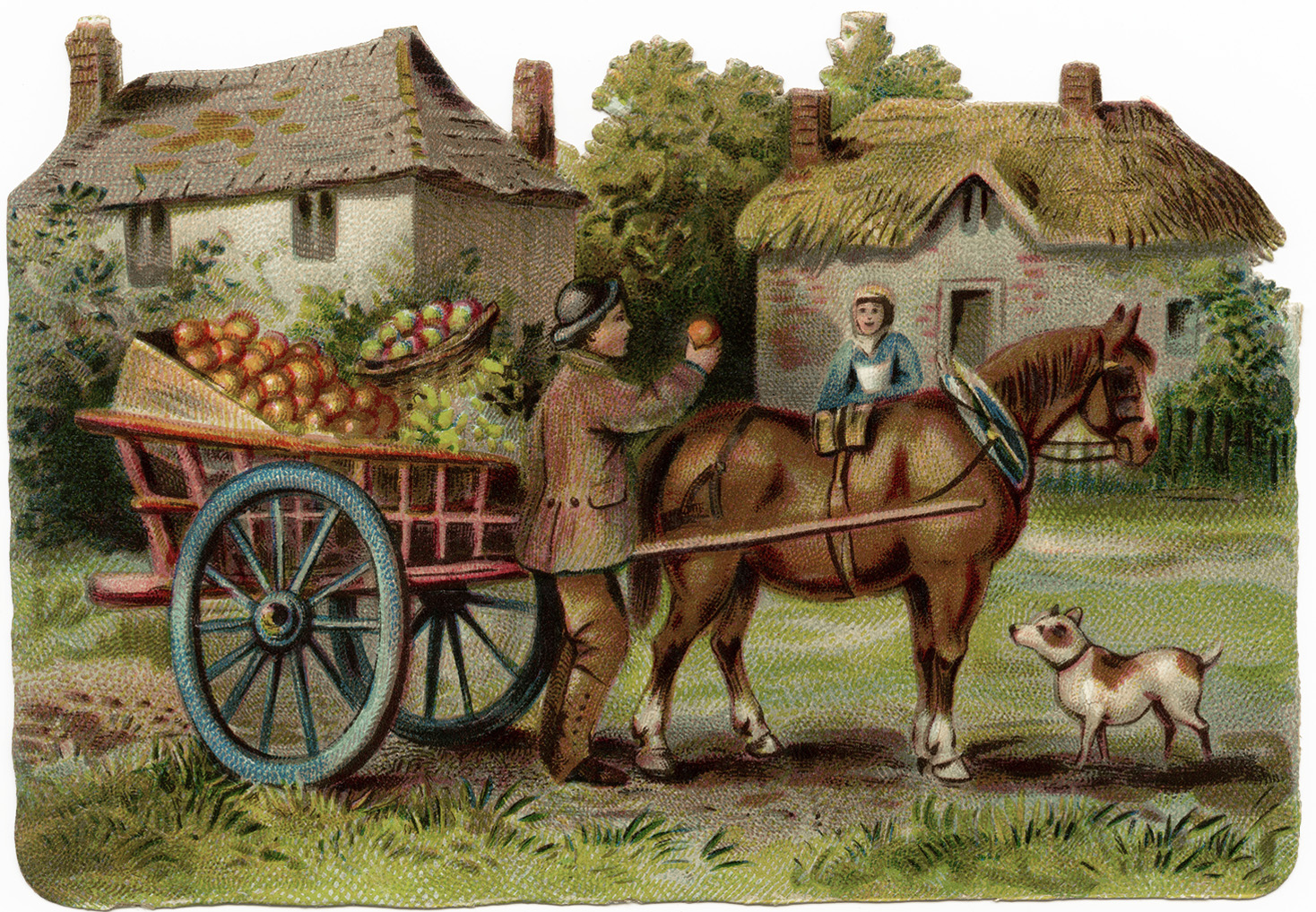
    Picking apples with a shovel…


    vintage farm clip art, printable farm horse illustration, horse drawn apple cart, farmer selling apples, Victorian country sceneolddesignshop.com/wp-content/uploads/2014/07/OldDesignShop_HorseAppleCart-1024×709.jpg 1024w, olddesignshop.com/wp-content/uploads/2014/07/OldDesignShop_HorseAppleCart.jpg 1468w” sizes=”(max-width: 300px) 100vw, 300px”>

    Picking apple by hand….


    The Herefordshire Pomona - Adam&#39;s Apples


    “Hey, Marjorie, I just got an email from Dan…he found a copy of the Herefordshire Pomona for sale.”
    “You should buy it…You’ve been talking about the book for60 years.:”
    “Good idea…we should buy it.  But there is one small problem.
    “Which is?
    “The price.”
    “I bet it’s around $100…rare book.”
    “Guess again.”
    “How much?”
    “$17,937.98”
    “What!  You must be kidding!”
    “No…that’s U.S. Funds and does not include the $20 shipping.”
    “We can only afford the shipping…twenty bucks.”

    “Why is it so expensive?”
    “That is my story today…it’s quite a story…I have been thinking how to start the story…how to
    engage readers.   That $17,937.98 price should do it.”
    “What was your original plan?”
    “I felt those two women who spent years drawing and using water colours to illustrate apples
    would be a good start.   But the story is so complicated that much could be lost.”
    “What were their names?”
    “Alice B. Ellis and Edith E. Bull.”
    “Pictures of them?”
    “Only a picture of Edith Bull in front of her easel….all I could find.”

    Golden Olden for the Modern Age: New Online Apples & Cider Collection –  Mann LibraryBonhams : HOGG (ROBERT) and HENRY GRAVES BULL The Herefordshire Pomona,  Containing Coloured Figures and Descriptions of the Most Esteemed Kinds of  Apples and Pears, 2 vol. in oneThe Herefordshire pomona 6 Painting by Artistic RifkiBonhams : HOGG (ROBERT) and HENRY GRAVES BULL The Herefordshire Pomona,  Containing Coloured Figures and Descriptions of the Most Esteemed Kinds of  Apples and Pears, parts 1-5 (of 7) in 2 vol.The Herefordshire Pomona – Biodiversity Heritage Library


    “And concluded by welcoming very cordially the presence of the two ladies, Miss EUis and Miss Bull, whose great artistic talents have enabled the committee to publish that magnificent work The Herefordshire Pomonawork that will carry down the renown of the Woolhope Club for many generations to come.

     April 3, 1883   WOOLHOPE NATURALIST FIELD CLUB”


    “Did the ladies come up with the idea of chromolithographs of all the apples in Herefordshire?”
    “No…the idea grew from conversations between three men and a wealthy supporter.”
    “When?”
    “Between 1876 and finally published in 1885….these guys were members of the Woolhope Naturalist 
    Club in Hereford…”
    “Woolhope…what?”

    “Woolhope Naturalist Club…around 200 well healed men determined to unravel the mysteries of
    the world around them.  They collected fossils, dug up Roman forts, admired ancient oak trees, 
    collected and illustrated mushrooms…then published their discoveries.  Their reports are all on 
    the internet if you can find them…hundreds and hundreds of pages with  few illustrations.  These
    were not dabblers…these were Victorian men, most men, prompted, I guess, by the work
    of Charles Darwin.”
    “Fungus and mushrooms…sounds sort of odd.”
    “The Woolhope Club was not just devoted to apples.  As a matter of fact the mention of
    the Hereford Pomona is not easy to find in the club minutes.”

    page77image899146688


    Doctor Robert Hogg, 1886.


    Reverend Charles Bulmer.   (His two sons founded Bulmer’s Cider Company which
    eventually dominated cider production in Herefordshire now sold under Strongbow name I believe)


    Doctor Henry Graves Bull (1818-1885)  (His daughter Edith Bull and Alice Ellis 
    used watercolours to paint all the apple and pear varieties in years between 1876 and 1883)


    Lot 88 - Hogg, Robert and Bull, Henry Graves


    STEPS THAT LED TO CREATION OF THE HEREFORDSHIRE POMONA

    1) June 1876: Reverend Charles Bulmer invited Doctor Henry Graves to see the apple exhibition in Hereford
    Doctor Hogg was worlds leading expert on apples in 1876…published the 759 page “Fruit Manual” for head gardeners.
    Reverend Bulmer was vice at Credenhill , Herefordshire, and a member of the Woolhope Naturalists Field Club and had
    just won second prize for his perry (Pear Wine) perhaps judged by Dr. Hogg at the Bath and West Show of 1876.

    2) The Woolhope Naturalists Field Club members were interested in diverse subjects from Roman ruins to Ancient Oak trees to fossils,
    mushrooms and apples,  etc. etc.  The minutes of the Woolhope Club can be found on the internet…hundreds and hundreds
    of pages, mostly print, several engravings.  In 1876 Club members were worried about neglect of Hereford orchards making
    the apples an pears unmarketable. The question:”Why are so few of our apples in grocery stores?” (my question imposed)
    “We owe it to those who come after us to maintain an strengthen our title to the garden of England!” (Club comment in 1876)

    3) Oct. 14, 1875: Woolhope Naturalist Club has its first apple and pear exhibition to try snd identify local varieties.  On display 
    were 128 apples and 62 pears.  This was big step that was to become immense in subsequent years.

    Exhibitions in Hereford

    1875  — 128 apples
    1876  __ 637 apples and pears
    1883 __  2.500 apples on display inside in Hereford
                   1,000 apples on display outside in Hereford

    1883 __  10,500 apple varieties in national exhibition Oct. 4 to 25 Chiswick
    1885__   600 copies of Herefordshire  Pomona 


    4) 1878:  Dr. Hogg offers to promote and record apples and pears worthy of attention and cultivation.
    The ides of a “Herefordshire Pomona” is born with Dr. Henry Bull as general editor and Dr. Hogg as
    technical editor.

    5) 1878-1883: Two ladies recruited to do the illustrations,  Edith Bull and Alice Ellis, to replicate worthy
    apple and pear varieties for chromolithographic reproduction. Alice Blanche Ellis was a gold medal winner
    from a Bloomsbury School of Art (no picture that I could find) while Ediths Elizabeth Bull was Doctor
    Bull’s daughter (picture included)

    Edith Bull © Herefordshire Libraries, Herefordshire History project <a href=www.herefordshirehistory.org.uk” style=”max-height: 1049px;” apple-inline=”yes” id=”E728D8EE-96E6-44EF-926E-8CEEFE24D3D4″ src=”https://alanskeoch.ca/wp-content/uploads/2022/01/8-Edith-Bull-1.jpg”>


    6) 1885:  Herefordshire Pomona completed with 600 copies of the two volumes book finished…”the most 
    perfect and thorough and artistically beautiful work ever published on the subject.” (Woolhope Transactions 1884)
    Chosen: 262 apples and 169 pears in “lavish chromolithograph plates from watercolours”


    The National Apple Congress exhibition. The Gardeners Magazine Vol 26 20 October 1883 © RHS Lindley Collections


    7)  1883  National Apple Congress in Chiswick Gardens was major, indeed phenomenal success with 236 exhibitors
    and 10m500 dishes of apples.  When closely examined there were 1,545 varieties classified by purpose, season, size, 
    shape, surface texture and colour.  “Never before had so many varieties even brought together in one place,
    and probably never will again.” (Jane Morgan)  The best eating apples were names..King of the Pippins, Cox;s
    Orane Pippin and Ribston Pippin.

    The National Apple Congress was so popular that railway companies offered cheap tickets so working class
    people could attend and the exhibit was extended a week. 
    Sketches “from a jocular point of view” at the Apple Congress at Chiswick 20 October 1883 © Illustrated London News Ltd Mary Evans
    Drawings from the Apple Congress ar Chiswick, Oct 20, 1883

    “Visitors are requested not to touch the fruit”…obviously being ignored in sketch

    8) Soon afterward Reverend Bulmer’s two sons constructed a cider factory in

    Hereford that  became the world’s largest cider maker  and Herefordshire still

    has more apple orchard than any other county in the United Kingdom.


    (See “When Doctor Hogg Went to Hereford)


    PIUTTING EDWARD FREEMAN BACK IN THE STORY

    “ALAN, the apple paintings/engravings are stunning but what motivated you to do all 
    this research?”
    “Granddad did.”
    “You said that you knew little about his life.”
    “He was born in 1871, that makes him  5 years old in 1876 when sudden interest in apples began.
    “Too young to know an apple from a soccer ball.”
    “True but that would make him 12 years old in 1883 when the Hereford Pomona was released.”
    “On the verge of adulthood back then…at 12 he became a gardener’s boy and then in 1884 a gardener apprentice
    and y 1894 soon to become the head gardener of Eywood Court in 1898.”
    “He grew up with this apple hysteria in full bloom.”

    “How old were those apple trees at Eywood?”
    “”Never saw them.”
    “There were two walled gardens…first one was a kitchen and flower garden…then
    behind the dividing wall was the orchard where some scraggy looking apple trees stood … bet dollars
    to doughnuts those trees dated back to Edward Freeman’s time.  Apple trees can live
    for 60 years or more.”
    “Do you know for sure that Edward Freeman was interested in apples?”
    “I do.  this is the year 2022 and there is still one last apple tree in granddads Canadian orchard.  It looks
    bad, uncared for, but it is still alive.  That tree and others were in full life when Was in the garden seventy years ago.”

    “What kind of apples?”
    “Wormy apples…scabby too.”
    “But what kind of apples?”
    “Might be neglected MacIntosh…I have no idea though.”

    “How do apple trees get their names?”
    “Same way as street names…some person gives them a name.”
    “Why not name that tree then?”
    “NO.”
    “Why not?”
    “I have my eye on a wild apple tree near the field gate.”
    “Wild apples are no good.”
    “Usually so…but every once in a while a wild tree turns out to be swell”
    “And the name?”
    “Pick a name…I am open to suggestions.

    “What does the tree look like?”
    “not likely to win a beauty contest but last year the apples were nice”
    “Name?”
    “Open to all … Name the tree!”

    alan skeoch
    Jan. 30,, 2022

    Le Herefordshire pomona, contenant des figures de couleur et descriptions  des types les plus estimés de pommes et de poires. Hereford, [Eng.]Jakeman  et Carver, 1876-85. <a href=biodiversitylibrary.org/page/55785600 Photo Stock – Alamy” apple-inline=”yes” id=”20CE5F97-983A-431F-AB99-7C5442E5F816″ src=”https://alanskeoch.ca/wp-content/uploads/2022/01/images-7.jpeg”>49 ideeën over Herefordshire Pomona in 2021 | botanische tekeningen,  appels, planten


    POST SCRPT:   THE NOTE SENT TO ME BY DAN BOWYER RE: PRICE OF MINT CONDITION HEREFORDSHIRE POMONA


  • EPISODE 522 HARD CIDER AT ASCHOOL DANCE leads to the HEREFORDSHIRE POMONA

    EPISODE 522   HARD CIDER AT A SCHOOL DANCE LEADS TO HEREFORDSHIRE POMONA


    alan skeoch
    january 28, 2022

    The Herefordshire Pomona, containing figures and descriptions of the most  esteemed kinds of Apples and Pears, Volume 2 only with 77 fine  chromolithographs colored from Nature by Miss Ellis and Miss Bull
    The Redstreak apple … one of the most famous apples in the world

    HEY, KID! DO YOU WANT A SLUG OF HARD CIDER?
      Date  October, 1953
      Place  Humberside Collegiate auditorium
      Purpose:  School Dance
      Startling Event:  Crock of hard cider passed around
      Person: Alan Skeoch, Grade 9

    “Here take a slug of this, kid…right from the gallon crock.”
    “What is it?”
    “Never you mind…take a slug or pass it on.  Consider 
    the stuff an initiation into high school.”
    “But what is it?”
    “Grow up kid, it’s just hard cider…Ontario hard cider….won’t kill you.”
    “Not too sure.”
    “Your a big man now, kid…no short pants anymore…take a slug.”

    That happened a long time ago.  Back in 1953 at Humberside Collegiate’s first fall dance.  My eyes were wide
    open…saucers taking  in a new world of big kids.  I think I took a slug but not too sure.  I know I whirled Elizabeth 
    Kilty a little too fast on the dance floor and her skirt went up like Marilyn Monroe’s.  That could have been the hard
    cider at work.

    Hard cider!  Quite common and not wonderfull…looked sort of muddy and tasted way too sweet to be enjoyed.
    Years later I discovered why this elicit booze was not so great.   Our cider, Ontario cider in unlabelled gallon crocks
    was made with windfall applies likely.  Apples from a bunch of trees.  Maybe even wormy!  Who could tell if worms
    were present once the apples were ground to pulp with a spiked roller and then pressed in a wooden press
    that had been sitting in a barn or back yard garage for a year.

    I never developed a taste for hard cider after that welcome by the big boys at Humberside.

    Never is the wrong word.  In 1965 , Marjorie, Eric and I lived on hard cider for one wonderful summer.
    Bulmer’s hard cider and the occasional mug of  “Scrumpy” from beneath a pub plank counter.  The
    scrumpy reminded me of the gallon crock stuff.  But the commercial Bulmer’s cider was wonderful
    and inexpensive.  Our tour of England, Ireland and Scotland in 1965 floated on English cider…Herefordshire
    English cider in heavy glass quart bottles with stoneware screw tops.  Available everywhere along with
    all kinds of cheeses and great turtle shaped loaves of fresh bread.  The cost was minimal and the place
    to dine could be a dry stone fence or a great pile of loose stacked hay in a farm field.

    That kind of cider is sold in LCBO stores even today.  About $3 a can.  No stone topped bottles anymore.


    WHY IS HEREFORDSHIRE CIDER SO ADMIRED BY THOSE WHO THIRST”

    “The Redstreak cider apple is one of the oldest cider apples in circulation.   A few books establish the Redstreak  cider apple trees to Herefordshire in 1600’s. One book notes the Redstreak cider apples were considered ‘fit for Princess’ establishing Herefordshire’s reputation as the cider country of England. Produces a good quality bittersweet juice, an excellent addition for blending. The fruit is medium to small yellow apple with red strip

    (ADVERTISEMENT by one Hereford nursery now offering Cider Apple trees at $44.90 each)

    What is so special about English cider…especially Herefordshire English cider?  It’s the apples.
    Special cider applies…the greatest of which was the REDSTREAK.  Not a spectacular apple.  Very
    nondescript…small, perhaps a bit of apple scab…yellow background with red streaks…bitter sweet 
    taste.  Definitely not an eating apple or an applesauce apple.  But a perfect cider apple.  Proved so
    by centuries of care.  Imported into Hereford and named the “Scudamore Crab“, having first been intensively planted by the diplomat and politician John Scudamore, 1st Viscount Scudamore from France  and grown
    on his country estate.  Noted as being present as far back as 1600.

    DO NOT BUY APPLE REDSTREAK APPLE SEEDS…APPLES DO NOT BREED TRUE.

    Apples do not breed true.  Orchards with mixed varieties will never produce Redstreak apples.  
    They must be grafted from cuttings.  Edward Freeman, my grandfatheer, was good at grafting.  Our farm once had
    wild apple trees on which he grafted prize apples but granddad never produced fine cider.
    His alcohol thirst was satisfied with rhubarb wine and the occasional bottle of whisky that mom
    smuggled into the fifth line kitchen unseen by the ‘lips that touch liquor will never touch mine’ crowd.
    Granddad did love apples and he knew how to get apples with his grafting knife and wax.
    I remember some branches on Edward Freeman’s wild apple trees we’re loaded with fruit while
    the rest of the tree had tiny apples or none at all.  I was too young to know that Edward Freeman had 
    been busy grafting.

    Hereford Redstreak
    Herefordshire Redstreak apple today…small, bitter, bit of scab…and lots of thick skin..perfect for cider.

    This is only the beginning of my apple episode.  A teaser.  The bigger story is coming.  Previous episodes have
    outlined the nature of the Country Estates…up to 5,000 o them…that were being built and renovated by
    affluent English families during the 18th and 19th centuries.   Along with the renovations came the desire
    to develop unique gardens with plants gathered by plant collectors roaming the seven seas.    Some plants 
    did not need to be distant.  There were so many apple varieties in England that many had no names. Thousands
    of apple varieties most of them unidentified.
    Not for long.   Head Gardeners and owners of these country estates began paying attention to the wealth of apple varieties, particularly those
    in Herefordshire.   Walled gardens had sections for fruit orchards…exotic fruit like peaches and nectarines but
    also apples and pears.  My grandfather, Edward Freeman, was one of these head gardeners for a short few years between 1898 and 1906
    at Eywood Court in Herefordshire.  Some of His plantings still existed in the 1960’s, perhaps still do.

    From 1878 to 1884 or thereabouts two women were at work with paint brushes making Hereford Apples 
    famous among art lovers and gardeners.
    The most spectacular art of the apple emerged at the same time as the gardeners nursed their orchards from decline
    to explosive growth.
    What emerged was one of the wonders of the world of the
    apple.  Two volumes of wonderful art were produced by two ladies between 1878
    and 1884 titled THE HEREFORDSHIRE POMONA.  Only 600 copies were printed. Volumes
    that are so highly valued today that when copies were moved from one place to another
    they were accompanied by armed guards. (*that will be subject of Episode 523 coming next)

    Book breakers have broken the spines of many of these books and then professional 
    framers have enclosed the apple artwork into high cost lithographic art.
    Shortly after 1965 Marjorie and I were able to buy two of these pages.  They now
    hang in our house.  Visitors hardly notice them.  Who would want a picture of
    a bunch of apples in their living room?  One of these (right in picture below) is
    the famed Redstreak now lost to the world.


    Our living room is small but features two very famous lithographs on the north wall…see them?


    One is more famous than the other…our dog Woody is aligned perfectly…his body
    points to the picture.  See it?

    Close up…just a picture of some apples, right?  Wrong…picture of the Redstreak
    apple variety.  Now believed to be extinct.


    THE famed redstreak cider apple…the cornerstone of great hard cider.  Nondescript
    in appearance.  Small.  yellowish skin covered with red streaks. Not tasty.  But when converted from apple juice to hard apple
    cider a wonder happens.

    ‘Redstreak’
    Redstreak apple.jpg
    Species Malus domestica
    Breeder John Scudamore, 1st Viscount Scudamore
    Origin upload.wikimedia.org/wikipedia/en/thumb/b/be/Flag_of_England.svg/46px-Flag_of_England.svg.png 2x” data-file-width=”800″ data-file-height=”480″ style=”border: 1px solid rgb(234, 236, 240); vertical-align: middle;”> England, 1600s.
    “The Redstreak, also spelt Redstrake, Red Streak or Red-streak, is or was a very old variety of cider apple formerly commonly planted in England.
    It is sometimes referred to as the Herefordshire Redstreak or Old Redstreak to distinguish it from later-developed varieties, such as the Somerset Redstreak, with a similar name.

    Excerpt from Wikipedia below


    The variety is traditionally said to have first appeared in the early 17th century; John Evelyn recorded that it was originally named the “Scudamore Crab“, having first been intensively planted by the diplomat and politician John Scudamore, 1st Viscount Scudamore.[1] Scudamore’s efforts in improving and raising fruit trees on his estate at Holme Lacy were an attempt to match the superior French cider available at the time.[2] Scudamore had been ambassador to France, and supposedly raised this apple from a pip brought back from there.
    During the 17th century, the Redstreak (as the apple was later to become known) became celebrated as the finest cider apple variety in England, and was the source of Herefordshire‘s reputation as the premier cider-producing region in the country.[3] Scudamore himself assisted in popularising the drink, having tall, elegant glasses for it engraved with his and the royal arms, and setting up large-scale production at Holme Lacy, where the cider was bottled and kept in water-cooled cellars.[4]
    For a time cider made from Redstreak apples changed hands at extraordinarily high prices – as high as the best imported wine – but by the late 18th century the variety was already in decline.[3] By the 19th century the Redstreak was reported to be almost extinct, much like the Styre, another formerly well-known cider apple variety that had suffered from an apparent decline in quality and productiveness. Thomas Knight‘s Pomona Herefordiensis (1811), noted that “trees of the Red-streak can now no longer be propagated; and the fruit, like the trees, is affected by the debilitated old age of the variety, and has in a very considerable degree, survived those qualities to which it was owing its former fame”.
    This decline may have occurred in older apple cultivars as viruses gradually built up in their tissues over time and were transferred during propagation, with increasing negative effects on productiveness, vigour and even flavour.[5]
    Herefordshire Redstreak” apples are currently available from some nurseries, but it is unclear whether these are related to the original variety, which may now be extinct.”

    CONCLUSION…BUT NOT THE END OF THE STORY

    Over my lifetime I have found and tasted many wild apples whose parent tree was
    planted by birds and animals.  Each wild tree is approached with hope and wonder but
    none have approached the Redstreak.   But how would I know?   Honestly I will
    never know because few have ever been crushed and squeezed .  I may have
    missed the great Canadian cider apple.

    Next Episode “  THE STORY OF THE HEREFORDSHIRE POMONA
                     (Includes the Redstreak Cider Apple…when I tell this story I get
                      emotional…such a wonderful story.)


    post script:  Some cider apples trees available today in Herefordshire nursary


    • Bramley's Seedling apple tree
      Bramley is the essential English cooking and sharp cider apple, famous for its rich tangy acidity.
      • Awards: RHS AGM (current)
      • Picking season: Late
      • Pollination group: 3
      • Self-fertility: Not self-fertile
    • Cider apple tree

      Brown Snout

      Brown Snout cider apple tree
      A traditional English bittersweet cider apple.
      • Pollination group: 6
      • Uses: Hard cider
      • Self-fertility: Not self-fertile
    • Cider apple tree

      Brown’s Apple

      Brown's Apple cider apple tree
      Brown’s Apple is a traditional English cider apple variety producing a sharp juice.
      • Pollination group: 5
      • Uses: Hard cider
      • Self-fertility: Not self-fertile
    • Cider apple tree

      Bulmers Norman

      Bulmers Norman cider apple tree
      A traditional English bittersweet cider apple.
      • Pollination group: 3
      • Uses: Hard cider
      • Self-fertility: Not self-fertile
    • Cider apple tree

      Chisel Jersey

      Chisel Jersey cider apple tree
      Chisel Jersey is a traditional English hard cider apple variety, producing a bittersweet juice.
      • Pollination group: 6
      • Uses: Hard cider
      • Self-fertility: Not self-fertile
    • Cider apple tree

      Dabinett

      Dabinett cider apple tree
      Dabinett is a traditional English cider apple variety, producing a bittersweet juice.
      • Pollination group: 6
      • Uses: Hard cider
      • Self-fertility: Self-fertile
    • Cider apple tree

      Ellis Bitter

      Ellis Bitter cider apple tree
      Ellis Bitter is a traditional and popular English cider apple, producing a bittersweet juice.
      • Pollination group: 5
      • Uses: Hard cider
      • Self-fertility: Not self-fertile
    • Cider apple tree

      Geneva Tremlett’s Bitter

      Geneva Tremlett's Bitter cider apple tree
      A bittersharp cider apple variety, found at the USDA repository at Geneva, but probably of English origin.
      • Pollination group: 4
      • Uses: Hard cider
      • Self-fertility: Not self-fertile
    • Cider apple tree

      Harry Masters Jersey

      Harry Masters Jersey cider apple tree
      Harry Masters Jersey is a traditional English cider apple variety, producing a bittersweet juice.
      • Pollination group: 4
      • Uses: Hard cider
      • Self-fertility: Not self-fertile
    • Cider apple tree

      Kingston Black

      Kingston Black cider apple tree
      Kingston Black is one of the premier English cider varieties and produces a bittersharp juice.
      • Pollination group: 4
      • Uses: Hard cider
      • Self-fertility: Not self-fertile
    • Cider apple tree

      Major

      Major cider apple tree
      A traditional English bittersweet hard-cider variety.
      • Pollination group: 3
      • Uses: Hard cider
      • Self-fertility: Not self-fertile
    • Cider apple tree

      Porter’s Perfection

      Porter's Perfection cider apple tree
      Porter’s Perfection is a 19th century English cider variety producing a bittersharp juice.
      • Pollination group: 3
      • Uses: Hard cider
      • Self-fertility: Not self-fertile
    • Cider apple tree

      Somerset Redstreak

      Somerset Redstreak cider apple tree
      An English cider apple variety producing a very high-quality bittersweet juice.
      • Pollination group: 5
      • Uses: Hard cider
      • Self-fertility: Not self-fertile
    • Cider apple tree

      Stembridge Cluster

      Stembridge Cluster cider apple tree
      A traditional English bittersweet cider apple from the town of Stembridge in Somerset.
      • Pollination group: 2
      • Uses: Hard cider
      • Self-fertility: Not self-fertile
    • Cider apple tree

      Stoke Red

      Stoke Red cider apple tree
      A traditional English cider apple producing a bittersharp juice.
      • Pollination group: 6
      • Uses: Hard cider
      • Self-fertility: Not self-fertile
    • Cider apple tree

      Sweet Coppin

      Sweet Coppin cider apple tree
      A traditional English cider variety, producing a sweet juice.
      • Pollination group: 3
      • Uses: Hard cider
      • Self-fertility: Not self-fertile

    Excerpt from the Hereford Pomona below…work done by two ladies who should never be forgotten.
    see next Episode for full  story.  There is quite  a difference between an apple photograph (page above) and the
    apples painted in the Herefordshire Pomona, (page below)

    The Herefordshire Pomona – Biodiversity Heritage Library

  • Fwd: Ben Franklin’s Quotes

    Seems that Ben Franklin has some good one liners like Napoleon.  This list was sent

    to me by Dan Bowyer, friend and fellow teacher of history. *He that falls in love with himself will have no rivals.”
    The Narcissus syndrome.

    alan skeoch
    Jan.28, 2022


    Be at war with your vices, at peace with your neighbors, and let every New Year find you a better man.

    Diligence is the mother of good luck.

    Love your enemies, for they tell you your faults.

    He that would live in peace and at ease, must not speak all he knows or judge all he sees.

    Great beauty, great strength, and great riches are really and truly of no great use; a right heart exceeds all.

    He that falls in love with himself will have no rivals.

    The sting of a reproach, is the truth of it.

    Reading makes a full man, meditation a profound man, discourse a clear man.

    Beware of little expenses: A small leak will sink a great ship.

    Hide not your talents, they for use were made: What’s a sun-dial in the shade?

    Do you love life? Then do not squander time, for that is the stuff life is made of.

    Well done is better than well said.

    Glass, china, and reputation, are easily crack’d, and never well mended.

    He that lies down with Dogs, shall rise up with fleas.

    Genius without education is like silver in the mine.

    If man could have half his wishes, he would double his troubles.

    The poor have little, beggars none, the rich too much, enough not one.

    Don’t throw stones at your neighbors, if your own windows are glass.

    A true friend is the best possession.

    Wish not so much to live long as to live well.


    Also attached…picture of Frank Freeman’s folk art version of a biplane that Sam Markou has
    researched and identified.  Not a Camel as John Wardle said.