Year: 2022

  • EPISODE 278 SOCKEYE SALMON

    EPISODE 578   SOCKEYE SALMON ..AND BRISTOL BAY


    alan skeoch
    May 7, 2022

    See that little red dot?  That is the site of the Pebble Mine.  We worked 
    somewhere in the centre in 1959;


    If you eat canned salmon, odds are it came from Bristol Bay, Alaska.


    Sockeye salmon….milions of them…startled us.  We came looking for mineralization.


    we did not know that sockeye
    salmon from Bristol Bay, Alaska. are highly valued  They provide 47% of the wild salmon
    fishing industry in the world.  

    “Between 1990 and 2010, the annual average inshore run of sockeye salmon
    Was appoximately 37, 500,000 fish.” (Sept. 9,2021).   Oher studies say 70 million.


    Sockeye salmon | U.S. Geological SurveyWildlife Preservation | The Conservation Fund

    We did not know that.   This was a mining job;  We did not even  know that the 
    river below our campsite was loaded with huge creatures working their way
    eastward to their prime spawning ground.  Sometimes they virtually walked up
    the river with their backs in the air where he water was shallow.

    Bristol Bay, bounded on the south by the Aleutian Island chain, contains the
    largest commercial salmon fishery in the world.  

      We were
    searching for gold and copper. no one mentioned ’sockeye salmon’ to us.  Only Bill Morrison brought
    a fishing rod and he was a sport fisherman looking for trout because they put
    up such a fight.

    Look closely…that’s Bill ..a speck of red.


     When Bill slipped down to the river he was astounded.   The river seemed
    full of bright red fish…all moving determinedly to the river headwaters.
    Today the estimate is that 71.2 million sockeye salmon will return to Brisol Bay
    (Nov 16, 2021)

    Why so many?  British Columbia salmon runs are diminishing year by year.
    Why is Alaska’s Bristol Bay watershed loaded with millions and millions of salmon.

    “Alannah Hurley, executive director of United Tribes of Bristol Bay, a consortium working to protect the traditional Yup’ik, Dena’ina, and Alutiiq ways of life in southwest Alaska, calls Bristol Bay a “salmon powerhouse.” There are many reasons for Bristol Bay’s bounty of salmon stocks. But chief among them is the robust health of the bay’s mountainous watershed, which remains untouched by industrial development. “There are no dams, there are no mines,” Hurley says in a telephone interview. “This is as pristine as it gets.”


    “THERE ARE NO MINES…THIS IS AS PRISTINE AS IT GETS”  (Alanah Hurley, United Tribes of Bristol Bay)

    In 1959 we were the thin edge of a wedge that would change Bristol Bay.  The toxic waste
    of the mini industry tends to eliminate the word ‘pristine’ from vocabularies.

    Of course we did not know that.  We did not know that the stage was being set for a momentous
    battle that would last 60 years.  A battle between the people dependent on Sockeye salmon
    and the Pebble Mine.   Both could not coexist. Only room for one.
    Sockeye Salmon or gold and Copper.


    DON Vanevery nd Bill Morrison…snagging sockeye salmon in Alaska in 1959


    For us, we never thought of the big picture.  All we thought about was catching these 
    30 pound salmon ….snagging them because they were not interested in food …then
    dragging them ashore for s picture. Then releasing them.  They had not long to live.
    The deeper the  redness, the closer to death.  Once spawning was complete they died
    and the rivers were clogged with their bodies.  All the better for the Kodiak bears…


    Bill Morrison…too big for 1 man to lift

    “Al, I got a bIg one…must be better than 30 pounds.”
    “Guess you have to land it yourself, Bill.”
    “Why?”
    “For the record books.”

    The real battle was about to begin.   Would Bristol Bay remain pristine?.  Or would
    the inevitable leaks from Pebble mine tailing ponds kill the salmon industry?


    Dillingham native fishing drying rack

    We never thought of the future.  But there were s great many people who would
    find the next 60 years from 1959 to 2022 very stressful.   Victory was declared
    eventually but wil it last?

    NEXT EPISODE:  THE PEBBLE MINE … LARGEST OPEN PIT MINE IN NORTH AMERICA…MAYBE NOT

    alan skeoch

    post scriptGuided Salmon Fishing in Cooper Landing - Jason's Guide Service“There are no dams, there are no mines. This is as pristine as it gets.”


  • EPISODE 577: Skeoch CAR re-creation hailed as ‘Epic Restoration’ in national magazine

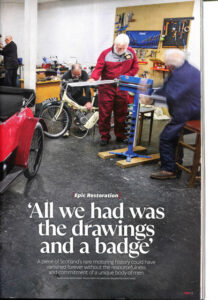
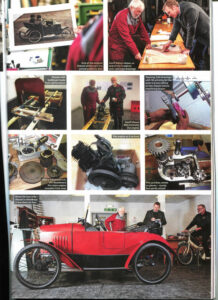
    > On May 4, 2022, at 9:05 AM, ALAN SKEOCH <alan.skeoch@rogers.com> wrote: > > EPISODE 577 THE SKEOCH CAR > > alan skeoch > May 2022 > > Well this note from Geoff Allison was a big surprise that may interest readers. > The ‘Little Skeoch’ had a short life when created in 1921 when fire destroyed the > factory and 6 of the 10 models ever made went up in smoke. Fragments of > the car remained … especially the paper plans. Thanks to Geoff and his > gifted friends a model of the little car has been made as you may remember as I did > a story on the car some time ago. > > Well today a thorough story has been printed in the june 2022 edition of > Classic Car. And I mean through. With a pile of detail pictures. The full > article is included. > > What is our family connection to this car.? I really do not know for sure. > Nice to imagine the connection may exist though. > > alan > >> >> Dear Transatlantic Skeochs, >> >> I am sending you a copy of an article published in the June 2022 edition of Classic Cars which refers to the re-creation of a 1921 Skeoch Cycle Car as an epic restoration – for your interest. >> >> Kind regards, >> >> Geoff > > > >

  • Fwd: EPISODE 575 MINING CAMP ON THE ALASKAN BARREN LAND ADVEMTURE..1959.(SERIES ON PEBBLE MINE)


    EPISODE 575   ALASKAN MINING CAMP ADVENTURES…1959 (SERIES ON PEBBLE MINE)


    alan skeoch
    MAY 2022


    Large mosquito?  Don Van Every and Helicopter in Alaska 1959


    SUMMER 1959:  Don VanEvery, Ian Rutherford, Bill Morrison, Mike Chinnery, Alan Skeoch and Dr. John StaM were flown to Dillingham, Alaska to conduct a Turam
    geophysical ground survey in he summer of 1959.  From Dillingham the Canadian crew were flown into the Alaskan interior  by two Sikorsky
    S 52 helicopters.   A camp had been constructed overlooking an Alaska river valley where thousands of sockeye salmon were laying their eggs before they died.

    We were told the site was a secret.  Whether this was true or not I have never been able to prove one way or another.  What I do
    know is that the site is located overtop a huge area  mineralization.  To this day, May 2022, no mine has been constructed

    The hinterland of Bristol Bay has become one of the most controversial sites in the history of north America mining. All that needs to be
    said is “How about the Pebble Mine?” and a stormy debate will follow.  “Are you for or against the Pebble mine?”

    There was no such debate when we were there in 1959.   So let me state and restate some of our adventures and 
    then look st the Pebble Mine controversy.   This is not a tiny story best forgotten.   It is one of the most controversial
    issues in mining today.  Is the Pebble Mine a dead issue?  Could be.  One of our adventures was linked to the big story.
    But we did not know it.  One tiny adventure.   


    alan

    ADVENTURES (as memory serves)


    1)  TWO huge Sikorsky S 52 helicopters piked us up when our F 27 Fokker landed at the
    obscure Dillingham fishing village on the Bering Sea not far from the Aleutian Island chain of
    south west Alaska.  Flying in a helicopter became routine that summer . So much so that we often
    sat with our legs outside the open cargo door.  Some kind of force held us in place.  Centrifugal?
    totally enjoyable.   The lead pilot awoke us each morning singing over the camp Public address system,
    “Let’s get fucking airborne”…and we would fly over the endless tundra to our survey points where we 
    would be dropped for the work day then picked up.  I even had one small misadventure when trying 
    to jump from the pontoon to the cargo cabin with a 90 pound reel of wire on my back. I missed
    and fell through the gap just as lif toff began….distance 10 or 20 feet, hit the soft tundra like hitting
    a rough feather bed.  I remember asking the pilot “What happens if we hit a sudden downdraft?”
    “If I have a sling load I just press this button and drop the whole load.”
    “Has that ever happened?’
    “Had to drop a whole diamond driller drill unit once.”
    “Wrecked?”
    “Imagine so, never checked.”


    2) WEAPONS:   “You boys can expect to be given rifles at base camp…30-06 hunting rifles. Be prepared.” said our boss
    Dr. Norman Paterson, one June morning in Toronto.
    And sure enough rifles were handed out on our first helicopter ride into the tundra.  I still remember my partner, Bill morrison , 
    commenting.  “How the hell can we carry rifles when harnessed into the Turam?   So We just stacked the rifles at
    the landing point.   Took a few practice shots at stunted spruce trees then forgot about the rifles.  Why were these
    weapons distributed?  The Humble Oil contractor feared we would have trouble with Kodiak bears. I suppose that was
    a legitimate fear but it never happened.  The closest I ever got to a Kodiak was one day trying to follow Bill up a 
    river densely thick with tag alder scrub brush.  I was about 100 feet behind Bill.  Saw his footprint in the river bottom…
    a swirl of sandy mud…and made a wrong turn.. I followed a bear who was getting out of our way.  Noticed a big patch of
    brown fur . Moving.  Turned fast .  Bill had gone downstream.  Bear moving upstream.  Nobody hurt.  Would the rifle have
    been any help?


    Normally Bill and Were strapped together by a 100 feet of rubber sheathed cable.
    Traversing river brooms often made it necessary to disconnect.  Hence my
    confusion leading to the bear incident.  Bears do not like our smell so
    they usually get out of the way if we make enough noise.  Sometimes a tin can
    with pebbles strapped to our waist was all that was needed to alert the bears.


    We were not the only people with weapons. The camp had a double purpose
    Our job was to pin point anomalies (unknown but surprising blips on our Turam consols).
    Then a diamond drillers crew would be ferried to the site to confirm by hard evidence (i.e. diamond
    drill core) the nature of the anomaly.  

    There were 25 diamond drillers in camp… and six Canadian geophysicists.   Seemed to me that 
    they were all armed with revolvers on western styled gunbelts.  Maybe not all.   But many.  If you
    carry a gun, there is a tendency to use the gun  As one of the drillers did one evening
    down by our beaver pond in the river bottom.  “Watch this!” And he made a fast draw and aimed
    at the beaver some distances busily chewing.  Killed the poor beaver.  
    “Damn, I did not think I was that good.”

    Bottom line?  The most dangerous place in my Alaska was our camp.


    TO BE CONTINUED

    “ADVENTURES IN ALASKA = THE PEBBLE MINE CONTROVERSY = TRIUMPH BY ENVIRONMENTALISTS”

    ALAN SKEOCH
    MAY 2022

  • EPISODE 577: Skeoch CAR re-creation hailed as ‘Epic Restoration’ in national magazine

    EPISODE 577 THE SKEOCH CAR
    alan skeoch May 2022
    Well this note from Geoff Allison was a big surprise that may interest readers. The ‘Little Skeoch’ had a short life when created in 1921 when fire destroyed the factory and 6 of the 10 models ever made went up in smoke. Fragments of the car remained … especially the paper plans. Thanks to Geoff and his gifted friends a model of the little car has been made as you may remember as I did a story on the car some time ago.
    Well today a thorough story has been printed in the june 2022 edition of Classic Car. And I mean through. With a pile of detail pictures. The full article is included.
    What is our family connection to this car.? I really do not know for sure. Nice to imagine the connection may exist though.
    alan
    > > Dear Transatlantic Skeochs, > > I am sending you a copy of an article published in the June 2022 edition of Classic Cars which refers to the re-creation of a 1921 Skeoch Cycle Car as an epic restoration – for your interest. > > Kind regards, > > Geoff
    {CAPTION}

    {CAPTION}

  • EPISODE 576 : SOCKEYE SALMON or GOLD (a human dilemma )

    EPISODE 576 :  SOCKEYE SALMON or GOLD (a human dilemma )

    alan skeoch
    may 2,2022


    WHY THE DELAY?  

    Sorry about the story delay.  What I wrote about the Alaskan mining camp

    suddenly took a twist in my mind and I decided a bigger story would
    be better.  

     I worked in Alaska in the summer of 1959.  It was a grand
    adventure that I have presented in an earlier episode but the story
    has unfolded into a bigger and more startling story since 1959.
    A story that has only recently been resolved in favour of sockeye
    salmon instead of opening what would have been the largest open
    pit mine in the world.  The gold and copper extraction would have lasted
    for 45 years and 1,000 miners would have been hired at an average wage of
    $100,000 each.  The downside?  The last remaining wild sockeye salmon
    breeding ground would have been lost forever. A vast tract of wilderness.

     This decision was made
    in 2021.  The fight has been going on for more than 40 years.  Long after
    we abandoned our mining campsite in 1959.  I really believed that
    big money and human greed would trump sockeye salmon.  Hard to believe that
     Environmentalists
    and the fishermen from 30 Alaskan aboriginal tribes won the
    battle.  At least for now!

    Caroline, our grandson Jack’s girlfriend is studying environmental science
    at Queen’s University. I am writing this story for Caroline and her professors
    as well as my readers.  The decision to abandon the Pebble Mine project
    in Alaska needs to be told to a wider audience.  I still find it hard to
    believe that 55 billion pounds of copper and 67 million ounces of gold
    will remain buried in the Alaskan wilderness.

    So give me a little slack.  I need time to put this decision in readable form.

    alan skeoch
    may 2, 2022

    POST SCRIPT:  TAILING PONDS

    “Scars from large mining operations are permanently etched across the landscapes of the world. The environmental damage and human health hazards that these activities create may be both severe and irreversible

    Many mining operations store enormous quantities of waste, known as tailings, onsite. After miners excavate rock, a processing plant crushes it to recover valuable minerals such as gold or copper. The leftover pulverized rock and liquid slurry become tailings, which often are acidic and contain high concentrations of arsenic, mercury and other toxic substances. 

    Mining companies store tailings forever, frequently behind earth-filled embankment dams. Over the past 100 years, more than 300 mine tailing dams worldwide have failed, mainly due to foundation weakening, seepage, overtopping and earthquake damage.”  (Research Scientists group studying river systems)

    NEXT EPISODE— THE CAMP IN 1959