Note: Sorry this story needs editing but I have no time…trying to do one story each day
EPISODE 341 YUKON DIARY: DOING THE YUKON IN REVERSE ORDER
DEAD HORSE GULCH
alan skeoch
Feb.1 2021
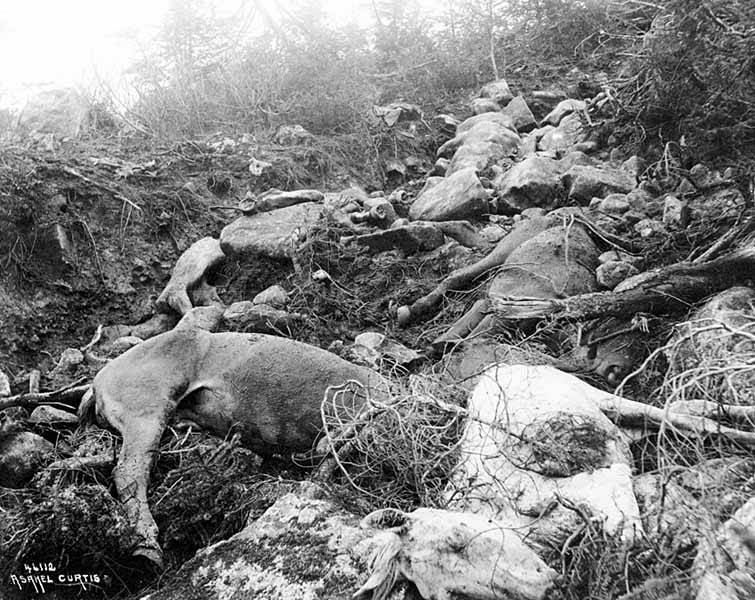
There were two passes to the Yukon. The Chilkoot Pass and the Dead Horse Pass…renamed
the White Pass. I took the latter. There were a lot of dead horses here. I never saw any. Their
bone were now as great as the rocks.
Only due to the lust for gold were these passes found
“There is no route from Skagway to the Yukon.:
“Not so.”, said the Tlinget native.
“Those coastal mountains are impassable.”
“Not so.” said the Tlinget native
“Impassable…no way to reach the Yukon River….Lake Bennett headwaters.”
“Not so.” said the Tlinget naive
“Prove it…show me the way.” said the white man
“Secret trail of my people.”
“Show me.”
“We have traded with the interior people of the HighYukon plateau for many years…through this
pass.”
“Show me.”
And the Tlinget revealed the mountain pass now called the Chilkoot Pass. Steep with
jumbles of loose rock on a formidable incline. Then snow and ice high above the Ocean
far below. Crested slot that then tipped downward to the icy waters of glacial Lake Bennett.
But this was not the end of the trek. Only the beginning. From Lake Bennett the gold seekers
still had 550 more miles to cover if they were to reach Dawson City.
Wednesday Sept. 12, 1962
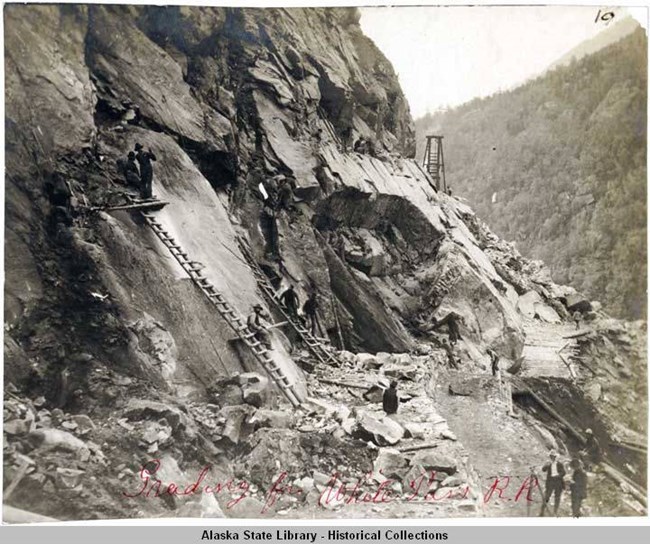
Building the White Pass Railway 1890’s
Narrow gauge railroad that goes just about nowhere. Climbs over the Coastal mountains
from tiny inconsequential Skagway by twists and turns…through tunnels that seem rough blasted…over
timbered bridges clinging to Mountainside.
The White Pass moves slowly. As if expecting catastrophe any moment. Screaming braking system
jawing musically as metal on metal maintains the slow descent through Dead Horse Gulch. This is
not the Chilcoot Pass route. The railway follows another somewhat gentler but loner route named
after a long forgotten politician. This is the Dead Horse Gulch Pass.
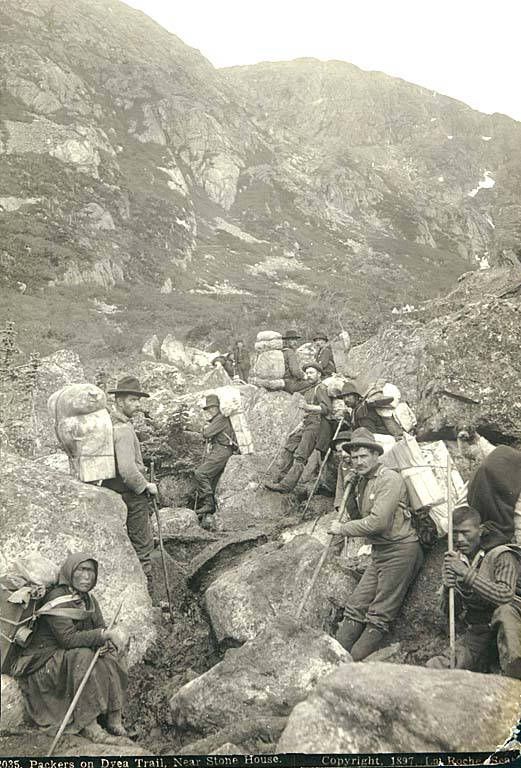
Chilkoot Pass…no easy trip with 1 ton of supplies per man
In 1897 the Yukon Territory was virtually an unknown land peppered here and there by
natives. Even these people avoided the eastern part of the Yukon in fear of evil spirits that
were living there. A few white trappers and even fewer white placer miners eked out a
shaky existence. Food, other than wild meats, had to be carried over the coastal mountains
or steamed up the Yukon River. Not worth the aggravation was the conclusion of most people.
There were better places. As a result much of the Yukon was an empty land. That changed when the gold fever of the Klondike. And then,
when the easy gold ran out, along came the silver boom at Keno Hill.
White Pass Railway was the route out for the silver ore. Refined in the United States.
Think of the Yukon as a huge tank of water with one tiny spigot at the bottom. The White Pass.
My passenger car was made in 1900 just when the White Pass route was completed
Ancient. Coal stoves for heat in each car. Soft seats now but I bet they were once slatted
seats.
And I bet dollars to donuts the White Pass railroad passed by the piles of dead horses
whose putrifying remains littered the crevices and deep trenches along the way. Dead
Horse Gulch in particular. I strained my eyes expecting to see a boneyard far below
but saw nothing. In 60 to 70 years the bones got as grey as the rocks.
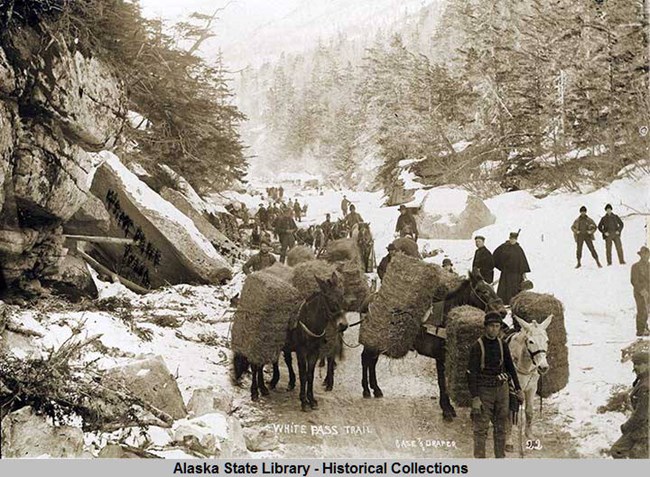
How many horses? Dozens? No. Thousands…perhaps as many as 3,000 horses
died on this so called easier route to Lake Bennett. Terrible stories neglect and
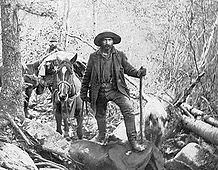
brutality. Many of the men climbing through this Pass knew nothing about horses
and pack saddles. They just strapped the gear to horses backs. When a hundred
pound sack of flour shifted, horses fell over. Often injured horses were killed. I suspect
even this humane act was not done since some horses rolled over and over down
the rock strewn slopes. These thousands of horses were ill treated before they ever
got to Skagway. Jammed bum to bum on steamships. Some already weak and sick.
Best described by Jack London
“The horses died like mosquitoes in the first frost and from Skagway to Bennett they rotted in heaps. They died at the rocks, they were poisoned at the summit, and they were starved at the lakes; they fell off the trail, what there was of it, and they went through it; in the river they drowned under their loads or were smashed to peices against the boulders; they snapped their legs in the crevices and broke their backs falling backwards with their packs; in the sloughs they sank from fright or smothered in the slime; and they were disemboweled in the bogs where the corduroy logs turned end up in the mud; men shot them, worked them to death and when they were gone, went back to the beach and bought more. Some did not bother to shoot them, stripping the saddles off and the shoes and leaving them where they fell. Their hearts turned to stone- those which did not break- and they became the beasts, the men on the Dead Horse Trail.” -Jack London, Journalist. The God of His Fathers, Doubleday Page & Co., New York, 1914, p. 70-80
There are other even more gruesome stories about these horses. Men impoverished and
starving cut slabs from these dead horses for food. Hard to believe? Try starving yourself
to near death and see if your opinions change.
And suppose a great many horses actually survived and made it to the shores of
Lake Bennett. What then? Load them aboard the hand made boats that rafted down
the Yukon To Dawson. Shoot them? Sell them?
Or just abandon the horses…or sell them…or eat them. Horses do wander away unless
fenced. Mares can be captured by stallions. In 1962 there were wild horses here and
there in the Yukon. In small herds of mares with one stallion. Where did they come from.
I think we saw a small string on our trip to Dawson. Almost hidden in the brush.
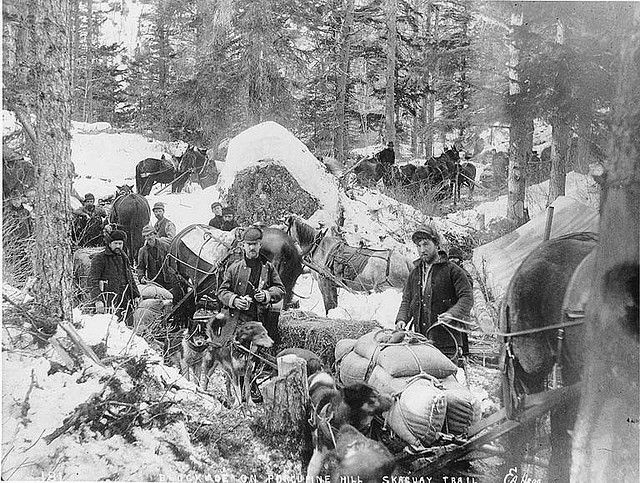
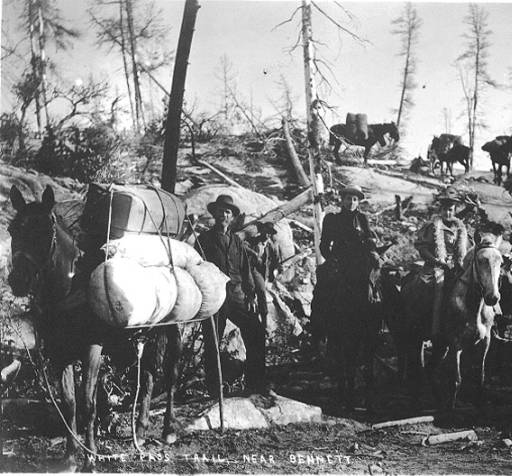
These horses from Skagway do not look abused. They are hauling goods not
carrying them. Not much room for error here. But no precipices either. Each
man had to show he was brining 1 ton of supplies to Canadian authorities…i.e. Sergeant Sam
Steele of the NWMP otherwise refused entry to Canada’s Yukon Territory.
MY interest was triggered by a misty event on our two day holiday to Dawson City in midsummer.
Three or four of our gang of joyriders were jammed into the back of a Peso Silver half ton truck
for that long 3 to 4 hour jaunt. At one point we noticed movement in the brush at the side of
the road. There was something alive behind the screen of scrub. Several animals…not a single
animal like a moose.
“Could be wild horses, mares with a stallion. Several strings of them
have been sighted. A couple have been hit on the highway around Dawson”
“You must be kidding?”
“Check it out.”
Which is exactly what I did. The wild horses are a concern on the Alaska highway where
they seem to cluster in several strings. Very wiley creatures. Efforts to catch them have failed.
How can horses survive the brutal winters? Simple answer. On each side of the Dawson
Highway are the remains of large hay fields. Yukon summers are full daylight…maybe 16 hours.
Lots still grows in these wild fields. From the gold rush days to the 1930’s horses were
important as a means of transportation. Every 20 or 25 miles of the old Dawson road there
were roadhouses where teamsters could get fresh horses or give their 4 to 6 horse teams a
rest. Some of these roadhouses were decent places. Others were as dirty and neglected as
the hubs of hell. Eventually the internal combustion engine replaced all the horses hauling
goods from Whitehorse to Dawson.
I do not know what happened to those horses. Many would be slaughtered of course…dog food
for sled dogs along with moose. Some just got loose. Turned loose or abandoned. Most would
die but it seems there were…there are….a few stallions with their mares trotting cautiously
through the underbrush of the Yukon. I think I saw a string of them from the back of that
half ton truck.
Now this next comment is a real stretch. Total speculation…ridiculous speculation. It might just
be possible that the wild horses running in the Yukon in 1962 might have been survivors who crawled
up Dead Horse Gulch (White Pass) and survived because their owners knew how to handle a horse
and knew that horses could be useful in the mining business. In the 1920’s there were 98 horses
working on Keno Hill…and at the same time there were far more doing work on the Dawson Road
living in the barns beside those roadhouses.
Wouldn’t it be wonderful if those wild horse strings had a genetic connection to Dead Horse Gulch.
Wild horse herds did exist in the year 1962 in the Yukon Territory. In 2010 one of the last herds of
wild Yukon horses was captured and all eleven including the stallion were put up for auction in hope
that some horse lover would want to rehabilitate them…i.e. break them, make them docile. Whether
this happened or not is not mentioned in the CBC news release.
“Animal control officer Paul Heynen said he has spent years trying to capture the Takhini Valley herd of wild horses, but the animals have proven to be elusive.
“I can have a report that they’re out there and I can be there in an hour and they’re gone. You know, they’re just like ghosts … poof, and they’re gone,” Heynen told CBC News.”
These horses were not easy to handle once corralled because the stallion went wild once
fenced in. Lunging at the fences.. Longing to escape. While government officials believed
this was the last herd ofYukon wild horses, many locals believe one or two strings of
them still thrives in hidden places. They are as wily as wolves, never staying long in
one place and therefore difficult to trap.
ANCIENT WILD HORSES OF THE YUKON
Wild horses once commonly roamed the Yukon as has been proven by a bone found by Duanne Froese, an earth
science professor ar the University of Alberta. The bone was found in the permafrost enveloping the
Thistle Creek gold mine about 100 km. south of Dawson City.
in 2013. The bone fragment’s genome once annilysed turned out to be 700,000 years old.
It seems that Horses have thrived in the Yukon for a long long time.
alan skeoch
Feb. 1, 2021
Post Script
Events have a curious way of coming together and making sense. Serendipity is the word. It means a coming together
of seemingly disparate events. Here’s a weird one. In 1963-64, Marjorie (then Hughes) was teaching high school
in Napanee, Ontario. Miles and miles from western Canada. A group of girls joined Marjorie in forming their cell
of the Canadian Wild Horse society. They donated some money to support the survival of wild horses primarily in
Alberta but also in the Yukon. These horses needed protection. The Canadian government considered horses
an introduced species…therefore gave them no protection. Marjorie’s students and other young people, mostly
girls, were assuring that a few herds of wild horses continued to roam through the Rocky Mountain valleys.
I am not sure that is still the case.


 wpyr.com/wp-content/uploads/2017/07/broadway-construction-300×197.jpg 300w,


