Month: February 2021

  • EPISODE 248 TRAGIC DEATH OF LIVINGSTON WERNECKE … AIR RESCUE THAT FAILED HORRIBLY

    EPISODE 248   YUKON DIARY    THE TRAGIC DEATH OF  LIVINGSTON WERNECKE  … AIR RESCUE THAT FAILED 


    alan skeoch
    Feb. 2021


    Such a complicated  man.  Livingston Wernecke.  A man whose force of will shaped so much of the
    mining history of the Yukon.  A man who realized that silver was more important than gold.  A man who
    watched the Treadwell disaster on Douglas  Island, Alaska in 1917 then shifted his attention Keno Hill, Yukon 
    Territory, Canada.  So complicated.  A man of few words…action…irritable at times…soft at others.
    Loyal throughout.  Loyal to the Treadwell Corporation.

    Maybe I can gat a handle on his life by the account of  his death in 1941.  Two months before Pearl Harbour
    (Dec. 7, 1941) The  Treadwell Yukon Corporation was
    bankrupt.  Livingston Wernecke was frantic.  What could he do to save the company.?   Maybe tungsten was
    the answer rather than the silver/lead veins of Keno Hill.  Something had to be done.  


    Dec. 7, 1941, Japanese attack on Pearl Harbour


    Wernecke was always in a rush…recklessly so.  It was late fall.  Foggy.  Not good flying weather but Wernecke
    was a man on a mission.  How to save Treadwell from total collapse?  His pilot, Charles  Gropstis was not a bush 
    pilot but he was a  fine airman in normal weather.  The weather was  not normal that final day  in 1941.  Fogged
    as dense as a  blanket in places.  Not all over…just in places.  The wrong places as thing turned  out.

     No matter.  Wenrecke wanted to check out a tungsten property Hyder, Alaska, and then
    head down the west coast to Settle.  They never made it.

    America was  not yet at war but the war in Europe was forcing the United States into commitment.  And events in the 
    East were also troubling.  Tungsten is an important part of weaponry.  Wernecke thought the US would need more tungsten shortly.

    Applications of Tungsten in the Military

    As we know, the service life of steel barrels is not long. Therefore, in order to prolong the service life of the barrel, that is, to enhance the barrel’s resistance to the corrosion of gunpowder burning, people added tungsten to gun steel as early as 1822.

    By the time of World War I, German ordnance engineers had paid special attention to tungsten barrels. There are data records that at that time, the light machine guns of Russia and France could only fire about 6,000 rounds and were damaged, while the light machine guns of Germany could fire 15,000 rounds, which was more than doubled. To this day, the German ordnance industry is still well-known in the world. And tungsten steel has been applied to all kinds of military equipment.

    Armour piercing tungsten bullets


    Nothing wrong with the airplane.  It was brand new…a five passenger Bellanca Skyrocket float plane powered by
    a 550 horsepower Pratt andWhitney radial engine.  Even the lousy weather was not a big problem.  Flyable.
    The problem was Livingston Wernecke.  He was a reckless person…always a rush.  Rushing places was normal
    for mining geologists.   Get to sites first.  Get claims tagged.  Get fast assays on ore  samples.  Get what was
    needed to open a mine and get whatever needed fast.  He  drove  a car with abandon.  He encouraged  his  pilots
    to take  chances.  He pushed  men and machines to get mines in production as fast as possible.   Faster.

    Although he  never said  much…some called him irascible…he was a good man.  Prepared to make life
    pleasant for his miners.  Loved the wilderness life  and the men and women with whom that life was shared.

    The next Episode will provide a  better picture of Livingston Wernecke.  

    Wernicke wanted to rescue Treadwell Yukon which faced a 10 million dollar debt and a board of directors that did not seem to 
     give a sweet goddamn about Keno Hill and Yukon Silver prospects.  I can just imagine the torment he felt.  He had spent
    20 years of his life loyally supporting his company and now, with a world war raging, no one seemed  to shar his concern that
    Treadwell Yukon was finished.   Perhaps the wartime need for Tungsten would resuscitate things.  

    Livingstone  was in
    a rush when Gropstis was told to take off and fly down the  coastline towards Seattle.   The  weather closed in.  Visibility
    was OK but reducing fast.  The pilot sought a lower altitude.  Thick clouds above…whispy patches of fog below.

    Then Gropstis spotted something unusual.  A plane floating upside down  in the ocean with two  victims waving frantically
    on the  wreckage.   Wernecke and Gropstis must have agreed  on the rescue.  Their plane  was in fine  shape…almost 
    brand new and outfitted with pontoons for the ocean landing.  The rescue  should have  been easy.  Circle. Then come
    around for a final approach into the wind.

    They never saw the tree that was hidden in a fog bank. WHAM!  Later the victims in the water would describe  the horror
    they felt when Wernecke’s Bellanca just disintegrate before their eyes.   Livingston Wenrekce and his pilot
    were killed instantly.    

    Two  days later the men in the water were rescued and described the last few minutes of Livingtons life.

    The death of Livingston Wernecke paralleled the death of Treadwell Yukon.   Wernecke  was buried in
    Berkeley, California.  Treadwell Yukon was mothballed on Keno Hill, Yukon Territory.  Other assets were  sold including
    his to compete with INCO in Sudbury, Ontario ..Errington Mine property.  Whatever high grade  silver/lead concentrates remained
    at Elsa were sent to the refinery.   The  camps were stripped bare and abandoned.  Much of the remaining gear  was sold to the Alcan 
    highway. 
     
    In 1946 Thayr Lindsay bought the now derelict Treadwell mines.

    A double tragedy for Keno Hill.   

    Mining continued in the Mayo district however.

    In 1962 when we arrived  in the Yukon with our sophisticated Turam geophysical equipment, Livingston Wernecke was forgotten except for old timers..
    AND Dr. Aaro Aho who gave Livingston Wernecke recognition in his book Hills  of Silver..  I had never heard  of Livingston Wernecke.

    alan skeoch
    Feb. 2021

    NEXT STORY:    LIVINGSTON  WERNECKE  ON KENO HILL 1920’S AND 1930’S


    P.S.   See if you can find the SERIOUS ERROR in this document.   It threw me for a loop.  So easy to make errors if a document 
    does not have an editor.   When I found this citation by accident I thought the error in spelling was my error so I changed all references
    to Livingston Wernecke.  Turns out it was not my error.  See the error yet?…below. I must contact the publisher.

    ALASKA MINING HALL OF FAME FOUNDATION


    Livingston Wenrecke

    (1883 – 1941)

    Print Friendly Version

    Livingston Wenrecke, explorer, scientist, and mine executive, was born January 16, 1883 in Livingston, Montana and named for that Rocky Mountain city. Wenrecke graduated with honors in mining engineering and geology from the University of Washington School of Mines in 1906.

    Wenrecke started his mining career as a draftsman, and later as a construction engineer at the Nevada Consolidated Copper Company plant in Ely, Nevada. He was chief engineer for the Copper River and Northwestern Railroad from 1910 to 1912.

    From 1913 to 1917, Wenrecke was chief geologist for the Treadwell Mine. During that period he investigated causes of subsidence in the mine and wrote a lengthy report with a recommendation of a 40-month plan of action on controlling the problem. The Treadwell Board of Directors approved his recommendations in September of 1916, but there was not enough time to fully implement it before the mine flooded on April 21, 1917. While investigating the cave-in and flooding of the mine, he was the last man to be lifted out of the mine.

    During the four years following the flooding of the Treadwell mine, Wenrecke examined hundreds of prospects by dog sled and aircraft throughout Alaska, British Columbia and the Yukon on behalf of the company. His search led to the development of the Nixon Forks mine near McGrath, which he managed from 1919 to 1925.

    From 1918 until the time of his death, Wenrecke was the chief geologist for the Alaska Juneau mine, vice-president and manager of the Treadwell Yukon Mining Company. In 1921, on behalf of the Treadwell Yukon Company, he purchased and operated the northernmost silver mine in the world in the Mayo district of the Yukon. It was there that he pioneered aviation in northern mining and the use of tractors to haul ore over snow. Much of Wenrecke’s early flying was over territory never before explored by air or ground. His notes and photographs taken on flights east from Point Barrow into the vast reaches of the Canadian arctic were turned over to the Canadian government, which hailed them as valuable contributions to the knowledge of its geography.

    In 1929, Wenrecke’s geologic report predicted that a rich ore-body would be found at depth in the northern half of the A-J Mine. His prediction came true and led to the most profitable years in the mine’s history.

    A co-founder of the mine’s loan fund for needy students at the University of Washington, Wenrecke lectured there many times on visits while traveling between his Berkeley home and his northern interests.

    In his home in Berkeley, California he built an advanced scientific laboratories, which included a rock cutter and thin-section grinder of his own design.

    On October 21, 1941 Wenrecke and his pilot Charles Gropstis, while returning from an investigation of the Riverside Tungsten mine near Hyder, Alaska, perished in a plane crash on the shore of Millbank Sound, British Columbia.

    Equally at home in the boardrooms of eastern corporations and in the arctic wilds, Wenrecke died as he would have wanted to die, his friends believed – quickly, and in the wilderness where he won so many victories in life.

    Written by Charles C. Hawley and John Mulligan, 1999


  • EPISODE 247 YUKON DIARY THE TLINGIT PEOPLE AND THEIR LEGENDS (why mosquitoes want my blood)

    EPISODE  247   YUKON DIARY    WHO ARE THE TLINGIT PEOPLE?  They  love and hate ravens as we do.


    alan skeoch
    Feb. 2021


    A Tlingit Raven rattle.  The raven is a central legendary creature of the Tlingits and many other First Nations people.  Often
    as a trickster…possessing both good and evil tendencies.  

    *NOTE: We have a pair of ravens living in our sons’ drive shed.  They watch us…make one hell of a mess…rob
    other baby birds…talk to each other or us…seem to know us by facial recognition…drop their excrement on
    my fanning mills.  I feel like a  Tlingit…love and hate.

    Why tell you about these people?  Reason…links to the Yukon. They  knew the secret trail across the mountains  to the Yukon…Chilkoot Pass.
    But they could not understand the third for gold.  Given a choice they would choose lead because lead  makes
    bullets and  Hunting for food and  clothing seemed more important than gold. 

    For those of you who love mystery as  I do, the Tlinget people are the most mysterious of all First Nations.
    They are believed to be Ainu people.  Some are blue eyed.  Big people.  How did they arrive on the west
    coast of North America thousands of  years ago?   When massive ice sheets made the ocean lower.
    Is evidence of their arrival long gone beneath the waves of global warming?   So  much more to say
    so little time to say it.   

    Most endearing story?  The legend of the origin of the mosquito and the giant who loved  human blood.
    The legend  makes some sense.  I have shared the torment … the viciousness … of mosquitoes…unremitting
    bloodsucking…trying to kill me at times…mosquitoes are  trying to get even with that Tlingit with the knife.
    Now I understand.

    alan


    Tlingit People


    Friday Sept. 14, 1962


    After waking I explored Juneau as much  as was possible before  takeoff  time.  Lots
    of curiosity shops…art shops.   What was apparent was the richness of  Tlingit legends.

    It was a Tlingit that revealed the  Chilkoot pass to gold seekers heading for the Klondike.
    Tlingit village 

    Tlingit art brings  legends to life.  Two ravens?  What are they doing?  Protecting
    or threatening or both?  Animism


    Later I bought a wall hanging reputed to be  Tlingit in origin but more likely mass produced
    in Japan.   Interesting though.  Titled  “Toads on Tidewalker” .  Must have some ledgenderyu
    meaning among the Tlingits.

    The Tlingit people of Juneau, Douglas Island, Skagway are related to the Ainu people  of Japan
    and other ancient peoples of Siberia.   Today there are over 16,000 Tlingits living in North America
    principally on the west coast although some have spread across the continent.  At time of first contact
    the population was estimated at 15, 000 of which half soon died of smallpox. So today, the Tlingit 
    population has returned  to first contact level.

    They were converted to the Russian Orthodox Christian church in the 18th century  when  Alaska
    became Russian territory…and  most maintain that
    connection .  Some suggest the reason might be a tribal attempt to resist the  surrounding white  culture
    which was trsditionally Presbyterian.

    Photograph of two Tlingit children  taken in 1903 and owned by Miles Bros. #872  Public Domain

    Did they cross the Bering land bridge as most North American First Nation people did some 10,00 years ago
    when the world was  colder and a  great quantity of water was ice?  Not sure about that. The Tlingit are Ainu.
    The Ainu are mysterious people of Northern Japan.  They are not Japanese ethnically.  They are different.
    Did the Ainu island hop along the coastal  island chain from Japan and  perhaps Korea and Siberia to North
    America thousands of years ago?  A maritime people. Asiatic in origin for sure as genetic testing has proven
    When?  No idea but certainly more than 10,000 years  ago.  Why?  No idea why they risked such a migration.
    Were  they following the animals?  Were they driven out by other peoples?  Possibly.
       taiken.co/uploads/2015/05/820px-Ainu_Woman_from_Japan_with_the_Department_of_Anthropology_at_the_1904_Worlds_Fair-481×600.jpg 481w, taiken.co/uploads/2015/05/820px-Ainu_Woman_from_Japan_with_the_Department_of_Anthropology_at_the_1904_Worlds_Fair-321×400.jpg 321w” sizes=”(max-width: 820px) 100vw, 820px” apple-inline=”yes” id=”D0E17B72-A89E-452B-B7F9-7CA3A5DD1A9F” src=”https://alanskeoch.ca/wp-content/uploads/2021/02/820px-Ainu_Woman_from_Japan_with_the_Department_of_Anthropology_at_the_1904_Worlds_Fair.jpg”>
    THE  Ainu people of Japan….different from the Japanese, population from 25,000 to 200,000 living
    around Hokaido.   Their history hidden .  Some suggest they are Caucasian in origin as blue eyes
    and size suggest.  No one is sure but they remain a mystery people.  perhaps  Tlingits are Ainu in origin.

    Ainu religion holds the belief that everything has its own spirit or god to which one can pray and make offerings. This is particularly prevalent in their hunting culture. Prior to eating any meat, they will perform a ritual with the intention of “sending back” the spirit of the animal they are about to eat. Ainu also believe in an afterlife and believe that upon death their immortal spirits will join the “Kamui Mosir” (land of gods)


    The Tlingits  explanations of the world around them are fascinating.  Why do mosquioes like to torment
    us so  much?  The Tlingit explanation.


    framed, one-story structure with numerous fish hanging to dry in a forest clearing
    19th century Tlingit camp…drying salmon


    TLINGIT LEGEND OF THE ORIGIN OF MOSQUITOES

    :  How  the Mosquito came to exist

    Once upon a time there was a  giant who loved to eat human beings and drink their blood..  One brave Tlingit man
    decided to do something about the situation before  all humans … all Tlingit people …
    were  eaten.  He pretended he  was dead.  The  giant found him, touched him, decided
    his body was still warm and therefore edible.  The giant carried the man home for a
    fine dinner.  But he needed wood for his fire so left the man on he floor to get wood
    outside.  The  Tlingit man looked around and grabbed the giant’s skinning knife then
    threatened the giant’s son with the knife at the boys throat.  “Tell me where  your father
    keeps his heart,”  he demanded.  “In his heal,”  the terrified boy angered and when
    the giant stooped at the door…he had to stoop because he was bigger than the doorway…
    when he stooped the Tlingit man stabbed him in the foot killing him.  But the giant
    did not die and threatened to kill and eat all Tlingit people.   So the man cut the giant
    into small pieces and flung the pieces on the land.  Then the  pieces became  alive
    as mosquitoes who spend their time on earth sucking the blood of Tlinget people.

    And that is why we have mosquitoes on earth.

    ORIGINS OF LIFE  ON EARTH:  TLINGlT LEGENDS

    The Tlingit legends centre around the raven.   Ravens are also featured in legends of many 
    other First Nations people where the birds are associated with trickery,  lies and  mimicry.
    Ravens are a force for good and evil.

    Tlinglt legends try to explain where their people came  from…and the nature of the world
    around them…by the Gift Boxes held by the Great Spirit.   These gift boxes were first given
    to the animals that existed before humans…i.e. before Tlingits.  When the animals opened
    these cedar boxes all the things that make our world were  released…mountains, fire,waer,
    wind, seed.  But one  box was special and had been given to the seagull.   It contained the light
    of the  world.  All was darkness because the seagull refused to open that cedar box which
    was clutched  under the seagulls wing.  The people pleaded with the raven to persuade the
    seagull to release the  light needed by the world.  The raven tried begging, flattery, trickery to
    get the box opened.  No luck.  So raven stuck a thorn in Seagulls foo…pushed it deep  until
    Seagull dropped the box.  It opened and  ou came the sun, the moon and the  stars brining
    light so the  first day coold begin.

    The ravens skill at trickery also accounts for the presence  of water in the world.   It put ash
    on its tongue to show the owner of water extreme thirst. When  given a drink the raven grabbed
    the water and put it into a sealskin bladder and flew away with water which  was then released
    into the world.

    DID MY WALL HANGING HAVE  ANY MEANING?

    “Toads on Tiedwalker”…no meaning that I have found yet.  Although
    the term tied walker is a solid clue.   The Tlingit are matrilineal…trace
    family origins via females.  And the legendary tide walker was female.
    Perhaps  someone  reading this knows far more than I do.  Feel free to
    enlighten me.


    alan skeoch
    FEb. 2021
  • EPISODE 246 YUKON DIARY THE TREADWELL MINE DISASTER and Livingston Wernecke

    EPISODE 246   YUKON DIARY   THE TREADWELL MINE DISASTER  and Livingston Wernecke


    alan skeoch
    Feb. 6, 2021


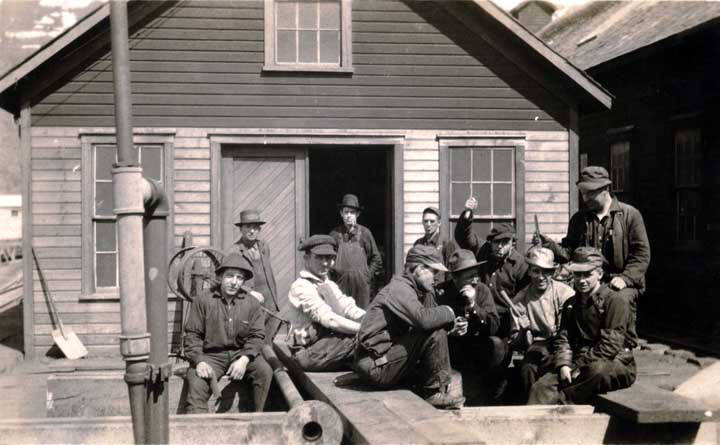
    Treadwell Mine employees shortly after the Disaster.  New jobs were found for all of them.
    Men from 17 countries, many of them Serbians who left Treadwell when WW 1 broke out.

    WHY DID I VISIT JUNEAU ON SEPT. 13 AND14, 1962?  NO GOOD REASON

    Was there some unfathomable force pushing me from the Yukon.  Pushing me with a purpose in mind.
    Pushing me out the peephole of Skagway.  Pushing me south to 
    the mysterious capital of Juneau, Alaska.  

    Pushing me I knew not where or why.  I say this in 2021…59 years after I wrote my Yukon Diary.  Ha! 
    What a laugh.  I wrote that diary…stuffed it with bits and pieces of my life…and never opened it
    again until the year 2020 when the whole world hit a dead stop and hundreds  of thousands…millions
    and millions of people suddenly had to reconsider their lives.

    Was  that push to Juneau in 1962 real or imagined?  I mean was I just wandering pointlessly?  Wasting time?
    Wasting a little bit of my $350 a month salary?  

    Did  my unconscious mind whisper “Alan, you must see Douglas Island?  Even if you have never heard of
    Douglas Island, you must go there!  “

    My conscious mind must have responded. “What the hell are you talking about.  Douglas Island? Delete now.”

    Unconscious mind must have responded.  “You willl only know why you went there in 2020.  No point in me whispering
    to your goddamn  conscious mind.  It blocks things.   But you will go there and then wait 59 years to find out why.”

    YUKON DIARY

    Friday, September 14, 1962

    Got up early and walked the tilted streets of Juneau.  I could  look across the Channel where mountains threaten
    to tumble into the Fiord.  I look behind me and mountains that are even higher pose the same risk. But I have
    seen mountains  all  summer.

    Nothing to see really…nothing to do…why am I here?…I must fly home as fast as I can…seems I have
    wasted my time coming to Juneau.  Skagway made sense.  Juneau does not make sense

    DOUGLAS ISLAND

    I did not notice Douglas Island in 1962.  The island was there.  Across the Channel from Juneau.
    A big lump of real  estate with a humped back.  Unremarkable because the mountain  backdrop
    dominated.  I looked but did not see.  On September 14, 1962, I had no idea…no interest…in that
    lump of land.  

    I did not know it was the site of one of the great mining disasters in North American history.  I had
    never heard of the Treadwell Gold Mine.  I did  not know that this lump of land humping its way into
    view across from Juneau had a direct
    connection with a mining engineer and prospector called Livingston Wernecke.  I did not even
    know that the Wernecke Camp that Bill Dunn and I explored on Keno Hill was named after
    a man.  


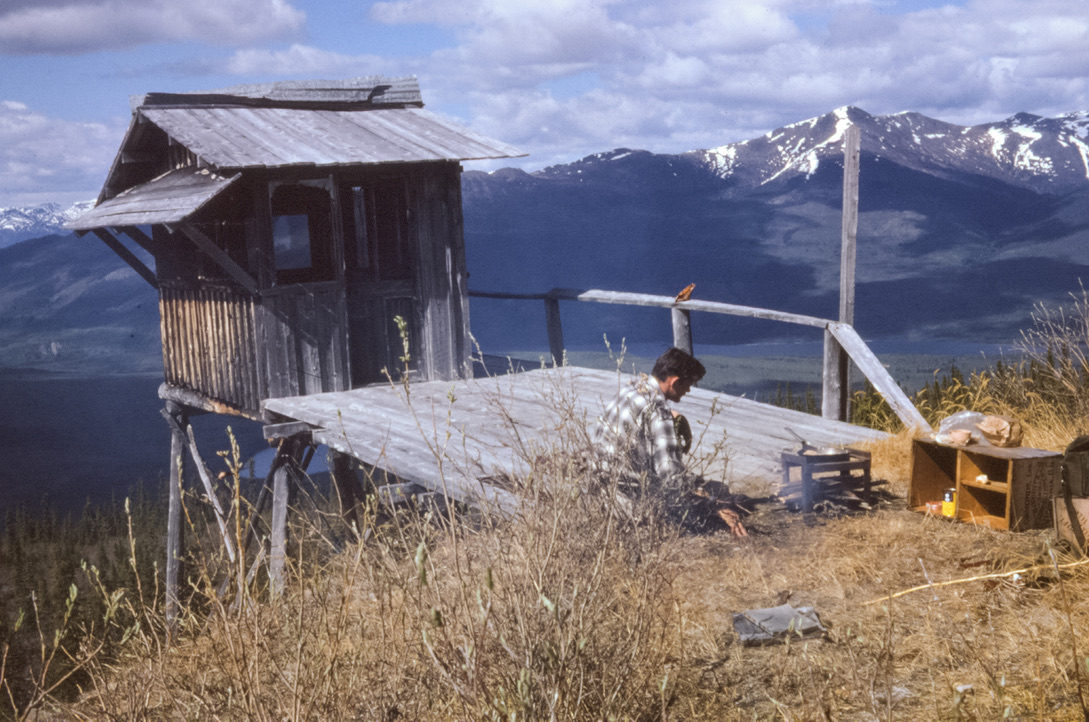
    Early June 1962 when Bill Dunn and I explored ruins of a mine on Keno Hill.  Later we discovered this was  once the Wernecke Camp
    Mine.


    Indelibly in my conscious  mind , however, was the joy Bill Dunn and I shared that June day as we
    cooked our lunch with our feet hanging over the McQueston Valley of the Yukon far below.
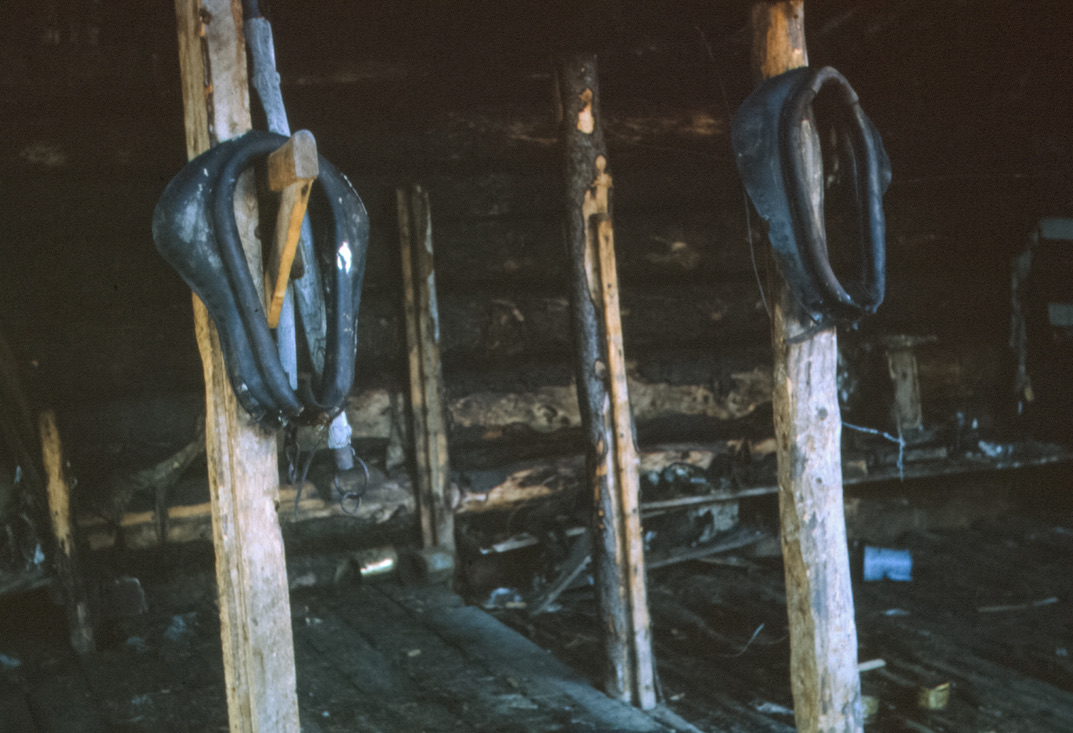
    My conscious  mind noted lots that day, particularly the lonely horse collars  hanging in
    the wreck of the horse barn…and the vacant cabin with plates, cups and saucers on the table.
    The emptiness where men once lived and left behind for Bill and I to find.

    I had no idea how this abandoned  mine connected to another humungous abandoned gold 
    mine on the coast of the Alaskan panhandle.   

    Let me jump right to the  disaster in 1917 … cut the crap  …

    THE TREADWELL DISASTER  April 21, 1917
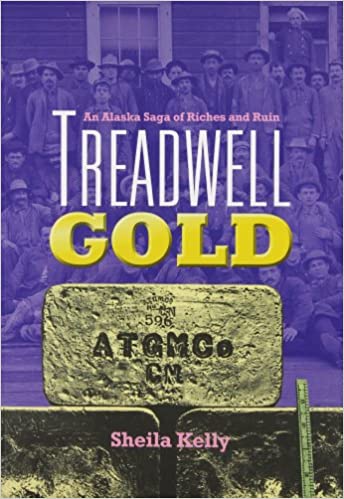

    In her book “Treadwell Gold,” Sheila Kelly references an eye-witness account of the cave-in:

    “At one fifteen a.m., the small group standing vigil watched as the ground around the natatorium and fire hall slipped sideways, then with ‘cracks, groans, and noises of shattering boards’ dropped straight down into the innards of the mine.

    “Finally, at two fifteen a.m., after another eruption at the cave-in site, a two-hundred-foot geyser of saltwater shot out of the top of the central shaft. The spouting display went on for a full five minutes before it stopped, like fireworks announcing a finale. After a harrowing three and a half hours, the mine was full. In those forty-five miles of mine shafts and drifts underlying the town to a depth of twenty-three hundred feet, those ancient geologic pockets that gave up ten million tons of gold-bearing ore were filled with three million tons of seawater.”


    Witnesses watched as their social club and company swimming pool suddenly disappeared  in a gaping hole  filling with sea water from deep below.  All miners escaped except maybe for one man who just disappeared.
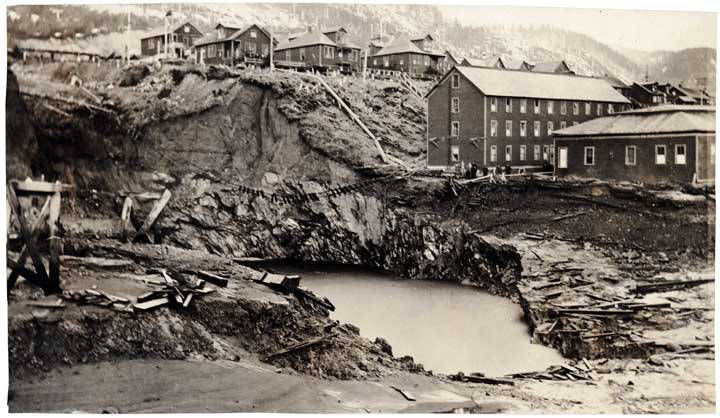
    The Treadwell mines and company town came to a spectacular end on April 21, 1917, when a massive cave-in flooded three of four underground mines, 2,300 feet deep. They’d yielded 10 million tons of ore. The void was filled with an estimated 3 million tons of seawater. Failure of unstable underground rock pillars and an extreme high tide led to the collapse. (Alaska State Library / Harry F. Snyder Photograph Collection P38-100)
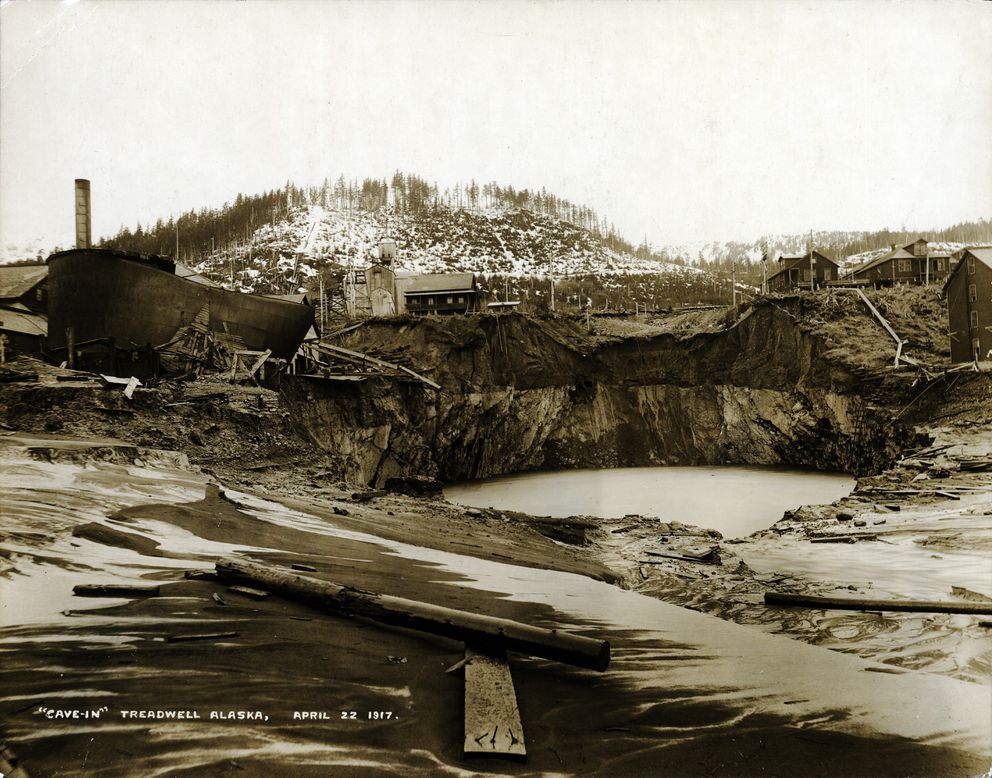
    The  Treadwell mine disaster on April  22, 1917…The day after the collapse.  Before  the disaster this  was the site of
    the Treadwell  social club swimming pool.  The  day after  the mine was filled with millions of gallons of salt water that
    cascaded into the passageways and drifts (stopes) below.  In between  the two events geologist Livingston Wernecke 
    crawled  out on a trestle precariously strung over the hole. He shone a light down into the blackness below as a pile
    of mud slipped into the dark.  When the mud and fragments of mine buildings hit the rising  water from below he breathed in “a blast of air that had the musty 
    oder of the deep reaches of the mine.”

    FACTS ABOUT THE TREADWELL GOLD MINE

    1)  The city of Juneau, capital of Alaska, is named after he  first prospector to lay claim to parts of Douglas Island, 1880’s.

    2)  Treadwell was the founder  of the mine which he  sold for $1.5 million dollars

    3) The Treadwell Gold Mine became the largest mines in North America between 1880  and 1917

    4) The mine buildings and property covered 2.5 miles of the Douglas Island shoreline

    5) It began as an  open pit mine then became a shaft and stopes mine that got deeper and deeper into the rock.

    6) To get one ounce of gold 8.5 tons  of  ore had to be  ‘stamped’

    7) The noise of  the stamping machines could be  heard for miles
    (a stamping machine is a kind of power driven hammer that reduced the ore
    into grains of sand that allowed other machines to sift and separate the gold.)

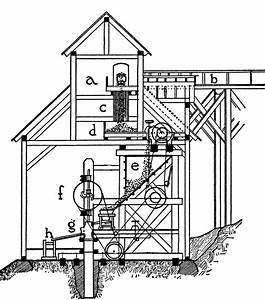
    Architectural  drawing of the workings of a stamp mill.  Easier to understand
    than pictures  of stamp mills at the Treadwell Gold  Mine.  Raw ore dumped  in
    stamp mill then pulverized into tiny pieces by power driven  hammer.  The noise
    from the Treadwell stamp mills was overwhelming but even so there was a sign
    “Quiet…Men  Working”…apparently


    8) Miners were all male because  women  were considered to be bad luck
    if working underground.  The men  got upset when some well intentioned women
    entered the mine and  sang to the men.

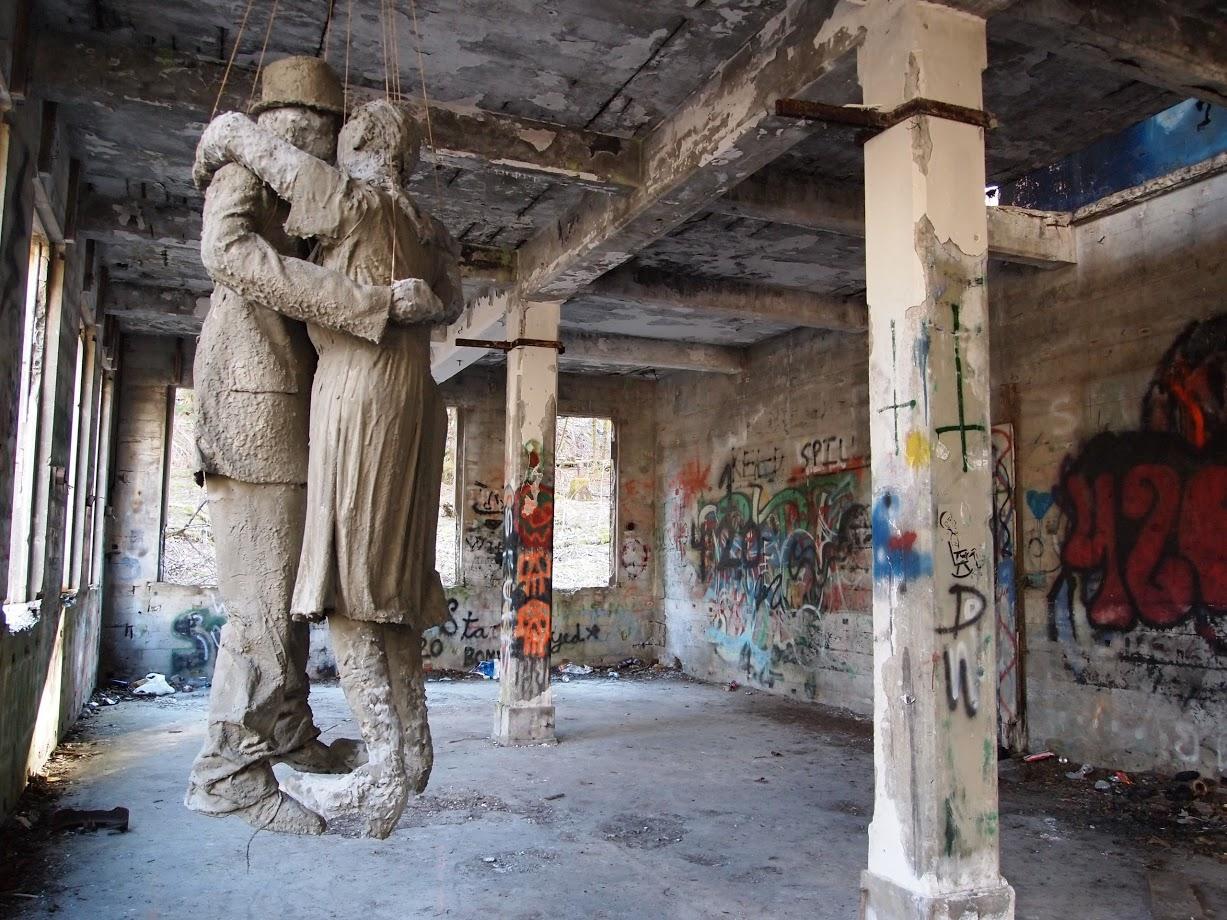
    Strange sculpture found in ruined cement  Treadmill Mine building…vandalized walls but intact mysterious sculpture

    9) The mine was excavated more than 500 feet below the Douglas Island and  out under the Channel
    …60 miles of underground operations, 45 miles were suddenly flooded in the disaster.

    10)  There were1,000 to  2,000 miners employed by Treadwell. (sources give two figures)  About 350 were in the mine
    when it was  flooded.  There was just barely enough warning for the miners to escape.

    11) All the miners got out in the nick  of time… Except for one man who was  missing.  He seems to have used the disaster  as a way
    to disappear rather than die.  But no one is sure about him.  His wife was awarded a settlement
    …no one is sure what happened to him but suspicion was that he survived.


    Abandoned horse  stable at Wernecke Camp Mine on Keno Hill, Yukon.   June 1962


    12)  There was not enough time to save the horses and one mule…all of whom soon drowned.  These  
    animals had been well treated…loved.  Some miners even offered to go down and try to save them.  Too late.


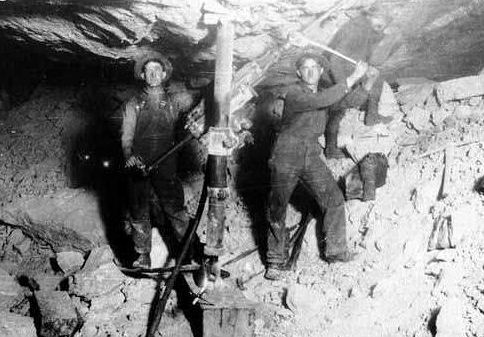
    Treadwell mners at work.  Stopes do not look like cathedrals but
    floor is rubble strewn.  How could stopes like these be called ‘cathedrals’?

    13) The drifts (stopes) were cathedrals more than 100 feet high on thin pillars.  Not enough pillars according
    to one source..

    14) Noise  of the stamping machines was so loud that the firing of cannon could not be heard

    15) This was Tlinget tribal land  and several of the  miners were Tlingets. Apparently
    they could not understand why these new  people from 17 countries valued gold so much.

    16) The stamping machines only recovered 50% of the gold. The rest of the gold
    was separated from pyrite using chemical process.  Arsenic was a dangerous by product
    that was difficult to conceal…led to many cancers of internal organs.

    17) Waste rock from the mine made 80 acres of beach along Douglas Island

    18)  26 million tons of rock were crushed in the life of the mine (40 years)

    19) $70 million worth of gold was produced

    20)  A raging fire on Oct. 10, 1926 consumed what was left of the Treadwell surface 
    buildings.  

    21)  The water tower is the only obvious surviving structure.

    22)  Employees were well treated…swimming  pool, dining hall, fair income, writing room, etc.

    etc. etc. So much to say … so little time to say it.

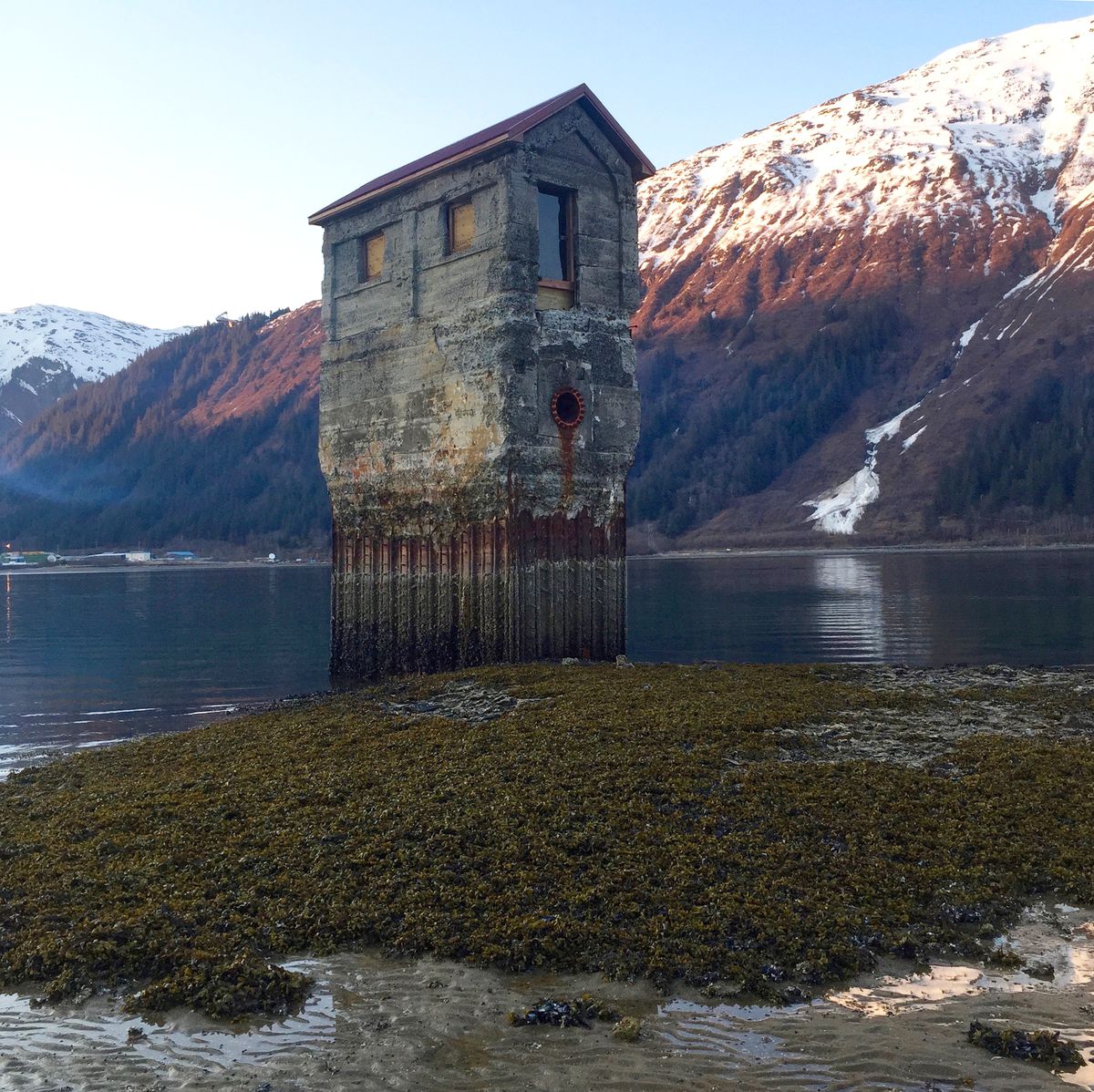
    The Treadwell Historic Preservation and Restoration Society restored the shell of the Treadwell pumphouse. Mt. Roberts serves as backdrop. (Katie Bausler)
    THE salt water tower remains as a gravestone of the Treadwell Gold Mine…recently roofed  by the local historical society


    LIVINGSTON WERNECKE


    “Mine geologist Livingston Wenecke rushed to the site, inched his way out on the tram trestle that was precariously strung over the hole, and shone a light down into the widening cauldron. He watched a mass of mud and water accumulate and then slide away with a deep rumble. As the muck was gulped down, the lower regions underground belched a blast of air that had the musty odor of the deep reaches of the mine.”


    Livingston Wernecke’s name seemed to jump at me from the description of the Treadwell Disaster.  He  had crawled  across  the gaping 
    hole after soil, rubble, buildings had tumbled into the shaft and disappeared.   His name  is unusual.  This had to be the same man who built the silver mine
    called Wernecke’s Camp halfway up Keno Hill in the early  1920’s.  Just a few years after the Treadwell disaster.  And it is the same man.

    Seemed to me that my Yukon experience was coming full circle now…59 years after the event.  All the pieces began make sense.
    Without the Treadwell disaster it is doubtful that Wernecke would have arrived in Mayo Landing, Yukon Territory, Canada, with a lot of equipment no longer needed
    at Treadwell.  Mining carts, tracks, skilled labour, investment capital, 98 horses, and his ‘boys’ (a father like term he applied to his miners). Livingston Wernecke is a
    hard  man to describe.  He will be the  subject of a coming Episode.

     Livingston brought was a man of few words…also he had  strict moral code…  He  would look after his ‘boys’  with the  same care  the owners of
    Treadwell looked after their miners before and after the disaster.  

    All 1,000 of the Treadwell men except one were found
    new jobs  in other mines.   And the one?   Well, now there is a mystery man that needs a novel … non fiction.
    (*  a challenge to readers.  Can you suggest reasons why a  man would want to disappear…a married
    man with children? )

    alan skeoch
    Feb. 2021

    STRANGE STOPES AT TREADWELL:  A MYSTERY

    I am not a mining engineer, not a geologist, not a geophysicist, not an engineer.    Nor have I devoted
    hours my time  to uncover the reason for the collapse  of the Treadwell  Mine.  But I have questions…
     curious thoughts.

    As i read about the disaster I noted this odd comment.  “The stopes deep down in the mine
    were cathedrals hundreds of feet high.”   I thought that must be a misprint.  I have never  
    heard of  a stope that high.  Too bloody dangerous.  it must  be a mistake.  Then another
    source said the miners worked from the bottom up.  They chiselled  and blasted rock
    from the ceiling…and the walls..a good deal of it gold bearing ore. (i.e.one  ounce of gold in every
    8.5 tons of ore.   In the process there was lots of  waste  rock that was strewn 
    on the floor of the stope.  So the floor got higher and higher as the miners chipped
    more and  more from the ceiling.  Hence the stopes deep  beneath Douglas Island
    were  huge rooms filled with waste rock which got higher and higher as the miners
    kept chipping at the ceiling.   Does this make  sense?  Not to me.

    Surely these huge rubble filled stopes were weak. (If true.)

    Another comment mentioned the  pillars.  The pillars in the stopes were not
    thick enough to hold up the incredible weight of rock and ore more than 2,000
    feet above.  Why would pillars be thin?   Because  the miner managers wanted to get
    as much  ore as possible out of the mine.  Could this be possible as a reason
    for mine collapse.  Do mines pull pillars?

    Surely the thin pillars weakened the mine.  (If true_)

    (This reminded me  of work we did deep down in Can Met Uranium mine, Elliott Lake, Ontario,
    in 1960.   When the mine was abandoned the miners had been instructed to “pull the pillars” to get
    as much high grade Uranium as they could.  The pillars left behind could 
    not take the weight and the roof of some stopes collapsed. If pillars are  pulled
    a mine  could never be reopened.  Right?  I remember the sound of a stope
    collapsing  and wondered why the hell we  were down there…four men in
    a collapsing mine.  But I loved the danger…shots of adrenalin.)

    These are questions in my mind.  Based on some short remarks in
    the Treadmill story.  Persons wiser than me might
    offer explanations.

    POST SCRIPT:  THE TREADWELL MINE
    (MY comments just touch the surface…here are more details)


    The Treadwell gold mine was on the south side of Douglas Island, .5-mile (0.80 km) east of downtown Douglas and southeast of downtown Juneau, owned and operated by John Treadwell. Composed of four sub-sites, Treadwell was in its time the largest hard rock gold mine in the world, employing over 2,000 people. Between 1881 and 1922, over 3 million troy ounces of gold were extracted. Not much remains today except for a few crumbling buildings and a “glory hole”. Although John Treadwell had twelve years of experience in both placer and lode mines, he was a carpenter and builder by trade who had come to Alaska prior to the Klondike Gold Rush.


    Beginnings

    In 1880, prospectors Joseph ‘Joe’ Juneau and Richard Harris discovered gold in Silver Bow Basin. This brought waves of prospectors to the region, including John Treadwell, whose first move was to purchase a lode claim on Douglas Island from Pierre Joseph Erussard de Ville. Treadwell also formed a partnership in September, 1881 with Erussard de Ville, D.P. Mitchell and Dave Martin under the name of The San Francisco Company. For unknown reasons he later backed out of this, and in early December 1881 he devoted his attention solely to the Douglas Island property. He then went on to buy two claims neighboring his property from D. W. Clark. Treadwell extracted twenty two samples from his three claims which he sent to San Francisco, California for a mill test, yielding encouraging results.


    On December 27, 1881, Treadwell organized the Alaska Mill & Mining Company and began operations at the Treadwell Dike. Shortly after this, five men from California bought over $10,000 worth of stock in the business. These men were James Freeborn ( 1828 – June 21, 1894 ), San Francisco banker and mining magnate John Douglas Fry (July 1, 1819 – February 3, 1901 ), Horace Lewis Hill (1840 – November 6, 1912 ), Howard Hill Shinn ( born April 4, 1857 ) and E. M. With these men funding him, Treadwell began running a tunnel and discovered that much of the vein he was mining was not on his property. Because word of his strike had not yet gotten out he was able to buy many of the adjoining claims for very little money, after which he returned to San Francisco to secure more backing for a much larger mill. His financial benefactors agreed to invest more and the major mining operation had begun.


    In 1889, Treadwell sold his stake in the company for $1.5 million and returned to California.

    Operation

    At the height of the operation there were five mills with over 960 stamps in continuous operation, closing down only on Christmas and Independence Day. These mills were fed by four mines known as the Treadwell, 700-Foot, Mexican and Ready Bullion. At this time the mine employed over 2,000 people and was the largest hard rock mine in the world. The gold was 55% free milling and 45% embedded in pyrite, which was extracted using chlorination, smelting, and cyanidation. Power to the complex was supplied by a coal-fired power plant (later switching to oil and two hydroelectric dams).


    Some of the shafts extended as much as 2,400 feet (730 m) below the surface.

    Decline

    The mine was still yielding gold in 1917 when the Treadwell, 700-Foot and Mexican mines (excavated to a depth of more than 500 feet (150 m) below sea level under Gastineau Channel) suddenly began leaking and were evacuated. Hours later the mines collapsed. At the climax, sprays of water were sent up to 200 feet (61 m) in the air from the mine entrances. The only casualties were a dozen horses and one mule; local lore has it that one man unaccounted for used the opportunity to head for parts unknown.


    Evidence of instability had been noticed around 1909, but there was no indication of impending disaster until 1913, when major geological shifts occurred. Reinforcements were constructed but were ineffective. The last shaft was worked in a limited fashion until 1922.

    Today

    The site eventually became the property of Alaska Electric Light & Power, which has since deeded a portion to the city of Juneau with the stipulation that it be maintained as a historic site. Under the management of the Treadwell Historic Preservation & Restoration Society there are recreation trails with markers identifying various locations. Another portion of the property is leased to a zip line operator.

    Directly above the cave-in site is a concrete pad where the Alaska Department of Transportation and Public Facilities places a 105mm howitzer, which is fired across Gastineau Channel at a shoulder of Mount Roberts to break up avalanches before they get so big as to pose a danger to Thane Road and residences there.

    Printed

    • Hard Rock Gold by David & Brenda Stone, Vanguard Press, 1987
    • History of the Mines & Miners in the Juneau Gold Belt by Earl Redman, 1988
    • The Birdman of Treadwell: Diary of a Treadwell Gold Miner by Edwin Warren with Barry Kibler (ISBN 9781425960643)
    • I Remember Treadwell by Charlotte L. Mahafly, Accra Print, 1983


  • EPISODE 247 CREDIT RIVER SUDDEN FREEZE BREAKS COVID 19 ISOLATION FEB. 6

    EPISODE 247   CREDIT RIVER SUDDEN FREEZE BREAKS COVID 19 ISOLATION  FEB. 6, 2021


    alan skeoch
    Feb. 6, 2021

    The creation of perfect ice on the Credit River is a rare event.  Today  is that kind  of day
    and it seems a lot of people were anxious to take a chance.  Solid  Ice in close proximity
    to open water.   Human  beings on blades in close proximity to mallards  and swans  sleeping
    in the water.

    Memories that no one will believe next summer are made of such  as this.   Maybe memories
    for generations if global warming gets any worse. “Remember when we had lunch on a boulder
    while skating on the Credit River from the QEW to Port Credit?”
    “Remember when those two boys playing hockey came to talk to us and we married them?”
    “Remember when  we skated while the swans  watched.”

    This is such an ephemeral event.  Tomorrow there may be a  snow storm.  And the opportunity
    will be  gone.  And there is an element of danger.  Danger if the ice breaks while chasing
    a  puck close to open water.  Danger just trying to get down to the river on the icy, boulder strewn,
    river banks.  Danger you will find  a wind blown patch  of sand  while watching the horizon then
    nose diving onto the ice.


    alan  skeoch
    Feb.  6, 2021


    FLASHBACK A FEW  DECADES: ON THE CREDIT RIVER

    We were able to skate  on the Credit several times.  And we knew there was  some  danger.  The ice could give way suddenly
    if we made the wrong choice.  But to miss the chance was to miss something to cherish.


    I have never been a super duper skater.  My first skates were hand me down  skates two sizes too large. I ankled  my way
    across the ice.  My worse time was the ‘sand  on the ice’ mistake that enlarged my nose as I grooved my way down a  patch.
    I remember that moment so well.  My skates stopped  but my body kept moving parallel to the ice and BOOM…my nose hit
    before my hands. Blood … lots of it.


  • EPISODE 245 NORM SENDS PICTURES OF SKAGWAY … AND RESPONSES TO MY PRUNING (WHICH I CANCELLED)

    EPISODE 245    YUKON DIARY    NORM SENDS SOME PICS OF SKAGWAY … AND  RESPONSES TO MY PRUNING 

    alan skeoch
    Feb. 5, 2021

    First, my former boss in the mining business, Dr. Norman Paterson, also  visited Skagway with his wife.   He got to take
    a peek inside a Skagway brothel that might interest readers.   You might notice the calculating  machine …
    Skagway citizens made light of the prostitution in the Yukon.  My earlier Episode was closer to the truth.
    It was an  unhappy business.   THANKS  for the pics Norm.  Dr. Paterson will be the subject of a future
    episode…


    > Sally and I did that trip the reverse way (Skagway to Whitehorse). Your photos are better than mine but here are two or so anyway. The tent brothel was in Skagway, along with a lot of other old timetheatrics. The sign on the side of the hill marks the original foot- and horse path.
    > Norm 


    Norm also  got this  great picture of a plus  slope (boreen rock slope) which is very unstable for horses  or human beings.  


    Alaska Best (29).JPG

    Alaska Best (21).JPG
    February 3,  2021

    NOTICE OF PRUNING…NOW WITHDRAWN


    Hi

    1)  Some people may not want these Episodes…now at 243…they  clutter up email, are offensive perhaps, etc. etc

    2) So I will remove  all who have not responded in one way or the other.  You do not need  to do anything unless 
    you want back  on the list.  Episode  243 will be  your last email story.  If you get Episode 244, you are still on the list.

    3) Sorry for cluttering.

    4) If I make an error and you want back on the BCC list, let me know by email

    5) The Episodes started last March 2020 as a way for some of my friends to
    get a daily relief from the isolation caused by Covid  19.  I never expected
    to spend a whole year writing and  illustrating stories. I enjoy doing the stories.

    alan

    SOME OF YOUR RESPONSES…MADE ME FEEL GOOD…THANK  YOU.
    I HAVE CANCELLED THE PRUNING.  HERE ARE A  FEW OF  THE REMARKS
    I RECIEVED.   NICE.  

    Alan


    In 1980 my mom took our 2 eldest kids (Robert 14, Elizabeth 12) on an Alaskan cruise
    One of the stops was Skagway. They talk about it to this day.

    Al,
    I NEED to be kept on the list.
    Love every story and eagerly await my daily “fix”.
    I had my first vaccine yesterday and Lesley is having hers today.
    Trust you are both well.
    Loved the photos of you both in the snow.
    Also, laughed when reading how you stole the bus!
    Keep safe,
    Champs

    Please keep me on the list. Although I don’t comment have enjoyed your emails.
    Norma

    Alan,


    Nooooooooooooooooooo! 
    Keep me in the loop!

    Dan
    ~
    I enjoy the stories especially the history.   The Yukon is not an area I knew much more about than Robert  Service’s poems .   Have been on the White Pass Railroad as it was an excursion from Skagway 3 years ago when we took an Alaskan cruise 

    I am thoroughly enjoying your missives. I spent some time in Whitehorse in the mid eighties and followed the travails of those gold rush dreamers. You stories continue to enlighten and amuse from a life well led and well recorded. If you are comfortable continuing I am comfortable lurking and receiving.  Marilyn

    Hope you are well. 

    Keep me on the list! 

    Please do not remove us from your list. Your stories have helped so much to keep us entertained through 2020. Just hope you are not doing yourself in, trying to keep up one per day!
    David and Mary 🤗

    Please keep going ….I get behind sometimes. I pass this on to Jim and he reads too.   Kate

    For gosh sakes, don’t drop us from your valued list.

    We are not Republicans. 

    CBS

    By all means — please keep me on your list! The stories are great!

    By the way, I’m curious as to how many faithful readers you have out there.

    Ron Nowell (PCI 67)
    Calgary

    Found a puppy for the girls by the way. We bring her home on Saturday! I’ll keep you posted with pictures! 

    Skagway and up the rail. Unfortunately that was as close I ever got exploring the Yukon. I slept in one of those white things down the street.
    Ed

    Hi Alan, 

    I am a friend of Bob Cwirenko and Mary Lee.  We live in the same condo building and share many get togethers (used to share, damn COVID) including drinks, bbqs and social events. I have enjoyed your memories and find them interesting and engaging. Especially enjoyed Episode 53 and harvesting the kelp on the island! 


    Oh my Alan!!!!!

    Please do not delete me from your email list. Admittedly, I did not read all, but was certainly entertained by many, and have forwarded some to family/friends whom I know would be entertained by your antics. 

    In fact…..as a result of your escapade on the Don River, I understand that I will be taking part in that event this spring with my daughter Lindsay and her partner. 

    In addition, I forward each and every episode to Jane Borland, (a RWTO friend) who lets me know if I fall behind in sending your daily email on to her. 

    So please Al…..keep em coming.   Peggy

    Keep me on the list, Alan.    I am waiting breathlessly for Ep 244.

    Bob Cwirenko


    How do we get you on a DARE I SAY GOVERNOR’S GENERAL’s LIST for recognition as a 20th century pioneer? Definitely your stories deserve a book which my own grandchildren let alone the hundreds from H.C.I. will get for  their  Christmas. You and Pierre Burton are neck and neck. Don’t prune nothing nohow. You wrote from the heart and the circumstances of the time.
    I don’t know how you bloody well survived from the tales you told.  Marjorie obviously is the luckiest wife I know.
    Choiketi – hoik.
    Thom
     
    Beautiful mountains in the background.

    Funny isn’t it when the tourists come in off the big ships.

    When I went to visit the Galapagos we stayed on the islands. During the day the tourist ships would disgorge hundreds of tourists, then they would be gone before dinner. Meanwhile, we got to eat in peace and quiet in outdoor restaurants on our own without the crowds and watch the sunset, and stroll on the beaches with the sea lions. 

    We also saw areas in the off times from the ships and often had the place much to ourselves. It seems most people visit the Galapagos by ship and very few actually stay on the islands. 

    Jeannette 


    Please keep me on your list.  I look forward to reading your stories.  

    They are a bright spot in this pandemic.  
    Isn’t it hard to believe that a year ago we were running around like crazy getting ready for our Leap Day fundraising dinner at the brewery?!!! That was our last social event.  We flew to Florida the following week and then the fun began as Canadians were urged home, the borders closed and flights started to be cancelled.  

    Patricia

    Keep me on the list,  and thanks for the $5.00.
    Are we really in our eighties?
    Eric

    Hi Alan,

    Enjoying all your writing. Keep up the good work.   


    Your history lessons/teaching continues. I’m sure many of your readers would have no idea of what living, working, surviving in the Northern bush country requires of a person.

    Say Hi to Marjorie.

    Ted

    Hi Alan,

    I enjoy the stories and adventures !!

    Rooter

    Keep me on it Alan-amazing to read!!!!

    Stay well and say hi to Marjorie.
    Greg


    Please keep me ON the list. Love your stories Alan.

    Jayme

    > Sally and I did that trip the reverse way (Skagway to Whitehorse). Your photos are better than mine but here are two or so anyway. The tent brothel was in Skagway, along with a lot of other old timetheatrics. The sign on the side of the hill marks the original foot- and horse path.
    > Norm 
    >

    Etc. etc.   Lots more responses so I will keep going.

    Alan