February 3, 2021
Hi
1) Some people may not want these Episodes…now at 243…they clutter up email, are offensive perhaps, etc. etc
2) So I will remove all who have not responded in one way or the other. You do not need to do anything unless you want back on the list. Episode 243 will be your last email story. If you get Episode 244, you are still on the list.
3) Sorry for cluttering.
4) If I make an error and you want back on the BCC list, let me know by email
5) The Episodes started last March 2020 as a way for some of my friends to get a daily relief from the isolation caused by Covid 19. I never expected to spend a whole year writing and illustrating stories. I enjoy doing the stories.
alan
Year: 2021
-
I am pruning my BCC list….let me know if I make a mistake. Alan
-
EPISODE 243 YUKON DIARY SKAGWAY IN 1962…suddenly a crowd
EPISODE 243 YUKON DIARY SKAGWAY IN 1962alan skeochFeb. 2021 White Pass Railway today…with at least a dozen passenger coaches to handle the one million tourists. On my trip in 1962 there were only a few coaches…an empty train.
 Skagway Today…before a tourist ship arrives.
 Skagway…back then.Wednesday Sept. 12, 1962The White Pass Railway threaded the Dead Horse Pass needle slowly…carefully. To make anerror … a full speed ahead kind of error….invited a swift and catastrophic end to my Yukon Diary.So we Twisted our way down to Skagway. (Excuse the double metaphors…i.e.threading a needleand ‘ Twist Again Like we Did Last Summer’) Travelling the Klondike trail in reverse. Alone. No baggageexcept my brief case and extra socks.I find it hard to believe that just yesterday I was tagging mining claims in a God awfulswamp with patches of Yukon stunted Spruce. Carrying a 30-30 rifle and a Blazing axe.My feet breaking through an inch of ice with each step. Feet awash in ice water that mybody temperature heated into a thin kind of hot soup as my feet boiled.And today I am sitting alone on a near empty passenger coach built in 1900 in theexpectation that the Yukon was about to open up to settlement. That never happenedso the White Pass Railway eked out an existence with gawking tourists of which theredid not seem to be many and heavy shipments of silver ore destined for an Americanrefinery.The rails screamed in protest with each turn. Only 107 miles of track between Whitehorseand Skagway. But what a difference. Whitehorse was Canadian territory where I metWaler Malecky by chance. Small town atmosphere really.Now Skagway was something else. First off, it was American territory. Strange in a way.I had no passport yet at no time was asked to show my identity. I guess the powers thatbe figured anyone coming or going from Skagway was no danger to either Canada orthe United States.The only austere part of the trip other than the yawning chasms was the lone Skeleton ofa Presbyterian church somewhere along the way. A church where once there must havebeen congregants. Now as solitary as the moon. A bit chilling.The trip took longer than I expected. Only 107 mlles….s couple of hours at most I thought.I should have known better for I had been reading Pierre Berton’s Klondike whichmade both passes…the Chilkoot and the Dead Horse Pass…terrifying, dangerous, deadly.That was my state of mind as the train flattened out for a piece on its final approachto Skagway. I was a miner. A mining claim tagger. A veteran of the Yukon. Leaving tough,hard drinking, foul mouthed, humorous and tragic Yukon veterans behind. Yesterdaymy boots crashed through that ice foretelling the coming of a Yukon winter.I often read and re-read Robert Service’s ‘Spell of the Yukon’. Almost memorized. I thoughtof the men who sat around our campsites quoting Robert Service by heart. Especially whentheir tongues were loosened by Double overproof rum.I wanted the gold, and I sought it;I scrabbled and mucked like a slave.Was it famine or scurvy—I fought it;I hurled my youth into a grave.Day dreaming my way down from the Coastal Mountainsto one of the strangest places on earth…Skagway.Where 100,000 men and a few women rolled the diceof life’s journey in a hopeless chance to grab the goldenring of their trip on life’s merry go round.It is important that readers understand my state of mind.I was trying to replicate things that happened here inSkagway sixty years ago…back just before mom anddad were born. Ancient times.Skagway. Finally I was there. The intricate plan of myescape from the Yukon was really happening. Skagway“a tiny decrepit ghost town given life by a few souvenir shops”My verbatim Yukon Diary entry.I bought mom a souvenir plate…$5.50 plus .65 tax or exchange .What? Everything is going to cost 10% more than I counted upon.Will I be able to manage? Booked into the Skagway Inn at $4.00for the night.Outside the single main street was suddenly full of people. Not men intorn work pants taking a leak in a ditch. Not the kind of men I knew.Men in sport clothes with women on their arms. Older people…lotsof them rubber necking their way from souvenir shop to railway cars.Cameras clicking. People posing beneath a Soapy Smith shop sign.Why would anyone want a picture of that son of a bitch. His namewas obvious on Skagway storefronts. Did no one know that SoapySmith was a murderiing thief who extorted money and goods fromthose poor deluded gold seekers. Did no one take joy in the facthe was shot dead by a justifiably angry fellow? The people of Skagwayback in the gold rush days were little better than Soapy for they grewwealthy selling goods at inflated prices…buying half-dead horsesfrom steamships knowing that those horses would soon be overloadedand plodding up Dead Horse Pass .There was no hay up there. Those horses were starving. Skagwaywas not a town to admire in those times.I expected an empty town. Now it was suddenly full of people. Where didthey come from. More people than buildings. Skagway was a tinysliver of a place. A bit of flatened gravel backed immediately by thesoaring Coastal Mountains. Where did all these people come from? Where will all these peoplesleep?The answer came as I reached the waterfront where a couple of largesparkling clean passenger ships were anchored. The Lynne Canal isa long and deep stretch of water snaking inland to Skagway. Perfectfor shipping.Note: There are 800 or so permanent residents of Skagway today (2021)but the town is capable of handling 10,000 people daily. Skagwayis the target town for those huge passenger ships ferrying thousandsof tourist up and down the coastal northern waters of Canadaand the United States. Huge ships. In 1962 the ships were not as largeand the volume of tourists was considerably less. But Skagway wasa kind of Mecca nonetheless.
 “Suddenly there were crowds of people”…the reason is obvious in this picture. One millionpeople visit Skagway today. They sleep in that white thing at the end of the Skagway street.
 So I joined the crowd. Soon got over the shock. Later in the eveningI even went to the DAYS OF ’98 show put on by Skagway local citizens,a rather delightful amateur production. Sincere…repeated each nightfor the tourists ships that come and go on schedule.Gambling was another piece of the Skagway mystique. I lost a coupleof dollars. But had fun. Easy to get to know the tourists. They wantedto meet locals. Wanted to meet descendants of the gold rush throng.I fitted that image better than most. I had walked those bleak Yukon Hillsin search of silver. I had nursed those Double OP’s with men likeAaro Aho, Moses Lord, Waler Malecky, Bob Gilroy, Bill Dunn,Bill Scott…Alex, Andy,Dinky…so many characters.And I had a full red beard as was expected of a person ‘who moiled for gold’I had even done some successful gold panning as proved by he specs of goldon swatches of black electrical tape mailed to Marjorie. The only image thatdid not fit was the smell. I had bathed twice…once in Whitehorse and once inSkagway. I smelled like a tourist awash in Aqua Velva after shave lotion.There were a couple of poorly disguised patches on my pants which may haveclues that I was one of the Yukoners…a Miner.
 I talked with a lot of people. Asked around. Like “how do I get outof Skagway? There are no roads south to Juneau where I have bookeda flight. One group of young ladies offered to hide me on their big passengership destined for Seattle. They said no one would notice. The offer was madein jest I think. Not sure Marjorie would be too enthusiastic had I taken the offerseriously.But I was very serious. How in hell was I to get out of Skagway. The only road wasnorth to the the Alaska Highway and on to Anchorage…miles and miles the wrongdirection. I got a bit alarmed when I hit the sack. Needlessly so. The answerwas simple but a little more expensive than I had anticipated.Expenses (not eligible for expense account)Train $19.00Hotel $4.00Ceramic Plate $6.15 (*Goddamn Tax of .65)Show, Days of ’98 $1.00Food $1.65Stamps and cards .53Gambling $1.50This trip was costing more than I had planned“They’re making my money diminishI’m sick of the taste of champagneBut I’ll battle on to he finishAnd head back to the Yukon again.”*Funny…I remember this Robert Service fragmentso well that I can almost quote it verbatim now in 2021.Perhaps one of my readers would like to check myaccuracy. I do not have time for that right now.I must ‘battle on to the finish’ even though I willnever get the chance “to go back to the Yukon again.”alan skeochFev. 2021POST SCRIPT: Some Critics of Robert Service…pompously …accusehim of doggerel poetry. I think those who love poetry were a little more broad mindedthan that. Read this aloud…enjoy it. Forget about metaphors and convoluted meanings.
The Spell of the Yukon
I wanted the gold, and I sought it;I scrabbled and mucked like a slave.Was it famine or scurvy—I fought it;I hurled my youth into a grave.I wanted the gold, and I got it—Came out with a fortune last fall,—Yet somehow life’s not what I thought it,And somehow the gold isn’t all.No! There’s the land. (Have you seen it?)It’s the cussedest land that I know,From the big, dizzy mountains that screen itTo the deep, deathlike valleys below.Some say God was tired when He made it;Some say it’s a fine land to shun;Maybe; but there’s some as would trade itFor no land on earth—and I’m one.You come to get rich (damned good reason);You feel like an exile at first;You hate it like hell for a season,And then you are worse than the worst.It grips you like some kinds of sinning;It twists you from foe to a friend;It seems it’s been since the beginning;It seems it will be to the end.I’ve stood in some mighty-mouthed hollowThat’s plumb-full of hush to the brim;I’ve watched the big, husky sun wallowIn crimson and gold, and grow dim,Till the moon set the pearly peaks gleaming,And the stars tumbled out, neck and crop;And I’ve thought that I surely was dreaming,With the peace o’ the world piled on top.The summer—no sweeter was ever;The sunshiny woods all athrill;The grayling aleap in the river,The bighorn asleep on the hill.The strong life that never knows harness;The wilds where the caribou call;The freshness, the freedom, the farness—O God! how I’m stuck on it all.The winter! the brightness that blinds you,The white land locked tight as a drum,The cold fear that follows and finds you,The silence that bludgeons you dumb.The snows that are older than history,The woods where the weird shadows slant;The stillness, the moonlight, the mystery,I’ve bade ’em good-by—but I can’t.There’s a land where the mountains are nameless,And the rivers all run God knows where;There are lives that are erring and aimless,And deaths that just hang by a hair;There are hardships that nobody reckons;There are valleys unpeopled and still;There’s a land—oh, it beckons and beckons,And I want to go back—and I will.They’re making my money diminish;I’m sick of the taste of champagne.Thank God! when I’m skinned to a finishI’ll pike to the Yukon again.I’ll fight—and you bet it’s no sham-fight;It’s hell!—but I’ve been there before;And it’s better than this by a damsite—So me for the Yukon once more.There’s gold, and it’s haunting and haunting;It’s luring me on as of old;Yet it isn’t the gold that I’m wantingSo much as just finding the gold.It’s the great, big, broad land ’way up yonder,It’s the forests where silence has lease;It’s the beauty that thrills me with wonder,It’s the stillness that fills me with peace.Robert Service This shows how small Skagway appears when dwarfed by both luxury ships and the Coastal Mountains.END … NEXT EPISODE WILL BEYUKON DIARY THURSDAY SEPT. 13, 2016
skagway.com/wp-content/uploads/2016/01/Skagway-1898-may-300×208.jpg 300w” sizes=”(max-width: 766px) 100vw, 766px” class=”wp-image-5357″ apple-inline=”yes” id=”46A6F100-044F-4E70-AC83-C45D42638E7F” src=”https://alanskeoch.ca/wp-content/uploads/2021/02/Skagway-1898-may.jpg”>
-
EPISODE 242 YUKON DIARY THE WHITE PASS AND YUKON RAILWAY
EPISODE 242 YUKON DIARY RIDING THE WHITE PASS AND YUKON RAILWAYalan skeochFeB 2021 Wednesday Sept. 12, 1962Dark and dreary day. Tough day for my ride on the White Pass Railway from Whitehorseto Skagway. The downhill run. Narrow Gauge railway…3 feet between rails…cheaperto build than a standard railway. The builders had enough trouble trying to find a routeover the Coastal Mountains. International…toughest part from White Pass to Skagway.…only 107 miles long. Completed in 1900.The White Pass and Yukon Railway was just about worn out by 1939…old enginesand old coaches. Relied on freight from Yukon mines…such as Keno Hill, Galena Hilland others that shipped their concentrate down to Skagway and then by steamships torefineries in the United States. The Great Depression led to the closing of many mines.Then came the 1960’s…boom times for everyone.Opened August 1, 1900Closed October 2, 1982Re opened May 24, 1988NOTE: IN 1963, the year after I left the Yukon, 70 tons of stollensilver ore was surreptitiously shipped from the Yukon. The storywill be coming shortly. An unbelievable adventure. This stollen silveror was being moved to hiding spots near Elsa …The thief, Mr. Preistwas arrested by a fluke action taken by a White Pass trucker who wanteda cup of coffee in Elsa before driving to Whitehorse. Priest was arrestedand testified that “the 70 tons of silver were his because the 70 tons “fellfrom the Moon” I had no idea this was happening while we weredoing our survey. The story is riveting.
Commercial operations Original gauge 3 ft (914 mm) Preserved operations Reporting mark WP&YR Length 107 miles (172 km) (Skagway to Whitehorse); 67.5 miles (108.6 km) (Skagway to Carcross) Preserved gauge 3 ft (914 mm) Commercial history Opened August 1, 1900 Closed October 8, 1982 Preservation history May 24, 1988 Reopened as The White Pass Route Headquarters Skagway, Alaska 
 WHITE PASS AND YUKON RAILWAY…AND WORLD WAR II(Critical supply source for the Alaska Highway)Alaska became strategically important for the United States during World War II; there was concern that the Japanese might invade it, as Alaska was the closest part of the United States to Japan. Following the Attack on Pearl Harbor, the decision was made by the US and Canadian governments to construct the Alaska Highway as an all-weather overland route to ensure communication. One of the principal staging points for construction was Whitehorse, which could be supplied by the WP&YR.By that time the railroad was a financially starved remnant from Klondike gold rush days, with well-worn engines and rolling stock. Despite this, the railroad moved 67,496 tons during the first 9 months of 1942, more than double its prewar annual traffic. Even this was deemed insufficient, and so the U.S. Government leased the railroad for the duration, effective at 12:01 a.m. on 1 October 1942, handing control to the United States Army. What became the 770th Railway Operating Battalion of the Military Railway Service took over train operations in company with the WP&Y’s civilian staff.Canadian law forbade foreign government agencies from operating within Canada and its territories, but Japanese forces had occupied some of the Aleutian Islands by this time, and an accommodation was quickly reached to “make an illegal action legal.”The MRS scoured the US for usable narrow-gauge locomotives and rolling stock, and soon a strange and colourful assortment began arriving at Skagway. The single largest group was seven D&RGW K-28 class 2-8-2’s acquired prior to the lease in August 1942. 2-8-0’s from the Silverton Northern and the Colorado & Southern, all over 40 years old, and a pair of ET&WNC 4-6-0’s soon appeared, among others, as well as eleven new War Department Class S118 2-8-2’s. WP&Y’s original roster of 10 locomotives and 83 cars was soon eclipsed by the Army’s additional 26 engines and 258 cars.The increase in traffic was remarkable: In the last 3 months of 1942, the railroad moved 25,756 tons. In 1943 the line carried 281,962 tons, equivalent to ten years worth of typical prewar traffic. All this despite some of the most severe winter weather recorded since 1910: Gales, snowdrifts and temperatures of -30 degrees F. succeeded in blockading the line from 5 – 15 February 1943 and 27 January – 14 February 1944.The peak movement occurred on 4 August 1943, when the White Pass moved 38 trains north and south, totalling 3346 gross / 2085 net tons, and 2236 locomotive-miles in 24 hours.[33]ENJOY THE TRIP…THE PICTURES ARE MORE DRAMATIC THAN ANY WORDSI COULD WRITE.

 END EPISODE 242 YUKON DIARY
 -
EPISODE 341 YUKON DIARY: DOING THE YUKON IN REVERSE ORDER: DEAD HORSE GULCH
Note: Sorry this story needs editing but I have no time…trying to do one story each dayEPISODE 341 YUKON DIARY: DOING THE YUKON IN REVERSE ORDER
DEAD HORSE GULCHalan skeochFeb.1 2021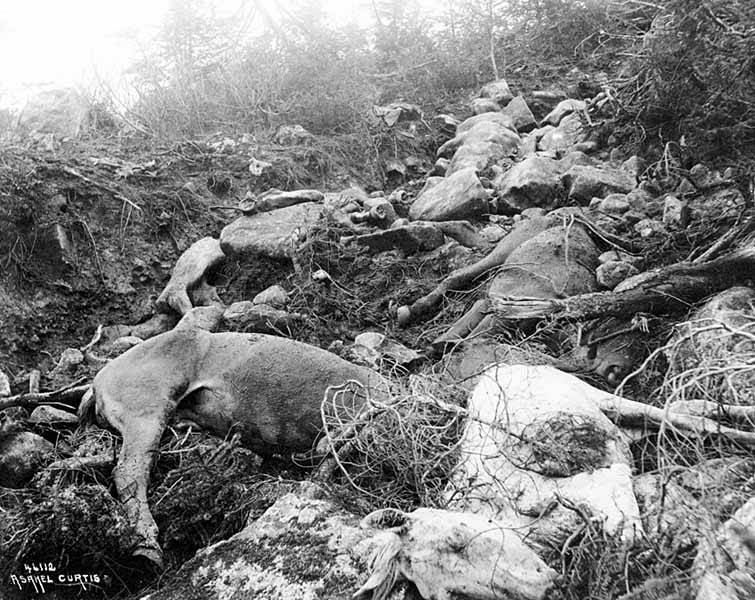 There were two passes to the Yukon. The Chilkoot Pass and the Dead Horse Pass…renamedthe White Pass. I took the latter. There were a lot of dead horses here. I never saw any. Theirbone were now as great as the rocks.Only due to the lust for gold were these passes found“There is no route from Skagway to the Yukon.:“Not so.”, said the Tlinget native.“Those coastal mountains are impassable.”“Not so.” said the Tlinget native“Impassable…no way to reach the Yukon River….Lake Bennett headwaters.”“Not so.” said the Tlinget naive“Prove it…show me the way.” said the white man“Secret trail of my people.”“Show me.”“We have traded with the interior people of the HighYukon plateau for many years…through thispass.”“Show me.”And the Tlinget revealed the mountain pass now called the Chilkoot Pass. Steep withjumbles of loose rock on a formidable incline. Then snow and ice high above the Oceanfar below. Crested slot that then tipped downward to the icy waters of glacial Lake Bennett.But this was not the end of the trek. Only the beginning. From Lake Bennett the gold seekersstill had 550 more miles to cover if they were to reach Dawson City.Wednesday Sept. 12, 1962
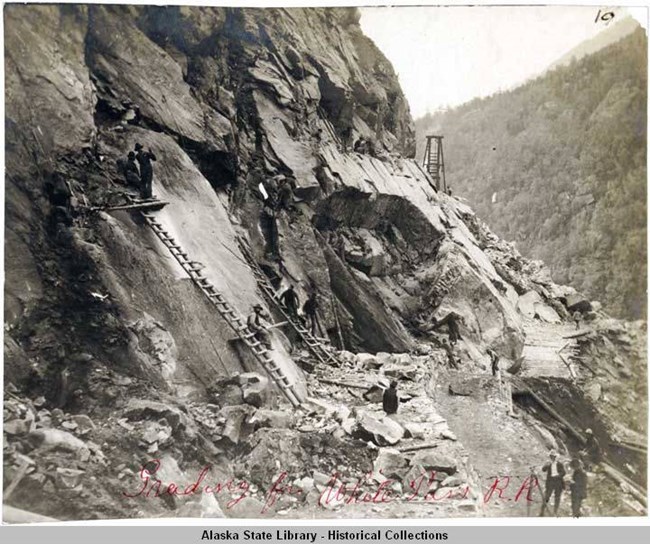 Building the White Pass Railway 1890’sNarrow gauge railroad that goes just about nowhere. Climbs over the Coastal mountainsfrom tiny inconsequential Skagway by twists and turns…through tunnels that seem rough blasted…overtimbered bridges clinging to Mountainside.The White Pass moves slowly. As if expecting catastrophe any moment. Screaming braking systemjawing musically as metal on metal maintains the slow descent through Dead Horse Gulch. This isnot the Chilcoot Pass route. The railway follows another somewhat gentler but loner route namedafter a long forgotten politician. This is the Dead Horse Gulch Pass.
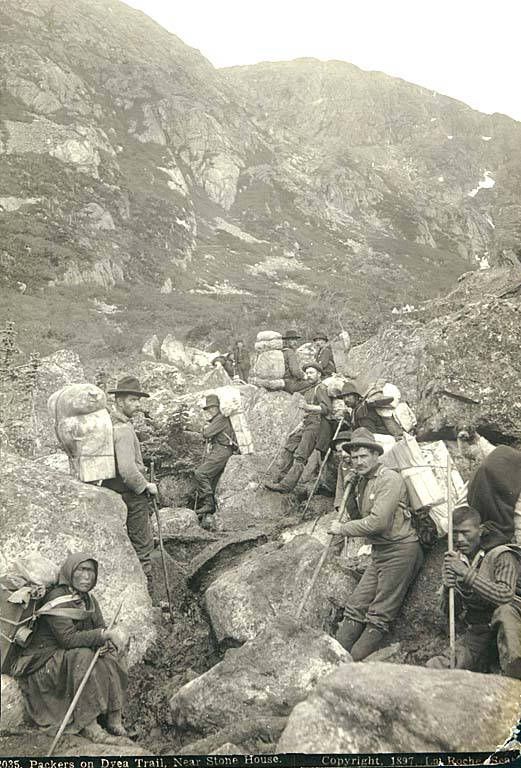 Chilkoot Pass…no easy trip with 1 ton of supplies per manIn 1897 the Yukon Territory was virtually an unknown land peppered here and there bynatives. Even these people avoided the eastern part of the Yukon in fear of evil spirits thatwere living there. A few white trappers and even fewer white placer miners eked out ashaky existence. Food, other than wild meats, had to be carried over the coastal mountainsor steamed up the Yukon River. Not worth the aggravation was the conclusion of most people.There were better places. As a result much of the Yukon was an empty land. That changed when the gold fever of the Klondike. And then,when the easy gold ran out, along came the silver boom at Keno Hill.White Pass Railway was the route out for the silver ore. Refined in the United States.Think of the Yukon as a huge tank of water with one tiny spigot at the bottom. The White Pass.My passenger car was made in 1900 just when the White Pass route was completedAncient. Coal stoves for heat in each car. Soft seats now but I bet they were once slattedseats.And I bet dollars to donuts the White Pass railroad passed by the piles of dead horseswhose putrifying remains littered the crevices and deep trenches along the way. DeadHorse Gulch in particular. I strained my eyes expecting to see a boneyard far belowbut saw nothing. In 60 to 70 years the bones got as grey as the rocks.How many horses? Dozens? No. Thousands…perhaps as many as 3,000 horsesdied on this so called easier route to Lake Bennett. Terrible stories neglect andbrutality. Many of the men climbing through this Pass knew nothing about horsesand pack saddles. They just strapped the gear to horses backs. When a hundredpound sack of flour shifted, horses fell over. Often injured horses were killed. I suspecteven this humane act was not done since some horses rolled over and over downthe rock strewn slopes. These thousands of horses were ill treated before they evergot to Skagway. Jammed bum to bum on steamships. Some already weak and sick.Best described by Jack London“The horses died like mosquitoes in the first frost and from Skagway to Bennett they rotted in heaps. They died at the rocks, they were poisoned at the summit, and they were starved at the lakes; they fell off the trail, what there was of it, and they went through it; in the river they drowned under their loads or were smashed to peices against the boulders; they snapped their legs in the crevices and broke their backs falling backwards with their packs; in the sloughs they sank from fright or smothered in the slime; and they were disemboweled in the bogs where the corduroy logs turned end up in the mud; men shot them, worked them to death and when they were gone, went back to the beach and bought more. Some did not bother to shoot them, stripping the saddles off and the shoes and leaving them where they fell. Their hearts turned to stone- those which did not break- and they became the beasts, the men on the Dead Horse Trail.” -Jack London, Journalist. The God of His Fathers, Doubleday Page & Co., New York, 1914, p. 70-80
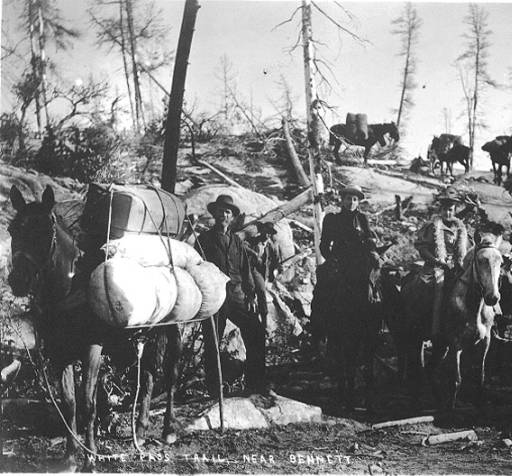 There are other even more gruesome stories about these horses. Men impoverished andstarving cut slabs from these dead horses for food. Hard to believe? Try starving yourselfto near death and see if your opinions change.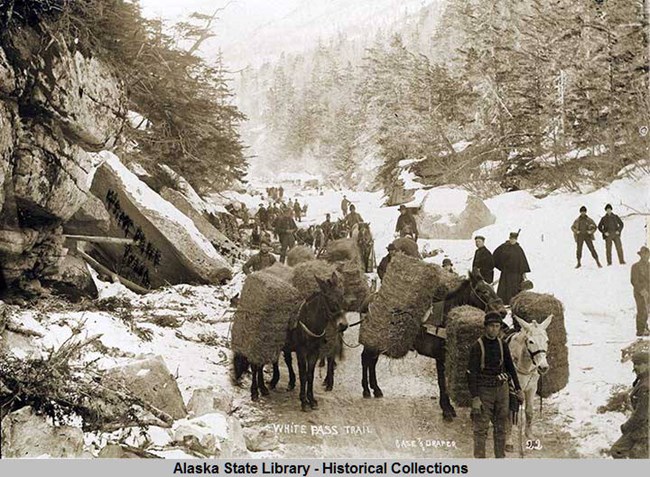
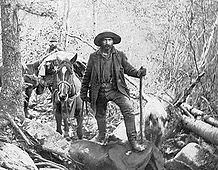 And suppose a great many horses actually survived and made it to the shores ofLake Bennett. What then? Load them aboard the hand made boats that rafted downthe Yukon To Dawson. Shoot them? Sell them?Or just abandon the horses…or sell them…or eat them. Horses do wander away unlessfenced. Mares can be captured by stallions. In 1962 there were wild horses here andthere in the Yukon. In small herds of mares with one stallion. Where did they come from.I think we saw a small string on our trip to Dawson. Almost hidden in the brush.
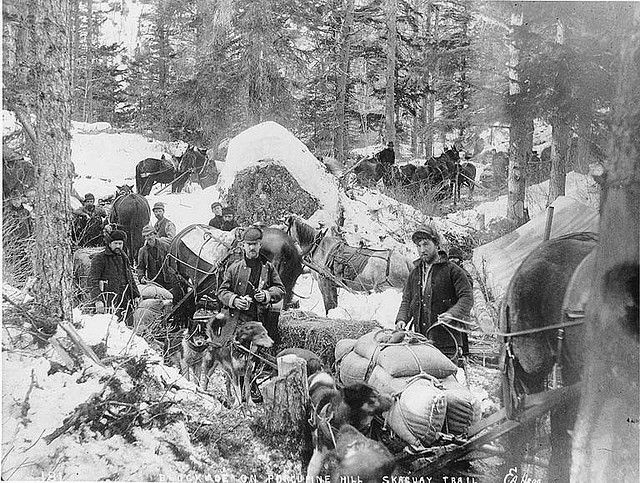 These horses from Skagway do not look abused. They are hauling goods notcarrying them. Not much room for error here. But no precipices either. Eachman had to show he was brining 1 ton of supplies to Canadian authorities…i.e. Sergeant SamSteele of the NWMP otherwise refused entry to Canada’s Yukon Territory.MY interest was triggered by a misty event on our two day holiday to Dawson City in midsummer.Three or four of our gang of joyriders were jammed into the back of a Peso Silver half ton truckfor that long 3 to 4 hour jaunt. At one point we noticed movement in the brush at the side ofthe road. There was something alive behind the screen of scrub. Several animals…not a singleanimal like a moose.“Could be wild horses, mares with a stallion. Several strings of themhave been sighted. A couple have been hit on the highway around Dawson”“You must be kidding?”“Check it out.”Which is exactly what I did. The wild horses are a concern on the Alaska highway wherethey seem to cluster in several strings. Very wiley creatures. Efforts to catch them have failed.How can horses survive the brutal winters? Simple answer. On each side of the DawsonHighway are the remains of large hay fields. Yukon summers are full daylight…maybe 16 hours.Lots still grows in these wild fields. From the gold rush days to the 1930’s horses wereimportant as a means of transportation. Every 20 or 25 miles of the old Dawson road therewere roadhouses where teamsters could get fresh horses or give their 4 to 6 horse teams arest. Some of these roadhouses were decent places. Others were as dirty and neglected asthe hubs of hell. Eventually the internal combustion engine replaced all the horses haulinggoods from Whitehorse to Dawson.I do not know what happened to those horses. Many would be slaughtered of course…dog foodfor sled dogs along with moose. Some just got loose. Turned loose or abandoned. Most woulddie but it seems there were…there are….a few stallions with their mares trotting cautiouslythrough the underbrush of the Yukon. I think I saw a string of them from the back of thathalf ton truck.Now this next comment is a real stretch. Total speculation…ridiculous speculation. It might justbe possible that the wild horses running in the Yukon in 1962 might have been survivors who crawledup Dead Horse Gulch (White Pass) and survived because their owners knew how to handle a horseand knew that horses could be useful in the mining business. In the 1920’s there were 98 horsesworking on Keno Hill…and at the same time there were far more doing work on the Dawson Roadliving in the barns beside those roadhouses.Wouldn’t it be wonderful if those wild horse strings had a genetic connection to Dead Horse Gulch.Wild horse herds did exist in the year 1962 in the Yukon Territory. In 2010 one of the last herds ofwild Yukon horses was captured and all eleven including the stallion were put up for auction in hopethat some horse lover would want to rehabilitate them…i.e. break them, make them docile. Whetherthis happened or not is not mentioned in the CBC news release.
“Animal control officer Paul Heynen said he has spent years trying to capture the Takhini Valley herd of wild horses, but the animals have proven to be elusive.
“I can have a report that they’re out there and I can be there in an hour and they’re gone. You know, they’re just like ghosts … poof, and they’re gone,” Heynen told CBC News.”
These horses were not easy to handle once corralled because the stallion went wild oncefenced in. Lunging at the fences.. Longing to escape. While government officials believedthis was the last herd ofYukon wild horses, many locals believe one or two strings ofthem still thrives in hidden places. They are as wily as wolves, never staying long inone place and therefore difficult to trap.ANCIENT WILD HORSES OF THE YUKONWild horses once commonly roamed the Yukon as has been proven by a bone found by Duanne Froese, an earthscience professor ar the University of Alberta. The bone was found in the permafrost enveloping theThistle Creek gold mine about 100 km. south of Dawson City.in 2013. The bone fragment’s genome once annilysed turned out to be 700,000 years old.It seems that Horses have thrived in the Yukon for a long long time.alan skeochFeb. 1, 2021Post ScriptEvents have a curious way of coming together and making sense. Serendipity is the word. It means a coming togetherof seemingly disparate events. Here’s a weird one. In 1963-64, Marjorie (then Hughes) was teaching high schoolin Napanee, Ontario. Miles and miles from western Canada. A group of girls joined Marjorie in forming their cellof the Canadian Wild Horse society. They donated some money to support the survival of wild horses primarily inAlberta but also in the Yukon. These horses needed protection. The Canadian government considered horsesan introduced species…therefore gave them no protection. Marjorie’s students and other young people, mostlygirls, were assuring that a few herds of wild horses continued to roam through the Rocky Mountain valleys.I am not sure that is still the case.
 skagway.com/wp-content/uploads/2016/01/Skagway-1898-may-300×208.jpg 300w” sizes=”(max-width: 766px) 100vw, 766px” class=”wp-image-5357″ apple-inline=”yes” id=”46A6F100-044F-4E70-AC83-C45D42638E7F” src=”https://alanskeoch.ca/wp-content/uploads/2021/02/Skagway-1898-may.jpg”>

