In 1952 the Cuyahoga River caught fire when a spark from a passing train dropped on to the water surface. The result was an immediate explosive fire that was so
high it almost engulfed a tug boat. The Cuyahoga River flows through the centre of Cleveland, Ohio…a city that was heavily industrialized… spewing various pollutants
including human sewage waste directly into the river. Nobody cared really. Even when the river caught fire because the water surface was covered with oil and other flammable
chemicals little was done to control the use of the river as a sewer taking the city waste directly into Lake Erie.
As far back as the 1880’s the river was a sewer. “The river was yellowish , thick, full of clay, stoking of oil and
sewage. Piles of rotting woo were heaped on either bank of the river, and it was all dirty and neglected….I was disappointed by this view of an American river,” wrote Frantisek Vicek, a recent
Czech immigrant. Cleveland was not alone. The use of rivers as a sewage and waste disposal mechanism was true for all rivers and creeks flowing from cities and towns all around the Great Lakes. Nor was the Cuyahoga River the only river that caught fire. Pollution problem ho spots
included Toronto. Some places were worse than others noted a few concerned organizations. Of particular concern on he Canadian side were two ‘hot spots’…Toronto Harbour and Hamilton
Harbour.
Firemen stand on a bridge over the Cuyahoga River to spray water on the tug Arizona, after an oil slick on the river caught fire in 1952.
The waste those firms did discharge turned the river muddy and filled it with oil, solvents and other industrial products. Between 1868 and 1952, it burned nine times. The 1952 fire racked up $1.5 million in damage. But by most, occasional fires and pollution were seen as the cost of industry—a price no one was willing to dispute.
When fire broke out on the river again in 1969, it seemed like business as usual. “Most Clevelanders seemed not to care a great deal,” writeenvironmental historians David Stradling and Richard Stradling. “Far too many problems plagued the city for residents to get hung up on a little fire…The ’69 fire didn’t represent the culmination of an abusive relationship between a city and its environment. It was simply another sad chapter in the long story of a terribly polluted river.”
But attitudes toward the environment had changed since the last river fire. In the years before the fire, Rachel Carson published Silent Spring, which became a bestseller and opened the eyes of many Americans to the danger of DDT and other pesticides. Congress had begun passing laws to boost air quality and protect endangered species. And a growing counterculture had begun to embrace sustainability as people experimented with back-to-the-land subsistence farming and communal living.
Another factor was at play: an enormous oil spill in Santa Barbara, California that sent 3 million gallons of oil into the Pacific Ocean. Suddenly, people’s telev
Three men in a motor boat take water samples of the Cuyahoga River where the shore is lined with semi-submerged automobile wreckage in 1968.
Alfred Eisenstaedt/The LIFE Picture Collection/Getty Images
Those same citizens soon opened their copies of Time Magazine to see a story on the Cuyahoga fire, along with a photo of the 1952 fire. The conditions it described, which included a river that “oozes rather than flows,” caught readers’ attention. (As the National Parks Services notes, many bought that issue of Time because it featured an exposé on the Chappaquiddick scandal.)
Soon, cries for regulation of water pollution became a roar. A grand jury investigation of the causes of the fire followed, as did coalition efforts to clean up the Great Lakes. It even inspired plans for a national environmental “teach-in”—an event that would become the first Earth Day. In early 1970, President Richard Nixon called for sweeping environmental reform. He created a council on environmental reform which, shortly afterward, was consolidated into the Environmental Protection Agency. In 1972, Congress overrode Nixon’s veto to pass the Clean Water Act, which created national water quality standards.
Though the Cuyahoga River fire did not directly lead to the formation of the EPA, it was an important landmark for a burgeoning environmental movement. Today, the river is no longer stagnant or filthy. Public and private efforts have diverted sewage and cleaned up its banks. According to the National Parks Service, the river still has unhealthy amounts of sewage in some areas. But in March 2019, the Ohio EPA announced that its fish are now safe to eat.
Whether or not the river ever overcomes the remainder of its environmental challenges, the memory of the 1969 fire will continue to mobilize those intent on protecting the natural world.
After The Cuyahoga caught fire in 1952 there was not much local concern because the river had caught fire nine times between 1868 and 1952. Of most concern was the $1.5 million in damage. Most city fathers
and businesses chalked the river fire as just another cost of doing business. Occasionally the Cuyahoga River would burn. As it did again in 1969. “Most Clevelanders seemed not to care a great deal,’ wrote
environmental historians David Stradling and Richar Stradling.
But a major change in public attitudes was coming. The publishing of ‘Silent Spring’, by Rachel Carson in 1962 shifted the thinking of many North Americans. Her central thesis that North America was en route to an
environmental disaster was confirmed by events like the 1969 Cuyahoga River fire…the tenths such blaze. One look at the river banks was enough to heighten concern. The bank of he
river was filled with scrap automobiles cheek to cheek as a storm break.
Concern led to action and top of the list was an attempt to clean up the Great Lakes which contained 20% of the freshwater on the planet Earth. In 1970 President Richard Nixon urged environmental
refer that led to the formation of the Environmental Protection Agency (EPA). The first Earth Day was The result in March 2019 was that the Ohio EPA announced that fish caught in the Cuyahoga river were safe to eat.
The first Earth Day was held on April 22, 1970 as young and old North Americans created a counterculture with new values as expressed in a hand drawn sign on the back of a hippie bicycle.
“Pollution, brought to you by the same folks that brought you Viet Nam”
CANADIAN POLLUTION
Many of my friends were Boy Scouts in the 1950’s. We loved going on our own camping trips…i.e. without leaders.
Access to the wilderness west of Toronto was easy. One of our favourite spots was along the banks of the Etobickoe
Creek. There was an old iron bridge crossing a side spot in the Creek. We loved jumping and diving from the bridge
into the deep pool below Mostly jumping. I remember distinctly how our feet would sink to the knees in the black
muck beneath the pool.. It did not smell good but hot weather trumped any concern we had. One of the other
boys, maybe it was Good Sanford, announced that sewers emptied into the creek farther north. That did not stop
us. Today, April 15, 2021, I think a little differently.
Our two Toronto Rivers…the Humber and the Don, were certainly used for sewage, chemical waste and refuse.
No point in taking a holier than thou stand on the issue of pollution. One March camping to the nearby Etopicoke
Credk stands out because someone had dumped a dead horse in the middle of the creek.
There was so much construction waste thrown in the Humber River that I gathered enough to build a small
barn at the farm. Not pretty. Not designed properly for it collapsed after two months but it does demonstrate
our view that rivers are for garbage. At least that was the predominant view back in the 1950s and 1960’s
JUST FOR LAUGHS: The 1960’s
EVERY piece of lumber that built this barn was retrieved from Sunnyside Beach after floating down
the Humber River in springtime.
SO MUCH lumber was dumped in the Humber River in the 1960’s that I decided to collect the timbers snd planks
and build a new barn on our farm. I was naive. 1) I did not know I would need a building permit 2) I had
no knowledge of construction principles 3) I wa proud of the result for a month or two then discovered
the building had collapsed…do not know why.
The reason I have included this admission of failure is to lighten up this Episode while at the same time
illustrating the use of the Humber River as a dump for construction waste. Who knows what was in
the water.
alan skeoch
A reminder of those careless days came in today’s Toronto Star (April 12, 2021) “During the 1960’s, the paper plant
in Dryden, then owned by ReedPaper, dumped 10 tonnes of mercury, a neurotoxin, in the Wabigoon River, contaminating
fish and those who ate them.”
“Details….emerged when a retired casual mill labourer came forward out of ‘guilt’ in 2015, saying that in 1972 he was part
of a crew that dumped 50 drums of salt and mercury into a pit….tests at the site found mercury readings in the soil were
80 times natural levels….fish near Grassy Narrows remain the most contaminated in the province.” Toronto Star, page A13, April 12, 2021
Dryden factory now owned by Domtar. Previous owners dumped mercury…barrels of it…into the
regions rivers and lakes with devastating effect.
MERCURY:
Mercury pollution is a local, regional, and global environmental problem that adversely affects human and wildlife health worldwide. As the world’s largest freshwater system, the Great Lakes are a unique and extraordinary natural resource providing drinking water, food, recreation, employment, and transportation to more than 35 million people.
“Mercury is one of the most persistent and dangerous pollutants that threatens our health and environment today.” – U.S. Senator Susan Collins
June 2011 – Senator Collins Introduces Mercury Monitoring Legislation Legislation follows up on studies by Biodiversity Research Institute. Read full press release here.
The widespread loading of mercury into the Great Lakes environment is responsible for mercury-related fish consumption advisories in the eight U.S. states and the province of Ontario that border the lakes. Visit the U.S. EPA website and Ontario province’s Guide for more information.
For nearly 200 years, mercury has been released into the air and waterways of the Great Lakes region from human activities such as fossil fuel combustion, waste incineration, metal smelting, chlorine production, mining, and discharges of mercury in wastewater.
POLLUTANTS
EACH ONE OF HE POLLUTANTS BELOW COULD BECOME A FULL EPISODE
-FERILIZER FROM FARM FIELDS
-UNTREATED SEWAGE FROM TOWNS LACKING SEWAGE TREATMENT
-PHOSPHATES FROM LAUNDRY DETERGENTS
-PESTICIDES
-DDT
-MIREX
-MERCURY
-BENZOAPYRENE
-PCB’S
-ARAMITE
-CHROMIUM
-LEAD
-CARBON TETRACHLORIDE
POLLUTION HOT SPOTS ON LAKE ONTARIO identified by the INTERNATIONAL JOINT COMMISSION
-OSWEGO RIVER
-ROCHESTER EMBAYMENT
-HAMILTON HARBOUR
-TORONTO
By the 1960’s and 1970’s increased pollution caused blooms of algae that killed fish in large numbers. Fish eating birds
such as osprey, bald eagles, and cormorants were poisoned from the contaminated fish they ate. Since those two decades
a clean up of pollutants has been underway…better sewage treatment plants, deindustrialization, public protests.
Some good
signs are happening. Walleye that are known to favour clean water have returned. The relatively new sport fishery which
supports the release of Coho and Chinook salmon has increased public awareness of the importance of he Great Lakes.
Finally there are now more bald eagles and osprey sighted around the Great Lakes. All is not lost.
ALAN SKEOCH
APRIL 2021
POST SCRIPT: Note 1: PART OF SERIES TITLED “LIFE AND DEATH IN THE BIGGEST FISH BOWL IN THE WORLD
FEATURING SO FAR 1) OVERFISHING 2) LAMPREYS 3) ALEWIVES 4) HOWARD TANNER
AND INTRODUCTION OF COHO AND CHINOOK SALMON TO THE GREAT LAKES 5) POLLUTION
NEXT WILL BE 6) INVASIVE SPECIES….ZEBRA AND QUAGGA MUSSELS…AND OTHERS
Note 2): Each pollutant has a detailed history. If I wrote that history and the concern attendant with the release
of each pollutant I could not do that and maintain my ’ story every day of Covid 19 lockdown ‘ In addition I am not sure
that readers would have the time to read the full story of pollutants in the Great Lakes. Sometimes it is apparent
that quite a few readers just look at pictures and ignore the print. Understandable since we all have personal
agendas. Having said that I have copied an abstract on MIREX below…a chemical used as a fire retardant
and pesticide. GREAT LAKES fish were considered dangerous to eat due to Mirex in their flesh. That is changing
now but even after ’35-40 years of cessation of production…mirex is considered a contaminant of concern.’
Also included below is an abstract documenting the issue of PCB’s in the Great Lakes.
MIREX Abstract
Mirex, historically used as a pesticide and fire retardant, was released to Lake Ontario during the 1960s. Even after 35–40 years of cessation of its production and bans on use during the 1970s, mirex is considered a contaminant of concern. In this study, we present a comprehensive view of long-term trends and significance of mirex/photomirex levels in fish from the Canadian waters of the Great Lakes. Majority of measurements (except for Lake Ontario) were below detection, especially in recent years. Concentrations of mirex in Lake Ontario fish decreased by approximately 90% between 1975–2010, and both mirex and photomirex decreased by 75% between 1993–2010. Half-lives of mirex and photomirex for the entire period ranged from 4–10 years, but were lower at 2.5–8 years in recent times indicating expedited recovery possibly in response to remedial actions performed in the 1990s. Simulated fish consumption advisories generated by considering only mirex and photomirex indicated that mirex/photomirex is a minor concern. We predict that within 15 years mirex/photomirex levels in Lake Ontario fish will drop to levels that will result in advisories of at least 8 meals/month. In either case, the presence of other contaminants in Lake Ontario fish contributes to more stringent advisory than generated by mirex/photomirex. It is recommended that the routine monitoring of mirex/photomirex be replaced with periodic surveillance to reduce analytical costs. Dechlorane family compounds (that mirex is a part of) need to be evaluated further for their monitoring needs once in-depth toxicological information becomes available.
PCB’S…POLYCHLORENATED BIPHENOLS
This chapter reviews the scientific understanding of the concentrations, trends, and cycling of polychlorinated biphenyls (PCBs) in the Great Lakes. PCBs were widely used in the Great Lakes region primarily as additives to oils and industrial fluids, such as dielectric fluids in transformers. PCBs are persistent, bioaccumulative, and toxic to animals and humans. The compounds were first reported in the Great Lakes natural environment in the late 1960s. At that time, PCB production and use was near the maximum level in North America. Since then, inputs of PCBs to the Great Lakes have peaked and declined: sediment profiles and analyses of archived fish indicate that PCB concentrations have decreased markedly in the decades following the phase-out in the 1970s. Unfortunately, concentrations in some fish species remain too high for unrestricted safe consumption. PCB concentrations remain high in fish because of their persistence, tendency to bioaccumulate, and the continuing input of the compounds from uncontrolled sources. PCBs are highly bioaccumulative and many studies have shown that the complex food webs of the Great Lakes contribute to the focusing of PCBs in fish and fish-eating animals. PCB concentrations in the open waters are in the range of 100–300 pg L−1, and are near equilibrium with the regional atmosphere. PCBs are hydrophobic yet are found in the dissolved phase of the water column and in the gas phase in the atmosphere, and they continue to enter the Great Lakes environment. The atmosphere, especially near urban-industrial areas, is the major source to the open waters of the lakes. Other sources include contaminated tributaries and in-lake recycling of contaminated sediments. Until these remaining sources are controlled or contained, unsafe levels of PCBs will be found in the Great Lakes environment for decades to come.
LAST COMMENT
I think this is about all you can take as readers of these Episodes. There is some comfort in knowing that controls have been placed
on the release of these pollutants. The constant runoff of polluted water from farms is a thorny issue whose resolution seems distant…
if at all possible. Who cares? Japan just announced that treated (?) nuclear waste was about to be released into the Pacific Ocean.
It seems we are at a terrible cross roads…no matter what road we take there will be trouble.
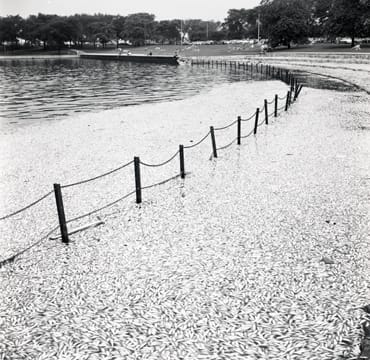
June 19, 1967 – The beaches at Montrose, Rainbow, North Avenue, Ohio Street and Oak Street are flooded with dead alewives in what a park district official calls the worst plague of the fish that he has seen in his career. Park district crews use bulldozers and high-lift trucks to remove the fish, but they keep washing up on the beaches faster than they can be carted away.Joseph Krzesinski, the director of landscape maintenance for the park district, says, “They keep coming in.In some places they are a foot deep.Look out over the lake there they are as far as the eye can see.”[Chicago Tribune, June 20, 1967].The invasion was first noted on June 15 when an official of the Great Lakes Region of the Federal Water Pollution Control Administration spotted streaks of the dead fish being blown toward the Michigan shore.Between June 17 and 18 the wind shifted, blowing from east to west, and by June 19 “Chicago’s shoreline was clogged with a silvery carpet of alewife carcasses.”[nepis.epa.gov]. Alewives, originally inhabitants of the North Atlantic, were first seen in Lake Ontario in the 1880’s and gradually moved through the Great Lakes over the years.Marine biologists suggest that a combination of factors has led to the plague of dead alewives in Lake Michigan.Over-fishing in the Great Lakes in the early part of the century, along with the explosion of the sea lamprey, an invasive species, resulted in the demise of the lake trout, the only natural threat to the alewife. When the 1960’s arrived, it was estimated that alewives made up 90 percent of Lake Michigan’s biomass. Schools as large as 40,000 fish moved close to shore in late spring to spawn, with a female alewife carrying between 10,000 to 12,000 eggs.After spawning a mass die-off of the fish would occur, which was especially pronounced in 1967, biologists theorize, because of extreme fluctuations in the temperature of Lake Michigan.After 1967 the government began stocking the lake with Chinook salmon, “the most voracious fish in the lake”.[Chicago Tribune, January 22, 2006].The salmon feed at the same water level as alewives and have kept the alewife population in check. The above photo shows the lake shore at Diversey Harbor during the invasion.
The old adage, “an east wind is neither good for man nor beast,” was especially relevant for Wilmette in the summer of 1967. That was the year that a particularly heavy die-off of alewives washed up on the beaches. The prevailing east winds pushed the decaying bodies of these small, silvery fish ashore in droves. By July, the Wilmette Park District was hauling six or seven truck loads of alewives out to a landfill in Des Plaines every single day. Next door at Winnetka’s beach, the dead fish were piled up one foot deep and ten feet wide, while Highland Park hauled sixty tons of dead fish away in just two days. Accompanying the sharp smell of decay was an influx of flies and mosquitoes. All in all, not a great beach year for Wilmette. Beach attendance was already hitting record lows– down almost sixty-five percent from its high in 1960– before the alewives arrived. Then things got even worse.
It’s summer. We’re all enjoying the great outdoors, and some of us are going to the beach. Back in the 1960s, when people around Chicago went to the beach, they had to deal with alewives.
An alewife is a kind of herring. It’s about 7 inches long and weighs a few ounces. You mostly find them off New England. In the Boston suburbs, one of the major streets is even called Alewife Parkway.
Well, during the 1930s, these alewives got into Lake Michigan. They weren’t much of a problem because the bigger fish–like the trout–would eat them. But the sea lamprey came along and ate the trout. Sea lampreys didn’t eat alewives, so suddenly, the lake had all these alewives and no predators.
Pretty soon there are alewives filling the lake. That’s what today’s story is about—July 7, 1967. There are so many alewives around Chicago that it’s become national news. Even Time magazine is talking about it.
Each year, we’d have the annual Alewife Die-Off. All these alewives would die in Lake Michigan, and their bodies would drift in. They’d fill the water near the shore or wash up onto the beach.
Of course, those alewives would be decaying, and you can imagine the smell—well, you probably don’t want to. The flies would come in, and the beaches would be a mess. The city would have to use tractors and bulldozers to clear off the beaches.
Nobody knew how many dead alewives there were. Experts said hundreds of millions, maybe a billion. A guy in a plane over the lake saw a ribbon of drifting dead alewives 40 miles long.
alan skeoch
April 2021
POSTSCRIPT: REVIEW LIFE AND DEATH IN THE GREATEST FISH BOWL ON EARTH: THE GREAT LAKES
TROUBLES: 1) OVERFISHING 2) SEA LAMPREYS 3) ALEWIVES 4) NEXT:…EPISODE 308 HOWARD TANNER …COHO AND CHINOOK SALMON