Year: 2021

  • EPISODE 316 Part Two: SCHOONER LYMAN M. DAVIS IS STILL HERE…135 FEET DOWN IN WATER OFF SUNNYSIDE BEACH….diver in heavy suit 1933 DIVERS 107, AND 218


    EPISODE 316:  SCHOONER LYMAN M. DAVIS IS STILL HERE…135 FEET DOWN IN WATER OFF SUNNYSIDE BEACH…


    alan skeoch

    April 2021

    PART TWO…THE LYMAN M. DAVIS STORY…NOT LOST, BUT SAVED FOREVER (unless the Zebra mussels destroy her)

    Effort to save the schooner  Lyman M.  Davis included a diver admiring just how trim the old wooden schooner
    had been kept.   His dive was shallow but the description of the diving technology of 1933 is interesting. 

    What I found most startling however was a discovery that a Canadian diver with colour camera found the
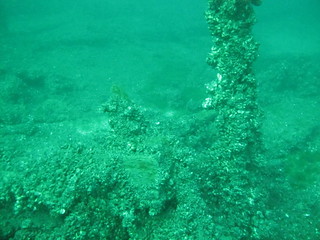
    grave of the Lyman M. Davis and took an amazing sequence of pictures. (see Warren Lo, internet)   The ship is covered with thousands
    of zebra mussels…like a gilded  bird in a watery cage.   His  photos are copywriter\d so  I guess
    you will have to find them yourself.   AnOther photo taken by a diving club is included below.

    What is the bottom line of this story?   The last commercial schooner on the Great Lakes is still with us….150
    feet down in the water off Sunnyside Beach.

    Oct. 18, 2018…divers to the wreck of the Lyman N. Davis

    The Lyman M. Davis, Toronto Harbour, Toronto, Ontario

    Readers are encouraged to punch up the pictures taken by Warren Lo in 2005

    and 2007…magnificent pictures of the Lyman  M. Davis with her masts still

    erect and the remains of her body clearly outlined by the Zebra mussels.  (Pictures by Warren Lo © 2005, 2007)


    WRECK INFO: 
    Ship Type: 2 Masted Schooner
    Lifespan: Built 1873, Sunk 1934
    Length: 123ft 
    Depths: 135ft 
    Location: Humber Bay, Toronto, Ontario 

    This wreck lies in about 135 feet of water, in Humber Bay, just outside Toronto Harbour. This was one of the last working schooners on the Great Lakes, built in Michigan in 1873. It was sacrificed for the entertainment of the masses when it was set afire and left to sink just off Sunnyside Park in Toronto, in 1934. 

    The dive conditions at this wreck site can be variable. At 135 feet in depth, the wreck lies at the limit of recreational diving and beyond. Water temperatures at these depths can dip down to the 35F range, even in the height of summer. Historically quoted as a “black wreck in black water”, there may not be much ambient light and a dive to this depth is much like a night dive. Proper deep cold water dive planning is a must to attempt this wreck.


    . O. S. The LYMAN M. DAVIS: Schooner Days CIII (103)
    Publication
    Toronto Telegram (Toronto, ON), 2 Sep 1933
    Description


    Full Text
    S. O. S. The LYMAN M. DAVIS
    Schooner Days CIII. (103)
    “What a shame to burn that old schooner out at Sunnyside!” so many have protested to The Telegram, in letters and over the phone.
    The Telegram thinks so, too.
    “That old schooner” is the Lyman M. Davis, of Kingston, built at Muskegon, Mich., in 1873, and now the last lake sailer left afloat.

    That she is an “American bottom” is incidental. She is absolutely typical of the medium sized schooner of the Canadian and American fleets which queened it on the inland seas up to fifty years ago, thriving until the railways drove them under the horizon.
    The Lyman M. Davis has been Canadian-owned for twenty years and traded out of Kingston under Captains McCullough and Daryaw up to last year. The “three links” on her stern symbolize her owners’ membership in the Order of Oddfellows; the stars, her American origin. In the absence of any corresponding original Canadian-built vessel she is the best possible example of one of the old wind-driven wooden walls which once girdled the Great Lakes. The small schooner, Shebeshkong, renamed, rebuilt, rerigged and equipped with engines, which went to Chicago this year from Midland, is neither original nor typical. She was once the North West, built in Oakville in 1882.

    If Telegram readers want the Lyman M. Davis to be preserved The Telegram will help them to preserve her.
    If enough readers respond, the old schooner may be rescued and presented to the City of Toronto for permanent preservation at the Exhibition Grounds; a marine museum whose first function will be to demonstrate the patriotism of the water-loving citizens of Toronto in Centennial Year. The Lyman M. Davis would make a grand nucleus for a pageant representing a hundred years of water transportation in which Toronto has grown from a marshy bay to a ocean port.

    This is not an “appeal.” The public is sick of “appeals.”
    It is a straightforward offer of an opportunity to give evidence of the amount of earnestness behind the utterance of protests—with which The Telegram heartily agrees-against the wanton destruction of the last remaining sailing vessel on the Great Lakes.
    The Telegram will receive and acknowledge any expressions of opinion addressed to “Schooner Days” in care of this paper.
    If you want to save the Lyman M. Davis from the bonfire, say so.
    If money will do it, The Telegram is ready with the first $100 now. But it is not money that talks—yet. It’s expression of opinion.

    My shoulders are still sore from the bruises of the metal collar of the diving dress, but Diver Dennis Coffey assures me that either the shoulders or the soreness will wear off. He has callouses on his own like the leathery parts of the soles of the feet. In spite of the soreness, let me say, from my own meagre experience, that diving, in the sense of going under water in a suit and remaining down there to see what you can see, is decidedly worth doing, and every able-bodied seaman or seawoman should jump at the chance and into the lake with the chance on.

    One of those blistering hot afternoons recently Major D. M. Goudy shanghaied me for a submarine voyage outboard the good ship Lyman M. Davis, of Kingston.
    Major Goudy, after the Elizabethan fashion which gave command of ships to generals, is the Lord High Admiral and Fire Marshal of the recreation division of the Harbor Commission’s fleet. Major Goudy has burned more ships at Sunnyside than Hector succeeded in doing before Troy. It was in the pious hope of saving the Lyman M. Davis from his torch that this compiler of Schooner Days ventured a fathom or so below the surface.
    The Lyman M. Davis, as everybody knows, is the old black schooner which lies at Sunnyside pathetically proclaiming “Come Bid Me Farewell.”
    Thousands — seven thousand to date — have performed that rite during the last few weeks. I don’t know who Lyman was. He is probably dead long since. The schooner named after him is the last commercial windmill left on all these Great Lakes which once boasted an argosy of a thousand sails.
    If all in favor of saving her will speak up. Major Goudy can find the way. That is what he is good at.

    This, however, digresses from the diving exploit. The pitch was bubbling in the seams (at least, it always does in story books with similar provocation) when we hove ourselves over the Lyman M. Davis’ rail. Diver Coffey was broiling bacon on the brass plates of his dried out diving suit with no other fire than the sunbeams. After our purpose was explained I was taken to the captain’s stateroom in the cabin of the schooner and given a pair of khaki trousers, a white woollen sweater and a very heavy pair of black woollen stockings. 
    While I changed into this gear the radio in the galley gave a concert from Buffalo. What a contrast to the sort of concert the first skipper of the Lyman M. Davis had when he changed his wet sea clothes in this very room, on coming off watch while she wallowed down Lake Michigan from her launching place at Muskegon! That was in 1873, when “Marching Through Georgia” and “Ella Ree” and “Darling Nelly Grey” were still “new” songs. This first skipper, whoever he was, had never heard of the telephone, nor dreamt of the radio, and the concert he would be listening to would be the scream of the souwester whirling the last remaining ashes of the great Chicago fire. The Lyman M. Davis was launched the second year after the old woman’s cow had kicked over the lantern and almost obliterated what Will Carleton called the Queen of the North and the West.

    When I emerged on to the deck Mr. Coffey’s bacon was done to a crisp, and he could have boiled his namesake by sunpower if anyone had thought to provide a percolator. They hadn’t, so he laid out the suit for me to get into. It was a piece of heavy white rubber, rather like winter combinations made out of fire-hose, much patched at knees and elbows, and en-
    tered through a neckband consisting of a copper hoop that would head-a barrel. Sleeves were complete down to mitts with thumbstalls, all in one piece, and legs went right down to the toes. I wondered, at the last moment, what would happen if I wore a hole in the heel!

    By the time I was in the suit I knew what Shadrach, Meshach and Abednego felt like when they got that inside job stoking the burning fiery furnace. I don’t know any worse conductor of heat than rubber, and the suit had been in the sun all day. Mr. Coffey, however, conducted me to a steel ladder, and obliged with a wooden stool. While I sat looking enviously at the water he further obliged with a pair of shoes with thirty pounds of lead in the soles, and girded me with a belt shaped like an old cork lifebelt, only the “floats” were squares of lead. These added seventy-five pounds to my avoirdupois, and he capped my preparation for the bathroom scales by screwing on to the under-collar of the suit sections of copper, well set up with nuts and a monkey wrench. He then screwed on to the upper collar which these formed the copper helmet, until I looked like a Whitehall Lifeguard in a nightmare.

    The helmet was roomy, but its weight, and what I had added in lead and copper, came down very heavy upon my graceful shoulders. My borrowed plumage—beyond the trousers, sweater and socks—weighed three hundred pounds, and I could just toddle to the steel ladder fastened to the concrete seawall where the Lyman M. Davis was moored.
    Mr. Coffey gave a few final instructions and explanations, from which it appeared that the bottom was so soft it was hard to walk on, and other things equally difficult to follow. Before putting the head-piece on me he had given me a little black skullcap with ear phones attached. He now thrust into the hollow of my helmet a small telephone transmitter or mouthpiece, and snapped together connections with the insulated wire coiled around the 30-foot airline which trailed from where I would have worn my crest, had my helmet been that kind.
    I thought of the days of old when knights were bold, and how they must have waddled to war with three hundred pounds of iron on back and front, and by this time Mr. Coffey was screwing the circular facepiece or plate-glass window into my helmet, and I was cut off from the outside world.

    I heard the soft whish-wheeze of the air-pump, being worked slowly and carefully on the Lyman M. Davis’ rail, and someone whispered in my ear: “Can you hear me? How do you feel?” It was the pump-man, who had the other end of the telephone, and I promptly replied: “So hot that if you don’t let me out of this right away I’ll come out in smoke.”
    Mr. Coffey promptly unscrewed my facepiece and gave me a welcome breath of fresh air, hot though it was. He suggested taking off the helmet and cooling it, while I should go down the ladder and dip in the lake up to my neck, and so cool the suit.
    This I did, and it was delicious to feel the cold lake water all around me without being wet. Then I toiled up the ladder, and they bolted and screwed my copper headpiece on again, poured a bucket or so more water over it—was heating up in the sun while they fastened it—and down the ladder I again stumbled.

    The crushing weight came off my shoulders as the suit inflated and once in the water I felt as buoyant as a breakfast food ad. There was a strong feeling of pressure from the air in the suit against my ribs, and I tried to knock open the pressure valve with the back of my head, so as to let some of it out. Didn’t do very well with that, so I told the pump man on the telephone I didn’t want so much. It was easy to converse with him, and sometimes he switched over to Major Goudy, so that we were having a threesome, they in the sun and I in the drink.

    I didn’t notice when I got under water. The schooner was moored where it wasn’t very deep. I just came to the end of the ladder, about four feet below the surface, and then let go. The first thing I noticed, when I began to look around in the twilight of the lake, was the length and prettiness of the weeds growing on her. They are not as long as the weeds taken off the R.C.Y.C. launch, Kwasind, recently, but they are rather neat flat grassblades with rippled edges, and looked well, viewed close up. Below them the bottom planks of the schooner are quite bare, for, unlike yachts, schooner bottoms were seldom or never painted. They were intended to float for years without drydocking, and no ordinary paint will last for long under water. Schooner bottoms were sometimes slushed with hot oil or Stockholm tar—”stock ellum tar,” the boys used to call it—before launching, and the smaller hookers sometimes painted all the way across the bottom after the spring scraping, but vessels like the Lyman M. Davis were usually as unpainted as a wharf below the light waterline.

    The seams of the planks, where the oakum had been horsed in by caulking irons and mallets sixty years before, had been “paid” or filled flush with the surface, with tallow or white lead, and this paying showed white and clean. The work Diver Coffey had been doing under water, recaulking all the seams where the oakum showed signs of “crawling” or coming out, was also discernible.
    When I patted her oaken forefoot with my rubber mitt it sent a thrill through my diving helmet to realize I was stroking a piece of timber that had ploughed 590,000 miles of lake water. Calculate it for yourself. The schooner was launched in 1873 and was sailing every year up to the end of 1931; fifty-nine seasons. Even a sluggish schooner would average three hundred miles each week of the sailing season. That would be ten thousand miles for thirty weeks or so each year. Five hundred and ninety thousand miles! Almost twenty-four times round the world. A long, long cruise —even if the wheeze of pumped air in my ears made mental arithmetic with me a far from exact science.

    Not all of the schooner’s bottom could be explored, because she was lying in too shoal water to permit crawling under her—at least I couldn’t, for I do not know enough about moving in a diving suit. There are things you mustn’t do, such as getting your air-valve down, and things Mr. Coffee can do, such as bloating himself up by closing the air-valve and increasing his buoyancy until he shoots out of the water— these I couldn’t attempt.
    Besides, the soft silt at the bottom let my 30-lb. soles sink in until I was in mud to the knees, and the fouled water clouded so that I could see nothing. I remembered with interest , the wagon and team of horses that disappeared in the quicksand of the lake shore years ago, but it was too late to go looking for them.

    From what I could see of the bottom of the Lyman M. Davis it was apparent that she was sound enough to last indefinitely if she is retained as a museum of lake lore. She does not appear to need drydocking, although some of her seams will certainly benefit by Diver Coffey’s caulking iron. Her planking is not much scraped and scarred by grinding on beaches. She has been drydocked, of course, at intervals during her sixty years of service, but it is a long time since she was last out. Still, she is cleaner than one would expect, and appears to be quite sound below.
    “All right, I’m coming up,” I told the pump man, and could hear him tell the diver. Mr. Coffey had all the time carefully watched my airline, the heavy rubber hose which fed my nostrils, and also my lifeline, the light rope which encircled my waist.
    I had been keeping these together in lone rubber-mittened hand, but he I had been saving me the trouble. I had less difficulty getting on to the ladder than I expected, a knee at a time and then a foot at a time, but I became very “heavy” to my own feeling, as I emerged from the water and took the weight of the suit on my sore shoulders. They helped me out on to the seawall—and it was glorious to drink in the fresh air again.


    POST SCRIPT

    WHO WAS CHARLES SNIDER?   (AUTHOR OF SCHOONER DAYS)

    Rising through the ranks of the Telegram’s offices to the position of Editor, Snider’s interest in the Great Lakes was wide and varied — he authored a series of books on the marine battles and skirmishes fought on the Great Lakes during the War of 1812, and also discovered a vessel sunk during the course of that conflict, the Nancy, a British supply ship. An experienced sailor, he was also an accomplished marine artist, and provided many illustrations for John Ross Robertson’s classic series on old Toronto, Robertson’s Landmarks.
    CJH Snider

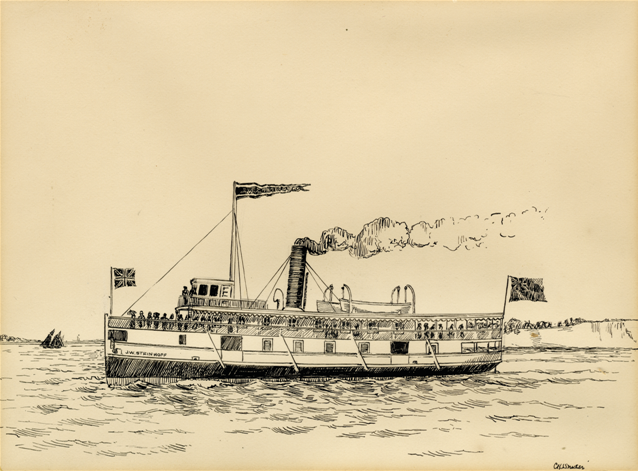
    “J. W. Steinhoff”, 1876-1899 C.H.J. Snider TRL, JRR 2654 Cab. IV

    Above is Snider’s rendering of the steamer J.W. Steinhoff, that plied the waters of Lake Ontario from the downtown docks of Toronto Harbour to Victoria Park, an early pleasure ground and later amusement park, located at the east end of the present day Beach district.

    Rather than presenting the reader with a straight recitation of fact and academic argument, Snider relied heavily on oral tradition to tell stories, many of which were published in his well-loved column, “Schooner Days”, which ran in the Evening Telegram from 1935 to 1956. His work included the first hand information he gleaned from aged captains of schooners, stonehookers, and steamers, Great Lakes sailors, and others who had an intimate knowledge of the inland seas of North America and the Toronto waterfront.


  • EPISODE 315: part one: THE DEATH OF THE SCHOONER LYMAN M. DAVIS: WHICH IS BEST …FIRE OR ROT?


    Last Survivors
    Schooner Days CXXV (125)


    OPINION (in 1934) seems nearly unanimous that the schooner Lyman M. Davis, of Kingston, built at Muskegon, Mich., in 1873, and Canadian for the last twenty years or longer, should, not be burned at Sunnyside, but should be preserved as a reminder of the great age of sail on the Great Lakes.
    Amid the volume of opinion expressed on the subject the question has been raised whether the Lyman M. Davis is “actually the last” sailing vessel left of the fleet which, a thousand strong, queened it the lakes when steam was only an infant.

    The Lyman M. Davis is the last sailing vessel of them all.
    It might be possible to resurrect some of the many old-timers, and rehabilitate them at great expense, but the Lyman M. Davis was in commission and fit for service up to the time she was bought for burning and in addition to being the last survivor is the most typical example of the Great Lakes centerboard schooner of medium siz


    EPISODE 315:  THE DEATH OF THE SCHOONER LYMAN M. DAVIS:  WHICH IS BEST …FIRE OR  ROT?
    (The last commercial schooner on the great Lakes)

    alan skeoch
    april, 2021


     THE LAST SCHOONER ON THE GREAT LAKES


    zenithcity.com/wp-content/uploads/2017/04/LymanBDavis_GLVI-300×223.jpg 300w, zenithcity.com/wp-content/uploads/2017/04/LymanBDavis_GLVI-24×18.jpg 24w, zenithcity.com/wp-content/uploads/2017/04/LymanBDavis_GLVI-36×27.jpg 36w, zenithcity.com/wp-content/uploads/2017/04/LymanBDavis_GLVI-48×36.jpg 48w” sizes=”(max-width: 750px) 100vw, 750px” apple-inline=”yes” id=”28D5CB33-1487-4FF3-9BB0-8DBC82AD3DD7″ src=”https://alanskeoch.ca/wp-content/uploads/2021/04/LymanBDavis_GLVI.jpeg”>
    THE SCHOONER LYMAN M. DAVIS ON A GRAND DAY (Named after her builder
    in Muskegon, Michigan…launched on Lake  Michigan, 1873

    ” her old captain died last week—Capt. John Alexander McCullough of Napanee, aged 66. He was trotting to his first schoolhouse, six years old, when J.P. Arnold built the Lyman M. Davis at Muskegon. She was an “old timer” when Capt. McCullough bought her from Graham Brothers of Kincardine, 18 years ago. They had had her in the Lake Huron lumber trade for years, after purchasing her from American owners. Capt. McCullough gave her a very thorough overhaul before bringing her to Lake Ontario. He sold her after some seasons, to her Kingston owner Capt. Daryaw.”   (Toronto Telegram, Sept. 13, 1933)


    The D. Freeman Schooner From Port Hope, Ontario, aground near Oswego, New York…seems to have the flat
    bottom of the stonehookers.  Old schooners  like this became stonehookers.  No date
    for photo.   The Lyman M. Davis got grounded much  like this in 1922 but was rescued, repaired
    and  put back in the business of hauling coal.

    WHICH IS BETTER…FIRE OR ROT?   Which would you remember best?  An historic fire…all consuming?
     Or a wooden monument prone to slow decay?

    “If we set the Lyman M. Davis on fire to entertain the people of Toronto, it will never be forgotten…and it will
    always be present.   If we  let it rot in some forgotten lakeport like Port Hope, Port Credit or Oakville, no one
    will remember the ship.   So make your choice…set it ablaze or let it rot”

    That was the choice.  Fire…out in a blaze of glory, then sunk in a watery graveyard.  Or rot…and end  up as
    a pile  of powdery dust on some forgotten shoreline.

    The choice was fire.  And on the dark night of Seplt .19, 1934, a tug boat hauled  the Lemon M. Davis from
    Toronto harbour to a spot in Lake Ontario just a short distance from Sunnyside Beach.  Midnight.   The ship
    was anchored and the tug boat powered off some distance to watch the death of the Lyman M. Davis.
    On shore was a great crowd…some estimate  at 50,000 people sitting and standing.  Gazing out into
    the gloom of Lake Ontario.  Darkness reigned but not for long.   The strangest entertainment of the
    Great Depression was  about to unfold.    The Lyman M. Davis bobbed gracefully in the darkness.

    There had  been protests…lots of them.  Canadians who romanticized over the days when
    the Great Lakes teemed with schooners had a nostalgic  appeal.  Why set the last 
    commercial schooner on the Great Lakes on fire just for a brief moment of entertainment.
    Shouldn’t something be done to honour the last schooner on the Great Lakes?  

    The owner.  The owner was  willing to sell the Lyman M. Davis to any serious collector…or
    a naval museum…or even a businessman who wanted to ship coal to Oswego, New York.  That’s
    what this grand old schooner had been doing.  Loads and loads black dusty coal.  How the
    mighty had fallen?  Just a coal barge with a keel and sails. The ship was in perfect shape when
    its time was  up.   And thousands waited to see  it burn.

    DAVIS, LYMAN M. (1873, Schooner)


    The schooner had been built in 1873 in Muskegon, Michigan, where it was fondly remembered even
    as late at 1934 when it was to become a burning spectacle.   61 years at work.  A record.   But nothing
    lasts forever.  A few  years ago while interviewing marine historian Lorne Joyce he made a
    comment underscoring this sad fact.  His dad, a commercial  fisherman from Port Credit, Ontario
    had cancer and died in 1928,   On his death bed he told  his wife “sell the fish boats as soon
    as you can after I am gone.  They are made of wood and wood does not  last very long.” She did.


    William Brinin was the las owner of the Lyman M. Davis, wanted to buy the boat back
    but could  not afford the price.  Some believed he died of a broken heart,

    zenithcity.com/wp-content/uploads/2017/04/LymanBDavis_GLVI-300×223.jpg 300w, zenithcity.com/wp-content/uploads/2017/04/LymanBDavis_GLVI-24×18.jpg 24w, zenithcity.com/wp-content/uploads/2017/04/LymanBDavis_GLVI-36×27.jpg 36w, zenithcity.com/wp-content/uploads/2017/04/LymanBDavis_GLVI-48×36.jpg 48w” sizes=”(max-width: 750px) 100vw, 750px” apple-inline=”yes” id=”28D5CB33-1487-4FF3-9BB0-8DBC82AD3DD7″ src=”https://alanskeoch.ca/wp-content/uploads/2021/04/LymanBDavis_GLVI.jpeg”>


    She had been loaded with dry wood and “tinder-like crates” and soaked with eight barrels of coal oil; her deck and rigging had been outfitted with “powerful bombs and rockets.” A tug towed her away from shore and at midnight she was set ablaze while a crowd of thousands looked on. The local newspaper described the destruction: “As the fire burned into her vitals, the bombs and rockets were ignited. The explosions fanned out in great sheets of flames and sparks and out from the burning ship rockets rose high and cut into the blackness of the upper sky.” Before she even burned to the waterline, the Lyman M. Davis was towed to deeper water; dynamite blew a hole in her hull and she dropped to the bottom. She was the last commercial schooner in commission on the Great Lakes. (From Tall Ships on Lake Superior)


    zenithcity.com/wp-content/uploads/2017/04/LymanBDavis_GLVI-300×223.jpg 300w, zenithcity.com/wp-content/uploads/2017/04/LymanBDavis_GLVI-24×18.jpg 24w, zenithcity.com/wp-content/uploads/2017/04/LymanBDavis_GLVI-36×27.jpg 36w, zenithcity.com/wp-content/uploads/2017/04/LymanBDavis_GLVI-48×36.jpg 48w” sizes=”(max-width: 750px) 100vw, 750px” apple-inline=”yes” id=”28D5CB33-1487-4FF3-9BB0-8DBC82AD3DD7″ src=”https://alanskeoch.ca/wp-content/uploads/2021/04/LymanBDavis_GLVI.jpeg”>
    Schooner Lyman M. Davis…last true sailing vessel on Great Lakes…purposely destroyed
    in 1934.   …burned off Sunnyside Beach in 1934
    as entertainment.  The wreck  lies in Humber Bay festooned with zebra mussels.


    DAVIS, LYMAN M. (1873, Schooner)


    BEFORE THE SHIP WAS BURNED: INTERVIEW WITH MR. GOUDY, MANAGER OF ATTRACTIONS AT SUNNYSIDE BEACH, TORONTO, SEPT. 1933
    (Source: Toronto Telegram -Schooner Days -Snider)


    and what I say is strictly my own personal opinion, But every expression I have seen so far is on one side, and it might appear that there is no other side to this affair,” stated D.M. Goudy, manager of attractions, Sunnyside Beach.
    “It is no insignificant decision that the owners of the “Lyman M. Davis” are being asked to make when they are asked to refrain from burning the boat. To proceed with the fire means a crowd of much greater than holiday proportions at the beach. Take a look at past experience, The first experiment with this boat burning stunt as made on July 1, 1927, when the “Barbara L.” an old 75-foot yacht, was burned. That night the police estimated there were 75,000 people at the beach, and there were still a large number around at 5 o’clock in the morning.
    In 1929 we burned the “John Hanlan” and “Jasmine” two old ferries. The police said that the Hanlan drew over 50,000 and two weeks later the police inspector said that, including the crowds, stretched along the beach out to Etobicoke, up on the King street bank, the Dowling avenue bridge, in High Park tree tops, on the two Canada Steamship Lines ships that were filled and even far away as the Island and Grimsby Beach, there were between 100 and 150 thousand people witnessing the fire. At Sunnyside the place was packed. If any other spectacle has ever drawn crowds like that in Canada, I do not know anything of it.
    “In 1930 we burned the old ferry “Clarke Brothers,” and in 1931 it was the second last sailing vessel, the ‘Julia B. Merrill.’ Each of these brought the same huge crowds.
    “Incidentally, at that time the newspapers drew public attention to the fact that the “Merrill” was the second last schooner remaining, and that the ‘Lyman M. Davis’ was at Kingston; From the storm of protest against burning the “Merrill” I thought that some effort would be made to save the ‘Davis’ before it got into our hands, but nobody else seemed to think about that. I was somewhat surprised this summer to find that the Davis was available at a price that we could pay for her.
    “The ‘Davis’, if burned, will make one of the biggest nights, if not the biggest, that Sunnyside Beach has ever had, particularly if the fire is held as a big one-night celebration as part of the city’s centennial. The more sentiment there is attached to a boat, the greater the crowd that turns our to see her finish. In this respect it is apparent that it will be impossible to get another boat with as much public regard as the “Davis. Her value as a burning spectacle exceeds any other boat that can be secured.
    “It is purely a business proposition for Sunnyside Beach. This talk of vandalism is silly. The men who are responsible take no more pleasure out of destroying an article of sentimental value than anyone else. They are even sentimental themselves, and I have often heard my principals say that they hated to see these old boats disappear. I hate to myself, and if it were possible to do so without suffering a loss, I would like to see the “Lyman M. Davis” preserved. My experience with ships is limited to cross-the-lake pleasure boats and troop ships, but I have been an enthusiastic reader of sea stories, and I can sense the feeling of a soul about a ship, where men have lived and laughed and struggled and feared. One has only to visit the Davis to feel the atmosphere of lingering memories of other years.
    “There is another angle also, as was often expressed when we were about to burn “Julia B. Merrill.”
    People said. Isn’t it just as well to see these grand old-timers go out in a blaze of glory with thousand of people present to pay them homage, as to let them rot on some beach, uncared for and unwatched? At one time there was a custom of shooting a general’s horse at the graveside when the soldier was buried. This is the same idea.
    The Lyman M. Davis would have been burned this year had it not been for Mayor Stewart’s intervention. Whether she shall burn next year or be held as a relic of the canvas era on the lake is up to the associated interests at Sunnyside Bach. Personally, I think she makes a wonderful addition to the beach as she rides at her mooring there, but the powers that be must decide whether sentiment is worth more than the actual financial reward.

    sunnyside1843784937.rsc.cdn77.org/wp-content/uploads/2014/10/sunnyside–300×223.jpg 300w” sizes=”(max-width: 600px) 100vw, 600px” apple-inline=”yes” id=”91A07971-58D5-432F-AEB6-AC4FE52AA113″ src=”https://alanskeoch.ca/wp-content/uploads/2021/04/sunnyside-.jpg”>


    WHAT CORRESPONDENTS URGE
    BURNING INDIGNATION
    Sir,-I want to add my warm protest to the plan of burning of the Lyman M. Davis. Surely it won’t be carried out. One of the most interesting exhibits of the Fair, to many, is the collection of “Old-Time Farm Implements” in the Coliseum, and the Lyman M. Davis would add a most attractive item to the relics of bygone days. Trusting your efforts in its behalf may be successful.
    Yours truly
    A.S.E.
    _______
    CLARKSON CALLs
    Sir,-Kindly accept this as my appeal for the preservation of this ship for exhibition purposes. I read in one of your editions of last week a very interesting account of the history of the ship, and I certainly deem it a sacrilege to burn a vessel of this type on the Great Lakes to make a Roman holiday
    Sincerely yours
    J.B. Biddle
    Clarkson, Ont.
    _______
    BONFIRE SUBSTITUTE
    Sir- as one of the many interested readers of Schooner Days column. I have given thought and done some planning re saving the Lyman M. Davis. Made a shank’s-mare cruise along the waterfront as a start. In my cruise along the waterfront three ideal locations showed for Col. Alley’s ideas. One location is close to the Navy League, the other two extreme east and west boundaries of Exhibition grounds. These are in a way unfinished spots in the vast shoreline improvements, and permit space for placing this schooner, without narrowing the width of line of channel behind the seawall, now much used and enjoyed by all aquatic sports and pleasure-seekers.
    My knowledge of the commodore of the Sunnyside amusement fleet permits me to see it no easy task for the champion of silver-tongued coaxers to persuade him to give up a set rule, “Carry out as advertised: never disappoint the public.” I have an alternative to offer, which I have confidence can save this schooner with the three link emblem. I have formulated plans for a burning “in effigy” that will give a more spectacular illuminating blaze than any burning yet presented at Sunnyside, and yet not destroy the schooner.
     the season with a cruise to Oakville and I recall a real blaze kept up for hours, just by willing co-operation work, that probably accounted for some sore backs and muscles next day. There was no derrick on the job, but the way you could stand back and see big semi-rotten pier timbers up-ended and placed in position and stimulated by tar barrels was inspiring. By the way, this was in the last century. How would the muscular development of the present members compare with these old-timers?
    There are few yacht clubs in the world the size of the R.C.Y.C, that have as small a number of power boats in its fleet. They have always been sailors, and none has a greater desire to see this schooner saved than the sailor yacht club members of Toronto. It might enthuse younger members to take an interest and show them progress and by inviting U.S.A. yachting clubs to come to Toronto and see them burn up the effigy of the last of their lake-built schooners. This done in effigy can be carried out at a cost less than value of this schooner, and getting U.S.A. interested would ass to the real objective of preserving her.
    Art Kemp
    348 Queen Street W.
    _______
    300 PER CENT AND THEN SOME
    Sir- Congratulations on the stand you are taking to try and preserve the Lyman M. Davis. On sentimental grounds I am with you 100 per cent. As a fight against iconoclasm- and surely the firing of a fine vessel can be classed as the “breaking of an image” I am also with you 100 per cent. On purely material grounds, the saving the schooner for further use along educational lines (to which purpose she could be easily put) I am again with you 100 percent. All this may be poor mathematics, but at least shows genuine enthusiasm for a most admirable cause. May I add that, once you start your subscription list (as I hope you will) I promise my small aid.
    Thanks for the opportunity
    Tiffy-Bloke
    _______
    THANK YOU MR. ANDERSON
    “Few of these old captain and the boats they commanded remain. Human life must end at death’s command, but a staunch old sailing boat may be preserved indefinitely as a memory and an example of water transportation a generation ago. Then why burn the Lyman Davis? Should it destruction by fire be proceeded with, not all who witness the scene will be entertained. There will be few so thoughtless as to enjoy the spectacle of this old vessel disappearing in flames and smoke, with its charred hull sinking below the waters it was wont to ride so proudly. The old Lyman Davis deserves a better fate. Don’t burn it at Sunnyside.:
    The Globe
    _______
    ANOTHER
    Sir-Please add my name to the protest of proposed burning of the Lyman M. Davis at Sunnyside.
    A. C. Shayler
    Birch Cliff
    _______
    “BE BRITISH” URGES WM. G.
    Sir- I can vow that there would be many chaps at my young age that would like to sail on the Lyman M. Davis if she should be kept alive-a wonderful training. Take a look at the old ships in England like the Victory, Why can’t we be like them? We could say with pride that we have an old vessel too. Come on, be British, and be a sportsman. Don’t let the old schooner go to Davey Jones locker by burning in her old age. I’ll bet it makes many an old slat water sailor’s heart tighten up when they think of her burning. They’ll tell you. Even ask her mate who has worked on her.
    Wm. G.
    _______
    RIGGER’S GOOD SUGGESTION
    Tom Taylor, formerly chief petty officer R.N. and now head of the rigging and sailmaking firm of Tom Taylor and Co., writes:
    As a child I was reared amidst sail craft, or seafaring ancestors, and since that have spent a life-time at sea on salt water. Since coming to Canada have been very interested in “Schooner Days” talks and pictures with history and fate of same, and each time I pass Sunnyside and see the Lyman M. Davis, lying there ready to make a spectacle for the fiend of destruction, it causes a lump to rise which needs a lot of swallowing.
    I understand this grand old vessel has had a long career of usefulness and is almost the last of her kind to survive and it occurs to me a great sin to destroy her. Her useful days commercially may be over but now that she is so near to the C,N.E. grounds I think it would be far more fitting if she were taken into dock at the Exhibition and preserved as a relic.
    The glories of the old sailing ship will still be written long after we are gone, but where will one have to turn to see what those glorious old vessels were like.
    The old “Victory” of Nelson fame was moored in Portsmouth harbor for many many years, but of course they will not float forever and this has been realized by the British Admiralty, and today she rests in Portsmouth dockyard, having been taken into an old drydock, shored up and the dock filled in, where she is preserved forever and ever.
    Why not put this old vessel into a similar berth at the Exhibition and fill in and build a nautical museum around her?
    During Exhibition time her canvas could be set on one or two fine days to give the world an idea as to what sailing ships really looked like.
    There are still enough sailors to fit her up, and keep her in shape, which would not be a very expensive proposition.
    Yours for preservation
    T.H. Taylor

    Alan Skeoch
    April 2021

    Note:  The burning schooners are not the Lyman M. Davis.  There were tens of thousands that watched
    the Davis burn but pictures seem not to exist.  

    WORTH REPEATING: THE FINAL HOUR OF THE LYMAN M. DAVIS

    She had been loaded with dry wood and “tinder-like crates” and soaked with eight barrels of coal oil; her deck and rigging had been outfitted with “powerful bombs and rockets.” A tug towed her away from shore and at midnight she was set ablaze while a crowd of thousands looked on. The local newspaper described the destruction: “As the fire burned into her vitals, the bombs and rockets were ignited. The explosions fanned out in great sheets of flames and sparks and out from the burning ship rockets rose high and cut into the blackness of the upper sky.” Before she even burned to the waterline, the Lyman M. Davis was towed to deeper water; dynamite blew a hole in her hull and she dropped to the bottom. She was the last commercial schooner in commission on the Great Lakes. (From Tall Ships on Lake Superior)


  • EPISODE 312 BURNING OF THE P.E. YOUNG, RETIRED STOHEHOOKER, AT SUNNYSIDE BEACH IN THE 1930’S

    EPISODE  312:  BURNING OF THE P.E.YOUNG AT SUNNYSIDE IN  1930’S


    alan skeoch
    April  2021


    The P.E. Young was quite a graceful schooner in her prime.  She was built on Lake Erie to ferry goods back and forth
    to and from the United States and Canadian Great Lakes ports.  Grain, lumber, etc.   Whisky was a big trade good carried
    on schooners.   Grain distilled into whisky was easier to handle and more profitable than grain.  It is likely that
    the P.E. Young  made money for its owners.  She was motorized with a 16 cylinder engine that could go 50 miles
    per Hour.  This would seem to place her in the rumrunning trade.  With that motor she could outrun some of
    the American border patrol boats.   

     Eventually, however, she was  no longer wanted.  Everyone knew Her days were numbered when she was sold
    to a stonehooker in Port Credit, Ontario.  Stonehooking was a rough business.  Great slabs of Port Credit  blue shale
    were hooked with an iron rake, loaded onto small skiffs and reloaded onto old schooners to be sold to builders
    as foundations for Toronto buildings.   The new owner renamed her ‘Paddy’ and immediately cut her keel lengthwise
    to give her a flat bottom.  That way she could get in close to shore where the stonehooking was easier.

    Her death was fast but not painless.  Some citizens protested but most citizens enjoyed the spectacle that sealed her fate.
     She was loaded  with explosives and  sailed to waters offshore of Sunnyside Beach,
    Toronto and set afire as entertainment for visitors to the Canadian Natonal Exhibition.  She was considered a memorial
    to the United  States navel ship Maine which was lost in the Spanish American war.

    No one seems to have recorded her demise.  Assume sometime in the 1930’s when the burning of schooners at
    Sunnyside was regular entertainment for as many as 50,000 people.

    NOTE:  I HAVE ASSUMED THE P.E. YOUNG WAS A FEMALE NAMED SHIP.  IT WAS CUSTOMARY TO 
    USE FEMALE NAMES FOR STONEHOOKERS WHICH WAS NOT REALLY CONSIDERED FLATTERING.


  • EPISODE 312: TWO RESPONSES TO THE INVASIVE CREATURES STORY ABOUT THE GREAT LAKES

    EPISODE 312:  TWO RESPONSES TO THE INVASIVE CREATURES STORY ABOUT THE GREAT LAKES

    alan skeoch
    April 2021

     Gary, Glen and Monica responded to the story about Asian Carp, Snakeheads, Zebra and Quagga Mussels.  Gary tells
    how the invasion affected his life along the shores of Lake Erie.  Glen and Monica provide a video on the Asian Carp.  Very
    dark humour.   We must take better care of our 20% of the world’s fresh water and the creatures therein…the good creatures.
    Asian  carp jumping 10 feet in the air by the hundreds is chilling.  Water Skiing through them with a fish net is funny…sort of funny…no,
    not funny in the least.

    638670DE-E8FD-4836-A159-7EB9D8DB30A1@rogers.com” class=””>

    Hi Alan, 

    Your last series of articles on the Great Lakes has really caught my attention, as we bought a lake shore property on Lake Erie,at Selkirk, ON. in 1994 as a weekend retreat, but we moved there permanently in 1998, for 10 years, then to Port Rowan at the inner Bay of Long point 2008. Up until we moved to Selkirk, i was unaware of the invasive creatures that infested our waters until then. I knew that a great effort in the 60’s and70′ took place to clean up lake Erie, and in 1994, it was really a clear, enjoyable lake . BUT, when we bought, we thought our beach was a sandy one, discovered in the spring, it was millions of tiny pieces of Zebra and Quagga mussels. I also discovered Zebra mussel, as they coated the bottom of my friends aluminum boat to the depth of 3 inches, fortunately my sailboat had a bottom paint that discouraged their attaching to it. Hydro inlets at Nanticoke were affected by them as were many other structures. 

    I experienced the Gobie, when fishing with my grandson, it was often the fish that he caught. 

    In addition we experienced Algae, a scourge of the Lake on our beach, that when drying created a Nauseous odour, that often prevented sitting on our deck overlooking the lake, if the wind came from the wrong direction. 

    No Asian Carp yet while there, but in the Spring during spawning , hundreds would do so on our beach, a nuisance in itself. The other invasives were not as prominent in our area, bur we were aware of them. 

    I have enjoyed these writings, as it encourages me to try to do something about the spoiling of our wonderful great Lakes. Keep up the information. Sorry such a long winded compliment to you, but many people who may receive your stories may not have experienced  them. I have, and am aware of the problems these invasive creatures have had on the fishing industry, sports fishing, the balance of the ecosystem etc. about which you have so interestingly written. Thanks old Buddy. Gary Logan 


    Hi Al

    Glen and I saw this Carpegeddon episode (link below) of the Water Brothers last year and were incredulous.

    Have a look at it!


    Monica

  • EPISODE 311: INVASIVE SPECIES….ZEBRA AND QUAGGA MUSSELS AND OTHERS APRIL 19,,2021

    EPISODE  311   INVASIVE SPECIES…SNAKEHEADS , ZEBRA AND  QUAGGA MUSSELS (and others)

    alan skeoch
    April 2021


    THE PERFECT STORM (since 1960)

    THE term ‘perfect storm’ was first used in 1998 …defined as a ‘disasrous situation created  by a powerful concurrence of factors’/
    To my mind the ‘perfect storm’ on the Great Lakes occurred forty years earlier when fishermen, scientists, ecologists, citizens became 
    alarmed at  the disastrous situation in the Great Lakes.  Taking action they discovered the perfect storm on the Great Lakes
    had no  simple cause.  The year was1960.  Commercial fishermen  could not longer make an income rising because here were
    not enough fish in the huge expense of the Great Lakes.  Why?  What factor had  caused so many fish natural to GreatLake 
    waters to just disappear.  

    No single villain.  If one factor has to be chosen it would be the opening of two canals…The Erie Canal and
    the expanding of the Welland Canal.   To a degree the changes in the St. Lawrence canal  system  is also
    responsible since by 1960 that system was being used by larger and large ocean ships which had  foul ballast 
    tanks which were emptied  into the Great Lakes.   65% of invasive species got here that way…and more will
    come in the future.  Both Zebra and Quagga mussels here in those tanks likely.  Some ecologists suggest banning ocean vessels from the Great Lakes as a solution.
    That is unlikely to happen.

    180 INVASIVE SPECIES
    I WAS startled to discover there are over 180 invasive species in the Great Lakes by the last count.  Mercifully most of these creatures
    and plants are no problem.  Small populations that do not survive long.  That is small comfort because the big populations of invasive
    species are capable of upsetting the delicate balance of life in the Great Lakes as was explained in earlier Episodes dealing with the
    Seal Lamprey and the Alewife.   In 1965 Robert Tanner countered the invasions of the Alewife which had multiplied into the millions by
    introducing two other ‘invasive species’, namely the Coho and Chinook Salmon whose voracious appetites seems to have brought the
    alewife under  control.  So much so that sport fisherman are concerned that the alewife decline is affecting the coho and chinook populations
    and, as a direct result, the economic profits of the $80 million sport fishery.

    Here are some of the other invasive species that are now thriving or possibly about to thrive in Great Lakes Waters.


    1) ZEBRA  AND    2) QUAGGA MUSSELS

    Three actions have seriously affected the Great Lakes since the stocking of  Pacific Salmon to control the alewife problem. 
    First, believe it or not, the Clean Water Act of 1970 reduced the number of nutrients flowing into the Great Lakes.
    ‘Damned if you do and damned if you don’t’..Water was cleaner but less food for the food chain.     Then, sometime in the
    1980’s some Zebra mussels were dumped from ship bilge tanks somewhere in the Great Lakes.   They loved  their new 
    home and multiplied by the hundreds of thousands.  And then an even worse accidental arrival of Quagga mussels
    occurred in the 1890’s.  Both mussels loved their new home even if they did not like each other much.  The Quagga mussels
    appear to have become dominant.

    Why are the Zebra and Quagga mussels a problem.  They clean the Great Lakes water.  Suck in nutrient laden water.  Pick the
    plankton.  Eject nice clean  water.  That does not sound so bad until you think about it.  Cleawater has no food floating around.
    The bottom of the food chain begins to starve which means ultimately that the whole food chain starves.


    Zebra and Quagga Mussels


    One mussel can filter up to a liter of water per day. People living near Lake Ontario back in the late 1960’s say that they could see down into the water about 6 inches. In July of 2011 the 158 year old shipwreck of “Queen of the Lakes” was found near Sodus Point, New York. An article about the find states “The water clarity was good allowing about 75 feet of visibility…” From 6 inches of visibility to 75 feet! Nice for Wreck Diving (if you can see through the mussels) but it can mean starvation for fish.

    So nice clean  clear water is proof that the Great Lakes are in deep trouble.

    Another way to find out that might hurt is to take a stroll in the water.  But watch out.  The sharp edges of the Quagga mussel will slice your feet
    like they are slabs of bologna.

    The mussel invasion was brought to my attention when an amateur photographer with a waterproof camera reported his findings as he sat
    on a pier … perhaps the pier at Port Credit.   When he looked at his film he saw densely packed  mussels in seemingly infinite numbers…just 
    below his feet.   All the mussels  busy cleaning the water of zooplankton and other nutrients.   The result?  A dead world.

    Is there a solution.  Is there something that will eat the mussels?   Turns out there is.  The means  another invasive species …the Goby
    like mussel meat and seems able to break open the casing.   But has the goby also become a problem?  The Goby is here already.

     The invasive round goby may benefit Lake Erie as it eats invasive zebra and quagga mussels. However, the goby’s long-term effects within the food chain are unknown.


    zebra mussels


    .
    Sharp edged Zebra  and Quagga shells make strolling along
    a sandy beach  in bare feet impossible.   Wadiing even worse.

    3)  The sea Lamprey


    Populations are under control using poisons in their breeding rivers…called ‘lampricides’.  As a result the
    sea lampreys population has dropped 90% from its worst years.  But he sea lampreys are still present.

    4) Northern Snakehead


    Sometimes called the Frankensten fish since it kills and eat other fish, amphibians and even small mammals with its
    mouthful of spine like teath.   Even more frightening is the fact that the Snakehead can live out of water for up to 
    a week.  Snakeheads have been sighted but are not at the scourge stage yet.

    5) Spiny Water Flea


    Almost invisible to the human eye, the Spiny Water Flea has a long tail with spikes on it. the tail is 70% of the 
    spiny water fleas body.   As a result it is hard for juvenile native fish to eat them.  Juvenile fish depend one
    plankton to survive in the water column of life.   Since inedible they are free to multiply.
    The bottom picture shows a grouping of spiny water fleas with their spiny tails .

    6) Killer Shrimp


    This shrimp kills anything trying to prey upon it. WARMING water temperature of the
    Great Lakes makes the likelihood of the killer shrimp becoming established and 
    reducing the food supply of juvenile fish and thereby affecting the ecology of the lakes.

    7)  Asian CARP


    Asian  Carp can eat 20% to 120% of their body weight in plankton every single day of their life.  Dense populations
    in the upper Mississippi river systems threaten to enter the Great Lakes at the base of Lake Michigan.  Pictures
    of Asian Carp jumping 8to 10 feet in the air are common.  They can even injure boaters and fishermen but their
    threat to plankton is the most serious.


    POST SCRIPT
     There is much more than can be said about each of these creatures.

    alan skeoch