Year: 2021

  • EPISODE 446 GUINNESS BREWERY … USING HORSES IN 1960

    EPISODE 446    GUINNESS BREWERY … USING HORSES IN 1960

    alan skeoch
    oct. 2021
    A9420FB4-26F9-4D0C-831D-1CDC14C39190_1_105_c.jpeg
    HORSES STILL HAULED WAGON LOADS OF GUINNESS THROUGH ST. JAMES
    GATE EVERY DUBLIN MORNING.  BARRELS AND BARRELS DESTINED FOR EVERY
    PUB IN  THE CITY.
    image.jpeg
    One of The many things i learned in Ireland was how important dark
    black pints of Guinness stout was to the subculture of Ireland.  It took a little time
    but eventually a pint of Guinness became necessary in any deep discussion.
    On my 13 day stay in Dublin at the beginning of the Irish job I visited
    the Guiness brewery tour 3 times.  On one of these visits a Catholic priest
    explained he was opposed to drink and gave me his sample pint. Nice guy who
    must have been looking for something to do while in Dublin.  As I was.
    NOTE:  I Think my picture of those horses is a treasure…cannot find any
    others.
    alan
    Note:  these short episodes are part of my learning curve on gmail.  Excuse the errors.
  • Fwd: EPISODE 445 IRISH STORIES: I WAS A POOR PAYMASTER (I NOW REALIZE 61 YEARS TO LATE)


    Note:John Wardle…tell me if you get this episode


    EPISODE 445    IRISH SORIES:   I WAS A POOR PAYMASTER (I NOW REALIZE 61 YEARS LATER)

    alan skeoch
    Oct. 2021

    FRIDAY WAS PAYDAY IN THE SHACK BEHIND THE KENNEDY STORE…WITH FREE CIGARETTES

     Being a paymaster was quite a shock on the Irish job. I hired a lot of people and was told by someone that an Irish pound a day
    was the going wage for unskilled labour.  Seemed OK to the men.  As i now know the wage was
    ridiculously low.  The real wage in Ireland in 1960 was $1.25 per hour (U.S)…about 6 to 7 pounds per day.

    How did I not know?  IGNORANCE. I Used my own wage as a template.  I was being paid $400 a month…about $5 a day for skilled labour so the difference was
    not really that great but my wage included room and board.  Not  luxury living. 
    On bush jobs we worked 7 days a week, cooked
    our own meals and slept in tents (enveloped in clouds of blood sucking insects).

     The Irish job was five days a week.  Luxury.

     
    There seemed to be much unemployment in and around Bunmahon.
    So I tried to hire as many men as I could.  There was a need for a large crew.

    Three men doing Turam readings myself and Barney with console another man with lead coil 
    and cable with 100 foot spacing
    Two men to guard our grounding rods and motor
    Three to four men as linecutters
    Two men to patrol the base line and try to stop cattle from eating cable.


    I suppose Barney must have seemed unnecessary to our boss in Canada. Explanation… “I need Barney to help me over the stone
    and Gorse fence rows…and to watch for charging bulls or hungry boars.”  “I need him because it is impossible to run when in full
    Turam harness.”  Now who could believe that?  Barney’s role
    was also to protect me from tics as much as possible.  The cattle were infested with them making their noses look like
    pin cushions.   Where did they get the tics?  From the tall grass and scrub bushes in the fence rows.  Barney was also
    a buffer when confronted with angry farmers…many of whom wanted payment for damaged crops or stunned animals.
    I do not know if anyone made such payments.


    So these men earned their money.  I did not realize how small was their pay until I started to look at the cost of living and salaries
    in Ireland in 1960.   

    STATSTICS
    The average family income in the 1960’s was around $5,800. The tax rate back then was 20%, and minimum wage was $1.25/hour. Bacon – 79¢ per lb. Bananas – 10¢ per lb.

    “); display: inline-block; height: 24px; width: 24px; margin-top: -1px; transform: rotateZ(-180deg);”>
    NO ONE ever said to me that they were underpaid.   High spirits prevailed as is easy to see in Kirwin’s pub  on a special evening.    In 1960 a pint of Guinness was around 20 pence…let’s say 50 cents Canadian.  A bottle of beer in Canada or USA was around 75 cents. 
    So our employees could afford to buy about 3 pints of guinness spending their full wage.
    To sweeten the wages I got in the habit of buying small packs of cigarettes and later chocolate.  About half of the population of Ireland smoked in 1960.   I did not know
    that a 25 cent pack of Wild Woodbine cigarettes was the cheapest of smokes.  The pack looks nice
    and no one refused/

    IEP USD
    1 IEP 1.46744 USD
    5 IEP 7.3372 USD
    10 IEP 14.6744 USD
    25 IEP 36.686 USD


  • Fwd: EPISODE 444 IRISH STORIES: IRISH COTTAGES

    EPISODE 443 IRISH STORIES: IRISH COTTAGE

    Note to John Wardle, if email is received please respond, thank you.
    EPISODE 443   IRISH STORIES…IRISH COTTAGES (HOMES) 

    alan skeoch
    oct. 2021
    I wish I had taken pictures of many of the homes where our work force lived.  As I remember they
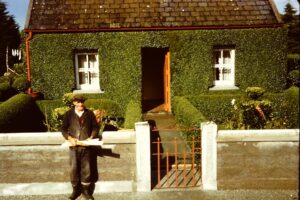
    used the term ‘cottage’ for their homes.  In Canada that has a different meaning.  Second homes. In Ireland in 1960 There was one
    cottage that stood out from others because the owner, perhaps his name was Mr. Casey, spent
    a lot of time pruning and painting to make the place look magnificent.

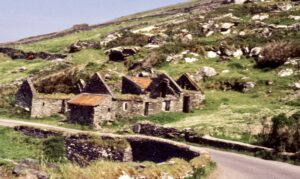
    Sad to say a lot of these small rural cottages on one acre lots were abandoned.  Or maybe it was just that I looked for signs of
    the past and tended to photograph empty, often roofless, places where people once lived.

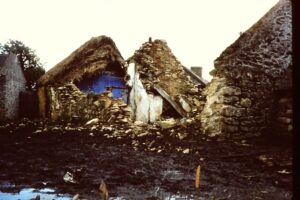
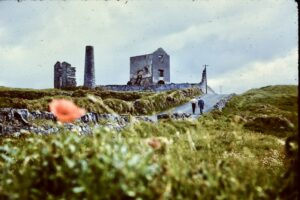
    This home in Bunmahon was just abandoned and allowed to collapse.   Barney told me a story  about the former owners.  A story
    on the edge of my consciousness.   I think the family retained ownership and just moved on…let the house fall apart.   Ruins like this
    must have been common in the late 1870’s when the mine closed and the people (population was around 2,000 then)….Miners are
    nomadic.   The miners of Bunmahon moved west to the United States and Canada.

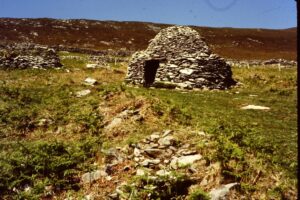
    This ancient bee hive home has withstood the ravages of time.   AT one time a monk may have lived here contemplating….just contemplating.
    What?   What would you think about  while sitting cross legged in a tiny stone house where you couldn’t stand?  Just sitting there alone.

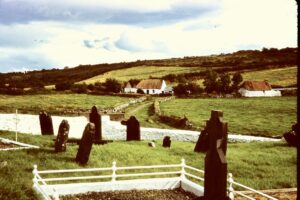
    I am so glad I took this picture because it was so ’normal’ to me in 1960.   Homes that were whitewashed…very neat in most
    cases…with every inch of the acre of land being used.  Often with domestic animals.
    And ancient graveyards were often present.

    So many of the abandoned buildings looked like this…as if the rooves had been removed deliberately.  Seems to me I read somewhere that
    landlords forcibly removed those rooves to force indigent tenants to move on…i.e.  people who were not paying rent.   That happened
    in the Highland Clearances in Scotland when large landwoners wanted land for sheep and not for people.   The 1840’s were rough years
    made worse by the sudden failure of the potato crop across western Europe.  


  • EPISODE 443 IRISH STORIES: IRISH COTTAGE

    EPISODE 443   IRISH STORIES…IRISH COTTAGES (HOMES) 


    alan skeoch
    oct. 2021

    I wish I had taken pictures of many of the homes where our work force lived.  As I remember they
    used the term ‘cottage’ for their homes.  In Canada that has a different meaning.  Second homes. In Ireland in 1960 There was one
    cottage that stood out from others because the owner, perhaps his name was Mr. Casey, spent
    a lot of time pruning and painting to make the place look magnificent.


    Sad to say a lot of these small rural cottages on one acre lots were abandoned.  Or maybe it was just that I looked for signs of
    the past and tended to photograph empty, often roofless, places where people once lived.


    This home in Bunmahon was just abandoned and allowed to collapse.   Barney told me a story  about the former owners.  A story
    on the edge of my consciousness.   I think the family retained ownership and just moved on…let the house fall apart.   Ruins like this
    must have been common in the late 1870’s when the mine closed and the people (population was around 2,000 then)….Miners are
    nomadic.   The miners of Bunmahon moved west to the United States and Canada.


    This ancient bee hive home has withstood the ravages of time.   AT one time a monk may have lived here contemplating….just contemplating.
    What?   What would you think about  while sitting cross legged in a tiny stone house where you couldn’t stand?  Just sitting there alone.


    I am so glad I took this picture because it was so ’normal’ to me in 1960.   Homes that were whitewashed…very neat in most
    cases…with every inch of the acre of land being used.  Often with domestic animals.

    And ancient graveyards were often present.


    So many of the abandoned buildings looked like this…as if the rooves had been removed deliberately.  Seems to me I read somewhere that
    landlords forcibly removed those rooves to force indigent tenants to move on…i.e.  people who were not paying rent.   That happened
    in the Highland Clearances in Scotland when large landwoners wanted land for sheep and not for people.   The 1840’s were rough years
    made worse by the sudden failure of the potato crop across western Europe.  
  • alan…re: failure to send episodes

    John (and others)…I have never in my life had so many problems
    started when I could not receive messages on my iPhone…then other things happened i.e. scrolling, flashing on my computer, etc. …had computer upgraded which solved the scrolling and flashing but iPhone could still not receive…switched to g mail but learning curve is steep
    So far I have spent money and time (a lot of time) and nothing has changed except a new email address … back to zero ;;; I am writing you on my old address…back to zero in other words
    I have an episode on a basking whale that scared me in Ireland in 1960…all written which I will send via my old rogers system…if? If this reacts John Wardle
    If this reaches you I will try to go back to old system…i.e. rogers… and reconstruct latest story
    alan