Year: 2020
-
EPISODE 93″ ALGOMA CENTRAL RAILWY “GOT THE DISAPPEARING RAILROAD BLUES” 1964 PART 1
EPISODE 93 ALGOMA CENTRAL…RAILWAY TO NOWHERE“GOT THE DISAPPEARING RAILROAD BLUES” (Guthrie)alan skeochAugust 2020
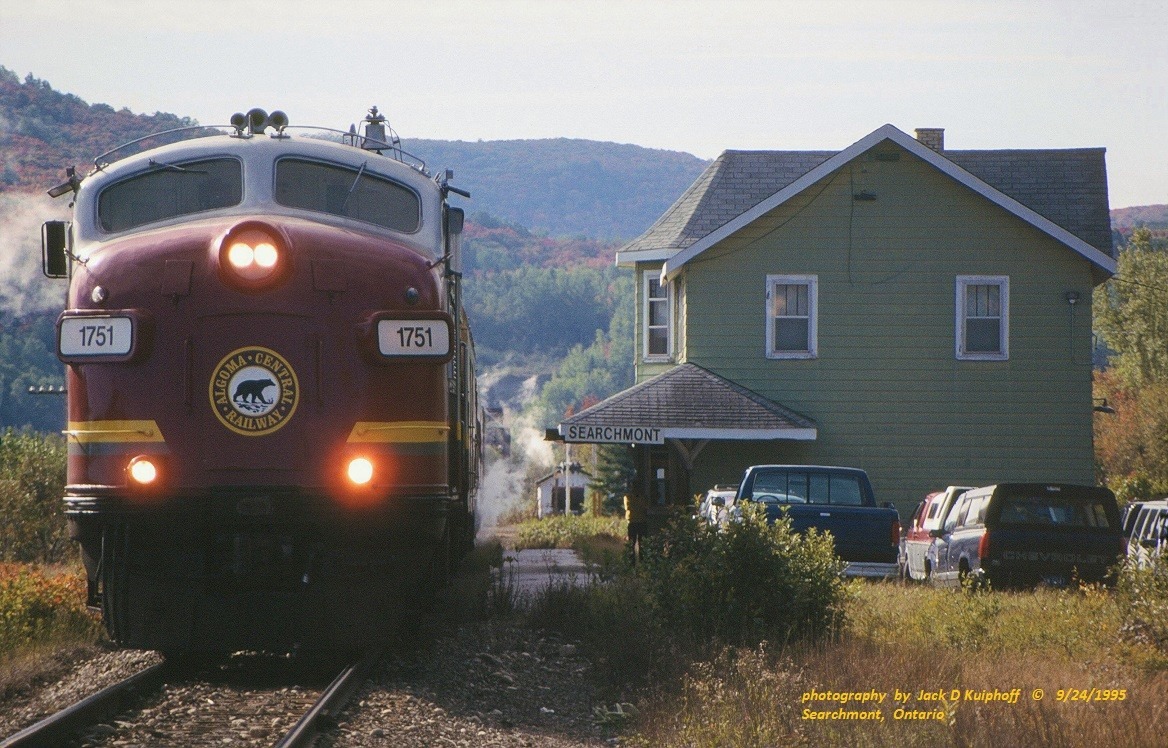
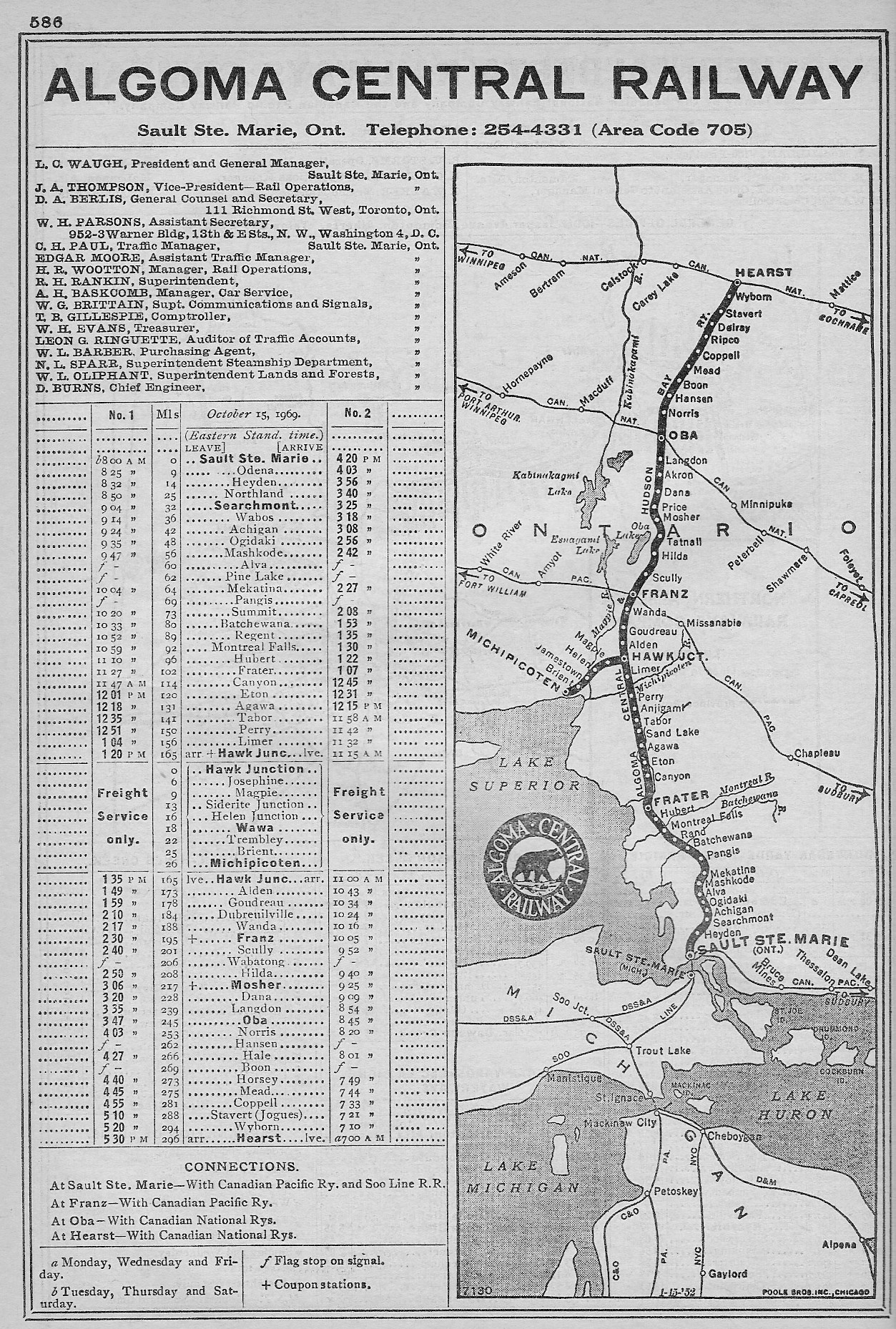
Early in the summer of 1964 I was offered a job deep in a forgotten part of Ontario.The only way in and out was on the ACR…the Algoma Central Railway. A railwaythat goes nowhere really.The ACR runs from Sault St. Marie northward to Hearst where it connects with theCPR transcontinental. It is a railway of broken dreams. The first builder only managedto construct 58 miles of rail before going bankrupt. Others completed the full 297 milesbut no one ever made money. Today the ACR is a ghost line only going as faras the mysterious Agawa canyon as a tourist adventure.There are people living along the line. Not many. Maybe fewer and fewer. The ACRis a rail line that links fishing camps. Today, August 11, 2020, I am not sure if theACR even reaches these lonely human outposts. The current owner, CNR, hasthreatened to shut the whole line down unless the federal government pitches inand bankrolls the line.In 1964, my destination was Mile 71 on the ACR. A fishing camp from which we werelaunching a mining exploration venture. “Paradise Lodge”The mist unusual characteristic of the ACR was its public service to people like us…prospectors…and others who hoped to catch a few fish. There was no scheduled series of stops.In 1964, If we wanted a ride on the ACR, we stood in the middle of the track and waveda white flag or red flag or old set of handlebar underwear or big bug net. The huge train would stop.There is nothing lonelier that the sound of the ACR in a wilderness where the only answer is a wolf howl.Might I suggest you listen to Willie NeLson singing Arlo Guthrie’s THE CITY OF NEW OLREANS…”the disappearing railroad blues”from album: Hobo’s Lullaby (1972)alan skeochPS Our next stories are framed by the ACR…that was 1964 when the line was privatelyowned for a few years. In 1965 it was sold and its survival was a question. A slow and sad decline ensued. -
EPISODE 91 TOUCHING KIDS IS A GOOD WAY TO LOSE YOUR JOB.
EPISODE 91 TOUCHING KIDS IS A GOOD WAY TO LOSE YOUR JOBalan skeoch’August 10, 2020
Marjorie and I at a dance around 1961. Before becoming a teacher. We are touching hands. In 1951 we did not knowthat such touching could be dangerous.
Marjorie, Kevin, Pete (the dog) around 1970CAUTION …THIS STORY IS HARD TO BELIEVE…EVEN BY ME.My profs at U. of T. faculty of education…John Ricker and Andy Lockhartboth cautioned us about touching. Yes, ‘Touching’.“If you want to lose your job just try hugging too many female students…one ofthem might report you saying, “He touched me!”” Whether true or not…whetherentirely non sexual or not…That does not matter, youwill suffer some terrible consequences. Maybe lose your job even if the touchingwas innocent or entirely fanciful…entirely in the mind of a teen-age girl. Be careful.”“How can I be careful…half of the students I will teach willbe teen-age girls. And I would like the students to like me…would likethem to say “Skeoch is a good teacher…I like his classes…I like him.”“Understood. The best way to stay out of trouble is to never ever be alonewith a female student. No touching. No patting on the back. No hug ofconsolation in event a family tragedy. Be careful.”The result was that I knew about ‘social distancing’ decades before thiscurrent pandemic. I kept my distance. Most kids liked that distancinganyway. They called me ‘sir’ which has a distancing effect. That is good.Kids can love a male teacher without smothering him in hugs and kisses. To mostkids their teachers are old people even if the age gap is barely four years.There is safety in that age gap. A gap reinforced by the use of ‘sir’ as aterm of respect as well as social distancing.WHERE AM I GOING WITH THIS STORY?Most of the kids I taught liked me. I could tell by theirsmiles and the occasional tap on the shoulder by the boys.Not all were admirers. I remember one girl told me to “FuckOff” in class. Sort of a shock. I asked why after class..“You were standing on my foot.”True. I thought that was amusing. “Stand up when you answer.”But she could not stand up because I had committed the cardinal sinof touching by standing on her foot. She could not stand up. Stupidbut most kids thought it was funny. She did not.I apologized and we got along well after that.In my first year of teaching one young Grade 9 girl really scared me.She was a nice person. Quiet. Scared of high school I thought. So Iwas nice to her. Big smlle. I made a point of greeting her just to allayher fears.Wrong thing to do!We lived on Westminster Avenue which was a nice walk fromParkdale Collegiate. Interesting stores on Roncesvales and Queen Street West.The student met me by accident and walked home with me several times.Too many times to be accidental. Got me really alarmed. I should notbe seen walking home with a female student. No touching involved. But imaginationof anyone who noticed might jump to dangerous conclusions.So I began to fear walking home. A grown man afraid of a lonelylittle Grade Nine girl. Seems ridiculous to others but not to me. I triedslow walking and pauses at store display windows. I tried fast walking like Olympicwalkers. She was there whether fast or slow This happened too oftento be accidental. Let’s say she caught up to me five or six times. Enoughto raise alarm bells in my mind.I shared my concern with other male teachers. Just keepingpeople informed was some protection.“How can I avoid the student without breaking her heart?”(She was fragile…I feared hurting her. What was really wrongwith a student liking her teacher?}“What can I do?”“Did you ever try walking on the south side of Queen Street. Awayfrom the crowds on the sunny storefront side?”“How would that help?”“You could spot her and take evasive acton.”That evening I took evasive action. South side of Queen St. Not somany stores but enough for me to look for reflections.Was she there? Sure. There she was paralleling me. Knowing thati would have to cross to the North side once I reached Roncesvales (theNorth South street that led to our home.I lingered. Watched the reflection. Watched her pause. Then a funny thinghappened. Instead of looking at the reflection I looked at the goods thestore had for sale. Women’s lingerie.., Brassieres etc. Bizarre. Rather embarrassing.Then the situation became even more bizarre. i decided to make a run forthe Roncesvales street car…zipping briefly on the north side of Queen thenrunning and jumping aboard the street car.Where was she? She was right behind me. Jumping aboardat the same time.“Hello, sir.”The weirdest thing then happened. Her mother was on the street carclose to the front doors. I knew her from parents’ night. We talked…smalltalk. But that was the end of the accidental meetings. I think her momintervened. After that event I could walk home without worry of a female student escort.Too incredible to believe? I know it seems so.Was the situation completely finished? Nope. A couple of weeks later oneevening when I was coaching football at the Exhibition grounds the younggirl stopped by our house and asked Marjorie if she wanted tobuy a bunch of pictures of me that she had taken secretly. Marjoriedid not buy the pictures of me walking home. We were amused buta bit disturbed at the same time. The tracking soon ended. The studentgot older…forget about me…got on with her life.Last I heard the young girl was married with three children of her own.alan skeochAugust 2020P.S. I made it a practice to never be alone in my room witha female student. It was a good decision. Perhaps I mightbe brave enough someday to tell the story of a student teacher I wasassigned later in my career. She tried to talk with me alone.I was too wise for that. I failed her. She was a terrible teacher.Another person she caught alone with her faced a rape insinuation.Her parting comment? “I will kill you.” Marjorie and I stayedhome that week end.P.P.S. Hard to believe? You bet. Even I find these storieshard to believe. Teachers are treated as guilty until proveninnocent. The exact opposite of our criminal justice system. -
EPISODE 91 PUT YOUR WARM AND TENDER BODY NEXT TO MINE (School Dance Oct. 1963)
EPISODE 91 PUT YOUR WARM AND TENDER BODY NEXT TO MINE (school dance, Oc.t 1963alan skeochAugust 9, 2020
Teen agers did dress up for dances but I do not remember suits and ties on the boysNote: I have told this story many times but I think it is worth repeatingnow…impact of social distancing has changed so much.Setting: Parkdale Collegiate Institute, School Dance Oct. 1963I was a new teacher at Parkdale Collegiate in 1963 which meant I was only afew years older that the senior students. Taught for about 6 weeks. And that, I believe, was the heart ofthe problem.“Mr. Skeoch, you along with Alison Petrie have been assigned as chaperonesat the school dance.”“Fine. Any advice?”“Just make sure no one is smoking inside the school…”“What if I catch a smoker.”“Throw him out.”(That sounded easier to say than to do. I did notknow the students, especially the senior students.)We had an overflow population at the school in 1963. The baby boomers boosted the studentbody from a low of 400 in the 1950’s to a bursting 1,400 by 1963. So many students that thetennis court and any other space was now filled with portable classrooms. Mine was thefurthest from the school. Charmingly isolated. So far away that most students did not knowI was a teacher. Fortunately a few senior students knew me as a football coach…new one.For most kids, however, I was an unknown as was my co-chaperone Alison Petrie. She wasvery short. Easily mistaken as a student.Marjorie came with me that October evening. We liked to dance and thought this was a goodchance to have fun and show off a few of our rock and roll dance steps. The gymnasiumwas packed with kids. Cheek to jowl as it were. Or, better said, they “put their warm andtender bodies next” to each other. The girls dressed to deliberately entice male admirers…short skirts as I remember.Sex seems to encourage combat among male animals…including male students. They canbehave like bull moose in rutting season.We did not get a chance to dance much that evening. We were really police officers.Who came to the dance? Not just our students but there were lots of strangersfrom god knows where. Alison and I could not tell Parkdale students from anonymousmarauders seeking to rob Parkdale females from Parkdale males.How the hell did these strangers get into the dane in the first place? They had friends onthe inside…at the door. And there was really no rule that strangers could not come to the dance.We grew up in the 1950’s when weekly dances were common and moose rutting performanceswere rather rare. At my high school, Humberside, the most rebellious activity at my first schooldance was passing crocks full of hard cider around the dance floor. Teachers thought itwas unfermented. No fights. The rotgut just made me sick.Lots of pop tunes n 1963 like Johny Cash and ‘Ring of Fire’…Roy Orbison’s ‘Blue Bayou’..or BobbyVinton’s ‘Blue Velvet’.Wow, did Johnny Cash ever fire up student dances…opening lyrics reveal much”Love is a burning thing
And it makes a fiery ring
Bound by wild desire
I fell in to a ring of fireI fell in to a burning ring of fire
I went down, down, down
And the flames went higherAnd it burns, burns, burns
The ring of fire
The ring of fireOn that October night in 1963 the gymnasium was quite dark. And sometimes the slow danceswere so magnetic that bodies seemed bound together…positively charged magnets. That wasa bit of a concern so we turned on a few lights. Not a popular thing to do. “Who the hell dothose new teachers think they are…police officers…morality officers”” We got some nasty looks.“Alison, I am going to patrol the halls for a few minutes.Will you and Marjorie be OK in the gym?”“Fine.”Seemed to me I had better check that no one is smoking in the school. If anyone was smokingit would be done in the halls. And sure enough there were a bunch of boys, maybe 5 to 6of them with lit cigarettes in the main hall. A challenge!“Put out those cigarettes, now.”“Who says?”“I say.”“Who the hell are you?”“I teach here…placed in charge of this dance. No smoking.”(mumbled comments may have been ‘Fuck You’ or some lesschallenging few words.)“What did you say?”“Free country…we can say what we want…”Prick!”“Are you Parkdale students?”(Silence. They were apparently not our students. I did not know for sure.And I think they still held their cigarettes.}“OK, That’s it, boys. Get out of here. Now. There’s the front door…leave.”(I hoped my voice did not crack as I got tough. I am not a fighter…always lookedto de-escalate confrontations because I had seen too many gang fights as a kidin the late 1940’s when my brother and I were small and lived in the middle ofDiufferin Park. One gang member got hit over the head with a lead pipe as Iremember. Bottom line, I was not as tough as the situation in 1963 escalatedinto something that could be physical.)“Get out. All of you. Now.”“Teacher. Think you are a big shot.”“OUT!”“Bet you haven’t got the guts to come outside with us.”“I’ll escort you out. NOW!”“Chicken shit teacher…”“OUT!”“Come out yourself.”
This image captures the tough guys … complete with cigarette…but these arenot the boys.Here I made a big mistake. The challenge to come outside should havebeen ignored. But that meant a loss of face and by then Parkdale studentshad gathered around. So I went outside with the boys who continued tomutter a mixture of challenges and obscenities. “Fucking teacher.”may have been one of the expressions although the F word was uncommonin the 1960’s. More likely I was called a ‘Son of a bitch”. Either way the challengehad been made and stupidly I herded the boys outside.Outside . Jameson Avenure was dark as a dungeon. The street was lined withmagnifcent old Elm trees that filtered the street lights. Our school had no exteriorlighting.This was not good. The boys gradually moved around me. Closing off my escaperoute back to the school. They were getting ready to do something. Maybe poundthe shit out of me. Maybe they were bluffing as I was bluffing. I was scared butkept my back straight.“Big tough teacher, eh?”“Get out of here.”“Afraid to do anything but talk…no guts.”The circle was closing. I was in bad trouble. If I touched one of theseboys then I had taken the first step. They would be defending themselves.No touching on my part, for sure. But they seemed to intend to do morethan touch me. I was trapped. In the dark. Strangers. Hot tempers.Maybe girls watching….which would be a catalyst for violence.Then a wonderful thing happened. Now, nearly 60 years later I remember that]moment as if was yesterday. Out of the darkness behind me came a voice.“Are you having any trouble Mr. Skeoch?””And a few Parkdale boys emerged, led by Ted Spencer who was on our footballteam as were the other boys who emerged into the filtered light. They knew Iwas over my head and might need them if push came to shove.The tough guys who were really just older teen agers from another school. Boyswith too much testosterone…They just drifted away…melted into the anonymity ofJameson Avenue and Queen Street West. Gone. As if a mirage.“Thanks, Ted, I was in trouble.”“No problem, sir, we knew what was happening.”Events back in the gym had also taken a turn for the worst. Well,not that bad, really. But Alison Petrie and Marjorie had their owntroubles.“How are things in the gym, Marjorie?”“Not good.”“What happened?”“Two or three boys were talking to Alison…”So I hearyou come from the Maritimes, Miss Petrie?”“Yes, Nova Scotia.”“What’s wrong with that, Marjorie?”“Lots.”“Like?”“As the boy in front was saying pleasant things, the boy behind Alisonwas slowly unzipping her dress…very slowly.”“Who? Point them out.”“Alison and I have decided best to let things alone…nothing reallyhappened. The boys thought it was very funny.”Eventually the dance ended. All the lights came on and the studentsdispersed. That was my first school dance in which I had beenput in charge. The principal and senior teachers were at fault I believe.Two new teachers … kids themselves…should never have been put incharge of a school dance.Sad to say but today, in 2020, school dances are rare. There might bea sort school dance in an afternoon but a school dance at night seemsnon existent. Too bad, really.Then again there is no point to dancing any more. Why? Socialdistancing. Covid 19 has killed dancing. Can you imagine dancing with a girl or a boy who aresx feet distanced from each other. No chance of them “putting theirware and tender bodies” close together.alan skeochAugust 9, 2020Post ScriptFor tje Gppd Times was written in 1970…seven years after the event…but the meaning applies
“For The Good Times”
(originally by Kris Kristofferson)
Don’t look so sad, I know it’s over.
But life goes on, and this old world will keep on turning.
Let’s just be glad we had some time to spend together.
There’s no need to watch the bridges that we’re burning.
Lay your head upon my pillow.
Hold your warm and tender body close to mine.
Hear the whisper of the raindrops,
Blowin’ soft against the window,
And make believe you love me one more time,
For the good times.
I’ll get along; you’ll find another,
And I’ll be here if you should find you ever need me.
Don’t say a word about tomorrow or forever,
There’ll be time enough for sadness when you leave me.
Lay your head upon my pillow.
Hold your warm and tender body close to mine.
Hear the whisper of the raindrops,
Blowin’ soft against the window,
And make believe you love me one more time,
For the good times. -
EPISODE 90 FAAREWELL TO IRELAND
Note: Error in Episode 90…Ignore my wage and bread calculations..woefully wrong.Note 2: All of these Episodes…discursive for sure, jumping around…all of them havebeen written as stories that might help the readers who are trapped in isolationas Covid 19 wreaks havoc with the world we once knew.EPISODE 90 FAREWELL TO IRELAND…alan skeochAugust 2020Stories about Bonmahon, and the copper mines at Knockmahon and Tankardstownmust come to an end I suppose. Readers reach a point of saturation no matterhow enthusiastic the author remains. If pushed I can write other Episodesabout my 1960 Irish adventure. I might decide to do more myself.Much will be left out and that bothers me. So let me leave you with a few partingcomments from the mine children of Bonmahon. Interviewed while sorting andcrushing copper ore. (quotes thanks to Des Cowman)
Women and girl Workers in the copper ore sorting shed of Bonmahon mayhave loved similar to these women. Clothing was ragged.
These children were American oyster shuckers pictured in the late 19th century. The miningchildren of Bunmahon would, I think, have looked similar.Thirteen year old Helen Howke:“We sit down at this work and lean on our elbows….I getfourpence (4d) per day. We come to work at 6 o’clock …at half past eight the bellrings for breakfast…we have half an hour. At one o’clock the bell rings for dinner.We have an hour and then work till six o’clock when the bell rings. In the winterwe work as long a light will permit. We begin at daylight and leave off when itgets dark. I had potatoes and a bit of fish for my dinner. I go home for my mealsbut many have their dinners on the works.” (She started work at 11 years of age)Margaret Gough, says she is “about 15 years old.“I have never been to school. I can neither read nor write. I have three brothers andfive sisters. They are all at home. Two of them besides me work here. Weare very poor. I get paid 4d per day (guess that might be 10 cents) very regularly.I have no shoes or any other clothes than theseI have on. I can sew a little. I givemy wages to my mother.”Two boys, 10 and 11 years old“Some of us get a slap on the head sometimes or a cut with a stick when notattentive to our work”Work at Knockmahon was not as abusive as it sounds. Mining copper was lessdangerous than working in the coal mines of the English midlands. Less dangerof fire, silicosis, mining collapse, physical abuse. The miners were well paid wenincomes are measured against other incomes in 19th century Ireland wherepoverty prevailed.. Likely most of the miners andtheir families hoped and prayed that the copper vein would extend deeperin the hinterland. It did not.Better to have a job at Knockmahon … either above or below ground…thanto have no job at all.(Wages: In 1850 — $100.00 was equal to $3,305.00 dollars today in 2020or in other words $1 in 1850 = $33 today in 2020.Four pence in1850 = roughly 50 or 60 cents today in 2020, not a bad wage)I would like to congratulate Des Cowman for his research skills that haveput flesh and blood on the bones of the copper cliffs of Bonmahon. Hiswork has also done much to make the area of Knockmahon into a UNESCOGEOPARK where tourists can imagine life in a 19th century mining community.Confused? The villages of Bonmahon and Knockmahon are really onelarge village separated by the Mahon River.alan skeochAugust 2020VISITING IRELAND? THE COPPER COAST HAS BECOME A UNESCO GLOBAL GEOPARK-IT is even possible to go underground and see the 19th century mining operationat Knockmahon.COPPER COAST ADVERTISED…OPEN FOR TOURISTS NOWThe Copper Coast, in County Waterford, is named after the historic metal-mining industry and is now a tourist attraction thanks to the geological history of the area from Palaeozoic volcanism to the last ice age.
In 2001 the area was declared a European Geopark. In 2004 it was named a UNESCO Global Geopark. The Copper Coast stretches 10.5 miles from Kilfarrasy to Stradbally.
The region is known for its panoramic seascapes, cliffs, bays, and coves. In fact, the Copper Coast Road, the R675 stretching from Dungarvan to Tramore, is considered to be one of the most beautiful scenic drives in the world. It’s also known for it’s beautiful, clean beaches such as Clonea and Bunmahon and the village of Bunmahon, Boatstrand, Dunhill, Annestown and Fenor. Tramore, the popular seaside resort, is the best known town along the Copper Coast, but it also has a wealth of “undiscovered” secluded coves and beaches.
Read more: Dublin and Surrounding areas tours
Knockmahon
At Monksland Church, in Knockmahon, there is a visitor center dedicated to the geopark and its 460 million years of history. The geopark itself is an outdoor museum of geological records. The park explains how volcanoes, oceans, deserts and ice sheets all combined to create the rocks which provide the physical foundation of the natural and cultural landscapes of the area.
For those who want to explore the area’s mining center Bunmahon is the town to visit. This was the center of copper mining in the area during the 19th century. In fact, some of the Tankardstown Engine House is still standing near the village.
The Geological Garden, in Bunmahon, provides visitors with a glimpse into the geology of the Copper Coast. The Time Path in the garden will guide you through geological time with 28 slabs depicting the major steps in Earth history and evolution of life. There are also two ogham stones found nearby which are aligned to the summer solstice.

Copper Coast
The Geopark grew out of the Copper Coast Tourism Group which had been formed in 1997; our application to join the new European Geoparks Network was accepted in 2001.
moreGeological Sites
The rocks of the Copper Coast recorded different geological events over 460 millions years. It all started on the ocean floor, near the South Pole, when this part of Ireland wasn’t a land yet.
more -
EPISODE 89 BUNMAHON AND KNOCKMAHON…MYSTERIOUS PEOPLE THOSE MINERS
EPISODE 89 BUNMAHON AND KNOCKMAHON….MYSTERIOUS PEOPLE THOSE MINERS
Look closely. See Barney Dwan resting comfortably on the cliffs of Knockmahon in 1960. Behind himis one of the adits he showed me back then. When I think of that 1960 adventure today in 2020 I am surprisedthat none of my work crew seemed to have any connection with the miners of Knockmahon between 1840 and 1880.But I never asked really as we spent most of our time keeping cows from eating our cables.
I This picture of an Irish cottage was taken in Knockmahon in 1960. Had there been cameras invented in 1850, manysuch pictures could have been taken. (alan skeoch)alan skeochAugust 2020I suppose most people who think of Ireland’s past history immediately say “Potato Famine” or“The Great Hunger”. For good reason since 1 million Irish people starved to death in the 1840’sand another 1 million fled Ireland for North America and Canada where living conditions weresomewhat better. The population of Ireland dropped from 8 million to 6 million in those years.Today, August 7, 2020, it is easier for us to understand those bad years. We are in the midstof the greatest Pandemic of our lives…Covid 19 has killed thousands of people already andpredictions are that eventually a million people will have succumbed to that tiny virus.HOW DID THE POTATO FAMINE AFFECT BUNMAHON AND KNOCKMAHON?The Irish miners of County Waterford were a mysterious people to me…ghosts inmy mind when I workedover the old mine remnants in 1960. No one ever told me they were descendantsof those 2,000 men, women and children who dug, sorted and shipped oopper orefrom that thick but single vein of ore evident on the cliffs and eventually disappearinginto faults and tiny traces one mile inland from the sea. That vein reached 800 feetbelow the ground…much of it out under the Atlantic Ocean.Who were these people? Many of them remain a mystery but thanks to the researchof Desman Cowman, a high school teacher in the Christian Brothers school in Tramore…Thanks to his impeccable research some of the curtain of mystery has been pulledaside.Here is what we know about those people…gleaned from fragments.There was a leader who tried to shepherd the mine families through the starvationyears. He was a miner from Cornwall who came to Knockmahon along with manyother Cornwall miners. His name was Pentheric. (sp?) As early as1841 the spectre of starvationhung over Bunmahon and mine manager Pentheric imported a large cargo of potatoesand oatmeal which was sold cheaply to the mine families.But it was not enough. By the dark year of 1846 deaths were common..“There is a great increaseof fever in the district. From 150 to 200 are unemployed in the village of Bunmahon. Aconsiderable increase of fever is apprehended from the scarcity and high price of food.” (Feb. 1846)“…a mining population of about 3,000 (guesiimate?) … some of these are in a state ofgreat destitution. They will no longer be supp[orted by the people of Kill and Newtown.…Only 116 pounds (money) left. Lorenzo Power and Richard Purdy have left for Dublin to get someemergency help.” (May, 1846)“133 tons of Indian meal have been distributed since 2nd of June among 3,520 people.”“A large quantity was distributed gratuitously and in return for work. (widening and straighteningpublic roads)…Any that had employment were sold the meal for prices ranging from 1/2 d to6 d per stone (halfpence to sixpence). Half a stone being allowed per person per week.The objects of relief in this district are chiefly cotters, farm labourers and miners.” (August 24, 1846)(*Note: Indian meal, i.e. corn meal, was difficult for Irish people to process and eat so it didnot always stave off starvation)“No more money to buy meal.: (Sept. 30,1846)“The hinterland of Bonmahon is one of the great distressed parts of this country….There is apathyto all farming orations and the ground is neglected.” )Feb. 22, 1847)“Out of population of 5,000 in Kill-Knockmahon area on one day 3,500 applied for relief. Therewere 1,400 on relief when food ran out.” (May to September 1847)“The rest is silence. The dimensions of the disaster emerge in the census of 1851. One third ofthe population of Bunmahon hadn’t survived … 628 people out of the 1,771 population recorded in 1841had simply vanished and their fate goes unrecorded. The shanty-town survived. (But) 76 of the 90habitations there were gone…about a quarter of the labouring class in the hinterland of the minesseem to have vanished. The human agonies behind these figures can well be imagined but norecord survives detail them.” (Des Cowman, quotes gleaned from reports of Mining Company ofIreland)So that dark decade from 1841 to 1850 has left only spotty records for us to consider. Minersand mine families just did not keep records. Most, it seems, could not read or write. And anythat could do so were too tired and too hungry to put their grief in print.
The irish labourers homes were small…in this case one room. Someminers cottages in Bunmahon had two families living one such home.Adult males and rural class
structure circa 1841 (2)
Category Number Per cent
Rich Farmers 50,000 2.9
(average holding 80 acres)
‘Snug’ Farmers 100,000 5.9
(average holding 50 acres)
Family Farmers 250,000 14.7
(average holding 20 acres and usually not
employing labour)
Cottiers 300,000 17.7
(average holding five acres)
Labourers 1,000,000 58.8
(average holding one acre, though often
without any land)Living standards of the rural poor
There were localised famines in 1800, 1817, 1822, 1831, 1835-37 and 1842. Prior to 1838 there was no state welfare system. In 1841, two fifths of Irish homes were one-roomed mud walled cabins. In the words of a contemporary observer: “The hovels which the poor people were building as I passed, solely by their own efforts, were of the most abject description; their walls were formed, in several instances, by the backs of fences; the floors sunk in ditches; the height scarcely enough for a man to stand upright; poles not thicker than a broomstick for couples; a few pieces of grass sods the only covering; and these extending only partially over the thing called a roof; the elderly people miserably clothed; the children all but naked.”3
The one roomed Bothans were makeshift structures often using astone farm fence as the back wall. The Bonmahon ‘ bothars’ just disappearedduring the famine. As did their residents
Evictions of Irish rural poor were coupled with the demolition oftheir ‘cottages’. Some of these roofless ruins are still evident hereand there in Ireland. At least one was present in 1960 in Bonmahon.Today, August 7, 2020 the best marker left by these people is the old winding towerand steam engine house ruins that haunt the land above the cliffs of Knockmahon. There ishowever, a modern playground in the village of Knockmahon where once the sortingshed existed. This was the place where to copper ore was dragged by horse andcart and later by a rail line to the village. Girls and young women, perhaps 200 ofthem , laboured separating the water rock from the valuable ore. Therewas a large water wheel that turned a crushing machine grinding the large lumpsof ore into concentrate that was sacked and sent by sailing ship to Swansea, England, formelting into copper ingots. Big girls and women were paid seven pence per day.Little girls got four pence per day.There are a few glimpses of these girls that show the poverty that prevailed.Several young girls were interviewed and detailed their work day…from dawnto dusk earning 4d (fourpence) per day. What does fourpence mean?In 1850 the British pound was worth about $1.25 American. The cost of aloaf of bread in the United States was 9 cents. This means that the fullday of labour by these young girls of 8 to 12 years old was barely enoughto buy one loaf of bread.How many loaves of bread can be bought by a person earning minimum wage today?Not hard to figure. eight hours times $15 per hour = $120. A loaf of breadcosts between $2 and $3 which means a minimum wage worker can buy40 to 60 loaves of bread from a single day of labour. (I must be wrong here…need to do more)
Irish miners in United States by the 1880’s
TO BE CONTINUEDalan skeochAugust 2020Post Script: Some of the Bunmahon miners, perhaps many of them , left Ireland for North America. Their livesmay have improved somewhat but their lives were still unpleasant…see belowAssistant Professor Jim Walsh’s dissertation sheds some light on these Irish migrant miners…perhaps some ofthem from Bonmahon.“Ten years ago, Colorado author Jim Walsh’s dissertation research on 1800s immigration to the Rocky Mountain region led him to the Evergreen Cemetery in Leadville and a previously unwritten chapter of history. There he came upon the “Catholic Free” section beyond the back of the cemetery, which extends for acres into pine forest. Records indicate that over a thousand Irish immigrants—averaging only 26 years in age—are buried there in unmarked graves. During the 1870s and 1880s, impoverished Irish miners flooded into the Rocky Mountains, often never to be heard from again. Rather than finding fortune in the gold and silver boom era, many met with untimely deaths. Walsh, a Clinical Assistant Professor at CU Denver, who now researches and lectures on labor and immigration issues, has felt compelled to find some recognition for those unacknowledged souls.

Colorado Irish Immigrants “These Irish immigrants, many from the copper mining region of the Beara Penninsula in west County Cork, were buried in what was called the Catholic Free section of Evergreen Cemetery between 1878-1890,” Walsh said. “The sunken graves include hundreds of infants and children. These are the forgotten Irish: destitute, transient, and facing dangerous working conditions. A massive miners’ strike in 1880 led by Irish-born Michael Mooney, failed to improve pay or working conditions for the community. On October 1, we will resurrect their stories and make sure that this space is recognized as sacred Irish space.””