Year: 2020

  • EPISODE 118 VIOLENCE IN MY LIFE, PART TWO. THE KILLING FLOOR

    Note:  Another warning…do not read if sensitive like I was (and am)


    EPISODE 118   VIOLENCE IN MY LIFE, PART TWO:   THE KILLING FLOOR


    alan skeoch
    Sept 2020

    My brother Eric with old Betsy, our shared woman’s bicycle…taken just before we moved
    from 18 Sylvan Avenue


    Mom really feared my brother and  I would be drawn into the mini gang climate
    of Dufferin Park in the late 1940’s.   We, my brother Eric and I, knew that was very
    unlikely.   We lived in our own world of make believe and found that very satisfying.
    Especially when we found the barrels.  

    Some importer on Dufferin Street was shipped his goods from the far east in huge 
    hand made wooden barrels  with wooden hoops.  Once emptied they were free for
    the taking so we rolled several…two or three..across  the park to the tin clad garage
    at the back of our rented flat at 18 Sylvan Avenue.  Our landlady, Mrs. Southwick, did
    not seem to care that we were creating a make believe world in that garage.

    We set the barrels up vertically then cut holes in the sides so that a one room barrel
    hideout became a three room barrel hideout.  Inside we put treasures found nearby
    like the wooden parts of old pianos from the piano factory or, better still, the so called
    weapons of gang warfare…pipes, knives, clubs.   Two throwaway items were not
    collected.  Used safes, by then  we knew what they were.  And broken beer bottles with’
    long necks.  These beer bottles with long shard necks for hand grips and  shards of
    lethal glass ready  for action.  An easy weapon.  just smash a long necked beer bottle
    on a rock.  Presto!  A weapon.  

    As mentioned earlier I knew this weapon intimately having fallen on one that
    had been discarded in the park when Eric, mom and  I were playing Blind Man’s
    Bluff.  I still have the stitched up scar on my instep to prove it.

    Our fort was grand until discovered by boys of  a rougher nature.  First some 
    took a shit in the fort.  Then they braced us once just outside the fort as mentioned
    in Part One of this story.   Remember  The incident when I learned my brother
    could  be very brave when faced with trouble. That incident was so disgusting that
    I will say no more other than to give Eric credit.

    Mom decided we must move.  Neither Eric, Dad nor I wanted to move.  We had the huge
    park  as our playground.  Dad had Dufferin racetrack across the road.  Convenient
    for the three of us.  But mom did not like what was happening. And she was the
    leader of our family  The supporter most of the time.  The money earner.   Dad 
    was a skilled and  well paid  tire builder but he spent every dime he earned at various
    racetracks.  

    One day mom’s friend Joyce
    Bannon phoned.

    “Elsie, the house next door just came up for sale.  It is cheap…$6,000…might
    be just what you wanted.”  Low downpayment.  So we  became house owners.  The house was ours.  We lived
    upstairs …3 rooms and a tiny kitchen.  Eric and I shared the bedroom with Dad
    when he was on night shift…we slept at night, dad slept on days.  Mom slept
    on the couch in the middle room with her purse as a pillow to inhibit Dad’s need
    for cash at the racetrack.  Imagine, or own house.  A duplex of sorts.

    Mr. and Mrs Douglas lived downstairs.  He was a bartender at Spadina and Bloor.
    She was a retired prostitute according to whispers.  Wonderful pair of people.
    Mrs.  Douglas loved having boys around since she never had any children. They
    were quite poor.  Chain smokers because when they died  the walls of the little
    duplex were a sticky sickly yellowish brown.  Awful. But good people.

    So mom bought 455 Annette Street by putting a small down payment and monthly
    mortgage payments of perhaps $100,   I do not know how she did it on the money
    earned as a garment sweatshop worker.  She was smart. That’s for sure.

    HALCYON DAYS…NEW HOUSE

    For Eric  and I these months and years at our own home were our halcyon years.
    Yes, we joined or formed a gang.  We patrolled the streets of our territory
    down Gilmour Avenue to Runnymede Public School.  A gang!  Did I say
    a gang?  We were a bunch of pansies.   Instead of fighting we sang.  What a 
    bunch  of losers.  A gang that sang.   “Heart of  My Heart,  Lazy River, etc.”
    Not a minute of violence.   

    I suspect readers would rather hear about violence rather than sweetness and light.
    So suffice it to say we had good things happen to us most of the time at our
    new home.  Cub scouts, Boy Scouts, Rover Scouts, Presbyterian Youth, even
    a short stint in a choir for me.  A longer stint for Eric whose voice must have been
    more angelic.  All that and  more.

    THEN ONE VERY DARK DAY :  VIOLENCE ON THE KILLING FLOOR

    STOP READING HERE…IF YOU ARE SENSITIVE


    Violence came though.  From a most unexpected source.  So violent that it was
    almost wiped out of my memory until I began writing this story.

    The  worst violence came from a kind of  do gooder from the YMCA.  Mom registered
    me with the High Park summer outdoor program in the summer of 1950.  Seemed OK but not
    great.  I could put up with it.  Until..until…until…the horror day arrived.   My do gooder
    leader, probably just a teen ager, ran out of things to do with his assigned boys
    so he got imaginative.

    “How would you like to go on a field trip to the slaughter house?”
    “Where?”
    “St. Clair and  Keele…Canada  Packers.”
    “Raise your hands if you would like to go.”
    (Hands must have been raised…not mine…I did not like the word ‘slaughter’
    and was confused by the word ‘packers’.  What is an abattoir? All the other boys were excited 
    by the idea.   Yes,  I mean all.  So away we went.)

    Right away we were led to the gallery above the cattle killing floor.  High up
    so we could see the whole process.
    If I had been hit by  a ten ton truck I think I would have been more shocked.

    “The cattle are led up the ramp by a Judas goat. See it there.”  (seems the 
    traitorous creature was a goat in my memory but it could have been a cow.)

    “The lead cattle are stunned by a bolt action hammer…breaks their skulls…maybe
    kills them.  Then a chain is wrapped  around their back feet and up they go on
    the moving line.  First the throats  are cut that’s why the killing floor is covered
    in blood…the twitching is just nerves, the animals are dead…”

    I was so horrified by what I saw  that this is the first time in my life I have ever
    spoken or written about it.   I am not sure readers could take the full story.  I
    moved to the back of the boys. Most of them crowded along the rail actually
    enjoying what they were seeing.  Perhaps some were faking.   I hope some 
    were faking.  It was hell.  I knew  at that moment what hell must look like even
    though I did not believe in hell.  

    I could not move.  Closed my eyes.  Behaved  like a pansy I suppose.  Would
    we ever leave this insane place?

    Who are those men with the long knives on the killing floor?  I mean who would
    take such  a job?  (There is an easy answer to that.  Most we’re New Canadians…immigrants)

    Men Sloshing through the blood. ..cutting, carving.  Will it never end.  Must i keep
    my eyes open?

    “Next we will go to the hog slaughter floor.  that is  done a little differently. Follow
    me.”

    “Did our councillor say ‘Next’?  What could be worse than what I am seeing
    below me.  Stop! Now! I must close my eyes….must get out of here…
    run, Alan, run…”


    I am  not sure how I escaped.  I never got to the hog killing horror.  Somehow I
    got out of the place.  Exit signs ,,, fear of a wrong turn. Somehow  I walked home.  Stunned. Trying to block  out
    what I had just seen.  I sm shaking now, in September 2020, just recalling that
    moment in 1950.

    Ever since that moment I have had trouble eating meat.  In The immediate aftermath
    I  ate no meat.  For months and months.  I never told mom much  about what
    I had  seen.  Not sure I even told  Eric.  That was a horror I have saved for my
    82nd  year…2020.  And even now I cannot tell the full story of those cattle moving
    along the chain hung from giant hooks as their bodies  were dismembered.  There
    I said  it.  At last.


    There has never  been violence in my life that comes near in comparison  to the
    St. Clair slaughter house…Canada Packers or Swift’s … not sure which.
    In later years I came to understand  why one farm family I knew ate lots of peanut
    butter and no meat.  They knew what happens to their animals eventually.  Or 
    maybe they just liked peanut butter as  I did from that moment on.

    Mom’s meals were  often things I would rather not think about like pork hocks and
    Head Cheese.  The names disguised the food somewhat.  Mom did not have
    a lot of money so she made do with cheaper lines of  meat.  I must have saved
    her some money when I  stopped eating meat.  

    Stopping was not so easy.  Meat was a staple…part of most meals and
    sometimes hard to resist.  I loved meat pies for instance even though
    a look at the contents below the crust was disquieting.  Chunks of meat…perhaps
    not the nicest cuts.   


    Time was a great cure.  It was  possible to relegate the memory of that killing floor
    to the back burner of my brain.  The older I got the less I thought about it.
    This is the first time I have put in words that horrible experience.  Even now
    that is not an easy thing to do.   I have spared my  readers by not going into
    the detail of what I saw with those long knives.


    Gutless, some of you are saying no doubt.  And it was true.  I was gutless…scared…and  scarred for life.

    alan skeoch
    Sept 2020

    P>S>  When Dad retired he took a short job st the St. Claire stock yards organizing the cattle unloaded  daily from farm
    stock yard truck, one of which was driven by Bob Root’s father strangely enough.  Dad’ stock yard
    job did not last long.  He had to climb s stock yard pen fast when an animal went mad and charged him.
    He got another part time job in a liquor store afterwards.

    My good friend  in High school, Jim Romaniuk, had a father who spoke only broken English and fluent Ukrainian.  He worked in one of
    the slaughter house at St. Clair and Keele, perhaps on the killing floor although I doubt it as he was such a gentle kind of msn.  Then
    again he had trouble with English and had to take whatever jobs he could find.


    P.SThe stock yards peaked in 1977 and began a rapid decline thereafter until it closed February 10, 1994. Redevelopment began with Home Depot, the first of the “big box” stores to locate on the stock yards site and the CPR shops. A new stock yard was established near Cookstown a small community north of Toronto without any rail service which was no longer required. Following a corporate takeover, Canada Packers closed, the property was levelled and eventually redeveloped with housing. (D/R Macdonald, The Stockyard  Story)


    COMING EPISODE 119  VIOLENCE IN MY LIFE, PART 3   WHEN FRIENDS BECOME ENEMIES

    EPISODE 120  VIOLENCE IN MY LIFE, PART 4    FOOTBALL CHANGED EVERYTHING


  • Fwd: EPISODE 117 tracked by a snapping turtle

    Error…story should bee 117


    Begin forwarded message:


    From: ALAN SKEOCH <alan.skeoch@rogers.com>
    Subject: EPISODE 117 tracked by a snapping turtle
    Date: September 13, 2020 at 11:10:23 PM EDT
    To: Alan Skeoch <alan.skeoch@rogers.com>, Marybeth Skeoch <northerndiva5@yahoo.com>, John Wardle <jwardle@rogers.com>


    EPISODE  117   TRACKED BY  A SNAPPING TURTLE


    alan skeoch
    Sept. 2020

    There is much to be  said  about that sixth sense we have on occasions.
    I was binding soybeans plants into sheaves for possible movie
    decor  when I got the feeling there was something behind me. Really.
    So I turned around.  Nothing.  I was all alone.

    But wait.  What is that black dot on the trail.  That dot was not there
    five minutes ago for that was the trail  I had just used.  Black dot?


    Yep.  I was being followed by this big snapping turtle.  Or maybe I was  just in his or her way.
    The snapper had no intention of hiding or escaping.  The turtle stayed on the path and expected
    me to move.  Which I did.


    Many scientists believe we are in the midst of the sixth great extinction of life on earth.  There have been five before ours. (if ours is true).
    The snapping turtles have survived extinctions in the past and they may survive  this sixth extinction.  We may not.

    The sixth extinction, by the way, has been caused by us….not by a meteor or a sudden volcanic explosion.  We are doing it.
    Maybe we can stop it but we have to change our behaviour.  


    Meanwhile back at base camp #1, Marjorie was harvesting weeds…keeping
    the place ship shape.  And  Woody was with her….


    Woody was in the swamp.  He never  goes over his head.


    I think these bundles of soybeans will be good decor for a movie set once the leaves
    fall off.  


    My plan is to reorganize the green house…make it accessible.  After the soybean sheaves have dried.  And  before movie set material
    …carts, work benches, stools, tobacco, flax…etc. etc….before all that stuff comes back.

    alan skeoch
    Sept 2020


  • EPISODE 116 tracked by a snapping turtle

    EPISODE  116   TRACKED BY  A SNAPPING TURTLE


    alan skeoch
    Sept. 2020

    There is much to be  said  about that sixth sense we have on occasions.
    I was binding soybeans plants into sheaves for possible movie
    decor  when I got the feeling there was something behind me. Really.
    So I turned around.  Nothing.  I was all alone.

    But wait.  What is that black dot on the trail.  That dot was not there
    five minutes ago for that was the trail  I had just used.  Black dot?


    Yep.  I was being followed by this big snapping turtle.  Or maybe I was  just in his or her way.
    The snapper had no intention of hiding or escaping.  The turtle stayed on the path and expected
    me to move.  Which I did.


    Many scientists believe we are in the midst of the sixth great extinction of life on earth.  There have been five before ours. (if ours is true).
    The snapping turtles have survived extinctions in the past and they may survive  this sixth extinction.  We may not.

    The sixth extinction, by the way, has been caused by us….not by a meteor or a sudden volcanic explosion.  We are doing it.
    Maybe we can stop it but we have to change our behaviour.  


    Meanwhile back at base camp #1, Marjorie was harvesting weeds…keeping
    the place ship shape.  And  Woody was with her….


    Woody was in the swamp.  He never  goes over his head.


    I think these bundles of soybeans will be good decor for a movie set once the leaves
    fall off.  


    My plan is to reorganize the green house…make it accessible.  After the soybean sheaves have dried.  And  before movie set material
    …carts, work benches, stools, tobacco, flax…etc. etc….before all that stuff comes back.

    alan skeoch
    Sept 2020
  • episode 116 VIOLENCE IN MY LIFE

    Note:  You may be sick of this biography.  Fine.  Don’t read it.  Simple.  


    EPISODE 116   VIOLENCE IN MY LIFE  Part One


    Sometimes  my imagination takes over in my life.  Memory can be faulty but always contains
    a kernel of truth or perhaps some events are so shocking that they get locked into our brains
    and are easy  to recall.  In this picture I must be eight years old.  Visiting our grandparents
    farm which was a very safe place to be in the turbulent 1940’s.


    What you see here is  not remotely connected to my real world.  This picture was taken in 
    western Alaska  in 1959 when an  American Mining company armed  our crew with 30-06
    rifles in case we were attacked by Kodiak  bears.  We never carried the rifles  Just stacked
    them where the helicopter dropped us.  There was no need for violence against the bears…
    their guts were stuffed  with dead  or dying salmon.  Playing guns  as  a child had no 
    connection  with playing guns as an  adult.  Two different worlds that did  not cross.


    alan skeoch
    sept  2020

    Violence is something I have tried to avoid all my life.  I just thought about that
    this morning while wrapped around Marjorie in our bed.  There are people that
    admire violence and try to replicate it in their daily life.  I know that. I have seen
    that.  I have been the receiver of violence on a few rare occasions.  Most of  the
    time I have found ways to avoid violence.  Like running although I cannot find
    a  memory of running away from violence.  I just try to avoid violence whenever
    such a situation arrives.  ‘Chicken shit’, was once the term.

    What in hell’s half acre ever made me think of that this morning?  I have no answer.
    But one violent incident came to mind.  Perhaps the incident should be left to the
    end of this story.  But I am going to put it at the first.  

    University life offered so many things to do other than sit in the library and try
    to become an intellectual like Emmanuel Kant.   Or a writer
    like Hemingway or Steinbeck.   Or even a poet of folk life like Robert Frost.
    Lots  more things to do than read  books in other words.  Best thing was to chase
    after Marjorie.  Not the only thing though.

    So one day I joined a make up basketball team at Hart House.  Victoria college
    boys against University College boys.  Just for fun.  I was  not a basketball star…
    can’t even remember ever getting any points in that career.  

    We were playing fast.  Running up and  down the floor.  Offence then defence. For some
    strange reason a UC kid took offence at one of our players and he hit him with
    his  fist.  Our player hit back.  The two of them tumbled and wrestled with lots of
    expletives like “You son of a bitch” and “bastard” between blows.  It was not nice
    so for some reason I  cannot explain I decided to break up the fight.  To pry them
    apart.  To be the peacemaker, a role I admired in the larger world of the United Nations.

    Peacemaking did not work.  Instead the UC guy turned on me.  He grabbed  me
    by the throat with both hands and began to strangle me.  I remember so clearly
    falling to the floor and looking up at  his face.  I knew him.  At least I knew ‘of him’
    because his family were famous  lawyers in Toronto.  His face seemed joyful.

    He kept pressing on my throat.  Choking me.  For no reason other than the
    love of  violence.  How to survive?   I think I faked  passing out…or maybe
    I did pass out for a moment.  

    I know that memory may seem trivial to any person reading this story but
    it was not trivial to me.  What I saw in his face was  a love of violence.
    He liked beating people up  That was why he played  basketball on that
    winter afternoon at Hart House.  The bible says something about “Blessed
    are the peacemakers for they shall inherit’…something or other.  Not true
    I realized that day

    So this story is going to be about my confrontations with violence in my
    82 years of life on this earth.

    I have avoided violence all my life except maybe in kindergarten.  Seems I dimly
    remember getting pushed  on the stairs at Kent Public School and pushing back
    at some other five year old.  A very misty memory.  Reinforced by the fact the
    teacher commented the fact to my mother.  A tale I find hard to believe.  My 
    only sharp memory of kindergarten was the teacher saying. “All fright children,
    time  for your nap, everyone put your heads on the desk.”  And that is hardly
    a violent memory.  Seemed stupid to go to school and then fall asleep with my
    head  on the desk.  I may have resisted  But I did not rebel.  

    Violence was all around me as a youngster.   The larger world of incredible
    violence  was World  War II of which my brother and I were largely unaware.
    We lived in a climate of  make believe violence for we loved playing ‘guns’
    together.   In the winter of 1944 we built a big snow fort on the front lawn of 
    18 Sylvan Avenue and then defended imaginary attackers with guns made out
    of broomsticks.    This  was not violence nor was it training for violence.  This
    was imagination and fun.   Mom took us to the movies regularly where we watched
    Slip Mahoney and the Bowery Boys act out silliness.  Then walking home in
    the dark on Fall or winter evenings  Eric and I would play ‘guns’ without even
    thinking of the deeper meaning of  that foolishness.  I remember being shot
    by Eric on one of those nights…imaginary bullet hit me…and I died in a
    great dramatic sprawl through a pile of leaves ready to be burned. Lucky
    I did not land on some dog turds.  But the drama was great.  Made greater
    by a woman  passing by who  really thought I was hurt badly or dead.
    Until mom came along saying, “Just the boys playing guns”
    We  lived  in a cocoon of non violence at home.  Protected and  secure
    and loving.  Made so mostly by mom but reinforced by Dad when the horses
    were not running at Dufferin  Racetrack across the park from our house.


    Mom  and dad seemed pleased  with having a  baby around.   So they wove a cocoon around me…and later around Eric.


    Mom made all our clothes.   She also enriched our imaginations.  Dad was a gambler and the kind of  father
    I wished most children could have had.  Eric  and I remember them both with great affection. They protected us.


    Eric and I loved playing guns.   It was  an  imaginary world for us.  Occasionally the two worlds  collided  as in this picture taken
    at the cannon that protects Howard House in High Park from American invaders.  We  were around  10 or 11 years  old.


    Outside the cocoon there was violence.  The real world scared me.  People 
    did nasty things to each other in that real world.
    It was easy to separate the two  worlds by the way.   Some psychological
    whizz bangs will say I am wrong.   Will believe that imagination can be
    a learning ground for violence.  Bull shit!

    Comfort…security…non-violence.  Encouraged by Grandma and Grandpa Freeman who provided an escape from
    the gang warfare we  witnessed in Dufferin Park in the postwar years of the 1940’s


    At Kent Public School I could have gotten the shit knocked out of me
    were it not for my friend Karl Slalberg.  Karl and his mom lived in a
    tiny apartment…two rooms I think…in a house on a street north of Bloor
    St.   I know that because his mom had  me over a couple of times.
    Karl got into some kind of trouble.  “Juvenile  Delinquent” was the term
    used I think.   That mystified  me because he was such a nice kid.  No father
    around.   But Karl protected me.  Funny because he must have  been the
    same age  as me.  Perhaps Grades 3 or 4 when we were 8 or 9  years old.

    “Alan, we could earn a lot of marbles with this cigar box.”
    “How?”
    “Cut little pieces out … some big, some small…all holes in
    which a marble could get through with difficulty.”

    “Oh, that game.  The big boys play it every day at recess…lots of
    cigar boxes put against the wall.  Get the  marble through the hole
    and  win  “Two  for  One” for the big hole or “Five for One” for the little 
    hole.  Miss the holes and lose your marble.  Most of us lose our marbles.”

    “Right.  So let’s set up our own cigar box.  Win lots of marbles.”

    So we did.  Karl got the cigar box ready…cut the holes, wrote numbers
    above the holes.  We took our place against the school wall and invited
    marble gamblers to take chance.  Big payoff…maybe five to one or higher.
    Karl left me in charge of the cigar box often.  One particular time, however,
    got ground into my memory.  I stood beside the box and a big guy..maybe
    a kid as ancient as ten or eleven years old…this big guy rolled his marble
    right into the big pay off hole.  I owed him ten marbles.  Ten marbles!
    I had no marbles.  We expected to earn marbles.  We expected  marble
    gamblers to lose most of the time.  We expected  to build  up our capital
    starting at zero.

    “OK, kid, you owe me ten marbles.”
    “I can’t.  I have no marbles.”  I said weakly, my knees trembling.
    “Pay up!”  he  demanded.  

    Then things got really nasty.  Other boys gathered around.  I was about to
    be punched when Karl arrived.  He was a great fighter.  An even better threatener.
    Nothing happened.   Maybe Karl said he would pay tomorrow or just Karl’s
    presence defused  the situation.   I learned a big lesson that day.  A couple of big 
    lessons.  First, do not make promises you cannot deliver.  Second, violence
    is easy to trigger…harder to reduce.

    I know this sounds silly but the memory is clear…75 years after the fact.

    I had an even earlier memory of violence.  A memory that today I find hard
    to believe.  Did this really happen?  Grade one maybe.  Six or seven years old.
    Our nice teacher  gave all of us a cucumber from his  garden.  Male teacher I
    seem to recall although that does not matter.  A cucumber.  Small one.  What a
    prize.  But how can I get it home for mom?   

    Getting home each day was difficult because I had to cross through Dufferin
    Park.  That meant crossing the ravine that ran  at right angles blocking the route to our house
    In 1944 or 1945.  Our house at 18 Sylvan Avenue was  almost right inside the
    park.  It has been demolished now sadly.   Crossing that ravine was like crossing
    no man’s land in our imaginary world of cops  and robbers or cowboys  and Indians.
    Only this ravine was real and the boys hiding there were very real.

    Often They frisked  me to see what they could steal.  Getting the cucumber home
    was going to be very difficult.  I  seem to remember even being stripped in these
    no man’s land  confrontations.  Could  I get the cucumber home for mom?
    How?   Then a solution came to me.  My shoe!   I hid the cucumber in my shoe
    and managed to get it home.  It must have been a small cucumber but it was a
    great victory.   The violence .. potential violence .. in that ravine remains a
    powerful memory even today.   

    Must be true because the City Parks sent a crew to cut down the bushes and
    trees in that ravine.  Today  it is just a dip in the grass of Dufferin Park.  Some’
    of the ravine has been in filled with subsoil to make a skating rink.  Did the
    city do this because of the dangers.  Or is that just my imagination.  Did  any of
    this really happen?  It must have.  How big was that cucumber in my shoe?  Did
    I walk with a fake limp?  Would mom make us a cucumber sandwich?

    Dad made a lot of mistakes in his life…some of which I have told in earlier
    Episodes.  Most of them were funny in retrospect.  But one that I remember
    was anything but funny.

    “Red, can you babysit the boys tonight”
    “What?”
    “I  will be working late.”
    “OK…Harumph”

    Dad did not play games with us.  He treated us as miniature adults
    really or as interlopers who got between him and the horses racing
    at Dufferin Racetrack.  He would have preferred to take us to the racetrack
    but no horses were running at night.

    That particular night he decided to fill in the time by taking us to a
    movie at the Doric theatre down at College and  Dufferin.  Dad  was not
    a motion picture movie buff.  He  did not even look at what was
    playing.  Mom, on the other hand, pre selected our movies as
    mentioned earlier.

    I will never forget that Doric movie. It scarred me for life  I came out
    terrified.  I wanted to run out before it ended but Dad  made me stay.
    I think he was half asleep.   

    This memory is graphic.   Not imaginary.  I can see in my mind the time
    and the place.  The dark night .  The Doric  theatre which was a run down 
    movie house.   What I remember clearest however was the horror of that film.
    Some sinister people operated a dual business.   They performed civil
    marriages … couples in love tying the knot.  Loving  couples.  Especially
    couples with no kinfolk to get in the way.  After the marriage ceremony
    the couples were murdered.  Their bodies kept in a dark place at the 
    back of the business.  Why murdered?  So they could  be robbed I think.

    The murders terrified me so  much that for weeks, months afterward
    I would not go to a movie theatre.  Not even a silly Bowery Boys movie.
    I had nightmares about the movie and  still do.  

    I think Dad thought I was a bit touched in the head.  He did not
    see the movie.  Mom wondered what had  happened as I was  white
    in the face and trembling.  Gutless some of you might say.  I did  not
    like violence.

    We saw lots of violence.  Eric and I.  It was all centred  in Dufferin Park
    where groups of ‘big guys and  big girls”  congregated.   
    Dufferin Park was  Beanery Gang territory.  Lots of things happened
    there.  Seems I remember being under a forsythia bush in the ravine 
    watching two people tossing around each other in sexual paradise.
    That memory must be close to reality as well since Eric and I collected
    used  safes at one point.  (Sheiks was the brand name as I remember).

    “Mom, they make great balloons.”
    “Don’t touch those dirty old things.”
    “But mom!”
    “Garbage..put them in the garbage now.”

    The jumping around under the forsythia bushes did  not seem that violent.

    The violence came when the Junction gang invaded  Beanery Gang territory.
    Gangs fought viciously.   Gang fights?  Was it plural…i.e many gang fights.
    Or was it just one  gang fight that we saw.  Likely just one which my  imagination
    has pluralized.  

    It was very violent.  Weapons were involved Knives and lead pipes….perhaps
    baseball bats.  Which memories  are most graphic.  Which memories are likely real
    in other words.   One stands out.  A gang member was trying to protect his girlfriend
    …fighting some guy face on when another guy came up from behind and hit him
    over the head with a lead pipe.  He dropped to the ground.   Another incident
    occurred near our house on Sylvan Avenue when a police officer caught one of the
    gang members and  had him spread eagled on the squad  car hood.

    How true was this?   The strange thing is that I cannot find written records
    of these gang fights.   Seems  they would be big news.   Are they only in my mind.

    So graphic to me.  Just down Gladstone Avenue was the home of the Simmons
    family whose boys were gang members as I remember.  Toenails Simmons was
    in jail I think.   His brother showed Eric and  I how to make a knuckle duster
    out of a  sharpened roofing nail and some white  medical tape.  

    “Just hone the nail to a sharp point with a file…needle point…then
    put the flat part of the nail on your finger.  Bind it there  by winding 
    white tape around it.  Make sure the tape covers the sharpened 
    point.  If a fight happens then your fist becomes a  better weapon . one 
    blow with the fist and the nail pops through and cuts the other guy.”

    Mom feared Eric  and  I would  get drawn into the gangs.  That 
    was why we moved  to 455 Annette Street in 1948 or 1949.
    How she managed to do that is one of the wonders of our lives.
    She did it …bought a small rather begraggled house in a very nice
    neighbourhood.

    END PART ONE:  VIOLENCE IN MY LIFE

    P>S.   I nearly forgot the Robertson’s Candy Truck heist.  That was also 
    a lesson in violence.  Rather a lesson in how to avoid violence.  Eric  and
    I witnessed  a bunch of boys stealing boxes  of candy bars from the
    back  of the Robertson Candy truck.  They got a few boxes and then ran
    like hell down Dufferin.   We knew who they were.  We saw  what happened.

    A policeman came and asked for witnesses and  Eric and  I did the 
    right thing.  Or the wrong thing.  

    “Any witnesses?” said the cop
    “We saw what happened”
    “Did you see who stole the the candy?”
    “Yes.”
    “Do you know where they live?”
    “Yes.”
    “Will you take me there?”
    “Yyyyes.”  (less confident voice)

    So he  drove us down to the thieves house on Dufferin just
    below College St.  The policeman knocked on the door and
    a woman answered.  

    “Do you have boys?”
    “I do.”
    “Can I see them for a moment?”
    (two boys came to the door)
    “Are these the boys that stole the boxes candy?”

    That was when I became aware that Eric and i had
    made a big mistake.  We were snitching big time.  
    We were also inviting violence if these boys decided
    to get even.  We were scared.    Nothing bad really
    happened.  We were not punched out as I remember
    but we were scared.  We deserved to be punched out
    I thought. 

    Since then I believe that policeman was not thinking
    straight by putting Eric and I in  danger.

    P.P.S.   In another disgusting moment of potential  violence
    I became  aware of the courage of my brother.  We had
    been surrounded  in the park by a group of tough kids.
    We knew them but did not associate with them.  I think I
    best not tell the full story however.  Suffice it to say they
    had disgusting plans for us.  First they picked on Eric and
    he Refused their orders no matter what.  And he
    was prepared to fight even if outnumbered and likely to lose…
    even with my help.  I had thought the wiser course was to
    run away but that would  have been difficult.   They backed
    down eventually so nothing really happened except I was proud
    of my brother.  These same boys  had broken into a fort
    we had made out of wooden barrels and scrap  lumber.
    They used the fort as a toilet.


  • EPISODE 115: INVADER? HUGE COHO SALMON CAUGHT BY ANDREW SKEOCH, SEPT. 5, 2020, PORT CREDIT


    EPISODE 115   INVADER CAUGHT!  HUGE COHO SALMON CAUGHT BY ANDREW SKEOCH, SEPT. 5, 2020, PORT CREDIT, ONTARIO


    alan skeoch
    sept. 9, 2020

    “Dad, just caught a big one  this morning….about a mile out in the lake.”
    “Holy Cow, what is it?”
    “Big Coho Salmon…lots of them down deep…These Coho’s love dining on the little alewives.”

    “What are you going to do with it?”

    “Already done….I got the remains of my lure out of its mouth then put it back in the lake.”
    “So what kind of a fisherman are you?”
    “Catch and Release…guess I would be called a sport fisherman.”
    “Why do it?”
    “Because  these big salmon…the Cohos and the Chinooks…they  put up a real  fight when  snagged…takes
    a lot of work to get this Coho hanging from my index finger…a lot of work.:
    “I hear the Coho’s are an invasive species…not natural to the Great Lakes.”
    “True.”
    “Don’t they disrupt the natural balance of underwater  life.   What has happened to the giant lake Trout
    that were once the top predators?”
    “Some are still around.  A breeding group are  still in a spot in Lake Superior”
    “Ever caught one?”
    “Sure.  Not much fun though.”
    “Fun?”
    “No challenge catching a big Laker.  They just float up to the boat.  Often  dead by the time they are landed…no point in
    catch and release.”
    “Why don’t they fight like your big  Coho.”
    “Bladder problem.  They live in the deep  water…200 to 300 feet down.  When caught and hauled up their bladders expand
    and pretty well knocks them out.  The Cohos on the other hand burp as they come up.”
    “Burp?”
    “Bladders adjust to shallower water.  So  they come up mad as  hell and ready for a fight.”
    “Looks ugly enough.”
    “These big salmon are all muscle…the giant Lake Trout have  a lot of fat.  Some old Lakers have been
    weighed at 200 pounds.   They can live for a hundred years.   These Cohos have a short life spent gorging
    on alewives.

    “Seems a shame to let an invasive species  like that Coho loose in the great Lakes…must have
    changed the whole ecology of the Great Lakes.   They must gobble  up all the small fish.”


    “They do…and that is  why they are here…to eat the alewives by the ton.”
    “Dad, look up that guy Tanner…a Yank from Michigan   He changed the Great Lakes…totally.  He dropped  in these  Cohos and
    also Chinooks…two kinds of salmon from the Pacific.  The  alewives were killing the Great Lakes  fishery.  By the time Tanner
    came  along  90% of the fish life in all the Great Lakes were alewives.”

    “What is an alewife.?”

    “Another invasive species that thrived in our waters.  Small…might be called a bait fish. Spend their lives eating fish eggs…killing the natural fish that way.   Seemed they could 
    not be stopped because our natural predators…the big Lake Trout the lurked  deep down…were being sucked to death by another
    invasive specie…the Sea Lamprey….ugliest thing in the Great Lakes.  Sort of a snake with a head full of Velcro.   They feasted
    on our Lake Trout.  Swam up alongside  them and ‘zap’ they shoved that Needle toothed most into the Lakers and  sucked their
    blood until they weakened  and died   One lamprey could kill 40 pounds of Lakefish in a season.  With no predator fish the alewives
    multiplied into the millions…billions.  So many that a few lost to Lampreys was insignificant..”

    “Have you ever caught a Coho with a Lamprey attached?”

    “Occasionally.  We are ordered to kill any Lamprey we catch.  Never release them. God, are they ugly.  Killers.”

    “How did the lampreys and alewives get into the Great Lakes in the first place.?”

    “Canals.   We built some great canals.  The Erie Canal in New York State was a highway for the alewives from the 1840’s.  Then
    the Welland  Canal and St. Lawrence Seaway became super highways for he lamprey.   We did it to oursleves.    We murdered
    the Great Lakes by overfising and by opening those  canals.

    “…Dad, why don’t you look up that guy Tanner.  He saved the Great Lakes.”

    “What’s  his first name?”

    “I’ve forgotten.  But I remember one thing he said just before he dumped the first Coho or  Chinook  Salmon into the Lake Michigan watershed.”

    “What?”

    “He was flying over Lake Michigan and notice a huge white  thing floating on he surface.  He asked the pilot what it was. “Those alewives,,,
    millions of them die when water temperature changes. They float.”   Tanner asked the pilot to bank the plane and go lower for a better
    look. The  white patch was  seven miles long and half a mile wide.  Millions…billions of dead alewives.”  Tanner never forgot that sight.
    By the 1950’s and 1960’s the
    Great Lakes were packed with alewives.  Often there were so many dead alewives on some beaches that front end loaders and
    dump trucks had to be hired to scoop them up and bury them in pits.  Something had to be done and Tanner was the man that changed everything.  Look him
    up, Dad.”

    I spent the months of studying the impact of invasive species on our Great Lakes. There are many fascinating stories about the changes in biomass in the
    Great Lakes.  Some stories are very disturbing.  No story is quite  as dramatic as the story of Howard Tanner.  Normally I would like to tell the story in my own
    words but the words of Lou Blouin, writer and public radio producer, are so good…so dramatic…so multi-faceted that I have quoted him below.

    NOTE:  HOWARD TANNER BROUGHT ABOUT “ONE OF THE BIGGEST BIO-MANIPULATIONS THE PLANET HAS EVER SEEN.”

    BELOW  IS THE FULL STORY OF  HOWARD  TANNER 
     

    Featured in the November 2015 issue of Traverse, Northern Michigan’s Magazine.

    Howard Tanner is not a man who likes to talk about himself. But there are moments when he can’t help but beam with some degree of self-satisfaction. Like the time he was just coming ashore from fishing and a 10-year-old boy identified him simply as “the man who invented salmon.” The latter isn’t such a bad shorthand for what actually happened. Because the fish that many assume has always been here is only in the Great Lakes because Tanner said it should be.

    The clock hanging on the wall of Howard Tanner’s dining room—the one he insists every guest pay a visit—is little more than a rectangular piece of wood, heavily lacquered, with thin gold hands. It has the look of something that was made in a trophy shop—which is appropriate, given that it’s really more of a plaque than a timepiece. Lean in closely, and you’ll see it is an award from the Freshwater Fisheries Hall of Fame; a memento documenting the day, according to a small inscription, that Tanner was “eternally enshrined” in fishing history.

    “Doesn’t it sound like I’m already dead?” Tanner, now in his early 90s, shouts from his chair in the living room.

    His morbid quip is clearly a well-worn joke—an attempt, perhaps, to blunt pride with a little self-deprecating Midwestern modesty. Because, in truth, Howard Tanner has been “eternally enshrined” for good reason. Some have dubbed his work of the 1960s as nothing less than the largest and most successful biomanipulation project ever attempted.

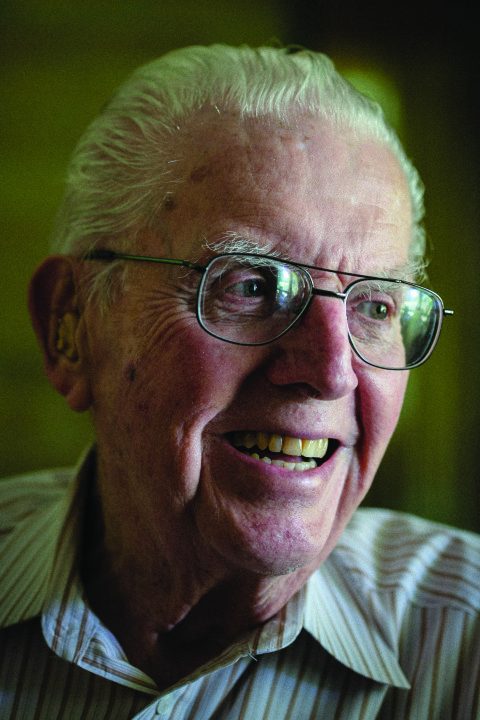
    Howard Tannermynorth.com/wp-content/uploads/2015/11/1115_TVM_feature1d-768×1152.jpg 768w, mynorth.com/wp-content/uploads/2015/11/1115_TVM_feature1d-682×1024.jpg 682w, mynorth.com/wp-content/uploads/2015/11/1115_TVM_feature1d-400×600.jpg 400w, mynorth.com/wp-content/uploads/2015/11/1115_TVM_feature1d-1140×1711.jpg 1140w, mynorth.com/wp-content/uploads/2015/11/1115_TVM_feature1d-970×1455.jpg 970w, mynorth.com/wp-content/uploads/2015/11/1115_TVM_feature1d-480×720.jpg 480w, mynorth.com/wp-content/uploads/2015/11/1115_TVM_feature1d.jpg 1333w” data-src=”https://mynorth.com/wp-content/uploads/2015/11/1115_TVM_feature1d-200×300.jpg” data-sizes=”(max-width: 200px) 100vw, 200px” class=”wp-image-153146 size-medium lazyloaded” src=”https://mynorth.com/wp-content/uploads/2015/11/1115_TVM_feature1d-200×300.jpg” sizes=”(max-width: 200px) 100vw, 200px” srcset=”https://mynorth.com/wp-content/uploads/2015/11/1115_TVM_feature1d-200×300.jpg 200w, mynorth.com/wp-content/uploads/2015/11/1115_TVM_feature1d-768×1152.jpg 768w, mynorth.com/wp-content/uploads/2015/11/1115_TVM_feature1d-682×1024.jpg 682w, mynorth.com/wp-content/uploads/2015/11/1115_TVM_feature1d-400×600.jpg 400w, mynorth.com/wp-content/uploads/2015/11/1115_TVM_feature1d-1140×1711.jpg 1140w, mynorth.com/wp-content/uploads/2015/11/1115_TVM_feature1d-970×1455.jpg 970w, mynorth.com/wp-content/uploads/2015/11/1115_TVM_feature1d-480×720.jpg 480w, mynorth.com/wp-content/uploads/2015/11/1115_TVM_feature1d.jpg 1333w” style=”box-sizing: inherit; border: 0px; height: auto; max-width: 100%; opacity: 1; transition: opacity 400ms 0ms; margin: 0px; padding: 0px; width: auto;”>

    Howard Tanner

    Meet Howard Tanner

    Hear Tanner’s own version of the story and he’ll tell you he was simply in the right place at the right time. The Michigan native and fisheries biologist who grew up in Bellaire had returned home after several years in Colorado to take the head job at the fisheries department at the Michigan Department of Conservation. In 1964, there were certainly more uplifting jobs he could have moved his young family across the country for.

    By mid-century, the Great Lakes had become, by many measures, an ecological disaster zone. Invasive species had devastated lake trout, the Great Lakes’ native trophy fish, and overfishing was finishing off what was left. Pollution had grown so intense that environmental groups were collecting dead, oil-soaked ducks from the Detroit River and dumping them on the lawn of the State Capitol. Rotting alewives were washing up on Lake Michigan beaches in a layer described as “a foot thick and 300 miles long.” And the Department of Conservation’s strategy for dealing with any of it, to the extent that there was a strategy, had been labeled a disaster. So when Tanner took the helm, he did so, he admits, aided by low expectations. In fact, as he remembers it, he was only given one directive: To “do something,” and if he could, “make it spectacular.”

    As it turned out, Tanner was well-practiced in dealing with loose instructions. Back in Colorado, regulations were thinner and bureaucracy more flexible within the fisheries division. “I wouldn’t say it was the Wild West exactly, but there certainly was a Western style,” Tanner remembers. As he talks, you can tell he has a certain degree of fondness for the time he accidentally got shot with a cyanide gun, or the winter he almost died in an avalanche. Official work, he says, often evolved into leisurely fishing trips where missions were accomplished with the aid of relaxed campfires and plenty of beer. Ecologically, his team played fast and loose with the rules as well, experimenting with all sorts of “crazy things”—for one, introducing non-native species into lakes and reservoirs. One of Tanner’s team’s most unusual and promising experiments in Colorado had been introducing Pacific salmon—a saltwater fish—into freshwater. Despite skepticism that a saltwater species could adapt to freshwater, the salmon thrived and the fishermen loved it.

    Now back in Michigan, faced with new challenges, Tanner began wondering if salmon could play a role in restoring some the Great Lakes’ former glory. Void of a top predator fish, the lakes had become ecologically and economically unviable—overrun by smaller, non-native fish like the alewife. Fish that the public actually wanted to catch were on the wane. If introduced, Tanner thought, the salmon could give the Great Lakes a much-needed new kingpin—and give the people of Michigan one of the world’s top trophy fish right on their doorsteps.

    To be clear, what Howard Tanner was now contemplating was nothing less than the intentional introduction of a non-native Pacific species to the largest freshwater system in the world. And when he worked up the nerve to start speaking publicly about his idea, people were quick to raise concerns. First and foremost, no fisheries biologist had ever attempted to manage water even close to this size. In Tanner’s case, his master’s degree program had put him in charge of a 27-acre lake; his doctoral program, six lakes—the largest of which was six acres. Lake Michigan alone was 23 million acres. “It was like somebody who had gotten good at raising geraniums in flower pots was now being given a cattle ranch,” Tanner says.

    There were also logistical questions. Some argued salmon would die in freshwater or simply head into the St. Lawrence River and out to the open ocean. Others pointed to the many failed attempts to introduce salmon to the Great Lakes dating back to the late 1800s. The plan also faced one giant, undeniable obstacle: coho salmon, the fish that Tanner had identified as the species of choice, simply couldn’t be had. At the time, every single coho egg harvested from the hatcheries of Oregon and Washington were spoken for—part of a grand attempt to re-establish salmon in the heavily dammed Columbia River.

    Then came the phone call.

    Howard Tanner was sitting in his living room, having his usual pre-dinner cocktail. On the line was one of his old Western colleagues. He was calling to let Tanner know there was an anticipated surplus of coho eggs on the West Coast.

    “It was just like the chair fell from under me,” Tanner remembers. “That night, I didn’t sleep much. I just sat there most of the night, thinking, What if … What if?”

    The following morning, he was in his office watching the clock tick. With a three-hour difference between Michigan and the coast, he had to wait until midday to confirm the rumors that coho were available. The hearsay turned out to be true. Still, to get some of the eggs, he and his contacts in Oregon would have to navigate a gauntlet of bureaucracy. On top of that, they were working with an immovable biological deadline: If the surplus coho eggs were going to be viable for hatching and release back in Michigan, the whole plan would have to get every bureaucratic stamp in no more than six weeks. But, in a scenario Tanner can characterize only with words like “miracle,” the approvals came. Within a few weeks, one million coho salmon eggs were on a plane, bound for the Great Lakes. Tanner’s spectacular experiment was now underway.

    Everything happened so fast that Tanner didn’t yet have money for things like fish food. And he didn’t know exactly where he was going to raise the fish once they hatched. Michigan’s hatchery system, which had been largely devoted to restoring lake trout, was 40 years out of date and in no shape to undertake a program of this size. He went to the legislature and asked for a million dollars—half of which he finally won by promising the chair of the Senate Appropriations Committee that 150,000 of the salmon (and the promised economic boom) would land in the senator’s district. Tanner and his team then embarked on a tour of the state’s hatchery system, looking for just the right place to raise the fish. Eventually, the hatchery on the modest Platte River in Benzie Countywas chosen as the spot where the salmon would start their lives—and, theoretically, return to spawn—if everything went according to plan.

    Tanner remembers the moment when the fish were finally ready to be Michigan Department of Natural Resourcesmynorth.com/wp-content/uploads/2015/11/1115_TVM_feature1b-768×1152.jpg 768w, mynorth.com/wp-content/uploads/2015/11/1115_TVM_feature1b-683×1024.jpg 683w, mynorth.com/wp-content/uploads/2015/11/1115_TVM_feature1b-400×600.jpg 400w, mynorth.com/wp-content/uploads/2015/11/1115_TVM_feature1b-1140×1710.jpg 1140w, mynorth.com/wp-content/uploads/2015/11/1115_TVM_feature1b-970×1455.jpg 970w, mynorth.com/wp-content/uploads/2015/11/1115_TVM_feature1b-480×720.jpg 480w, mynorth.com/wp-content/uploads/2015/11/1115_TVM_feature1b.jpg 1334w” data-src=”https://mynorth.com/wp-content/uploads/2015/11/1115_TVM_feature1b-200×300.jpg” data-sizes=”(max-width: 200px) 100vw, 200px” class=”alignright wp-image-153147 size-medium lazyloaded” src=”https://mynorth.com/wp-content/uploads/2015/11/1115_TVM_feature1b-200×300.jpg” sizes=”(max-width: 200px) 100vw, 200px” srcset=”https://mynorth.com/wp-content/uploads/2015/11/1115_TVM_feature1b-200×300.jpg 200w, mynorth.com/wp-content/uploads/2015/11/1115_TVM_feature1b-768×1152.jpg 768w, mynorth.com/wp-content/uploads/2015/11/1115_TVM_feature1b-683×1024.jpg 683w, mynorth.com/wp-content/uploads/2015/11/1115_TVM_feature1b-400×600.jpg 400w, mynorth.com/wp-content/uploads/2015/11/1115_TVM_feature1b-1140×1710.jpg 1140w, mynorth.com/wp-content/uploads/2015/11/1115_TVM_feature1b-970×1455.jpg 970w, mynorth.com/wp-content/uploads/2015/11/1115_TVM_feature1b-480×720.jpg 480w, mynorth.com/wp-content/uploads/2015/11/1115_TVM_feature1b.jpg 1334w” style=”box-sizing: inherit; border-style: none; height: auto; max-width: 100%; float: right; margin: 12px 0px 24px 24px; opacity: 1; transition: opacity 400ms 0ms;”>released as one of the great moments of his career. It was April 2, 1966, and the now year-and-a-half-old coho were ready to enter the Platte River near Honor, Michigan. He had a special wooden speaker’s platform built for the event. Public officials offered words touting the benefits of the salmon program. The press took photos. Then, Arnell Engstrom, the Traverse City house representative whose vote had been critical in funding the salmon program, picked up a golden bucket and dumped the first batch into the Lake Michigan watershed. Tanner got his turn later in the afternoon on Bear Creek, a tributary of the Manistee, at a site just below Tippy Dam. Swimming with the current, the four-inch “smolts” would find their way to the open water in less than two days.

    If everything went according to plan, the young coho would spend a year and a half in the open water before returning to the Platte River in the fall of 1967. And early indications suggested the fish would indeed find their way home. In the fall of 1966, the “Jack” salmon—a small class of precocious fish that spawn a year ahead of schedule—started showing up in Platte Bay, many in a form that astonished Tanner’s Western colleagues and foreshadowed a potentially colossal spawning run the following year. “On the coast, the Jack will maybe weigh a pound and a half or two pounds,” Tanner says. “Some of our fish were coming back at seven pounds. The guys from Oregon just shook their heads and said, ‘You’d better get ready. You’d better get ready.’ ”

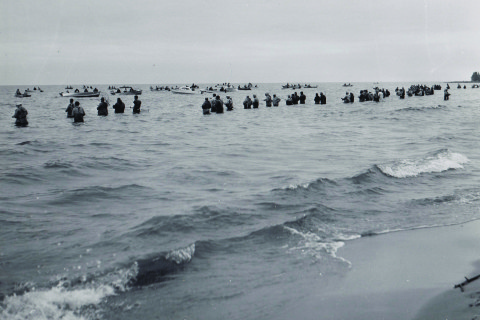
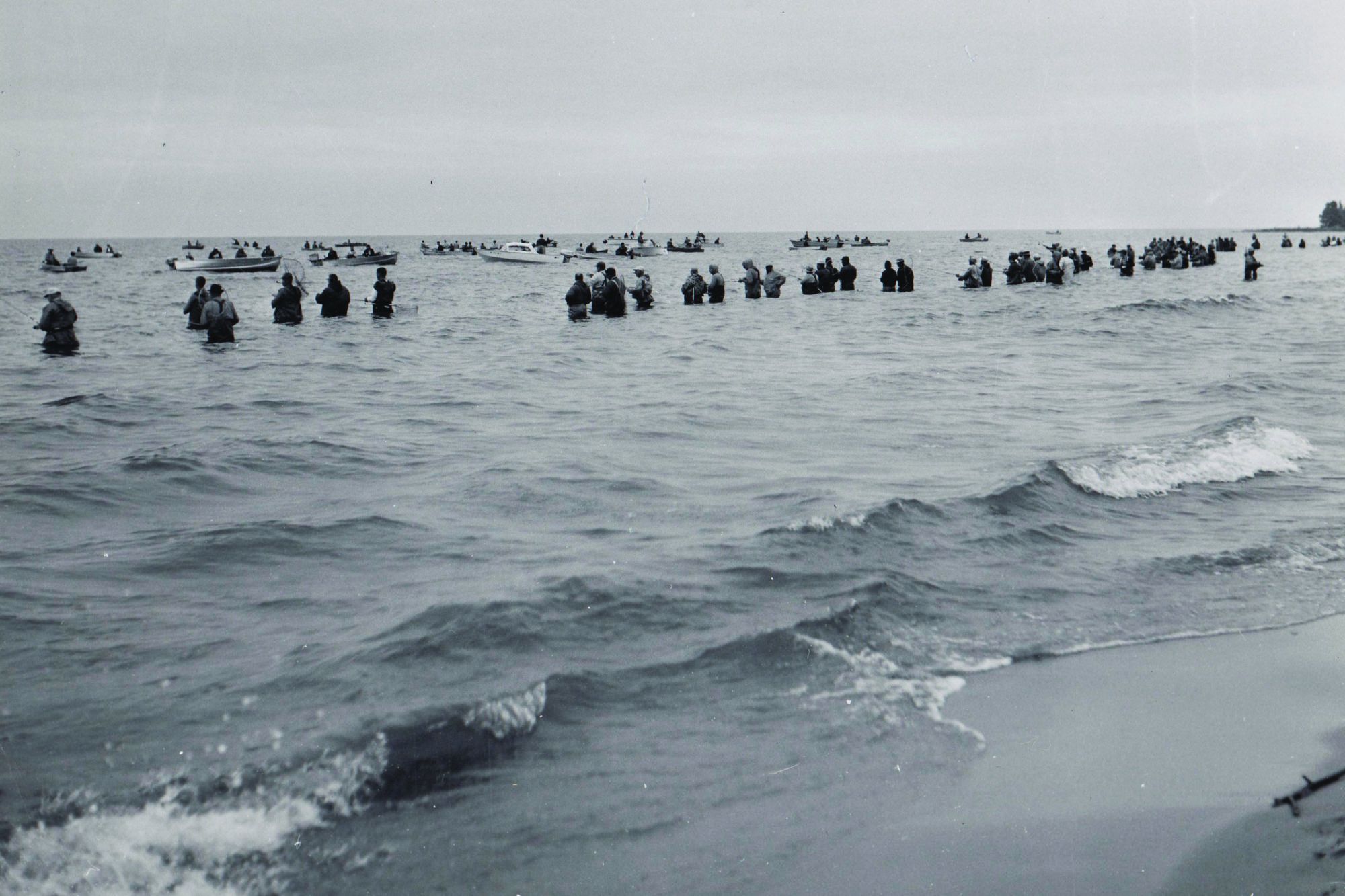
    Even today, what happened next still stands as the biggest “big fish” story in Great Lakes history. In late August 1967, tens of thousands of returning salmon suddenly announced their presence—this time without a formal speech. coho rushed into Platte Bay, and the fishermen followed—largely learning of the spectacle by word of mouth. Tanner has aerial photos from that fall showing tiny Platte Bay jammed with 3,000-plus boats, many of them canoes and little aluminum dinghies not suitable for open water. The boats formed a near-solid mass; some fishermen joked you could almost walk from boat to boat and never get wet. And in between, the fish were so thick, they were porpoising out of the water.

    Tiny coastal towns like Honor, Empire and Frankfort suddenly found themselves overrun with tens of thousands of fishermen and wannabe fishermen. The tiny boat launches grew tails of cars and trailers that ran miles long. One man, Tanner remembers, even started a taxi service to ferry people back and forth. Another guy was selling hot dogs. Lures sold out, so people started renting lures. In September, Sports Illustrated even showed up to cover the event they dubbed a “boom on Lake Michigan.”

    People who had never caught any fish of any size like these were catching five, and their tiny little boats were just full of salmon. Nobody had to embellish the stories. It was madness.

    Michigan Department of Natural Resourcesmynorth.com/wp-content/uploads/2015/11/1115_TVM_feature1-768×512.jpg 768w, mynorth.com/wp-content/uploads/2015/11/1115_TVM_feature1-1024×683.jpg 1024w, mynorth.com/wp-content/uploads/2015/11/1115_TVM_feature1-752×501.jpg 752w, mynorth.com/wp-content/uploads/2015/11/1115_TVM_feature1-1140×760.jpg 1140w, mynorth.com/wp-content/uploads/2015/11/1115_TVM_feature1-970×647.jpg 970w, mynorth.com/wp-content/uploads/2015/11/1115_TVM_feature1-480×320.jpg 480w, mynorth.com/wp-content/uploads/2015/11/1115_TVM_feature1.jpg 2000w” data-src=”https://mynorth.com/wp-content/uploads/2015/11/1115_TVM_feature1-300×200.jpg” data-sizes=”(max-width: 700px) 100vw, 700px” class=”aligncenter wp-image-153149 lazyloaded” src=”https://mynorth.com/wp-content/uploads/2015/11/1115_TVM_feature1-300×200.jpg” sizes=”(max-width: 700px) 100vw, 700px” srcset=”https://mynorth.com/wp-content/uploads/2015/11/1115_TVM_feature1-300×200.jpg 300w, mynorth.com/wp-content/uploads/2015/11/1115_TVM_feature1-768×512.jpg 768w, mynorth.com/wp-content/uploads/2015/11/1115_TVM_feature1-1024×683.jpg 1024w, mynorth.com/wp-content/uploads/2015/11/1115_TVM_feature1-752×501.jpg 752w, mynorth.com/wp-content/uploads/2015/11/1115_TVM_feature1-1140×760.jpg 1140w, mynorth.com/wp-content/uploads/2015/11/1115_TVM_feature1-970×647.jpg 970w, mynorth.com/wp-content/uploads/2015/11/1115_TVM_feature1-480×320.jpg 480w, mynorth.com/wp-content/uploads/2015/11/1115_TVM_feature1.jpg 2000w” style=”box-sizing: inherit; border-style: none; height: auto; max-width: 100%; display: block; margin: 24px auto; opacity: 1; transition: opacity 400ms 0ms;”>

    The impacts of the salmon were huge and immediate. The value of riparian property in the surrounding area doubled almost instantly. Hotels and businesses sprouted up in Michigan’s new salmon country. Tiny Honor, Michigan, population 300, even christened itself the state’s new “Coho Capital.” The joyful hysteria was only briefly interrupted by tragedy on September 23, when the crush of mostly inexperienced anglers ignored small-craft warnings and found themselves overrun by a violent Lake Michigan storm. One hundred fifty boats were swamped; seven people drowned. But it hardly blunted the public’s appetite for salmon. Now, every coastal town’s bait shop and city hall were lobbying for the fish to be planted in the local stream. And the state delivered, stocking millions more coho across the rest of the Great Lakes in the following years, and furiously expanding the antiquated hatchery system to give the people what they wanted.

    Doubling down on its great salmon experiment, the state added an even bigger trophy to the mix of Great Lakes fish the following year. The Chinook salmon was a Pacific species two to three times bigger than the coho, was cheaper to produce, and had a diet that consisted almost exclusively of the hated alewife. Within a few years of the new super-salmon hitting the open water, reeling in a 30-pounder became common. Fishermen loved it. Sunbathers loved the fact that alewives weren’t rotting on their beaches. And the fisheries department kept the big fish coming, flooding the Great Lakes with millions of coho and Chinook every year—the state’s economy, in turn, flooding with the windfalls of a world-class fishery that seemed to have been created overnight.

    “It almost gave us the impression that the system was unlimited,” says Randy Claramunt, a fisheries research biologist with the Michigan Department of Natural Resources. “The more salmon we put in, the more salmon we got out. Literally, we went from zero stocking to almost eight million a year in the 1980s, and we still had record-high harvest levels.”

    By the mid-1980s, there was no arguing that Tanner’s original vision had indeed evolved into something worthy of the word “spectacular.” Just two decades after his coho fingerlings were released into the Platte River, the salmon had brought under control one of the area’s worst invaders, alewives. The sport-fishing industry, previously non-existent, was now valued in the billions of dollars. And people came from all over the country to fish the Great Lakes.

    But the record catches and the new trickle-down salmon economy in which everyone seemed a winner weren’t telling the whole story. Though no one knew it at the time, the Lake Michigan fishery, the crown jewel of the lakes, was beginning to strain. The system did indeed have limits. And without warning, the once-mighty Chinook, the adopted king of Michigan waters, all but vanished almost as quickly as it appeared.

    In a plot twist worthy of the theater, it was the demise of the fish everybody hated that brought down the fish everybody loved. The alewife—the invasive saltwater species that was best known for dying and rotting en masse on Michigan beaches—had given the Chinook salmon what seemed like an endless food supply. In fact, when the salmon program was first conceived, it was never done so as an alewife control program; the small invaders were so prolific that the idea that their populations could be significantly impacted by a predator seemed like wishful thinking.

    In less than two decades, however, the Chinook began to chip away at the alewife’s dominance. In fact, by the early 1980s, alewife biomass in the Great Lakes stood at less than 20 percent of historic highs—largely because of salmon predation. With less to eat, the salmon being reeled in from the lakes started to get smaller and thinner. Then, in the mid-1980s, the already-stressed Chinook was overcome by an outbreak of a mysterious kidney disease, one that would later be linked to the high-density hatcheries unknowingly pushing out diseased fish to keep up with the public’s demand for salmon. Though the less-fished and more-adaptable coho toughed it out, the mighty Chinook soon disappeared from Lake Michigan.

    More than a decade later, the story repeated itself in Lake Huron in an even more devastating fashion. Better rates of natural reproduction and heavy stocking led to a scenario in which the Chinook ate themselves out of an ecosystem. To make matters worse, new invasive species like the zebra and quagga mussels—both of which filtered plankton out of the lake—undermined the alewives’ own food supply. Faced with pressure from both the bottom and top of the food chain, the alewife population collapsed in the early 2000s, the Chinook population following close behind. Stories of big fish harvested from Lake Huron were quickly replaced by those of gas stations, hotels and restaurants going belly-up. There were even stories about charter boat fishermen moving west to try to start over on the Lake Michigan side, where salmon populations had started to rebound.

    The salmon bust revealed new truths that had gradually become latent fundamentals of the salmon program. For one, if the state was going to maintain salmon as a top predator in the Great Lakes, it needed a more nuanced policy than raising as many fish as it could and dumping them into the water. It was also obvious now that the salmon economy had grown too big to fail: The experiment that Howard Tanner had started almost on a hunch had now evolved into a $7 billion economy and a vital tool for restoring balance to the largest freshwater system in the world. More importantly, though, the salmon program had inadvertently ushered in an era whereby the Great Lakes would now be a highly managed entity, and from which there was no turning back.

    Long gone are the days where the only thing limiting the number of salmon the DNR puts in the Great Lakes is how many salmon the hatcheries can produce. Today’s approach to managing salmon has evolved into a highly nuanced, high-tech venture. You can see it on the boat that fisheries biologist Randy Claramunt takes out on Lake Michigan every August, when he heads out to do a census of the lake. One of his favorite tools: A hydroacoustic survey unit that allows him to count prey fish like the alewife, and in turn, figure out how many salmon the lake can support.

    “Less than 15 years ago, it took two months to survey the entire lake,” Claramunt says. “Now we survey the entire lake in less than 10 days. It’s getting to the point where we can almost make annual changes to our salmon stocking rates based on how many prey fish are in the lake.”

    One of Claramunt’s newest research frontiers is getting a better handle on how much natural salmon reproduction is happening in the system. To do that, the fisheries division is now tagging every Chinook salmon that it stocks in the Great Lakes; when an angler catches a tagged fish, he or she turns in its head at their local research station. Knowing how many wild fish are in Lake Michigan lets the fisheries department know how many more hatchery-raised fish they can afford to add to the mix without pushing things out of balance.

    A strategy that involves so much less shooting in the dark is important to avoid periods of boom and bust like the Great Lakes have seen in the past. “The debate over salmon now is whether we can use them as a tool to control things like the alewife, or if they’re just a bomb waiting to go off,” Claramunt says. In particular, many biologists are now fearing the devastating collapse in Lake Huron could be soon be repeated in Lake Michigan. With some of the same biological forces now at work, many are surprised it hasn’t happened already. Zebra and quagga mussels, which undermine the food chain that all fish species depend on, are both abundant in Lake Michigan. Just as in Lake Huron, their pressure on smaller prey fish like the alewife has a direct effect on the Chinook. Indeed, Claramunt’s last two surveys of the lake, which revealed major declines in alewife reproduction, are cause for concern. “Three consecutive failures of prey fish reproduction almost always equates into a predator crash, which is exactly what we are managing to avoid,” he says.

    Some argue, though, it’s not worth all the effort. Many would rather see the fisheries program reorient itself toward a focus on restoration of native species rather than deepening the lakes’ dependence on an introduced species like the salmon. From their perspective, the salmon have done their job: bringing the alewife population under control, and even conveniently pressing their own self-destruct button. Indeed, since the Chinook collapse in Lake Huron, some native species seem to have rebounded, though biologists say this may have more to do with the lack of alewives, which preys on the eggs and juveniles of native species, than the lack of Chinook.

    “Some people would rather see us try to bring the lake trout back,” Randy Claramunt says. “But the question is, can a restored lake trout population control alewives? And before we have that debate, I wouldn’t want to eliminate a fishery that is providing both an economic and ecological benefit in hopes that the lake trout can do the job. As long as we’re going to see invasive species play a major role in shaping the ecosystem, we will have to have fish hatcheries and ways of manipulating the system to mitigate those impacts. And for the foreseeable future, salmon will likely be one of those tools.”

    Howard Tanner, for one, is happy the salmon will keep coming—not just because it’s his legacy, but also because he feels like it’s good management. He still likes to debate such issues, and though long-retired, he still talks about the department’s new ideas for the salmon program in the plural first person, as in “we.” A lifelong fisherman, he still likes fishing for salmon. In fact, every summer, he still makes the pilgrimage to “the Big Lake” in hopes of reeling in another big Pacific fish. Thanks to him, it’s an adventure that’s just a short drive away. So we say, thank you, Howard Tanner.

    Lou Blouin is a writer and public radio producer. He lives in Pittsburgh, where he covers environmental issues on public radio.