Category: Uncategorized

  • EPISODE 784 “MY NAME IS SAMUEL MERNER { WHY DOES NO-ONE LOVE MY THRESHING MACHINE?”

    EPISODE 784   “MY NAME IS SAMUEL MERNER { WHY DOES NO-ONE LOVE MY THRESHING MACHINE?”

    alan skeoch
    March 22, 2023


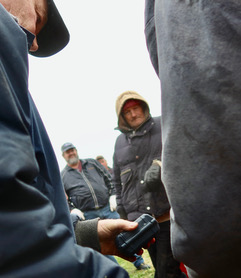
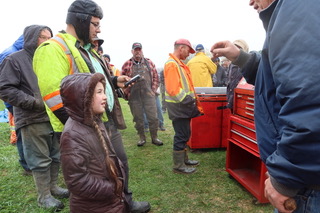
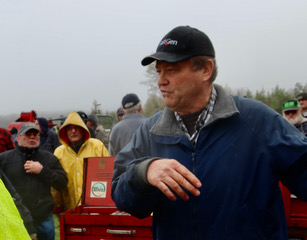
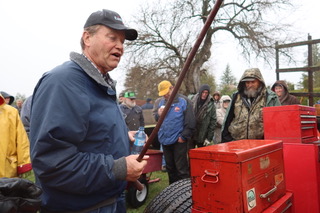
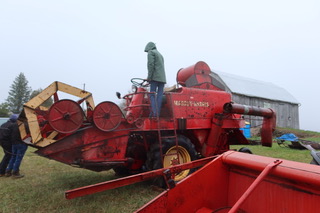
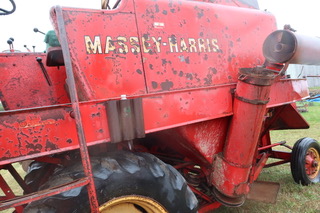
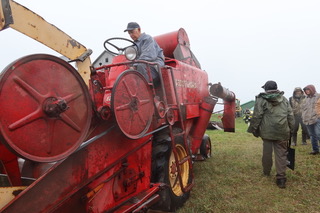
    1890’s Hamburg Threshing Machine made by Samuel and Simeon Merner 

    SAMJUEL MERNER SPEAKS FROM THE GRAVE…Imaginary conversation aided by Alan Skeoch

    “My name is Samuel Merner,  I build threshing machines and cannot for the life of
    me understand why you do not love them as I do.”
    “Mr. Merner, this is the year 2023, the days of the threshing machine are long gone. We now
    use motorized combine harvesters.  Your machines are just dust collectors in museums.”
    “Now that hurts my feelings…’dust collectors’ is an insult.”
    “Tell me about yourself, Mr. Merner, maybe we can appreciate you more.”
    “My parents migrated here from Switzerland in 1837 when I was 14 years old.  Got a small
    farm near New Hamburg where others like us, so called Pennsyvania Dutch people had setled…Germanic
    people from the Rhine River Valley.”
    “Are they those people dressed in black?”
    “Mennonites and some Amish.  Protestants.”
    “How is that connected to threshing machines?”
    “Long story.  As a boy I was fascinated by the local blacksmith and was lucky enough
    to be trained as such.  Farmers needed metal tools.  I began making them and opened a shop
    in New Hamburg in 1844. “
    “Alone?”

    My son Simeon Merner also became a blacksmith and both of us began making bigger machines.
    …threshing machines.”
    “Like the machine you want to give away today?”
    “The machine I would like to give to a museum was made around 1890…we kept improving our
    threshing machines but tried to keep them as small as possible.”
    “Local market?”
    “No.  Our machines were sold all across Ontario and even on the
    western prairies.  

    Threshing machines have hearts as we humans do.  This is the
    heart of a thresher….the Cylinder that spins ripping gran sheaves apart
    and hurling the grain….

    VOICE FROM THE GRAVE: SAMUEL MERNER  (assisted by Alan Skeoch)


     “OUR company was specially successful after my death.”
    (Imaginry dialogue continues)
    ”  By 1897 investors helped form the New Hamburg Manufacturing
    Company.”
    “How come?”
    “My son Simeon was a good businessman and  our company was able to lure
    Werner Brodrecht as manager back in 1888…his skill expanded the business and
    we even begn making tratcion steam engines.”
    “The factory burned down in 1901…”
    “Yes, but we rebuilt the whole operation and were successful until 1914 when we failed.
    “Attempts to revive New Hamburg Manufacturing in the 1920’s failed thereby endning  80 years
    of production”

    “I take it yo are disappointed today Samuel. “
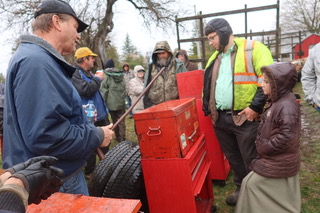
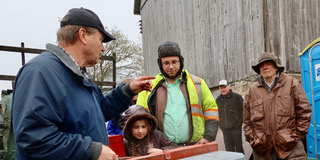
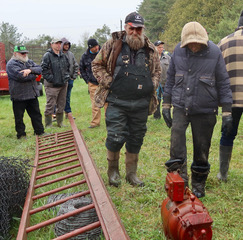
    “I am.  I would like to donate this sole survivor of our company’s threshing machines but 
    no one seems to care.”
    “I thought the booming city of Mississauga had the machine.”
    “Yes, donated by Alan Skeoch.  But Mississauga had no place for a threshing machine
    and no real interest in agriculture.  Someone called Alan and asked him to get
    the machine out of the tiny Bradley Museum barn.  So Alan and his Son Andrew persuaded 
    Bill Books to store it in his drive shed while they searched for a new home.  “
    “Where?”
    “Well, first attempted to make contact with the Wellington County Museum who have a huge barn
    with a largely empty threshing floor.  Perfect place. “
    “No response.”
    “Recently made contact with Doon Pioneer Village.  Alan gave them a beautifully stencilled
    thresher a few years ago…”
    “Any response?”
    “Yes, they are considering the offer.”

    “What is the problem with museums?”
    “Running a museum is a thankless job. Viisitors are few in number.  Storage space limited.
    Staff limited as well.  If tax revenue shrinks then first thing on the discard block is local
    museums.”
    “What about the Province of Ontario.\?
    “Are you trying to be funny.   The Province of Ontario does not give 
    a sweet goddamn about agricultural artifacts.   Look what happened to 
    the Ontario Agricultural Museum in Milton.”
    “Put in mothballs 20 years ago.  Now just sits there on precious land…and let the cobwebs thrive.”

    “Samuel,  what do you think will happen to your ancient thresher?”
    “It will go to the dump once Bill and Leah Brooks need the space in their machine shop in Limehouse.”
    “How did Alan Skeoch get  your threshing machine in the first place?”
    “He bought it at an auction of the Thompson collection 40 years ago…
    bought four threshing machines that day.””
    “Why?”
    “He said he could not stand to see historic artifacts like our Hamburg Thresher go
    to the scrap man.”
    “Why would a scrap man want a threshing machine?”
    “For the iron parts.  They set those old wooden machines of fire and  gather up
    the pulleys and threshing cylinders and haul them to the steel mill in Hamilton
    or any local scrap yard.”

    GHOST OF SAMUEL MERNER SPOKE  (aided by Alan Skeoch)


  • EPISODE 782 MAPLE SYRUP TIME … “LOOKS LIKE MID WINTER BUT ANDREW IS THERE WITH DRILL, SPYLE AND PAIL”


    EPISODE 782      MAPLE SYRUP TIME  … “LOOKS LIKE MID WINTER BUT ANDREW IS THERE WITH DRILL, SPYLE AND PAIL”

    alan skeoch
    March 19, 2023


    TIME WARP:  MARCH 19, 1975

    “Marjorie the sap is running.”
    “Too cold for sap, Alan….and we are in a snowstorm”
    ”Sap is running up the maples…feel it in my blood…time to tap the trees.”
     
    And so, in 1975, we packed the truck with styles, sap buckets, drill and headed for the
    Saunders maple bush on the fourth line.  Spent a happy day drilling trees with a slight incline
    so the ‘lifeblood of the forest’ could be harvested   The kids, Kevin and Andrew, joined Marjorie
    and me and Tara, our coonhound, in what turned out to be a delightful adventure.  So what if
    the sap pails were old and lead soldered!  We were unaware of lead poisoning.  So what if a
    deadbeat with a 22 rifle was getting ready to shoot holes in the pails “Just watch that lifeblood of
    the forest “drain to the ground,  We got enough to make a gallon or two of syrup.  It wasn’t so much
    as the joy of syrup making anyway.  We were out and about and ready for spring.  So what if the land was cold and
    snow covered.   The change of seasons was on its way  Wild garlic was poking its head through
    the snow.

    That was half a century ago.

    DATELINE:  MARCH 19, 2023


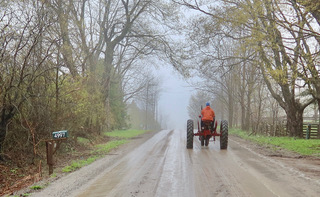
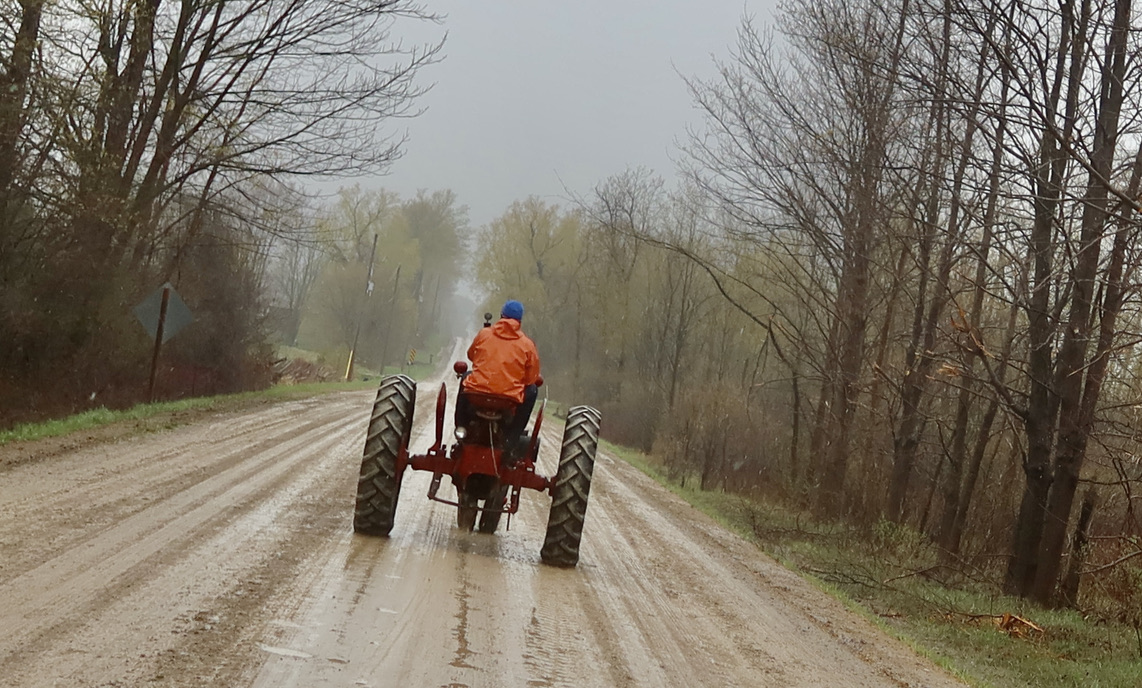
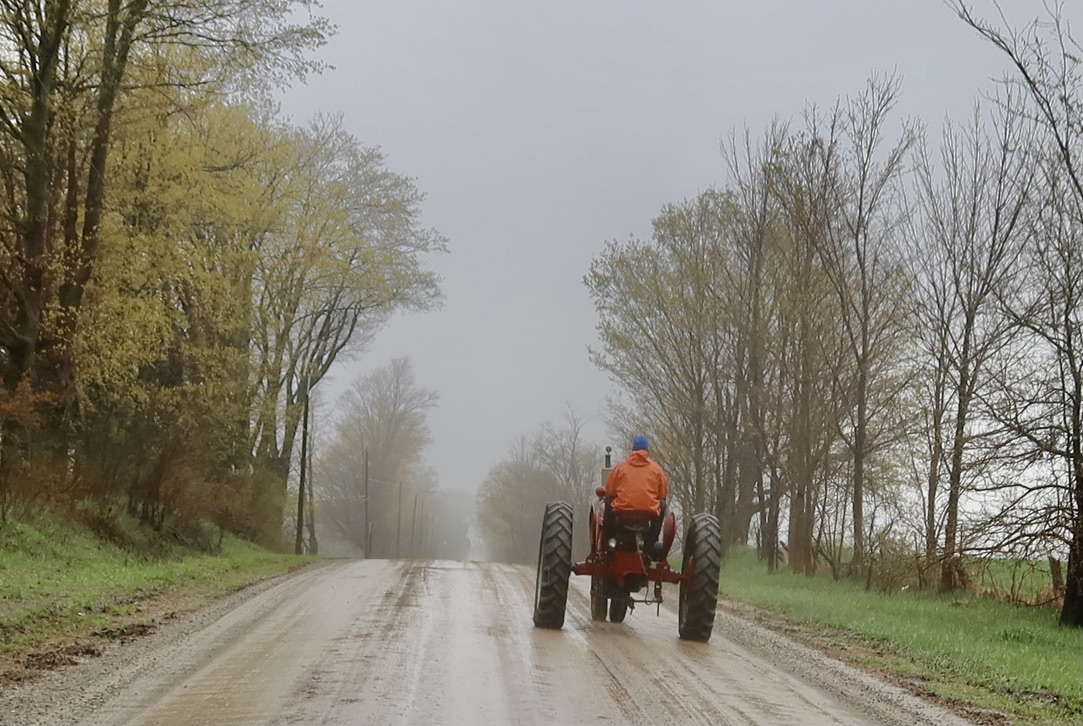
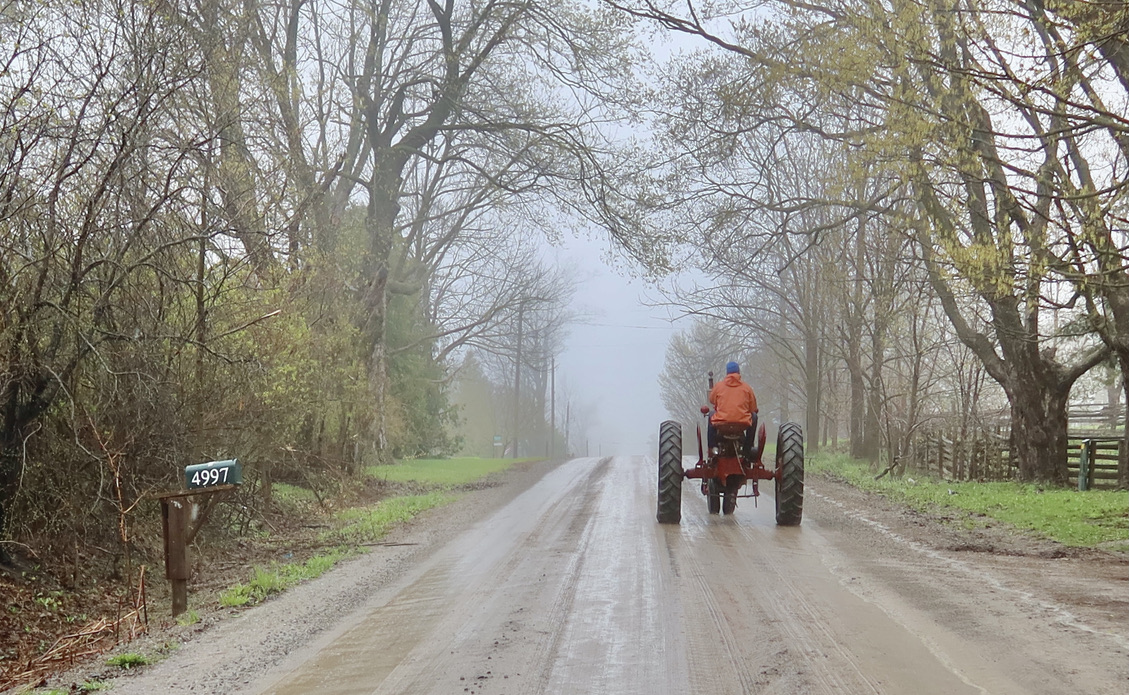
    Today was reminiscent of that time.  As we headed up the Fifth line in a light snowstorm under
    dark clouds we were suddenly startled by a blob of bright orange on the road ahead.  


    “Andy is out tapping the maple trees today.”
    “Using your old kit?”
    “Nope, he is using aluminum pails…no lead poisoning…but everything else he found
    in the barn.  Waiting half a century for him to come. “
    “Does he need the tractor?”
    “Yes, it is more than half a century old as well as most of the sap kit.”
    “You planted the seed in his brain, Alan.”
    “Notice he only puts one pail per tree…just takes a little of the lifeblood of
    the forest…like the Red Cross does with our blood.”


    “I wonder if the assassin with the 22 rifle is still around here”
    “That idiot was on the fourth line.  The fifth line is more civilized.”
    “Not in the deep forest…neighbours can watch.”
    “The guy with the gun was likely 14 years old…kids do
    stupid things.”
    “Just like you did.”
    “As God is my witness I did not know a BB gun could put a hole
    in the back window of Angus McEchern’s pickup truck.  That was]
    a long time ago when I was 14.”:
    ”A day just like this day.”
    “Spring was in the air back then just as it is today.”

    “Alan you must like that term.”
    “What term?”
    “Lifeblood of the forest.”
    “Suitable metaphor.”


    “You want to know what makes me feel good about the tree tapping today?”
    “We did it…we put the idea in Andrew’s brain on those days so long ago.”
    “And there he is wading through snowdrifts with drill and spyle and pail.”


    “The maple trees are waking up today?
    “Everyone else is fast asleep.”
    “No everyone.  Te Saunders cattle herd is busy eating what 
    remains of the corn field.
    “Along with about 100 Canada Geese also gorging on dropped corn kernels.”
    “Isn’t this where we startled a couple of wild turkeys last week?”
    “Same place…the land is alive.”
    “We are not alone.”


    “Did you see the ancient steam tractor on the Fourth Line.”
    “That belonged to Sherwood Hume…I think Gladys and the boys
    hauled it out there.  Sort of a gravestone for Sherwood…he loved
    the machines of the past.”


    “Look over there, Marjorie, that barn has turned green…it is alive
    and getting ready for spring…get he idea?”

    “Time to get home.”
    “Why?”
    “Time to get the pancakes ready.”
    “Slobber on the maple syrup.:
    “Don’t you mean the “lifeblood of the forest”
    “Did you invent the term?”
    “Like to think so but there is nothing new under the sun”

    alan

    “What are those carrot tops doing in the shopping bag?”
    “For the wild bunny living in the shed.”
    “Some people would think of shooting the little fellow.”
    “Not us.”
    “Even Woody likes that rabbit.”
    “Strange dog.”
    “Woody smells …he knows that Spring is in the air
    and in the ground…and under the snow and ice in the SWAMP.

    SWAMP
    A swamp, a fen, a marsh, a bog;
    they’re all the same.
    You trudge, you slog.
    The ground is soft and wet and spongy.
    Stay a while and you’ll feel grungy.
    Walk a little further yet.
    Your feet sink in;
    your legs are wet.
    Stay long enough,
    you very might
    be getting a mosquito bite.

    There’s dogfish, cattails,
    frogs and otters,
    some turtles, beavers, in the water,
    hawks and ducks and northern pike,
    bald eagles, black birds — 
    much to like.
    So grab your boots and come on in.
    It’s better if you do not swim,
    but save the wetlands
    marsh and bogs
    for all the turtles
    ducks and frogs.

    By Denise Rodgers

    Copyright© Denise Rodgers
    Great Lakes Rhythm & Rhyme


  • EPISODE 781 ERIC SKEOCH DONATES A PRICELESS FAMILY HEIRLOOM TO HIS BROTHER ALAN

    EPISODE 781    ERIC SKEOCH DONATES A PRICELESS FAMILY HEIRLOOM  TO HIS BROTHER ALAN


    alan skeoch
    March 18, 2023


    The picture tells the story.  No need for bafflegab.  The fact the unit is bashed around makes it valuable…and useful…and desirable.

    alan
  • EPISODE 780 CICER MAKING FACTORY — RED STREAK APPLES

    EPISODE 780     CIDER MAKING FCTORY


    alan skeoch
    march 17, 2023

    Task: To replicate this cider press in a folk art miniature about 4 inches high and long
    in order to complement a wooden quilt apple orchard.

    APPLE CIDER MAKING  — RED STREAK APPLE VARIETY BEST

    Apple cider making was once big business. Apples were available by the tons
    each fall and crushing them yielded lots of apple juice which could be converted to
    hard cider…i,e alcohol laden cider.

    Some apples were better than others.  Rather tart cider apples such as the famous
    Herefordshire Red Streak made the best hard cider but for some reasons Red Streak
    apple trees did not thrive in Canada.

    So our hard cider — alcohol laden — was made from pretty well any apple whether picked from the
    apple trees or gathered from the wormy windfalls on the ground.   I assume these apples were 
    not selected for quality.  Nor did it matter much if they were wormy. 

    Currently I am working on a wooden quilt that features my folk art impression of
    an apple  orchard and an apple press.   Cider making on Canadian farms was not
    exactly done with quality control  in mind.


    And each fall tons and Tons of Canadian apples were crammed into light wooden 
    barrels to be shipped to England . I assume that was for the ‘scrumpy’ Cider market.
    Scrumpy cider was low cost and low quality … kept often under the bar at local
    pubs.  I believe that is still the case.  Scrmpy drinkers are a special breed.  Right 
    or wrong?

    What mystified me about that 19th century business was how these barrels of
    apples were kept from rotting.  Once a barrel was filled an apple a press was
    applied to push the top apples down so a lid could be nailed on the barrel.
    Apples pressed together like this go rotten fast.   Even apples sitting in an
    apple bowl on a table will rot fast the then touch each other. Big bown, 
    ugly tings. Inedible. They rot fast.

    So I leave this question:   Did those barrels of Canadian apples arrive in
    England as rotten apples and were then made into rotten apple scrumpy cider.

    Whereas Herefordshire Red Streak apples made and still make a delightful
    sparkling somewhat alcoholic drink.   Bulmer’s Apple cider under the title
    ‘Strongbow’ , an English make, is prominent in our liquor stores.

    This reminds me of an embarrassing incident long ago when I was doing research on
    English tithe barns and came across a cider making operation in Herefordshire, England..

    “Kevin, you keep the video camera going while I do this interview
    unannounced.  I’ll do the talking.”
    “Sure.”
    “Hello there, just wondering if you use red streak apples…..”
    (The interview went badly…rotten.)
    “Just who the hell do you think you  are.  Nervy bastard.  Coming
    in here with your smarmy questions and camera rolling.  Get out.”’
    (I think our son Kevin lost some of his admiration for his father that day.
    I wonder where the tape of the three minute interview has been stuffed.)

    This was not my finest moment.  Never got to taste his cider.  We left with our tails between our legs.

    alan
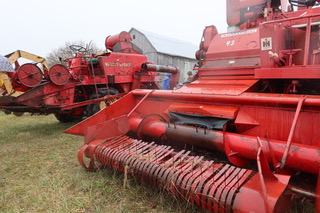

    Look closely at the apple barrel….see the press?  Apples being pressed .  They must
    have gone rotten fast.