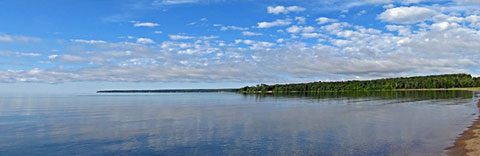
EPISODE 95: SPRUCE LAKE CAMP AT PARADISE LODGE GETS A FEMALE VISITOR SUMMER 1964
alan skeoch
august 2020
Note: See POSTSCRIPT AT END OF EPISODE … ESPECIALLY YOU DR. PATERSON
IN the summer of 1964 I thought my prospecting days were over. I had just finished my first year teaching
at Parkdale Collegiate, Tronto. Also we had not been married for a full year so taking off for a mining adventure
was highly unlikely. One of my many failings is that I never let go of things with ease. Seems that Marjorie knew that.
The phone call from Dr. Paterson came iii mid June. School was still in session. Final exams were being
written and marked when Norm called.
“Alan, we need you for a short 8 week job…are you available?”
“Let me check. Marjorie, Norm on the phone … wants me on a bush job.
What do you think?”
“How long?”
“About 8 weeks.”
“The whole summer in other words, right?”
“Yes…what do you think?”
“Take the job. You will be disappointed if you don’t. Hard to live with… Where is the job?”
“Where , Norm?”
“Mile 71, Spruce Lake…on the Algoma Central Railway”
“Algoma…Marjorie…where we had the Batchawana adventure last summer
before the wedding.”
“Take it, Alan. I will manage…lots to do.”
“When do I leave, Norm.?”
“As soon as you can…Linecutters are already working…Mag job and the Ronka…you
will have a four man crew…five counting yourself.”
(Well that was not what happened. We got a six person crew, one of whom was unpaid.)
Paradise Lodge was really a fishing camp built for well healed men. A lodge with dining room
and a cook then an assortment of small cabins strewn around near the shore of Spruce Lake.
This was only the second job where we had a cook for the crew. Back in 1959 on the Alaska
job we had a camp cook, actually two to three of them because cooks are sensitive people.
If diners get too critical, they quit and go elsewhere. The Alaska cook quit when we criticized
his ‘moose heart special’ which included all the ventricles exposed. Whatever our cook presented, I told
the crew to eat and keep opinions to themselves. That seemed to work.
The big surprise came as a shock to the whole camp except for me. We had
been working for about a week. Long enough for me to determine whether Paradise
Lodge was livable or not. It was grand. So I sent word south to Toronto.
“I expect a visitor today, boys…flagstop at Mile71.”
Marjorie arrived at Spruce Late…she startled us all. I will never forget the moment
the ACR ground to a halt. First off was the conductor with his special stool. Then
came Marjorie. Dressed as if she was going to dinner at the Royal York.
We had discussed this possibility in June. “If the camp is livable, maybe you
could join us. What do you think, Marjorie?”
“That is just what I was thinking. You have a camp cook, maybe I can help him.”
(That made me a bit nervous but I said nothing.)
“Give me a week or so to get things settled.”
Marjorie did not come alone. As she stepped down from the train she handed
our cat, Presque Neige, to the conductor. “Holy Cow…she brought the cat.”
We greeted each other warmly…I was really glad to have her with me. But the
cat was another matter. “Marjorie, we have to be careful with the cat. Wolves
howl from the other side of the lake each night. The cat will have to stay in our
cabin or attached to a rope of some kind.”
This picture is backwards but does show you how bleak the Mile 71 flagstop appeared. Marjorie
may have been a passenger on a nearly empty train. This was not the Agawa Canyon special
train with dining car and lots of glamour. This train was the regular passenger and freight train
on its way to Hearst far to the north.
“What else did you bring?”
“My electric sewing machine.”
“Sorry Marjorie…we have no electricity.”
Well, did Marjorie’s arrival ever stir up the camp. For a start our language improved with
less use of ‘son of a bitch’ and ‘goddamned’ that we normally applied to anything that
was disagreeable…mostly the voracious insects…occasionally to each other.
And we began to sing. Bob Bartlett was a folk singer. And he had his
guitar. 1964 was a great year for folk songs and Bob seemed to
know them all. Evenings were never boring even when we were tired after hours
long fighting our way through the spruce and cedar forests.
In 1964 Gordon Lightfoot’s ‘Early Morning Rain” was number 6
on the Pop Charts. To us, at Spruce Lake, it was Number 1.
Particularly the final lyric…”You can’t jump a jet plane like
you can a freight train…in the early morning rain.” Our own
freight train…the ACR…Algoma Central Railway. We sang
the blues away each night thanks to Bob Bartlett and Marjorie.
“Early Morning Rain”
In the early morning rain with a dollar in my hand
With an aching in my heart and my pockets full of sand
I’m a long way from home and I miss my loved one so
In the early morning rain with no place to go
Out on runway number nine big 707 set to go
But I’m stuck here in the grass where the cold wind blows
Now, the liquor tasted good and the women all were fast
Well, there she goes, my friend, well she’s rolling down at last
Hear the mighty engines roar – see the silver bird on high
She’s away and westward bound – far above the clouds she’ll fly
Where the morning rain don’t fall and the sun always shines
She’ll be flying o’er my home in about three hours time
This old airport’s got me down – it’s no earthly good to me
‘Cause I’m stuck here on the ground as cold and drunk as I can be
You can’t jump a jet plane like you can a freight train
So, I’d best be on my way in the early morning rain
You can’t jump a jet plane like you can a freight train
So, I’d best be on my way in the early morning rain
And Marjorie had the ability to keep our cook happy. She was willing to help him but
only if he asked for help. No danger of the cook quitting.
Marjorie has that great skill of making everyone feel comfortable. She makes
other people feel important. Because she is really interested in their lives. No
phoney bull shit kind of conversations. No special persons either. Sometimes
she became so much of a den mother that I felt just as much under who wing
as the rest of the team. She loved the folk singing. She had other skills too.
One illustration. Serge Lavoie was the only crew member with no
bathing suit. Before Marjorie arrived we just dove off the dock nude.
Who the hell cared.? When she arrived bathing suits appeared except for
Serge.
“Serge, do you want me to make you a bathing suit?”
Well, she did whether he wanted one or not. Hand cut,
modelled, sewn. And Serge was ecstatic. That is just one
example of how Marjorie took over the camp. Technically
I was the boss. And I did the work for the company…non stop.
One reason Norm gave me these jobs is he knew I would
deliver. I was the boss but not the director. Marjorie’s laughter
even made the trees start of grin.
The cat? Well, the cat live in our 12 c 12 little cabin. No objections
from her. Perhaps she knew what a wolf howl meant. “Owooooo! Qwoooo!
Owoooo!” which translated means “Im hungry and I am going to get You…ou…ou!”
“Presque Neige” (Almost Snow) was a wedding gift from Marjorie’s bridesmaid
Faye Nichols. Imagine getting a cat as a wedding gift! We loved her of course.
In turn the cat trusted us completely.
The cat got out occasionally…even went for boat rides as you can see below.
We made good use of the outboard motor boats rented from the Lodge.
Travel to our anomalies by boat was a lot easier than slogging for
hours by foot.
One day, Marjorie asked me “What exactly are you doing in the bush each day, Alan?”
“Why don’t you come along tomorrow. I have to
check out a base line north of here. Our crew will go in there
next week if the trail is clear and matches the aerial photo.
I do not remember why I had to check out this anomaly on
my own. Perhaps there was a claim post to confirm or an
error in the readings of some kind. I have No reliable recall.
But what I do remember vividly are the scars on a spruce tree just a few feet above our heads..
“See those scars, Marjorie,”
“Yes, do they mean anything?”
“Perhaps nothing but they look like a place
where a bear has sharpened its claws or a
place where a bull moose has rubbed the velvet
off its antlers. Just guessing.”
Funny thing about bears. I spent 10 years in mining surveys and never once met
a bear face to face on a linecutters’ trail. The closest I came was meeting a bear
while wading up an Alaskan stream…off the trail. Never on the trail. Why not?
Well, one opinion is that bears do not like us. We smell bad. But The basic reason is
that we make lots of noise…tin can with pebbles on our belts for instance. The bears
get out of our way. A bear with cubs might be different but I never met such a bear.
Fear of bears diminishes. I have said this one point often. When I asked Floyd Faulkner
on my second bush job…”Why don’t we have a gun?”
“Good reason, Al, (actually he called me ‘Fucking Al”) If we had a gun we
would be more likely to shoot each other. Living together in a tent, eating rotten food,
feet blistered, insect welts all over…all these tend to make us sensitive…trigger happy.”
(I did not take this bear picture but imagine parting some brush to find the bear looking at you..
never happens that way)
“Let’s get out of here now.”
“Never go fast on a linecutter trail. Just take it easy.”
“But what about the bear?”
“Scars may have been made months ago…if they are scars.”
“All the same, let’s get out of here.”
(This gave me a chance to show off…while at the same
time sowing how caution is needed on these linecutters’ trails.)
“The linecutter puts blazes on two sides of the trees…one blazé tells
us where the line is going…we line up the blazes. The other set tells
us the way back out…line up the other blazes. If we make a mistake and
get off the line it is damn easy to get lost. So go slowly…walking pace.
“The other dangers are the pickets close to the ground. They could act like
spears if we trip or slip. Walter Helstein fell on a sharpened picket…put
the spear right through his hand…got infected…could not get a plane in for
him because the weather was bad. He spent the year in hospital. Easy
to spear yourself on a tag alder sliced close to the ground. So it is best to
walk not run.”
All of this is true but writing it down makes me seem like some kind self appointed
preacher. Sorry about that.
Once we got back to the lake where our boat was tied to a deadfall, things
took a turn for the better. Better? You might disagree. Remember Marjorie
and I had only been married for ten months. Really newlyweds on a
different kind of honeymoon.
“Look at that beautiful little island…smooth granite landing places, bit
of sand, couple of stands of scraggly spruce. Deserted. Let’s land
and go for a swim.”
“Bathing suits are back in the cabin.”
“Who needs bathing suits? No one here to see us. We are alone
on a sunny afternoon with enough breeze to keep the flies at bay. Let’s
strip and swim.”
“Put that camera down, Alan…down this minute.”
“Just a couple of pictures to remember this glorious day.”
That was in July 1964. Today it is August 2020….56 years
later and I remember the day as if it was yesterday. And I have
the pictures to prove it. Male chauvinism at tis worst? Maybe.
But we don’t think so.
Whenever I think of the Paradise Lake job this moment on a little deserted
island is the first thing that comes to mind. When writing these stories about
the summer of 1964 all the details of our survey work have just melted away
and my memory savours our joint moment of absolute freedom that sunny
afternoon.
A good place to end EPISODE 95
alan skeoch
August 2020
postscript: I know it seems an odd thing to do…i.e. To take your
wife on a prospecting venture. Well, my boss Dr. Norman Paterson told
me in a moment of revealing conversation…”I took my wife on one of our first jobs.”
I remembered that comment and acted on it. Marjorie paid her own
way and she kept the camp happy. She even took over the cooking
when we moved to an abandoned lumber camp on Wart Lake in late
August.


 ACR Local Timetable

 www.ontarioparks.com/images/headers/parks/fall/768/batchawanabay.jpg 768w,