LILACS AT ANDY. KEVIN, ANDY, AND NICK’S FARM


Begin forwarded message:
From: ALAN SKEOCH <alan.skeoch@rogers.com>Subject: hx 313….escape of eric malletDate: May 22, 2021 at 7:56:42 AM EDTTo: Alan Skeoch <alan.skeoch@rogers.com>
EPISODE 348 SURPRISE — AN EMAIL FROM BELGIUM RE: SURVIVORS OF CRASH OF HX 313 (KEN SWEATMAN AND ERIC MALLETT)alan skeochMay 2021What a surprise! I do not think I can overstates the surprise I felt when I opened an emailfrom Edouard Reniere sent from Brussels in Belgium. He had been surfing the internet andfound my story about Victor Poppa and the crash of HX 313 on a raid over Bourg Leopoldon the night of May 27,28 in 1944. Most readers are familiar with the diary entries of Victor Poppa….both hilarious at times as he searched for women on his off hours and his graphic descriptionsof the bombing missions.
The story began long ago when I began tracing the events that led to the death of George Freeman
Here is the email from Edward Reniere and a print out of the escapes of Ken Sweatman and Eric Mallett …bomb aimer and pilot of the ill fated Blonde Bomber.
While searching further on the two RCAF airmen mentioned above, I found your website at https://alanskeoch.ca/?p=3687This is to tell you we have a page (in French only) for both of them :”
First is the English translation of the escape of pilot Eric Mallett followed by the story of Ken SweatmanERIC MALLETTPowered by
Translate
PERSON HIDDEN UNTIL RELEASE
Last updated May 20, 2021.
Eric Leo MALLETT / J.6186
4015 West 35th Avenue, Vancouver, British Columbia, Canada. (4141 Brand North, Vancouver in his Lib report)
Born November 14, 1916 in England / † April 15, 2000 Vancouver, Canada.
Fl / Lt, RAF Bomber Command 424 Squadron, pilot.
Landing location: near Bourg-Léopold and Zonhoven.
Handley Page Halifax Mk III, HX313, QB-B “Blonde Bomber”, shot down by a hunter during a mission to Bourg-Leopold military camp on the night of May 27-28, 1944.
Crushed near the Langven in Oostham , 6 Km OSO from Bourg-Leopold / Leopoldsburg, Belgian Limburg.
Duration: 3 ½ months.
Camps: Bellevaux, Acremont.Further information :
Escape report in WO 208/3350. Lib Report IS9WEA / MB / 1358.
The plane took off on May 27 at 11:45 p.m. from Skipton-on-Swale. After hitting the device near their objective, Mallett orders the crew to jump.
Photo of the Halifax HX-313 “Blonde Bomber” (source: https://alanskeoch.ca/?p=3877)Three men will be killed: F / Off Navigator Robert Aubrey Irwin, Radio / Mechanic Sgt Wilfred George Wakely and Dorsal Gunner Sgt George Frank Freeman. All three will first be buried on May 30 in Sint-Truiden. They were subsequently exhumed in the Heverlee War Cemetery in Heverlee / Louvain-Leuven.
Wounded rear gunner F / Sgt Victor G. Poppa is taken prisoner.
Eric Mallett, his bomber Kenneth Sweatman , mechanic Sgt Maurice Muir and F / Off co-pilot WJ Elliott escape capture.
On June 22, however, while Muir and Muir were cycling towards Veerle, they encountered two men in a car who brought them to 19 Rue Forestière in Brussels. They stay there until July 3, when they are driven by car to another house, where they meet five men. Four of the latter escort them to a car, supposedly to have them photographed. Muir reports that as he was about to get into the car, a German soldier appeared, the four men pulled out guns and told them to get in. The soldier was driving when the vehicle brought them to the Luftwaffe Police HQ at Avenue Louise. Muir and Elliott were searched there and then taken to Saint-Gilles Prison.
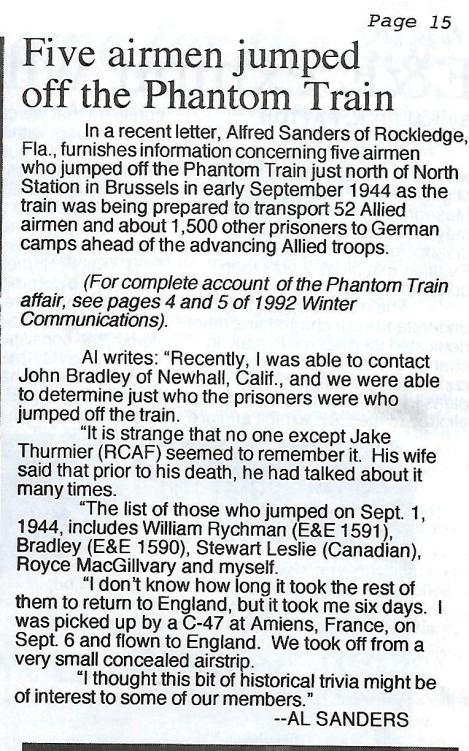
After 3 months in Saint-Gilles, Muir, Elliott and other prisoners are on September 2, 1944 aboard the “Ghost Train” (“Ghost Train”) leaving for Germany, but which will never leave the country, resistant railway workers prevented it, thus allowing the release of more than a thousand prisoners, mainly civilians. Muir and Elliott will be in hiding in Brussels until September 9, when they join the Hôtel Métropole. The next day, they flew to Paris for questioning before reaching England by plane on the 12th.
After landing, Mallett buries parachute and Mae-West and walks southwest for 2 kilometers. A man beckons him to hide and he stays for a while in a cornfield, where he unsticks his badges. At daybreak, he buys a pair of shoes from a farmer in a village and uses 50 BF from his escape kit to do so. A second man then takes him to another village, where he finds his bomber, Sweatman. They must stay 9 days in a nearby wood, where they are brought food and civilian clothes. They are then taken to Geel, where they are hidden for 8 weeks.
A 1948 report on the activities of the Geel Section of the MNB (Mouvement National Belge / Belgisch Nationaal Beweging) , indicates that “fallen to Balen-Nethe”, Mallett and Sweatman were recovered by Victor NEELS (from 97 Rosselaar to Balen-Nethe – of the Mol-Postel Section of the MNB ), which handed them over on June 5 to the Clement LEEMANS Group of Geel. The priest François SCHMIDT (College of Geel) lodged them for one day and then took them to Miss RENIES from Geel, where they stayed until July 14. On this date, SCHMIDT came to take them back and had them taken to Gustaaf RENAERTS, from Kasterlee, who entrusted them to Mme VERSTRAETEN from Turnhout.
According to information gathered by Kamiel Mertens, helped by Colonel NEELS before arriving in Turnhout. Sweatman and Mallett are hidden from July 14 to August 4, 1944 at Zozine Émilienne LAFFILI, 41, wife of François VERSTRAETEN (prisoner in Germany since May 1940) at n ° 80 (currently n ° 84) of the Kwakkelstraat in Turnhout. Note: Zosime LAFILI’s first name is used under different spellings depending on the sources: Zozine, Jozine, Josine, but his birth certificate drawn up in Leuven on November 17, 1902 clearly reproduces Zosime.
From Zosime LAFFILI, still according to Kamiel Mertens, they are guided by her in the company of Albert GEVERS (living in Mol) from Turnhout to Antwerp, then to Brussels, where the meeting was at the Place Communale in Laeken. There, the “packages” were handed over to Frédéric DE MEYER (living at 102 Rue de la Victoire, in Saint-Gilles-Bruxelles).
False identity card established in Brussels for Mallett, identifying him as Frans Dumont, employee,
living at 16 Rue Blanche in Saint-Gilles, BrusselsPassed through Brussels and Dinant, Mallett will be placed with Sweatman around mid-July in a Catholic school between Bastogne and Libramont. He will arrive there in the company of Paul Kasza , Lloyd Hermanski , Ronald Dawson and James Sherwood, among others . All will be liberated by American troops on September 8, 1944.
Articulet from the “Vancouver Sun”, July 5, 1944, announcing that Eric Mallett is missing
Articulet from the “Vancouver Sun”, September 28, 1944,
confirming that Eric Mallett and Kenneth Sweatman are safe.Eric Mallett wrote a book on his escape: “Eric Mallett’s Story: Through the German Lines with Forged Identity Papers”, edited by W. Ronald Conway and published by Conway Publishing, Victoria, BC, Canada in 1993.
The inset photo is from https://www.balenbevrijd.com/mei-2019.html.
© Philippe Connart, Michel Dricot, Edouard Renière, Victor SchuttersKEN SWEATMANPowered by
Translate
OPERATION MARATHON AVIATOR
Last updated May 20, 2021.
Kenneth Cyril SWEATMAN / R.20655
Kelliher, Saskatchewan, Canada (his wife Thelma lived in Calgary, Alberta, Canada during her service in Europe)
Born 1920 / † April 30, 1987 in Kelliher, Saskatchewan, Canada
WO 2, RCAF Bomber Command 424 Squadron, bomber
Landed near Balen-Nethe, Province of Antwerp, Belgium.
Handley Page Halifax Mk III, serial number HX313, QB-B, “Blonde Bomber”, shot down by a hunter during a mission to the Bourg-Leopold military camp on the night of May 27-28, 1944
Crashed near the Langven to Oostham, 6 km OSO from Bourg-Leopold / Leopoldsburg, Belgian Limburg
Duration: 3 ½ months
Marathon Camps: Bellevaux / AcremontFurther information :
The plane took off on May 27, 44 at 11:45 p.m. from Skipton-on-Swale.
Photo of the Halifax HX-313 “Blonde Bomber” (source: https://alanskeoch.ca/?p=3877)Three men will be killed: F / Off Navigator Robert Aubrey Irwin, Radio / Mechanic Sgt Wilfred George Wakely and Dorsal Gunner Sgt George Frank Freeman. All three will first be buried on May 30 in Sint-Truiden. They were subsequently exhumed in the Heverlee War Cemetery in Heverlee / Louvain-Leuven.
Fl / Sgt Victor G. Poppa, rear gunner, wounded, is taken prisoner.
Kenneth Sweatman, his pilot the Fl / Lt Eric Mallett, Engineer Sgt Maurice Muir and Fl / Off Co-pilot WJ Elliott escaped capture. On June 22, however, while Muir and Muir were cycling towards Veerle, they encountered two men in a car who brought them to 19 Rue Forestière in Brussels. They stay there until July 3, when they are driven by car to another house, where they meet five men. Four of the latter escort them to a car, supposedly to have them photographed. Muir reports that as he was about to get into the car, a German soldier appeared, the four men pulled out guns and told them to get in. The soldier was driving when the vehicle brought them to the Luftwaffe Police HQ at Avenue Louise. Muir and Elliott were searched there and then taken to Saint-Gilles Prison. After 3 months in Saint-Gilles, Muir, Elliott and other prisoners are on September 2, 1944 aboard the “Ghost Train” (“Ghost Train”) leaving for Germany, but which will never leave the country, resistant railway workers prevented it, thus allowing the release of more than a thousand prisoners, mainly civilians. Muir and Elliott will be in hiding in Brussels until September 9, when they join the Hôtel Métropole. The next day, they flew to Paris for questioning before reaching England by plane on the 12th. but who will never leave the country, resistant railway workers having prevented it, thus allowing the release of more than a thousand prisoners, mainly civilians. Muir and Elliott will be in hiding in Brussels until September 9, when they join the Hôtel Métropole. The next day, they flew to Paris for questioning before reaching England by plane on the 12th. but who will never leave the country, resistant railway workers having prevented it, thus allowing the release of more than a thousand prisoners, mainly civilians. Muir and Elliott will be in hiding in Brussels until September 9, when they join the Hôtel Métropole. The next day, they flew to Paris for questioning before reaching England by plane on the 12th.
A 1948 report on the activities of the Geel Section of the MNB (Mouvement National Belge / Belgisch Nationaal Beweging) , indicates that “fallen to Balen-Nethe”, Mallett and Sweatman were recovered by Victor NEELS (from 97 Rosselaar to Balen-Nethe – of the Mol-Postel Section of the MNB ), which handed them over on June 5 to the Clément LEEMANS Group in Geel. The priest François SCHMIDT (College of Geel), lodged them for a day and then took them to Miss RENIES from Geel, where they stayed until July 14. On this date, SCHMIDT came to take them back and had them taken to Gustaaf RENAERTS, from Kasterlee, who entrusted them to Mme VERSTRAETEN from Turnhout.
According to information gathered by Kamiel Mertens, helped by Colonel NEELS before arriving in Turnhout. Sweatman and Mallett are hidden from July 14 to August 4, 1944 at Zozine Émilienne LAFFILI, 41, wife of François VERSTRAETEN (prisoner in Germany since May 1940) at n ° 80 (currently n ° 84) of the Kwakkelstraat in Turnhout. Note: Zosime LAFILI’s first name is used under different spellings depending on the sources: Zozine, Jozine, Josine, but his birth certificate drawn up in Leuven on November 17, 1902 clearly reproduces Zosime.
From Zosime LAFFILI, still according to Kamiel Mertens, they are guided by her in the company of Albert GEVERS (living in Mol) from Turnhout to Antwerp, then to Brussels, where the meeting was at the Place Communale in Laeken. There, the “packages” were handed over to Frédéric DE MEYER (living at 102 Rue de la Victoire, in Saint-Gilles-Bruxelles).
Around mid-July, Sweatman and Sgt Richard Irwin , shot on June 13, arrived one evening at 10:30 pm at the house of “Monique” Yvonne BIENFAIT at 35 Rue Guillaume Kennis in Schaerbeek where they met Charles Earnhartand Woodrow Tarleton . “Monique” told the airmen that a Gestapo agent would drop by the next morning around 7:30 am to drive them to Dinant, from where they would continue their route by bicycle towards a place near the French border. She reassures her interlocutors by saying that the Gestapo is also a British Secret Service agent effectively helping the resistance.
At 7:30 the next day, the man appears, then accompanies “Monique”, Gaston MATTHYS and the four airmen to a house in the southern part of Brussels where Yvonne BIENFAIT telephones to announce their arrival to the following guides to take charge of them. She joins the group and tells them that only three men can be on this trip and that Earnhart will have to wait for the transfer the following week.
After his passage through Dinant, Sweatman will find Earnhart and Tarleton later in a Catholic school between Bastogne and Libramont. He will arrive there in the company of Paul Kasza , Lloyd Hermanski , Ronald Dawson , James Sherwood and Eric Mallett, among others .
All will be liberated by American troops on September 8, 1944.
Articulet from the “Vancouver Sun”, July 5, 1944, announcing that Eric Mallett is missing
Articulet from the “Vancouver Sun”, September 28, 1944,
confirming that Eric Mallett and Kenneth Sweatman are safe.Kenneth Sweatman rests at Horse Lake cemetery in West Bend, Saskatchewan, Canada
Inset photos are from https://alanskeoch.ca/?p=6465 (left) and https://alanskeoch.ca/?p=6448 (right)
© Philippe Connart, Michel Dricot, Edouard Renière, Victor Schutters


 wwiinetherlandsescapelines.files.wordpress.com/2018/08/afees-newsletter-sept-1996.jpg?w=94&h=150 94w,



