“Red, you go down to Jane and Bloor with Alan…This job he has taken makes me nervous.”
“And they are taking you God knows where for the whole summer…Men you do not know taking
“I don’t care if they’re training you as a dog catcher…I want your father to meet them.”
“Mom, all I really want to get is my Bushman’ s Thong from our 38th Rover Scout crew.”
“HOP IN THE TRUCK, ALAN, WE HAVE A LONG WAY TO GO” (Dad presided then waved good bye(
Floyd wedged me in between him and Bob with the floor shift gear rod in between my legs…That lasted until we got
of the tents and survey gear. Hell of lot more comfortable as we headed north on the day
long drive to South Porcupine.
THE summer of 1958. Unforgettble. Proud I had guts enough to stand it.
EPISODE 550 WORST JOB I EVER HAD IN MY LIFE…HATED AND LOVED IT AT SAME TIME: GROUNDHOG RIVER WILDERNESS 1958
LOCATION: GROUNDHOG RIVER: SUMMER OF 1958
WILDERNESS NORTH OF TIMMINS AND SOUTH OF KAPUSKASING
PURPOSE: TO CHECK OUT ANOMALOUS SIGNALS PICKED UP BY A CANSO FLYING BOAT DRAGGING A MAGNETOMETER
TO DO SO AS SECRETLY AS POSSIBLE
alan skeoch
March 22, 2019
Three men I will never forget…Floyd, Bob and Walter. We were thrown together by accident in that summer of 1958.
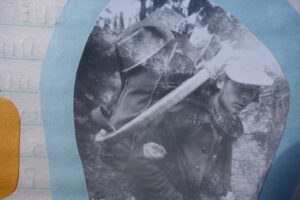
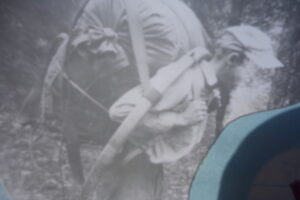
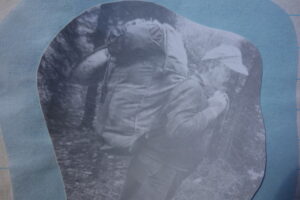
Floyd Faulkner was our crew chief. Bob Hilkar was our instrument man. Walter Helstein, was our soul. I think of his sad ending often.
Me? AIan Skeoch, a 19 year old blank slate, just a few days out of high school.
“So you are a Boy Scout, let’s see how you handle a real wilderness. No badge
for this job, Alan.” “No, you are wrong, there is a badge…my Bushman’s Thong.” And they laughed.
Floyd Faulkner
Bob Hilkar
Walter Helstein
Alan Skeoch
DEAR DIARY….
July 2 – 5, 1958
And so the adventure begins. I reported to company HQ at 1950 O’Coinnor Drive with my bag packed for the summer. Never knew how long…did not know
where I was going…had no idea who I was going with…had no idea how we were to get there. Did not really know why I was hired in that summer of 1958.
“We needed a Boy Scout to baptize into the real world,” commented Floyd or Bob. One of them. They intended to make a man of me. And I think they did
that. The events of that summer are still crystal clear in my mind I was 19 back then I am 83 now..
Mom and dad were a little concerned as the whole plan seemed
sort of loosey goosey Who were these men that called themselves ‘geophysicists’?
Right from the get go there were problems. Our Land Rover had not arrived nor had the canoe which was to be strapped to the Rover’s roof. And the two way radio was
still being overhauled. If we needed a two way radio that meant we were heading into the wild unknown. No telephone booths.
“Go back home, Alan, gear not ready quite yet.” Fine, I thought, for I was already on the payroll.
Floyd Faulkner and Bob Hilker Both seemed nice but a little distant .
They were veteran bushmen. I was just a high school kid. First day we drove to Oshawa where the company had a fleet of Canso double engined aircraft.
Vintage World War II submarine hunters.
One of the Canso’s had already overflown our target dragging an airborne magnetometer. The mag readings indicated several anomalies worth detailed ground
mapping. We were that three man mapping team. “Keep your mouth shut about the job, others are interested.” said our big boss, Dr. Norman Paterson. He
made me feel like a military hit man being sent on a mission.
Dr. Paterson gave us a final briefing on July 3. “This is a rough job, you will be dropped by aircraft as close as we can get to the anomalies. Virgin forest.
No people, no trails, no transport except the canoe and your feet.” Dr. Paterson was a bit intimidating…long and lean…a serious scientist who had been
a student under Dr. Tuzo Wilson…the man who put the expression Plate Tectonics in the dictionary. I felt we were doing something important…something
that would change the world. I was part of the team… on the bottom rung of the geophysical ladder. “What is my role?”, was a question that I was afraid to ask. As things turned out I should have
known when Dr. Paterson mentioned a blazing axe. A blazing axe differs from a regular axe. It is smaller, lighter and is used to blaze trails through virgin forest.
the idea is simple…lop a chunk out of both sides of trees ensuring that the line of blazes makes sense…i.e. going somewhere. Why both sides of the trees
are hacked should be obvious…one way into the wilderness and to get back out follow the alternate blazes. That was to be my job. It was never fully explained.
As things turned out all the jobs were shared. This was to be a real learning experience. Could I handle the job? I thought so and was comforted by a line
from Mr. Fred Burford, our football coach at Humberside Collegiate Institute…”When the going gets tough, the tough get going.” That line was called upon
many times in the following two and a half months.
July 6, 1958
“Al, meet us at the corner of Bloor and Jane…bring what you need for three months…but all in one bag.” Mom and dad got a little worried. Who were these
strangers? They were not even coming to our house but asking Alan to meet them on a street corner. So dad came along. My dad is a tough customer so he
planned to check ‘these assholes out’ before allowing me to crawl into the Land Rover. Dad knew the difference between normal assholes and dangerous assholes.
Floyd, my crew chief, was gruff but solid. So dad helped stow my rucksack in the back of the Rover and waved me off for the summer. This was a rite of passage.
We headed north to Gravenhurst where we ate a huge dinner on the expense account. The Food was heartburn hell but was on the company tab. Then we carried
on northward to South Porcupine. Floyd and Bob knew each other so they gabbed away. At some point Floyd gave me a nickname that stuck like a turd on a boot.
“Fucking Al will do the blazing…ever blazed a trail Al?” Conversation ebbed and I got a little tired of straddling the gear shift. “Floyd, could you stop and let me crawl
in the back on top of the gear…that would be more comfortable.” “Fucking good idea.” I learned that Floyd used fucking as an adjective for just about everything including
me…as in Fucking Al with a grin. It was not a term of derision…sort of a term of endearment. Sort of. So I spent the rest of the long long journey folded like a jackknife on our tents and rucksacks.
I even slept a bit. I was a little scared. Wondering just what the hell I had gotten myself into. At North Bay we got a canoe and strapped it to our roof. Lots of shaking and rattling.
I was determined to make the best of it…something to remember.
July 7
In Schumacker we visited our contractor, McIntyre Mines, where the geologist handed over a large sheaf of aerial photographs that pinpointed the anomalies we were
to find and map. “You guys will be the first mining persons ever to explore the wilderness northwest of the Groundhog River.”. Was that true? Wow…real wilderness. We rented
a Beaver float plane from Austin Airways in South Porcupine for a flight on July 9 at 8 a.m. McIntyre Mines did not want us to use their plane lest other mining people
got wind of our project. Mining is super competitive. The cloak of secrecy made the job seem all that more important.
Floyd drove us to Timmins where he handed Blahey’s Food Market a grub list that was to last three weeks. After that our food supplies would be replenished by Blakey’s and
Austin Airways.. The word “grub” or to use a more familiar, ‘maggot’. We would se lots of them on this trip, maybe even eat a few by mistake.
July 8
Today we hired Walter Helstein to help with the line cutting. Walter seems a little too fat and a little too old for what we are about to face. I know that seems unkind. Sorry
to say that but he has a fatherly…even grandfatherly manner. He speaks of the Great Depression and the Dirty Thirties as events he has experienced only yesterday.
Hard to say why he was hired. Then again I have no idea why I was hired. For the rest of the day
we lounged around South Porcupine…in the bright summer sunshine. Then in the evening we went to a small circus in Timmins.
July 9
In the morning We loaded the Beaver float plane with all our gear and our instruments. We had so much gear that we needed two trips as the Beaver could only
carry 1100 pounds. Walter Helstein and Bob Hilkar went with the first load. “Fucking Al and I will come later.” My seat for our flight was a crate of oranges some
of which got crushed since we had a rough landing an hour or so later on the Groundhog River. The river is tough for a float plane because it is so muddy that
obstructions cannot be seen. We bounced hard a couple of times throwing huge chevrons of water as we powered down. “Water’s high this time of
year, but water level will drop fast. Future landings will be difficult.”, said the pilot.
We parked our Land Rover beside the South Porcupine hotel for the summer. Entered the bush in early July, returned
on September 10. Naurally, The spare tire was gone as was any loose item after all this was Timmins, a tough mining
town. I guess we should have expected that.
Strapping our big four man canoe to the Beaver pontoon seemed a trifle dangerous to me but normal to Floyd and Bob…and the Austin
Airways pilot. Bob, Walter and the canoe would go first . A lopsided takeoff.
Floyd and I were wedged in among our gear and food supplies. Not much spare room. I wondered how the pilot would know
we had reached the 1100 pound limit. He had no scale. Just guessed.
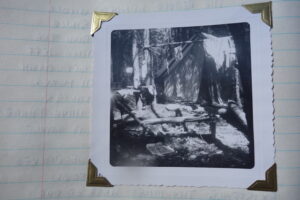
we began Erecting two tents even before the Beaver took off on its return flight…. first our sleeping tent and next our cook tent and then Floyd looped a long rope over a high tree branch on which would hang our meat supply “because otherwise the fucking bears will get it.” We did not know that a bear was watching us. He gave us the once over and planned a visit.
The little ‘bite ums no see ups…sand flies…are really ferocious. I get the feeling that we will be fly bate this summer. Later in the evening Floyd and Bob showed me
how to use stereo scope on the aerial photographs. Suddenly a flat surface become three dimensional. And our trip took on a cloak and dagger character. We were
commandoes on a mission.
July 10
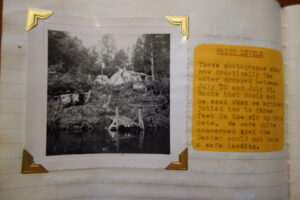
We cut trees today and lashed a dock together. Banks are very steep and we expect water level to drop significantly. Currently the river is
about 300 yards wide. Seems immense. We also erected our radio antennae. If anything goes wrong this will be the only way get help…if the radio actually works. Floyd and Bob took the canoe down river and were caught in a terrible storm…drenched. Then we had our first big camp supper using our most perishable food. As dusk settled I wrote a letter home. Do not know why… the letter
won’t get out for at least three weeks.
July 11
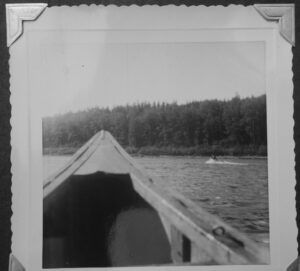
Rained all morning so survey start delayed until afternoon when we piled in the canoe…four men in a single canoe is a challenge. River current is super fast. Drove us at speed into a rock which
ripped the canoe open but not fatally so. Two of us bailed while the other two frantically paddled us back to camp. Patched the canoe with a piece of canvas. Then Floyd gave me a lesson
on setting a survey line. That was going to be my job.
And this, Al, is blazing axe…smaller, lighter than a regular axe…Don’t cut your fucking hand off with it…that float plane costs money, you know.”
Flies are voracious. Hard to say which is the worst. The little black flies that crawl in our ears or slip behind our belt bands and munch. Or the Moose flies land gently and tear a piece of skin if they have time. These moose flies are big yet able to make silent landings on exposed skin then chew holes.
July 12
Another day of heavy rain so we did what we could to improve our campsite. We have chosen a Rough spot really quite high above the river. Stupidly decided to test our Mae West life jackets in the river. That was like swimming
among ice cubes…noted that the Groundhog River flows north to James Bay. In other words this river was not like the Humber or Don or Etobicoke creek…sweet and warn, We then took the canoe, hooked on the outboard
engine, and motored down river for a spin. No sign of human habitation. Slight concern that our two way radio was not working. Who gives a damn? Good to be alive and young and healthy … watching a beautiful sunset.
Some of our camps and anomalies we tried to locate…last camp was Kapik Lake
July 13
Nice sunny day…motored five miles down the Groundhog River to check out our first anomaly. Walter Helstein and i set and cut line while Floyd and Bob followed with the EM…principally two great hoops of
tightly worn copper wire…looked like a hoop skirt without the underwear. Heavy. And a console with earphones to pick up the signals sent from one to the other. Coils had 100 foot separation each attached
to a heavy cable. Walt and I had
to mark these separations with pickets. As mentioned earlier, this job was for the young. Walter was about 60 or more years old and by five o’clock he was exhausted. Don’t get me wrong, I really liked Walter but
did not expect him to keep up.
When we got back to camp and made preparations for supper we found that others had been in camp. Blow flies had laid their eggs in the meat a few days earlier and the maggots were hatching. We cooked
the meat anyway…and ate what we could. Boiled maggots tasted okay if they were eaten unseen. Our radio is still not operating so any crisis will not be known to the outside world.
We cut 3,000 feet of trail for the E.M. unit today.
Bob and Walter with loaded canoe on Groundhog River
July 14
Hot and windy day.We motored back to the River anomaly. Walter and I blazed another trail for the E.M. unit…North East compass reading. Walter having a very tough time. Blazing sounds easy but that is
not the case. There is always dense brush that has to be cleared so the compass shot will be straight. Best to blaze trees that are on the compass line but that is not always possible. The line must be straight.
Big obstructions must be climbed over, waded through, or slashed and thrown to the side. Today we cut and marked 8,000 feet of line.
July 15
Today we checked out another anomaly whose location was confirmed by aerial photographs. Our base camp is located at the junction of a smaller creek or river where it joins the mighty Groundhog River.
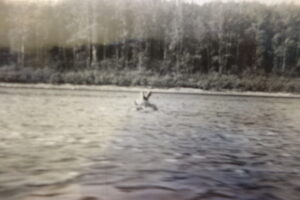
We travelled by canoe westward along this tributary to get as close to the anomaly as possible. Not easy. The canoe bottomed out regularly as the creek was quite shallow. A giant bull moose startled us
as we came around a bend. Or did we startle him? We were more surprised I think because he just stood there for a few moments looking at us and then wandered leisurely out of the water and into
the forest. His antlers were so large that they spanned the creek.
Really tough day blazing trail into the anomaly and then cutting formal lines for the EM (Electro Magnetic) unit. Nothing worse than a cedar swamp with tag alder shrubs. So much slashing that the blisters on my hands are getting
blisters beneath blisters. To make matters worse we we’re unable to find the anomaly.
Our crew…living together for the duration of the job. Lunch break in the bush with pot of tea…see if you can find the billy can.
When we stop for lunch, there is a danger that few new people in the bush know. The danger is piles…”your ass gets pulled out…the sphincter muscle bulges…bloody painful” “So, Al, do
not sit on those lovely soft spongy piles of moss. Wet. Wet underwear can cause piles. Sit on a dry log or anything other that wet moss.” “You can also get piles from constipation so keep the greasy
food coming.” What about heartburn? “We have some tummy pills. Lots of things can go fucking wrong on these jobs, Al” Nice to be on a 2.5 month camping trip with know-alls that tell me after the fact.
Constipation and piles. Must avoid.
July 16
Tough day. We went back up the tributary then followed our previous trail and extended it in a vain search for the airborne anomaly. Half of my time was spent working with the E.M. transmitter
which was nice. Creek is getting more shallow each day. Canoe struck bottom often today whereas yesterday we hit bottom only a few times. We startled a family of hell diver ducks who submerged as
we got close then popped up some distance away. we blazed and traversed 18,000 feet of line criss crossing what should be the anomaly. The bush is incredibly dense with cedars and tag alders…and
swamps. Cutting through cedar swamps is like trying to cut rubber bands…the branches seem to be elastic and cause the axes to bounce back…must be careful. Much of the time we are standing in
shallow water. Boots tend to leak.
Radio is full of dire news suggesting chance of another world war since the United States marines have landed in Lebanon.
Gum Rubbers tend to leak which means wet socks which means boiled feet which mean white pock marked feet. Not nice
I could peel skin from my feet as they were pomogranates. (sp?)
July 17
Wildlife is sure abundant. Just today we startled moose, mink, ducks, hawk, partridge and lots of little red ground squirrels. These creatures were the only nice thing about our day. Hard cutting but
no luck finding the anomaly. The creek is so low now that we decided to give up the search for the anomaly. We did our best. And there were many more blips picked up by the airborne magnetometer
and only so much time to confirm whether the blips were real or just a mistake.- Finding these fucubg anomalies will be no easy task. Did I use the F word? Part of the learning curve.
I am bothered by Heartburn often these days likely due to too much fried food. Sickness has to just be accepted as getting to a doctor or even a drug store is impossible. I dread having a toothache.
The black flies seem to love crawling through my hair just to get a little blood with a bite of my flesh. Maybe I should shave…easier to crush the little devils with a clean face.
Of course escape from the flies is impossible. Seems they love tight places such as under my belt. That’s where most of my welts seem to be. Keep clothing as loose as possible.
We spent an hour or so burning maggots in our garbage pit…thousands of them infested our rotten rolls of bologna.
We changed the position of our radio antennae in an attempt to establish contact with Austin Airways. Radio silence.
Even though we blazed and surveyed 20,000 feet of line we still had no luck finding the anomaly.
July 18
We followed an old blazed trail westward from our camp re-blazing as we went. Mystery who blazed original trail, perhaps some mining sleuth or maybe a trapper. When the trail petered out we blazed a new trail
in North West direction for 6,000 feet. A heavy rainstorm struck around three catching us several miles from our Base Camp. Arrived back about 6 p.m. soaked to the skin. Depressing. Later I skinned a mink that
had been trapped and killed recently. For some strange reason the trapper who spent his winters here left all his traps set. Killed animals for no reason. Floyd suggested He may have died here last winter. “His
trappers shack must be somewhere nearby.” The forest west of us seems loaded with partridge…they show little fear as we approach.
Today we travelled 32,500 west from base camp to a beaver dam we spotted on the aerial photos. Right on target proving we can pin point the anomalies.
Trappers Cabin found on river bank. Very rough place with heads of small animals nailed to logs. Some skinning method I guess.
July 19
Ferocious Storm all night and morning prevented trail blazing so we stayed in base camp. It was my meal shift so I had a chance to make breakfast rather extravagant. French toast with thick slices of sowbelly bacon
and lots of maple syrup and coffee. Each of us has meal duty days in rotation. In the afternoon the sun came out…an opportunity to wash clothes and sun dry them on the tent ropes. We cut a lot more scrub brush
from around camp so we now have clear view up and down the river. Water level is dropping rapidly…down a foot since we arrived and going down each day in spite of the rain.
Walter Helstein sunbathing in the nude. He has the ability to ignore the blood seeking flies.
Any notion that our campsite was built with military precision should be wiped away by this shot. Clean dry socks are the most important
item of clothing but the task to keep them so is impossible. Wet socks help to boil our feet in wet boots. As mentioned earlier,Boiled feet are pock marked
and peeling. Anybody believing this job was a luxury rich man’s camp has to be daft. Many days were just constant agony.
July 20
Today we trekked one hell of a long way to reach Anomaly site Number 3 and the days ahead will be even longer. Walt and I cut lines
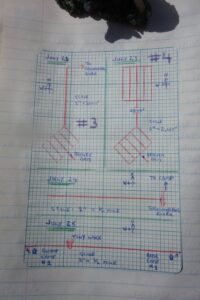
for the E.M. unit to traverse using 100 foot stations (see map for Sites 2 and 3). To reach the site we had to cross a big active beaver dam
about 200 feet wide and 8 feet high in places. Six feet thick.These beaver have been here for a long time.
At lunch we found the bones of a young moose killed by a bear or hunter…or perhaps a cougar if stories of their presence can be true. Maybe
it just died for the bones have been here for some time. Collected the teeth for what reason I do not know.
We returned to base camp very tired and went directly to bed.
Eureka! A successful day even if tough. We found the anomaly…high readings on the magnetometer and the E. M. unit just north of
the beaver dam.
Anomaly site #3: Eureka, we confirmed the airborne anomaly. Set up a grid pattern
as indicated above. Site #2 was less successful.
July 21
We retraced yesterdays’ trails then used compass to cut new trail North. Very slow progress due to the damn
cedar and alder swamps and their thick vegetation. I was point man using the compass and made a terrible mistake
having my heavy belt buckle too close to the compass. We had spent a couple of hours going in the wrong
direction…deflected. When we realized our error, Floyd and Bob made fun of my stupidity. Laughed at me.
So I threw a temper tantrum and began slashing the brush and heading nowhere really. Which made them
laugh all the more. Made me laugh too. Not my best day but i
guess I provided some entertainment. The compass error may not have been my fault for there were
strong indications of a body of magnetite below us. Floyd decided we should strike directly east through unblazed
bush towards the Groundhog River … far to the east. “Walter, you go back retracing our blazed trail to Base Camp
then get the canoe to meet us somewhere up river.” Well, things did not go well when sun got clouded over
and we got lost…strange how when lost in the bush we travel in circles. Eventually we reached the
Groundhog River around 8 p.m. as darkness was descending. Walter had been on patrol and found us thankfully.
Arrived at camp dead tired. Floyd and Bob told Walter about my temper tantrum.
As things turned out the errors may not have been my fault. The anomaly upon which we stood was likely
a whopping big magnetite find, confirmed by the aerial photo. Magnetite is strong enough to deflect
a compase…even confuse a compass giving one false reading in one spot and another a few feet away.
Were we standing on a future copper mine? If we were it was going to be one hell of a place for mine
families to live. Swamp…swamp…swamp. I read somewhere that certain plants like magnetite. Couldn’t
be true.
Today we traversed 39,500 feet finishing the beaver dam anomaly. Distance is a guess though due to being
lost for hours. Tomorrow Floyd decided to reconnoitre the territory east of the Groundhog River.
July 22
Today Floyd decreed we would all have a day of rest. Wonderful. To top things off a moose appeared
close to our camp at the rivers edge. I stalked him with the canoe in order to get within camera range.
Then towards evening another moose appeared. Floyd and I chased him by canoe along the river bank
until he found a gap to scramble up and get away. Moose around here seem interested in us as they move
away slowly if we approach. One moose even seemed to like music for he stuck his head out of the
brush behind our camp when we had cranked up the music as loud as possible. The moose seem almost
tame. A shame really for they are easy game for hunters.
Walter has become valuable in a totally unpredictable way. He is our berry tester. Lots of wild plants
are bearing berries but we have been cautious about eating them lest they are poison. Walter has no
such caution. He eats any berry he can find…well not any berry but most berries. He even has
names for them. Walter is colour blind so all berries look the same to him. We even named one
berry a ‘Waltberry’ as we had no idea the true name. If Walt could eat it, then it cannot be poison.

 PURPOSE: TO CHECK OUT ANOMALOUS SIGNALS PICKED UP BY A CANSO FLYING BOAT DRAGGING A MAGNETOMETERTO DO SO AS SECRETLY AS POSSIBLEalan skeochMarch 22, 2019Three men I will never forget…Floyd, Bob and Walter. We were thrown together by accident in that summer of 1958.Floyd Faulkner was our crew chief. Bob Hilkar was our instrument man. Walter Helstein, was our soul. I think of his sad ending often.Me? AIan Skeoch, a 19 year old blank slate, just a few days out of high school.“So you are a Boy Scout, let’s see how you handle a real wilderness. No badgefor this job, Alan.” “No, you are wrong, there is a badge…my Bushman’s Thong.” And they laughed.
 Floyd Faulkner
 Bob Hilkar
 Walter Helstein
 Alan SkeochDEAR DIARY….July 2 – 5, 1958And so the adventure begins. I reported to company HQ at 1950 O’Coinnor Drive with my bag packed for the summer. Never knew how long…did not knowwhere I was going…had no idea who I was going with…had no idea how we were to get there. Did not really know why I was hired in that summer of 1958.“We needed a Boy Scout to baptize into the real world,” commented Floyd or Bob. One of them. They intended to make a man of me. And I think they didthat. The events of that summer are still crystal clear in my mind I was 19 back then I am 83 now..Mom and dad were a little concerned as the whole plan seemedsort of loosey goosey Who were these men that called themselves ‘geophysicists’?Right from the get go there were problems. Our Land Rover had not arrived nor had the canoe which was to be strapped to the Rover’s roof. And the two way radio wasstill being overhauled. If we needed a two way radio that meant we were heading into the wild unknown. No telephone booths.“Go back home, Alan, gear not ready quite yet.” Fine, I thought, for I was already on the payroll.Floyd Faulkner and Bob Hilker Both seemed nice but a little distant .They were veteran bushmen. I was just a high school kid. First day we drove to Oshawa where the company had a fleet of Canso double engined aircraft.Vintage World War II submarine hunters.One of the Canso’s had already overflown our target dragging an airborne magnetometer. The mag readings indicated several anomalies worth detailed groundmapping. We were that three man mapping team. “Keep your mouth shut about the job, others are interested.” said our big boss, Dr. Norman Paterson. Hemade me feel like a military hit man being sent on a mission.Dr. Paterson gave us a final briefing on July 3. “This is a rough job, you will be dropped by aircraft as close as we can get to the anomalies. Virgin forest.No people, no trails, no transport except the canoe and your feet.” Dr. Paterson was a bit intimidating…long and lean…a serious scientist who had beena student under Dr. Tuzo Wilson…the man who put the expression Plate Tectonics in the dictionary. I felt we were doing something important…somethingthat would change the world. I was part of the team… on the bottom rung of the geophysical ladder. “What is my role?”, was a question that I was afraid to ask. As things turned out I should haveknown when Dr. Paterson mentioned a blazing axe. A blazing axe differs from a regular axe. It is smaller, lighter and is used to blaze trails through virgin forest.the idea is simple…lop a chunk out of both sides of trees ensuring that the line of blazes makes sense…i.e. going somewhere. Why both sides of the treesare hacked should be obvious…one way into the wilderness and to get back out follow the alternate blazes. That was to be my job. It was never fully explained.As things turned out all the jobs were shared. This was to be a real learning experience. Could I handle the job? I thought so and was comforted by a linefrom Mr. Fred Burford, our football coach at Humberside Collegiate Institute…”When the going gets tough, the tough get going.” That line was called uponmany times in the following two and a half months.July 6, 1958“Al, meet us at the corner of Bloor and Jane…bring what you need for three months…but all in one bag.” Mom and dad got a little worried. Who were thesestrangers? They were not even coming to our house but asking Alan to meet them on a street corner. So dad came along. My dad is a tough customer so heplanned to check ‘these assholes out’ before allowing me to crawl into the Land Rover. Dad knew the difference between normal assholes and dangerous assholes.Floyd, my crew chief, was gruff but solid. So dad helped stow my rucksack in the back of the Rover and waved me off for the summer. This was a rite of passage.We headed north to Gravenhurst where we ate a huge dinner on the expense account. The Food was heartburn hell but was on the company tab. Then we carriedon northward to South Porcupine. Floyd and Bob knew each other so they gabbed away. At some point Floyd gave me a nickname that stuck like a turd on a boot.“Fucking Al will do the blazing…ever blazed a trail Al?” Conversation ebbed and I got a little tired of straddling the gear shift. “Floyd, could you stop and let me crawlin the back on top of the gear…that would be more comfortable.” “Fucking good idea.” I learned that Floyd used fucking as an adjective for just about everything includingme…as in Fucking Al with a grin. It was not a term of derision…sort of a term of endearment. Sort of. So I spent the rest of the long long journey folded like a jackknife on our tents and rucksacks.I even slept a bit. I was a little scared. Wondering just what the hell I had gotten myself into. At North Bay we got a canoe and strapped it to our roof. Lots of shaking and rattling.I was determined to make the best of it…something to remember.
 July 7In Schumacker we visited our contractor, McIntyre Mines, where the geologist handed over a large sheaf of aerial photographs that pinpointed the anomalies we wereto find and map. “You guys will be the first mining persons ever to explore the wilderness northwest of the Groundhog River.”. Was that true? Wow…real wilderness. We renteda Beaver float plane from Austin Airways in South Porcupine for a flight on July 9 at 8 a.m. McIntyre Mines did not want us to use their plane lest other mining peoplegot wind of our project. Mining is super competitive. The cloak of secrecy made the job seem all that more important.Floyd drove us to Timmins where he handed Blahey’s Food Market a grub list that was to last three weeks. After that our food supplies would be replenished by Blakey’s andAustin Airways.. The word “grub” or to use a more familiar, ‘maggot’. We would se lots of them on this trip, maybe even eat a few by mistake.July 8Today we hired Walter Helstein to help with the line cutting. Walter seems a little too fat and a little too old for what we are about to face. I know that seems unkind. Sorryto say that but he has a fatherly…even grandfatherly manner. He speaks of the Great Depression and the Dirty Thirties as events he has experienced only yesterday.Hard to say why he was hired. Then again I have no idea why I was hired. For the rest of the daywe lounged around South Porcupine…in the bright summer sunshine. Then in the evening we went to a small circus in Timmins.July 9In the morning We loaded the Beaver float plane with all our gear and our instruments. We had so much gear that we needed two trips as the Beaver could onlycarry 1100 pounds. Walter Helstein and Bob Hilkar went with the first load. “Fucking Al and I will come later.” My seat for our flight was a crate of oranges someof which got crushed since we had a rough landing an hour or so later on the Groundhog River. The river is tough for a float plane because it is so muddy thatobstructions cannot be seen. We bounced hard a couple of times throwing huge chevrons of water as we powered down. “Water’s high this time ofyear, but water level will drop fast. Future landings will be difficult.”, said the pilot.
 We parked our Land Rover beside the South Porcupine hotel for the summer. Entered the bush in early July, returnedon September 10. Naurally, The spare tire was gone as was any loose item after all this was Timmins, a tough miningtown. I guess we should have expected that.
 Strapping our big four man canoe to the Beaver pontoon seemed a trifle dangerous to me but normal to Floyd and Bob…and the AustinAirways pilot. Bob, Walter and the canoe would go first . A lopsided takeoff.
 Floyd and I were wedged in among our gear and food supplies. Not much spare room. I wondered how the pilot would knowwe had reached the 1100 pound limit. He had no scale. Just guessed.
 we began Erecting two tents even before the Beaver took off on its return flight…. first our sleeping tent and next our cook tent and then Floyd looped a long rope over a high tree branch on which would hang our meat supply “because otherwise the fucking bears will get it.” We did not know that a bear was watching us. He gave us the once over and planned a visit.The little ‘bite ums no see ups…sand flies…are really ferocious. I get the feeling that we will be fly bate this summer. Later in the evening Floyd and Bob showed mehow to use stereo scope on the aerial photographs. Suddenly a flat surface become three dimensional. And our trip took on a cloak and dagger character. We werecommandoes on a mission.July 10We cut trees today and lashed a dock together. Banks are very steep and we expect water level to drop significantly. Currently the river isabout 300 yards wide. Seems immense. We also erected our radio antennae. If anything goes wrong this will be the only way get help…if the radio actually works. Floyd and Bob took the canoe down river and were caught in a terrible storm…drenched. Then we had our first big camp supper using our most perishable food. As dusk settled I wrote a letter home. Do not know why… the letterwon’t get out for at least three weeks.
 July 11Rained all morning so survey start delayed until afternoon when we piled in the canoe…four men in a single canoe is a challenge. River current is super fast. Drove us at speed into a rock whichripped the canoe open but not fatally so. Two of us bailed while the other two frantically paddled us back to camp. Patched the canoe with a piece of canvas. Then Floyd gave me a lessonon setting a survey line. That was going to be my job.And this, Al, is blazing axe…smaller, lighter than a regular axe…Don’t cut your fucking hand off with it…that float plane costs money, you know.”Flies are voracious. Hard to say which is the worst. The little black flies that crawl in our ears or slip behind our belt bands and munch. Or the Moose flies land gently and tear a piece of skin if they have time. These moose flies are big yet able to make silent landings on exposed skin then chew holes.July 12Another day of heavy rain so we did what we could to improve our campsite. We have chosen a Rough spot really quite high above the river. Stupidly decided to test our Mae West life jackets in the river. That was like swimmingamong ice cubes…noted that the Groundhog River flows north to James Bay. In other words this river was not like the Humber or Don or Etobicoke creek…sweet and warn, We then took the canoe, hooked on the outboardengine, and motored down river for a spin. No sign of human habitation. Slight concern that our two way radio was not working. Who gives a damn? Good to be alive and young and healthy … watching a beautiful sunset.
 Some of our camps and anomalies we tried to locate…last camp was Kapik LakeJuly 13Nice sunny day…motored five miles down the Groundhog River to check out our first anomaly. Walter Helstein and i set and cut line while Floyd and Bob followed with the EM…principally two great hoops oftightly worn copper wire…looked like a hoop skirt without the underwear. Heavy. And a console with earphones to pick up the signals sent from one to the other. Coils had 100 foot separation each attachedto a heavy cable. Walt and I hadto mark these separations with pickets. As mentioned earlier, this job was for the young. Walter was about 60 or more years old and by five o’clock he was exhausted. Don’t get me wrong, I really liked Walter butdid not expect him to keep up.When we got back to camp and made preparations for supper we found that others had been in camp. Blow flies had laid their eggs in the meat a few days earlier and the maggots were hatching. We cookedthe meat anyway…and ate what we could. Boiled maggots tasted okay if they were eaten unseen. Our radio is still not operating so any crisis will not be known to the outside world.We cut 3,000 feet of trail for the E.M. unit today.
 Bob and Walter with loaded canoe on Groundhog RiverJuly 14Hot and windy day.We motored back to the River anomaly. Walter and I blazed another trail for the E.M. unit…North East compass reading. Walter having a very tough time. Blazing sounds easy but that isnot the case. There is always dense brush that has to be cleared so the compass shot will be straight. Best to blaze trees that are on the compass line but that is not always possible. The line must be straight.Big obstructions must be climbed over, waded through, or slashed and thrown to the side. Today we cut and marked 8,000 feet of line.July 15Today we checked out another anomaly whose location was confirmed by aerial photographs. Our base camp is located at the junction of a smaller creek or river where it joins the mighty Groundhog River.We travelled by canoe westward along this tributary to get as close to the anomaly as possible. Not easy. The canoe bottomed out regularly as the creek was quite shallow. A giant bull moose startled usas we came around a bend. Or did we startle him? We were more surprised I think because he just stood there for a few moments looking at us and then wandered leisurely out of the water and intothe forest. His antlers were so large that they spanned the creek.Really tough day blazing trail into the anomaly and then cutting formal lines for the EM (Electro Magnetic) unit. Nothing worse than a cedar swamp with tag alder shrubs. So much slashing that the blisters on my hands are gettingblisters beneath blisters. To make matters worse we we’re unable to find the anomaly.

 Our crew…living together for the duration of the job. Lunch break in the bush with pot of tea…see if you can find the billy can.When we stop for lunch, there is a danger that few new people in the bush know. The danger is piles…”your ass gets pulled out…the sphincter muscle bulges…bloody painful” “So, Al, donot sit on those lovely soft spongy piles of moss. Wet. Wet underwear can cause piles. Sit on a dry log or anything other that wet moss.” “You can also get piles from constipation so keep the greasyfood coming.” What about heartburn? “We have some tummy pills. Lots of things can go fucking wrong on these jobs, Al” Nice to be on a 2.5 month camping trip with know-alls that tell me after the fact.Constipation and piles. Must avoid.July 16Tough day. We went back up the tributary then followed our previous trail and extended it in a vain search for the airborne anomaly. Half of my time was spent working with the E.M. transmitterwhich was nice. Creek is getting more shallow each day. Canoe struck bottom often today whereas yesterday we hit bottom only a few times. We startled a family of hell diver ducks who submerged aswe got close then popped up some distance away. we blazed and traversed 18,000 feet of line criss crossing what should be the anomaly. The bush is incredibly dense with cedars and tag alders…andswamps. Cutting through cedar swamps is like trying to cut rubber bands…the branches seem to be elastic and cause the axes to bounce back…must be careful. Much of the time we are standing inshallow water. Boots tend to leak.Radio is full of dire news suggesting chance of another world war since the United States marines have landed in Lebanon.
 Gum Rubbers tend to leak which means wet socks which means boiled feet which mean white pock marked feet. Not niceI could peel skin from my feet as they were pomogranates. (sp?)July 17Wildlife is sure abundant. Just today we startled moose, mink, ducks, hawk, partridge and lots of little red ground squirrels. These creatures were the only nice thing about our day. Hard cutting butno luck finding the anomaly. The creek is so low now that we decided to give up the search for the anomaly. We did our best. And there were many more blips picked up by the airborne magnetometerand only so much time to confirm whether the blips were real or just a mistake.- Finding these fucubg anomalies will be no easy task. Did I use the F word? Part of the learning curve.I am bothered by Heartburn often these days likely due to too much fried food. Sickness has to just be accepted as getting to a doctor or even a drug store is impossible. I dread having a toothache.The black flies seem to love crawling through my hair just to get a little blood with a bite of my flesh. Maybe I should shave…easier to crush the little devils with a clean face.Of course escape from the flies is impossible. Seems they love tight places such as under my belt. That’s where most of my welts seem to be. Keep clothing as loose as possible.We spent an hour or so burning maggots in our garbage pit…thousands of them infested our rotten rolls of bologna.We changed the position of our radio antennae in an attempt to establish contact with Austin Airways. Radio silence.Even though we blazed and surveyed 20,000 feet of line we still had no luck finding the anomaly.July 18We followed an old blazed trail westward from our camp re-blazing as we went. Mystery who blazed original trail, perhaps some mining sleuth or maybe a trapper. When the trail petered out we blazed a new trailin North West direction for 6,000 feet. A heavy rainstorm struck around three catching us several miles from our Base Camp. Arrived back about 6 p.m. soaked to the skin. Depressing. Later I skinned a mink thathad been trapped and killed recently. For some strange reason the trapper who spent his winters here left all his traps set. Killed animals for no reason. Floyd suggested He may have died here last winter. “Histrappers shack must be somewhere nearby.” The forest west of us seems loaded with partridge…they show little fear as we approach.Today we travelled 32,500 west from base camp to a beaver dam we spotted on the aerial photos. Right on target proving we can pin point the anomalies.
 Trappers Cabin found on river bank. Very rough place with heads of small animals nailed to logs. Some skinning method I guess.July 19Ferocious Storm all night and morning prevented trail blazing so we stayed in base camp. It was my meal shift so I had a chance to make breakfast rather extravagant. French toast with thick slices of sowbelly baconand lots of maple syrup and coffee. Each of us has meal duty days in rotation. In the afternoon the sun came out…an opportunity to wash clothes and sun dry them on the tent ropes. We cut a lot more scrub brushfrom around camp so we now have clear view up and down the river. Water level is dropping rapidly…down a foot since we arrived and going down each day in spite of the rain.
 Walter Helstein sunbathing in the nude. He has the ability to ignore the blood seeking flies.
 Any notion that our campsite was built with military precision should be wiped away by this shot. Clean dry socks are the most importantitem of clothing but the task to keep them so is impossible. Wet socks help to boil our feet in wet boots. As mentioned earlier,Boiled feet are pock markedand peeling. Anybody believing this job was a luxury rich man’s camp has to be daft. Many days were just constant agony.July 20Today we trekked one hell of a long way to reach Anomaly site Number 3 and the days ahead will be even longer. Walt and I cut linesfor the E.M. unit to traverse using 100 foot stations (see map for Sites 2 and 3). To reach the site we had to cross a big active beaver damabout 200 feet wide and 8 feet high in places. Six feet thick.These beaver have been here for a long time.At lunch we found the bones of a young moose killed by a bear or hunter…or perhaps a cougar if stories of their presence can be true. Maybeit just died for the bones have been here for some time. Collected the teeth for what reason I do not know.We returned to base camp very tired and went directly to bed.Eureka! A successful day even if tough. We found the anomaly…high readings on the magnetometer and the E. M. unit just north ofthe beaver dam.
 Anomaly site #3: Eureka, we confirmed the airborne anomaly. Set up a grid patternas indicated above. Site #2 was less successful.July 21We retraced yesterdays’ trails then used compass to cut new trail North. Very slow progress due to the damncedar and alder swamps and their thick vegetation. I was point man using the compass and made a terrible mistakehaving my heavy belt buckle too close to the compass. We had spent a couple of hours going in the wrongdirection…deflected. When we realized our error, Floyd and Bob made fun of my stupidity. Laughed at me.So I threw a temper tantrum and began slashing the brush and heading nowhere really. Which made themlaugh all the more. Made me laugh too. Not my best day but iguess I provided some entertainment. The compass error may not have been my fault for there werestrong indications of a body of magnetite below us. Floyd decided we should strike directly east through unblazedbush towards the Groundhog River … far to the east. “Walter, you go back retracing our blazed trail to Base Campthen get the canoe to meet us somewhere up river.” Well, things did not go well when sun got clouded overand we got lost…strange how when lost in the bush we travel in circles. Eventually we reached theGroundhog River around 8 p.m. as darkness was descending. Walter had been on patrol and found us thankfully.Arrived at camp dead tired. Floyd and Bob told Walter about my temper tantrum.As things turned out the errors may not have been my fault. The anomaly upon which we stood was likelya whopping big magnetite find, confirmed by the aerial photo. Magnetite is strong enough to deflecta compase…even confuse a compass giving one false reading in one spot and another a few feet away.Were we standing on a future copper mine? If we were it was going to be one hell of a place for minefamilies to live. Swamp…swamp…swamp. I read somewhere that certain plants like magnetite. Couldn’tbe true.Today we traversed 39,500 feet finishing the beaver dam anomaly. Distance is a guess though due to beinglost for hours. Tomorrow Floyd decided to reconnoitre the territory east of the Groundhog River.July 22Today Floyd decreed we would all have a day of rest. Wonderful. To top things off a moose appearedclose to our camp at the rivers edge. I stalked him with the canoe in order to get within camera range.Then towards evening another moose appeared. Floyd and I chased him by canoe along the river bankuntil he found a gap to scramble up and get away. Moose around here seem interested in us as they moveaway slowly if we approach. One moose even seemed to like music for he stuck his head out of thebrush behind our camp when we had cranked up the music as loud as possible. The moose seem almosttame. A shame really for they are easy game for hunters.Walter has become valuable in a totally unpredictable way. He is our berry tester. Lots of wild plantsare bearing berries but we have been cautious about eating them lest they are poison. Walter has nosuch caution. He eats any berry he can find…well not any berry but most berries. He even hasnames for them. Walter is colour blind so all berries look the same to him. We even named oneberry a ‘Waltberry’ as we had no idea the true name. If Walt could eat it, then it cannot be poison.

 END OF PART TWO…PART THREE WILL BE EPISODE 552(sorry if a little long…will make other episodes more bite sized.)alan
 WHY IN TARNATION WOULD ANYONE WANT TO READ ABOUT MY TOUGHEST JOB?Seems a little self-obsessed. I admit that. And I know some of you do not read any of theprinted part of these Episodes. Maybe glance at the pictures. Maybe just say “:God, notanother email from him! “HIM?” Well, I did an edit…cut the list of names but got objections.So here is an unusual story sent in parts. Why should you be interested? Let me try a simpleanswer. The job I am about to present was so rough that few of you would ever have had the chance toventure into the Canadian boreal forest wilderness for two months cut off from mosthuman contact except for rare three visits by a float plane from Austin Airways bringingfood or coming on an emergency flight to take two badly injured out to hospital where one, Walter ,spent months saving his arm from amputation. This was a tough job. Not pretty.Why should you be interested? Put yourself in my shoes. Would you get ina Land Rover with two men you had never met to spend monthsalone with them in a trackless wilderness. Would you let your son takethat risk?
 See that gap in the boxes and gear? That was my seat as we took off from South Porcupine. July 6, 1958.Why should you be interested? Would you grab at the chance to spend the summerof 1958 doing real exploration … searching for a source of magnetism found byan airborne magnetometer flying a grid over a seemingly endless Canadian wilderness.Would you be captivated by the task of cutting trails with a blazing axe where no onehad ever gone before. Do you know how dangerous a blazing axe can be?Why should you be interested? Could you stand to be a walking feast for thousandsof tiny blood sucking bastardly bush flies? Deer flies with chevron wings that could landgently and then take a good chunk of your flesh. Moose flies that were larger and got abit more flesh and blood. Mosquitoes that were tanker trucks for human blood. Black fliesthat loved to chew flesh in hidden places…around your belt, in your ears, on yourneck. Ground wasps that gave no warning until you stepped on their nesting hole.Protection? Would you rub yourself with foul smelling guck to ward off these attacks?Better to just stop washing. Let dirt and grime fill your pores and keep the flies confused.Why should you be interested? Would you like to sleep with three other menon a single huge bed made from spruce or cedar branches? Would you be ableto get along with strangers for months of close contact. At onepoint I asked Floyd why bush crews did not have guns. We were visited byblack bears often. “Simple, if we had a gun we might shoot each other.”Now that made sense to me. Especially when I threw two tantrums on the job.
 This is Walter Helstein. A man too old for the job really but necessity forcedhim to do so. A good man who got badly hurt when a tag alder spikepierced his hand. We could not help him. A rescue plane could not land.Walter was over 60 years old…tough man….toughened by the Great Depression.Why should you be interested? Have you ever heard a friend whimper inpain as infection took hold of his body which had been spiked by a tagalder spear.. Clear through his hand. And there was nothing you could do to help because the weatherwas so bad that a plane could not land on the little wilderness lake whereyou were camped. Have you heard those cries?Why should you be interested? Have you ever eaten wormy food? Not littleworms. Blow fly maggots regularly got into our slab of sowbelly. Each morningwe would slice off a chunk due to blow fly eggs and/or maggots just to get tothe good meat. Have you ever had to make do with a steadily diminishingfood supply until all that is left is raw oat meal? Have you ever eaten slabsof cold porridge slathered with peanut butter…lunch made from left oversat breakfast. Have you ever made tea from Labrador leaves? Have you eversipped scotch whisky from a coffee cup and considered it a luxury? Have you evereaten wild berries from plants you have never seen before? Have you evereaten swamp apples…orange in colour the size of big rasberries. Have you everbeen sick in a place where there is no medical aid?Why should you be interested? Have you ever worn gum rubbers with so many holesthat your socks became sodden lumps on your pock marked feet? Feet? Pock marked?Wet socks heated up and boiled your feet. Sometimes flesh could be peeled off. The mostimportant job returning to camp at night was to try and dry your socks for the next day.Have you ever had to patch your clothes with slabs of medical tape just to cover the holescaused by constant rubbing against tangles of tag alder or spruce boughs.?
 See those gum rubbers? They had holes that let water in…wet socks…boiledfeet became pock marked. So much so that flesh could be peeled.Why should you be interested? Have you ever turned to Lonely Hearts Club lettersfor entertainment and come to the conclusion there are people in this world whoselives are far worse than yours. How could girls become so desperate that they wouldoffer to move in with you sight unseen? How could their hell on earth be worse thanyour hell on earth? Why were these lonely hearts club letters be funny on first readingand then be so sad.Why should you be interested? Perhaps just to test yourself. Just to see if youcould triumph over adversity. To show you can overcome fear. Trekking alone throughthe forest following tiny blazes on trees. To lose the blazes is to become lost, perhapshopelessly so. And while slogging alone you begin to sense you are being trackedby some creature You stop suddenly and listen. No sound. The imagery carnivorefollowing you has stopped as well. You reach the Groundhog River base campand switch on the two way emergency radio to hear Evangelist Billy Graham savingsouls and look across he river to see a lumbering bull moose listening as well.Why should you be interested? Have you ever paddled beside a cow moose and her calf so close you can touchthem. Have you ever heard a cow moose telling her calf in sonorous voice that he orshe should beware of foul smelling human prospectors?Why should you be interested? Have you ever noticed that the leaves of springtime turn to the golden leavesof September? Have you ever lived among those leaves, those spruce boughs, those deadly tag alderslashed spikes. Have you ever had a black bear beside you both looking AT the moon at the same time.Have you ever been that close to nature.
 Have you ever made a four man bed out of spruce and cedar boughs and thenhad the thing collapse when all four bedded down?Why should you be interested? Have you ever felt real triumph? Have you ever testedyourself to see how much adversity you can take? Have you ever been 19years oldon the edge of adulthood and discovered you are OK?
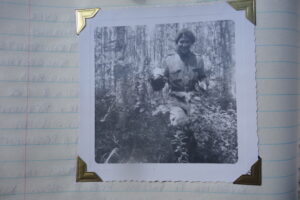
 THIS misty photo is Floyd Faulkner. He started as a cage man in Kirkland Lake. A friendwas also a cage man when the cable failed. “Had to scrape him off the floor with a shovel!”Floyd preferred to work aboveground after that. He was good at nicknames for people…had one for me..Why should you be interested? Have you ever been flattered with the newnickname ‘Fucking Al’. Have you ever realized that nicknames might becompliments in reverse.Why should you be interested? Have you ever had a stewardess on an Air CanadaVisCount offer you a Peek Frean shortbread cookie and a glass of lemonade? Haveyou ever had the feeling you are special and then nibbled and nursed the luxuryas the airplane lifted over Timmins and South Porcupine en route to Toronto.Why should you be interested? Have you ever come home from such a summer advenutureto find your friends Russ Vanstone, Jim Romaniuk, Big Red Stevenson, your brother Eric andyour parents standing there to greet you. Mom with a smile of relief. Dad, not saying much becausehe is en route to the racetrack. Proud though…son had survived. Your brother is holding a hand painted signsaying “Go Back, Al.” Have you ever had your friends, Russ and Jim, greet you at Pearson Airportbecause they want those lonely hearts club letters?Why should you be interested? Should I tell my friends that I have a new nickname?FUCKING AL ! Would they understand? How could I know that the next years of my life inthe summers I would be living rough and loving it?I Would love the wilderness so muchthat, in the future, take my wife Marjorie along with me?THIS Journal was written in the summer of 1958 then rewritten in 2018and now submitted in several Episodes.This was the toughest job I ever faced. Makes me proud to say that I only threwtwo temper tantrum on the whole job. See if you can find them.The Episodes will start shortly. Why should you be interested?GROUNDHOG RIVER EPISODES ARE COMING NEXTalan skeochMarch 14, 2022
 This barn once belonged to J.S. Woodsworth, founder of the CCF now the NDP. We were able to rescue it from demolition in Etobicokewhen the Shaver farm became a nest of condominiums. Cost $1,000 to move it and have fram erected. Today one of the barnbuilders we hired dropped by, 40 or so years afterward…Malcolm MacMillan remembered. I must take time to get it repaired a bit
 In this little depression between two of our four farm ponds there was once a large bank barn. When the animals no longer livedin the barn the winter frosts split the foundation and down it came. I was too young And too poor to do anything but watch it slowly returnto the earth from which it was born.
 Other Gothic farmhouses far more grand than ours are gone. But our remains in good shape. We gave her a new roof last year…likea new hat on a Victorian lady. The house was built in the 1870’s from local soft red bricks and hand hewn timbers collected from somebuilding that was must have burned for the scorch marks were found on the frame when we renovated some years ago. A lot of wildcreatures were very disappointed because they were evicted…mice, raccoons, red squirrels, garter snakes, big fat toads living in thedirt floored cellar.
 PLANS FOR HOUSES like this could be found or bought from the Eaton catalogue which is why so many of them existed and somestill do exist. We added the back room on the left built by Tim Rock, our neighbour.. He suggestedthe big verandah which was a great idea.
 Now this is a recent treasure. We had Jim Sanderson and his son bring their excavator to deepen what was once a swamp.Now a fine pond where a bunch of muskrats move about…and a wood duck had her young…and we even had a lonely beaver shoup for a season.


 This is our piece of the Fifth line. There was a time when Marjorie and the boys skated down the line in winter. Thatwas before salting became popular. Winter road graders and gravel spreading trucks kept the fifth line open on winter days suchas this. No longer closed with snowdrifts. No longer winter ice rinks. .
 Marjorie kept her horse Spartacus in the Saunders Barn. Spartacus knew I was nervous with him so he kept an eye onme. If he could speak he would have said “Boo!” just to see me run. On the few occasions I rode him…about two occasions…Ipulled so hard on the reins that I made his mouth sore. Little wonder he did not like me. Imagine being told what to do bya strip of iron in your mouth.
 THIS IS THE Gibralter Schoolhouse. A fine fieldstone building now restored. The community that once provided childrenfor the school, Gibralter, is long gone. A two storey rural school is very rare which suggests this may have been a ‘continuation school’for students that wanted to extend their education…i.e. a rural high school.


 This my favourite maple lined driveway for a farm just a mile or so south of Limehouse on the Fifth Line. I cannot stop takingpictures of this lane…spring, summer, winter and fall…you may have noticed that in previous Episodes.
 EverY time that I am alone in our farm house in winter time,especially on a lonely winter night…every time I think ofRobert Frost’s poem, An Old Man’s Winter Night. When I wasyoung and alone on such nights the poem moved me deeply.Now that I am old, the poem moves me moreso especially whenI clump clump clump in winter boots which on the wooden floor echoeslike the drumbeAt of a shaman. It is possible to scare myselfon such a night as this.AN OLD MAN’S WINTER NIGHT(by Robert Frost)All out of doors looked darkly in at him


 62313a08ba8bf.html